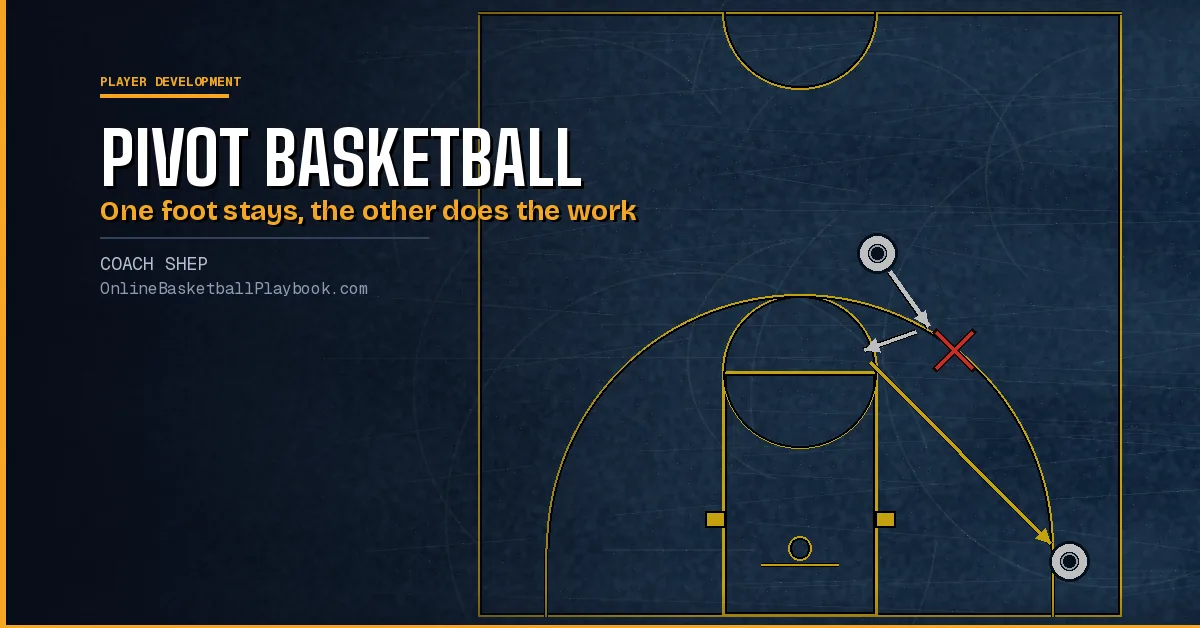
In basketball, a pivot is stepping once or more with the same foot while the other foot stays at its point of contact with the floor. The foot that stays is the pivot foot, and the foot that moves is the free foot. Every move a player makes after he catches the ball or ends his dribble runs through it: the jab step, the shot fake and step-through, the face-up on the wing, the turn out of a trap and the post player's drop step. This guide covers the pivot foot rules at each level, the front and reverse pivot, which foot to teach first, pivoting on the move, the drills and the mistakes that turn into travels.
Pivot Basketball Meaning: What Is a Pivot?
The NCAA, NBA and FIBA rulebooks define the pivot the same way, as stepping with the same foot while the other foot stays at its spot. Because it says once or more, a quarter turn and a full spin both count, as long as the pivot foot stays where it is. A home pivot routine puts it in plain words: the pivot foot stays in place on the ball of the foot, and sliding it or changing the pivot point is a walking violation.
Coaches teach the pivot early because a player who cannot pivot cannot get into position to pass or dribble without a turnover. Don Meyer, citing Bob Knight, called footwork the most undertaught phase of the game.
| Term | Meaning |
|---|---|
| Pivot | Stepping with one foot while the other stays at its spot on the floor |
| Pivot foot | The foot that stays down |
| Free foot | The foot that steps |
| Front pivot | The free foot steps forward and the player turns toward the side it steps to |
| Reverse pivot | The free foot swings backward and the player turns his back into the turn |
| Jump stop | Both feet land at once after both were in the air, so either foot may become the pivot |
| Stride stop | One foot lands, then the other, and the first foot down is the pivot |
Which Foot Is the Pivot Foot? The Rules by Level
The rule depends on how the player gets the ball and how he stops. The NCAA men's and women's books (Rule 9 Section 5), the NBA book (Rule 10 Section XIII) and the FIBA book (Article 25) agree on the main cases.
| Situation | Pivot foot | Level |
|---|---|---|
| Catches the ball standing with both feet down | Either foot. When one lifts, the other is the pivot | NCAA men and women (9-5 Art. 3), NBA (10-XIII a), FIBA (Art. 25.2.1) |
| Lands on both feet at once from the air (jump stop) | Either foot | NCAA men and women (9-5 Art. 4), NBA (10-XIII b), FIBA (Art. 25.2.1) |
| Lands one foot, then the other (stride stop) | The first foot down | NCAA men and women (9-5 Art. 4), NBA and FIBA count it as two steps, and landing on one foot first allows only that foot as the pivot |
| Jumps off one foot and lands on both together | No pivot foot. He may not pivot with either foot | NBA (10-XIII b), FIBA (Art. 25.2.1), NCAA men and women (9-5 Art. 4). The NCAA jump-stop rule (men 4-22 Art. 2, women 4-19 Art. 2) adds that a dribbler who jumps off one foot and ends the dribble in the air may land on both and use either foot |
| Starting a dribble | The ball must leave the hand before the pivot foot lifts | NCAA men and women (9-5 Art. 5), NBA (4-VIII, 10-XIII c), FIBA (Art. 25.2.1) |
| Passing or shooting | The pivot foot may lift, but it may not come back down before the ball is released | NCAA men and women (9-5 Art. 5), NBA (10-XIII d), FIBA (Art. 25.2.1) |
| High school | Check your state association rulebook | NFHS |

Two details catch players. The NCAA women's book now allows a jump stop that lands both feet at approximately the same time, where the men's book says simultaneously. And the 2026-27 NCAA men's points of emphasis say pre-dribble and split-step travels are not being called consistently, and tell them to identify the pivot foot once the player creates space. Pivot restrictions do not apply to a player making a throw-in (NCAA men, Rule 7-6 Art. 8.c). The full list is on traveling in basketball.
Front Pivot and Reverse Pivot
There are two directions to turn. On a front pivot the free foot steps forward and the player turns toward it. On a reverse pivot the free foot swings backward, so the player turns away with his back leading. A four-line turning drill calls them front and rear turns and teaches both in the first session.

The pivot-by-plan version picks the turn by what the player plans to do with the ball, decided before the catch.
| Situation | Pivot |
|---|---|
| Catch in the frontcourt, expecting to shoot | Front pivot off the inside heel, the foot closer to the basket. The heel drives down to stop the drift, and the free foot swings around to square up |
| Catch in the frontcourt, planning to pass or drive | Reverse pivot off the outside foot, so the free foot becomes the baseline foot |
| Catch in the backcourt on an outlet or inbound | Front pivot off the outside foot, turning away from pressure toward the sideline |
| Boxing out a man one pass away | Reverse pivot off the trail foot, swinging the lead foot into his path |
| Post drop step | Reverse pivot, the pivot foot chosen by where the defender plays |
That version allows one exception for a stationary shooter already facing the basket. He may use a favorite pivot foot, only with a very strong preference and only in the half court. Most right-handed shooters prefer the left.
Which Foot Should Be the Pivot? How to Teach It
At a high level, players operate with both feet as the pivot. The teaching order still matters. A right-handed player learns the left foot as his pivot first, and a left-handed player learns the right foot first. On the jab, the shot fake and the go, a right-handed player starts on the left foot pivot, and the foot that moves is the same foot all the way through the move. Anything else is a travel.
Coaches teach the pivot foot four ways. Every version is in use somewhere.
| Approach | How the pivot foot is chosen |
|---|---|
| Permanent pivot foot | One foot every time, the non-shooting or weak foot, so a right-hander pivots on the left and the strong foot jabs. In 18 years it produced three players who could pivot and jab off either foot |
| Inside foot | The foot closer to the basket on the catch, used to gather and shoot off movement |
| Split by intent | The inside pivot when the shot is there, the permanent pivot foot when attacking one on one |
| Either foot | Reps on the right foot every time, then the left, because a bad pass or a rebound forces either one. A four-pivot drill cycles all four turns after a jump stop |
A youth version notes that right-handed players naturally gravitate to the left foot as the pivot, and left-handers to the right, and still has them practice both because the best pivot foot changes with the situation. The split-by-intent version warns that high school referees call crossover-step drives travels, which is why it attacks off a permanent pivot foot.
Pivoting on the Move: The Inside Pivot
When a player comes open for a shot on the move, the quickest footwork is the inside pivot. Moving to his right, he pivots on the left foot. Moving to his left, he pivots on the right foot. The pivot foot stops him and the free foot swings around to square him to the rim.


Several programs build the shot off movement the same way. One gathers on the inside foot on every catch, one shoots off the inside pivot foot and calls it the difference between a contested and an uncontested shot, one pivots off the foot closest to the basket when going to the ball, and a timed shooting drill works the inside pivot into a 1-2 step. Have feet and hands ready before the ball arrives, with the guide hand up as a target. Antoine Walker's catch cue says it in one line: "Get my feet set, get my hands ready, get my legs up under me."
Standing still is different. A right-handed player who catches stationary steps into the shot left, then right, a 1-2 step. One shooting version keeps the 1-2 step for a closely guarded catch and uses the jump stop when the shooter needs a quick release. More on the catch is on catch and shoot.
Pivoting Out of Pressure
A dead dribble against a close defender is where pivoting saves possessions. The dead-dribble series has four parts.
- Jump stop. A small hop that lands both feet at once, so either can be the pivot.
- Step out. The free foot steps sideways, due east or west, toward the outside of the defender's lead foot. When your step gets past his foot, pass. Show the ball high and throw it low, or show it low and throw it high.
- Rip through. If the step-out is covered, sweep the ball hard and low, just above the shoes, while the free leg front pivots across the defender's face, with the ball protected beside the free knee. The reason given is that most defenders will not get that low.
- Swing around. If the rip-through is covered, a second front pivot goes back to the original side. Against a trap, the last option is to chin the ball, elbows out, and step through the gap.
The series separates passers from drivers. A passer's first step goes east or west. A driver's goes north, almost directly at the defender's lead foot.
Pivot Drills
- Home pivot routine. Head up, 15 forward pivots, then 15 backward, then switch the pivot foot and repeat, so each exercise is done four ways. A partner watches that the pivot point never moves and the foot never slides.
- Whistle pivots. Players spread out with a ball each, in an athletic stance with the ball at the chest. On the whistle they pivot 90 degrees in the called direction, then reverse after a set number of reps. The coach checks that each player keeps the same height through the turn.
- Four-pivot drill. After a jump stop, cycle front-left, front-right, reverse-left and reverse-right as a daily install.
- Four-line turns. Spin the ball to yourself, catch with the feet in the air, take two dribbles to the next line and work front and rear turns.
- Pivot-and-pass. The passer dribbles at a defender on the sideline, which shows whether the step-out is truly sideways. A completed pass scores +1 and a travel or bad pass scores -2.
The pivoting and passing breakdown drill runs the pressure series in groups of three, a dribbler, a defender and a receiver who catches and shoots. Each rotation is 55 seconds, it works on either foot, and a full squad gets through it in 6 minutes. In practice, two quick whistles after any killed dribble call for the series.

The circle footwork drill trains the inside-heel pivot for a whole team at once. Put 3 or 4 players on each free-throw circle, so a gym with seven circles holds the roster. They jog around the circle, toss the ball to themselves on the whistle, pivot off the inside heel and square to the center with no shot, then switch direction to work the other foot. The coach stands in the center and sees every foot.

Early in the year, the jump-stop version allows only jump-stop layups, and its 3 on 3 cut-throat puts a team off the floor for not using the permanent pivot foot, not squaring up, not catching with the feet in the air or not ending the dribble with a one-count jump stop. More stations are on basketball footwork drills.
Get the next coaching guide in your inbox
One email when a new guide or diagram set goes up. Free.
Common Pivot Mistakes
- Stepping before the dribble. One of the two habits behind most youth travels is moving the pivot foot before the first dribble hits the floor. On a jab crossover, lifting the pivot foot before the ball leaves the hand is a travel.
- Sliding the pivot foot. The other habit. The pivot turns on the ball of the foot and does not slide to a new spot.
- Changing feet in the middle of a move. On the jab, fake and go, the same free foot does all the stepping. A different foot moving partway through is a travel.
- Dragging the pivot foot near the rim. On a Rondo fake or any pivot all the way around, a dragged pivot foot is a travel.
- Catching off balance. Catch with the feet in the air and the chest over the shoes, so the stop is balanced and the pivot is a choice.
- Pivoting up. Keep the same height through the turn, as the whistle drill checks.
Moves Built on the Pivot
The pivot foot sits under almost every perimeter and post move. The jab step starts from a left foot pivot for a right-handed player. The basketball shot fake uses the same pivot for the step-through. The triple threat position is the stance the pivot works from. The Kobe Bryant pound pivot plants the back foot about five feet out and spins to shoot once the defender flies by. Post players use the reverse pivot for the drop step, covered on basketball post moves, and finishers use it on basketball finishing moves. The crossover page covers the crossover step from a set pivot foot.
Questions Coaches Ask About Pivot Basketball
What does pivot mean in basketball?
A pivot is stepping once or more with the same foot while the other foot stays at its spot on the floor. The foot that stays is the pivot foot.
What is the pivot foot in basketball?
It is the foot that stays on the floor while the player holding the ball steps with the other. After a two-foot landing from the air either foot may be the pivot, and after a stride stop it is the first foot down.
Can you lift your pivot foot in basketball?
Yes, to pass or shoot, as long as it does not come back down before the ball is released. To start a dribble, the ball must leave the hand before the pivot foot lifts (NCAA, NBA and FIBA).
Can you switch your pivot foot?
No. Once the pivot foot is set it may lift only to pass or shoot, and it may not come back down before the ball is released. A player who has not set one yet, such as after a two-foot catch, still has the choice. (NCAA, NBA and FIBA. Check your state association rulebook for high school.)
Which foot should a right-handed player pivot on?
Teach the left foot first, so the right foot is free to jab and drive. A left-handed player starts on the right. Good players learn both, and on the move they pivot on the inside foot.
What is the difference between a front pivot and a reverse pivot?
On a front pivot the free foot steps forward and the player turns toward it. On a reverse pivot the free foot swings backward and the player turns with his back leading, which shields the ball.
Is there a pivot foot after a jump stop?
Landing on both feet at once from the air lets the player choose either foot. A player who jumps off one foot and lands on both together has no pivot foot under the NBA and FIBA books. The NCAA books say the same for a catch, while the NCAA jump-stop rule lets a dribbler who ends the dribble in the air use either foot.
Want the printable playbook packs?
OBP Pro members get the premium playbook packs: the zone attack, out of bounds and practice plan PDFs, plus each new pack as it is finished. The membership page lists what is in each one. Or draw your own version free in PlayDraw.
See what OBP Pro includesMore Guides From This Batch
Back to Basketball Player Development and every Player Development page.
Keep Building
Related breakdowns
Euro Step in Basketball: Footwork, Rules and Drills
How to teach the euro step: the four-part footwork, when it beats help and shot blockers, the decelerated version for transition, the travel question and drills.
Basketball Footwork Drills for Teams and Individual Workouts
Basketball footwork drills for stops, pivots, cuts, jab moves and defensive slides, from the box drills to 30-minute workouts and where coaches differ.
Jump Shot Basketball: Footwork, Release and the Step-Back Jumper
The jump shot in basketball from the feet up: catch footwork, the lift and release, shooting off the catch or the dribble, the step-back jumper and fixing a miss.