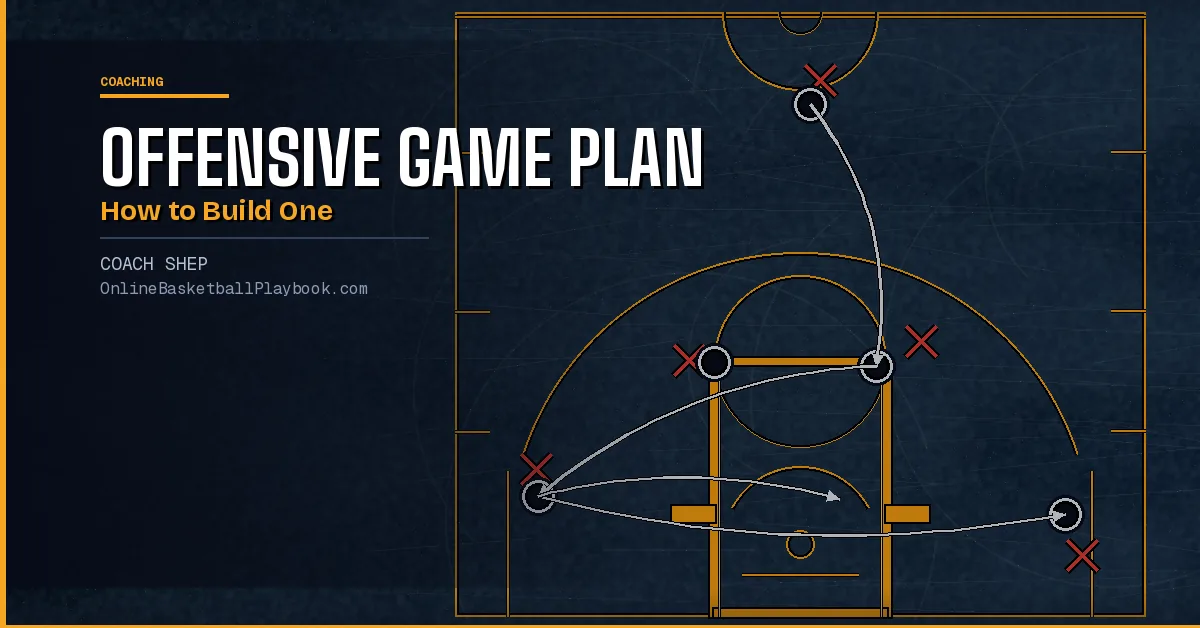
A good offensive game plan does one thing: it gives your players clear answers before the defense even sets up. Here is how to build one from the ground up, step by step.
Start With Your Personnel
Every offensive game plan begins with an honest evaluation of the players sitting in your locker room. You cannot build an effective attack by drawing up plays that require skills your roster does not have. Coaches who skip this step spend the season fighting against their own system.
Start by identifying your best playmakers, the players who can create advantages off the dribble. Then look at your spacing threats: who can knock down open threes? Who is a threat to cut and finish? Where is your best post presence? Mapping these attributes onto positions gives you the raw material for your offensive structure.
Next, identify your weaknesses just as clearly. If none of your perimeter players can handle ball-screen pressure, you need a plan to protect them. If your post players cannot pass out of double-teams, you need to limit how often you put them in that situation. A game plan that exposes your own weaknesses is more dangerous than the opponent's scheme.
This personnel audit also shapes your pace preferences. A team with four reliable shooters and a fast-twitch point guard may thrive in an up-tempo style. A team built around a dominant low-post player may want to slow the game down, run clock, and control possessions. Neither is wrong. The question is which pace favors your specific personnel on a given night.
Pair this evaluation with ongoing basketball player development work so your game plan can evolve as players grow. Coaches who revisit their personnel audit mid-season (rather than locking in one system in October and never adjusting) tend to get more out of their roster by March.
Scout the Defense
Once you know what your team can do, you need to understand what the opponent is trying to stop. Scouting is not about collecting information for its own sake. It is about identifying the specific cracks in the opponent's scheme that your personnel can exploit.
The first question is simple: what defense will you face? A team that lives in a 2-3 zone defense requires a completely different offensive approach than a team running aggressive man-to-man. Against a zone, you are attacking gaps, moving the ball quickly, and finding the high-low passing lanes. Against man, you are reading individual defenders, setting screens, and exploiting mismatches.
Beyond the base defense, look for tendencies. Does the defense hedge hard on ball screens? Do they overplay the passing lanes and invite backdoor cuts? Do they pack the paint and dare you to shoot threes? Does their help rotation collapse on the catch, leaving shooters open in the corners? Each tendency is an attack point.
Watch for personnel mismatches as well. If their best defender matches up on your second option, you now have a clear read: run your primary action through your featured player against a weaker defender. If their post players cannot guard in space, get them on the perimeter with ball screens and drive gaps.
Scouting also informs your press break preparation. Some teams trap on every made basket, full court. Others press only late in games. Building a press break into your game plan, even if you only use it twice, prevents a single defensive wrinkle from derailing your offense for a four-minute stretch.
Limit what you share with players to the two or three most actionable findings. A 40-point scouting report overwhelms more than it helps. Give them what they need to make the right decision in the first two seconds of a possession.
Choose Your Offensive System
Your offensive system is the framework that organizes your personnel and scouting insights into a repeatable set of actions. The system does not need to be complex. It needs to be teachable, executable under pressure, and flexible enough to handle the defensive looks you will see in a game.
Many coaches at every level have found success with a motion offense framework because it teaches players to read the defense rather than memorize scripted actions. In motion, players operate on rules (cut when your defender denies, screen away when the ball goes to the post, fill behind the ball), and the offense generates its own flow. This builds basketball IQ that carries over when the opponent throws a new look mid-game.
For teams that want more structure, a system built around three or four base sets with clear reads attached to each works well. The key is that every set has a primary action, a counter when the primary is denied, and a reset option when neither is available. Players who know all three options make clean decisions. Players who only know the primary stall when the defense takes it away.
Whatever system you choose, keep it simple enough that your players can run it correctly under fatigue in the fourth quarter. Complexity that works in a Wednesday walk-through often breaks down on Saturday when the other team's pressure is high. The best offensive systems are deeply executed, not broadly designed.
Consider how your system connects to your fast break philosophy. A team that pushes every missed shot into transition and only runs set offense on a secondary break plays very differently from a team that gets into its half-court sets immediately. Both approaches are valid, but they need to be deliberate, not default.
Install Your Primary Actions
Your primary actions are the specific plays, sets, and counters that form the core of your game plan for a given night. These should be limited in number. Three to five well-drilled actions will beat a menu of fifteen options that nobody executes cleanly.
Start with your best action. What is the one thing your offense does that the opponent cannot easily guard? Maybe it is a ball screen with your point guard and your best finisher. Maybe it is a dribble-handoff series that puts your shooter in motion. Maybe it is a simple post entry with a cut from the weak side. Whatever it is, that action is the anchor of your game plan. You will run it early, you will run it often, and you will have a counter ready when the defense adjusts.
The counter is as important as the primary. Every good defense will take away your best action. When they do, your players need to know immediately what comes next. If the defense hedges the ball screen, your roll man reads the hedge and slips early. If the defense goes under your shooter's screen, your shooter pulls up for a mid-range jumper instead of curling to the three-point line. These reads should be drilled in practice until they are automatic, not called from the bench in the moment.
Build your secondary actions around the same reads. A set play designed to get your best shooter off a pin-down screen might also trigger a lob opportunity for your cutter if the defense collapses on the screener. A good post entry series often creates a baseline drive opportunity for the wing if the help defender commits to doubling. Stack your actions so that the defense's answer to your primary creates your secondary.
This is where a well-designed basketball practice plan pays off during game week. The actions you install need enough repetitions that players can run them correctly at game speed without thinking. A play run once in a walk-through is not installed. It is introduced. Installation happens over multiple practices with live defense.
Prepare for Special Situations
Special situations are the moments in a game where a possession matters more than the average possession. End-of-quarter, end-of-game, free-throw alignments, basketball inbounds plays, and beating or using a press all fall into this category. Teams that prepare these situations deliberately win close games at a higher rate than teams that improvise.
For end-of-game offense, every player needs to know the clock management rules your team follows. When do you call timeout? When do you push and score quickly? When do you milk the clock down to four seconds and attack? These decisions made in the moment under pressure are usually wrong. Made in advance and rehearsed, they become reliable.
Your half-court set from an inbounds under your own basket is a possession that opponents often prepare a special defense for: trapping, switching everything, or extending denial. Have a specific play ready, not a general "run your offense" instruction. The same applies to the sideline inbounds with five seconds left down two.
Free-throw alignments on made and missed shots are a source of easy opportunities that many teams leave on the table. On a made free throw, you should have a defined set that gets into your half-court offense cleanly. On a missed free throw, your rebounders and guards need clear assignments so that an offensive board does not become a jump ball scramble.
Prepare a specific action for when the opponent extends their defense full-court. Knowing how to push against a press or use a deliberate fast break when numbers are in your favor prevents the panic that turns a three-point lead into a two-possession deficit in ninety seconds.
The teams that win in special situations are rarely more talented. They are more prepared. Devoting ten minutes per practice to situational offense is an investment that pays disproportionate returns when a regular season game comes down to the final possession.
Simplify and Execute
The final step in building your offensive game plan is the hardest: cutting. Most coaches design a plan that is too large, then spend the game trying to run all of it. The best offensive game plans are defined as much by what you leave out as by what you include.
Before the game, sit with your plan and identify the three things you most want to accomplish offensively. Maybe it is attacking their zone with skip passes and high-low entries. Maybe it is hunting their weakest perimeter defender in pick-and-roll. Maybe it is getting to the free-throw line early and often. Whatever those three priorities are, they should be visible in every player communication, every film session, and every practice repetition in the days leading up to the game.
Communicate the plan in player language. "We want to attack their closeouts off skip passes" is a usable instruction. "We are going to implement a multi-action zone attack utilizing weak-side skip progressions" is not. Players execute what they can visualize and remember under fatigue. Keep the language concrete and tied to specific moments in the game.
During the game, your primary job as a coach is to recognize when the plan is working and when it needs adjustment. If your primary action is getting stopped, identify whether it is a personnel problem (wrong matchup), a technique problem (players executing incorrectly), or a scheme problem (they found an answer you need a counter for). The adjustment has to be targeted. Changing everything at halftime usually makes things worse, not better.
After the game, review what actually happened against what you planned. Which actions produced quality shots? Which were over-used or under-used? Where did players hesitate because they were unsure of the read? This review cycle is where your game plan process compounds. Each game teaches you something that makes the next plan sharper.
The strongest offensive teams are not running the most complex schemes. They are running a small set of well-understood actions, reading the defense together, and executing with confidence because everyone in the gym knows exactly what to do and why they are doing it.
- Audit your personnel first. Build the plan around what your players can actually do under pressure, not what you want them to do
- Limit your scouting report to two or three actionable attack points. Information overload slows decisions
- Every primary action needs a built-in counter for when the defense takes the first option away
- Prepare specific plays for end-of-game, inbounds, and press situations before the game, not during it
- Cut the plan down to three offensive priorities and make sure every player can state them before tip-off
- Review execution after each game. Track which actions produced quality shots versus which ones you ran out of habit
Get free play diagrams, drills, and coaching guides delivered weekly.
Draw this play free in the play drawer →
Membership: the full library, playbook packs, and Pro drawing tools →
Keep Building
Related breakdowns
How to Build a Basketball Program: Identity, Staff and Culture
How to build a basketball program: identity first, written standards, staff roles, the season calendar, feeder programs and recruiting players who fit.
Basketball Scouting: How to Scout a Team and Build the Report
Basketball scouting for coaches: personnel first, what to chart, report formats, self-scouting, film sessions and turning the report into a game plan.