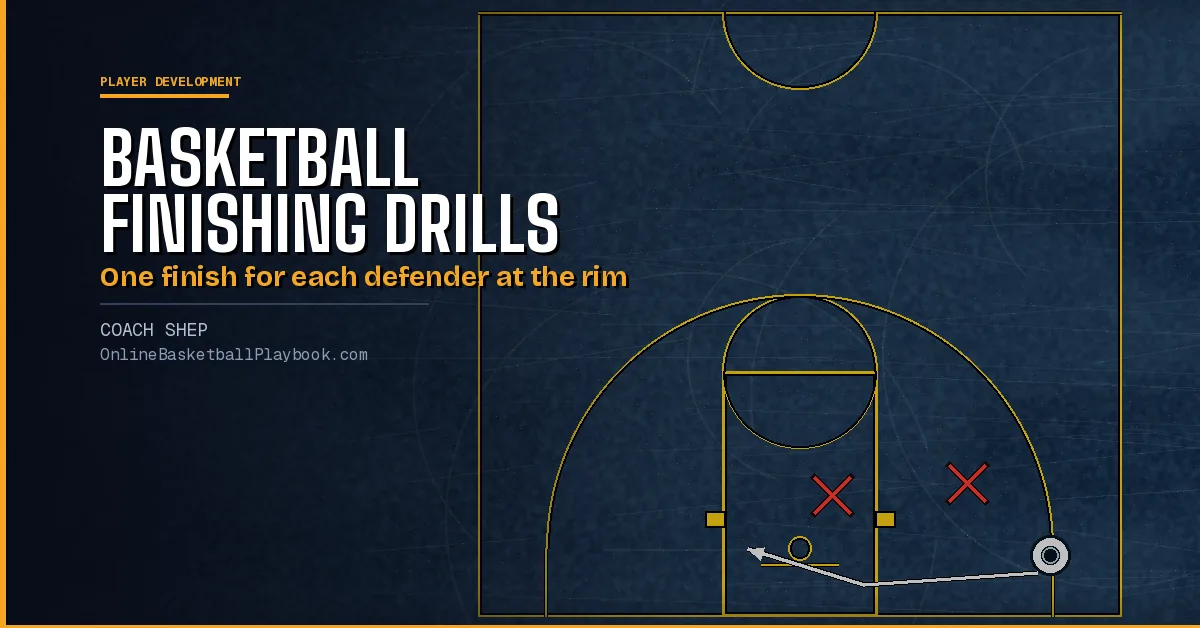
Basketball finishing drills work best when each finish is trained against the defender it beats. A trailer on the hip calls for the inside hand, a shot blocker waiting at the rim for the reverse, and a help defender set for a charge for a pro hop. The drills below are sorted that way, then by the contact and the live defender that make a finish hold up in a game. This page covers finishing around the rim.
Layup lines and team layup drills with a clock are on the layup drills page, the floater has its own floater guide, and stops and pivots are in the footwork drills. Where coaches teach a finish differently, the options are listed.
Basketball Finishing Drills Start With the Read
Read the defender at the rim, then pick the finish.
| Defender | Finish | Footwork cue |
|---|---|---|
| Trailer on the hip | Inside-hand layup, or a hold-off finish | Plant the outside foot and finish under the chaser, wide base to hold him off |
| Shot blocker waiting | Reverse, early one-foot takeoff, or a power finish off two feet | Use the rim as a shield, or skip the one-two and go up early |
| Help defender in the gap | Floater or runner | Find the gap, start slow, release before the peak |
| Defender set for a charge | Euro step, pro hop, Jamal Crawford finish | Gather one stride out, step sideways, land both feet together |
| Over-aggressive defender flying by | Pound pivot, Rondo fake, back leg finish | Plant the back foot about five feet out for the pound pivot, 5 to 8 feet for the back leg |
| Help defender bumps the drive | Bump and extend | Create space off the contact |
| Cut off completely | Stride stop and pass, bounce out, or two crab dribbles into a post-up | Head fakes for a delayed score |
The same read can be written two ways.
- A decision tree. If you beat the defender, reach for the layup or the reverse. If he is on your side, use a power hop or pro hop off two feet. If you are cut off, stride stop and pass or shoot, or take two crab dribbles into a post-up.
- An order of options. A quick score first, a delayed score with head fakes second, and what he calls protection plans when the drive cannot get a foot into the charge circle.
Read the defender first and the finish follows.
The Gather and the Last Two Steps
Drill the gather on its own before any finish.
- A chair series. Hips down, gather on the inside foot, sweep the ball below the knee into one bounce, and get from the gather to the shot quickly.
- For the pull-up off the dribble. The last dribble is the lowest and hardest, and the inside heel drives down as it lands so the shooter rises and lands in the same spot.
- Long last two steps. Cones move back toward the NBA line to stretch the last two steps long and low, with underhand finishes in front of the body. Half-court layups finish in one dribble.
- Low hop. The player drops into a jump stop with the ball and the feet landing together before the pro hop. The low-hop approach calls picking the ball up before the hop a travel.
Step counts after the gather differ by rulebook. The level-by-level rule is on the traveling page.
Own the gather and the last two steps take care of themselves.
Inside-Hand and Reverse Finishes
Pick the hand and the angle by where the defender is.

Inside hand or outside hand.
- Inside hand under the chaser. The inside-hand layup off an outside-foot plant finishes under a chasing shot blocker.
- Three finishes off the stride stop. Outside hand, inside hand and the donut, a fake of the inside hand into a turn for a jumper over the right shoulder.
- Ball on the outside shoulder. Carry the ball on the outside shoulder at takeoff.
- Two hands over the top. Bring the ball over the top with both hands against a beaten defender on the hip, and use one hand only when extending away from a trailer.
See the ball protection finish and the hold-off finish.

Reverse. Put the rim between the ball and the shot blocker.
- Rim between you and the blocker. The reverse layup puts the rim between the ball and the shot blocker.
- Baseline or angled drive. The Mikan Spins and Drive Reverse drills run it off a baseline or angled drive.
- Straight off the backboard. The low-hop approach shoots the reverse straight off the backboard with no side spin until the player is good, because side spin is where the misses come from.
- Ginobili Drill. Fake baseline and rip back across the body into a reverse.
- Spin into a power layup. A series includes a baseline reverse spin into a power layup.
More on the shot is in the reverse layup guide.
Finish with the rim between you and the blocker.
Two-Foot Finishes: Power, Pro Hop and Euro Step
When a defender is set for a charge, go sideways and land on both feet.

Pro hop.
- Jump stop, hop, land. A jump stop, a sideways hop with the ball carried across the body, a two-foot landing, then a finish squared up or turned with the defender on your back.
- Low hop, on balance. The low-hop approach wants a low hop on balance with ball, body and rim in a line, and names the mistakes: jumping too high, hopping sideways into the block, and landing off balance. It prefers the pro hop to the Euro step because it has a counter, the reverse pro hop.
- Jamal Crawford finish. The low-hop approach lands both feet at the same time after a sideways hop, or it is a travel.
- Crossover into a power layup. A Kevin O'Neill drill finishes a crossover into a power layup with the inside shoulder protecting the ball.
Euro step.
- Gather a stride out. Gather about one stride from the defender, take two sideways steps and finish with a layup, floater or scoop, selling the first step.
- Lines, cone, live. It progresses from lines to a cone to live one-on-one at 75 percent.
- Decelerate. A decelerated version against a bigger blocker closing fast.
- Keep it as a counter. The low-hop approach is the dissent. It says the Euro step cannot be redirected once the defender slides, that results at the youth level are poor because kids like the look of it, and it keeps it only as the counter when a jab finish is not bitten on.
The step-by-step is on the Euro step page.
Land on both feet, on balance, before you think about the finish.
Counter Finishes for Smaller Players
Six finishes serve players without size, each matched to a defender: the Rondo fake, the Euro step, the pro hop, the Jamal Crawford finish, the Kobe pound pivot and the Steve Nash back leg finish.
- Rondo fake. Plant at the basket, fake the reverse and pivot all the way around. Step-across and step-through layers follow when the defender does not bite (see the Rondo fake step-across).
- Pound pivot. Plant the back foot about five feet out and spin to shoot once the defender flies by.
- Back leg finish. Plant 5 to 8 feet out, lean back and jump straight up off that leg. It is framed as a counter, not a first move for beginners (see the back leg finish).
Match the counter to the defender and rep it until it is automatic.
Get the next coaching guide in your inbox
One email when a new guide or diagram set goes up. Free.
Finishing Through Contact
Add a pad so the finish is trained against contact.

- Help-defender drill. The driver bumps a coach's pad, creates separation and extends into the layup, 20 makes a side. The guard, forward and post series all score on a coach with pad contact.
- Power Shot Drill. The player powers the ball up between two raised arms. A dribble-moves drill adds a pad bump.
- Pads in the lane. Bump players with a pad during one-on-zero work. Alley drives have assistants hit drivers with pads. A further drill bumps the driver off a straight line into a pad finish.
- Contact Drill. A partner pulls the dribbler's hips from behind.
- Mark Few. Get low, establish contact, play big on top. Sean Miller says players have to be taught how to get fouled.
Seeking contact is one approach. The Euro step, pro hop and Jamal Crawford finish exist to get around a defender set to take a charge.
Practice layups miss in games for four reasons: fear of contact, no live defense in practice, too few finishes and game pressure (see missed layups).
Choose to seek the contact or avoid it by the defender in front of you.
From Air to a Live Defender
Move every finish from air to a live defender in stages.

- Air, escort, live. On air, then at speed, then an escort defender running beside the driver, then a live one-on-one test. Nothing sticks without the test.
- Chair or coach, then live. A chair or a coach first, then live.
- Guided defender first. A guided defender for a few reps before the game goes live.
- Three-dribble 1-on-1 cutthroat. A live-ball move, a maximum of three dribbles and a dominant pivot foot.
- A second defender. A guard catch series adds a second defender to beat body to body. A 1-on-2 beats the first defender, then the help, live.
- Shield on any drill. Adds a guided defender or a blocking shield to almost any drill.
Two standards attach to finishing work beyond the layup-line clocks.
- A go-to move at 80 percent. Finish the go-to move 80 percent of the time.
- Six in a row. Open big-man work with six no-dribble power finishes in a row and keep a season record of the most in a row.
The team layup drills with a time goal, from Bob Hurley's 80 in two minutes to Geno Auriemma's 13 clean trips, are on the layup drills page, and the Mikan series is on the Mikan drill page.
Whatever the drill, end it against a live defender.
Where Coaches Disagree
Coaches split on three questions.
| Question | Approach |
|---|---|
| Which stop before the finish? | The two-foot jump stop, so either foot can pivot |
| The stride stop, right-left with the second foot inside the charge circle. A staff that tried jump stops for two years found only its best athletes could score off them. | |
| The one-two step for a closely guarded catch, the jump stop for a quick release | |
| Euro step or pro hop? | Teach the Euro step, from lines to live at 75 percent, with a decelerated version against a bigger blocker |
| Prefer the pro hop, which has a counter, and keep the Euro step as a counter only (the low-hop approach) | |
| Seek contact or avoid it? | Create the contact: bump a pad and extend, or get low and establish contact (Mark Few) |
| Use a finish that gets around a defender set for a charge |
For the move library behind these drills, see finishing moves, the one-hand finish, the off-hand layup and the Jamal Crawford finish. Big players' finishing from the block is on the post moves page.
Settle each question before the season, then drill the answer.
Questions Coaches Ask
What are the best finishing drills in basketball?
Drills that pair each finish with the defender it beats, then add contact and a live defender. A pad series, the Mikan series, a pro hop against a set defender and an air, escort and live progression cover most of it.
How do you finish at the rim against a shot blocker?
The reverse puts the rim between the ball and the blocker. The same finish menu adds an early one-foot takeoff that skips the one-two, or a power finish off two feet.
Should players jump stop or stride stop before a layup?
Coaches split. Teach the jump stop, teach a stride stop with the second foot inside the charge circle, or use each for a different catch.
How do you teach finishing through contact?
Add a pad. The driver bumps a coach's pad and extends, 20 makes a side. A player powers the ball up between two raised arms. A drill bumps the driver off a straight line into the pad finish.
What finishes help a smaller guard?
Six: the Rondo fake, Euro step, pro hop, Jamal Crawford finish, pound pivot and back leg finish, each matched to a type of defender.
Want the printable playbook packs?
OBP Pro members get the premium playbook packs: the zone attack, out of bounds and practice plan PDFs, plus each new pack as it is finished. The membership page lists what is in each one. Or draw your own version free in PlayDraw.
See what OBP Pro includesMore Guides From This Batch
- Post Moves Basketball: Seal, Read and Score From the Block
- Coaching Youth Basketball: Practices, Games and Parents
- Basketball Fouls List: Every Foul, Penalty and Limit by Level
- Illegal Screen in Basketball: Rule, Examples and Calls
Back to Basketball Finishing Moves and every Player Development page.
Keep Building
Related breakdowns
Guard Workout: Handles, Reads and Finishing You Can Print
A guard workout you can print: a full session with its standards, plus handle work, jab, closeout and ball-screen reads, finishing and shooting off the dribble.
Post Moves Basketball: Seal, Read and Score From the Block
Post moves basketball coaches teach, from the seal and the catch to the drop step, jump hook and face-up, the read on each defender and the drills that build them.
How to Fix Common Shooting Errors: Read the Miss First
How to fix common shooting errors: read what the ball does on the rim, find the cause, apply one correction, and coach the shooter through the dip.