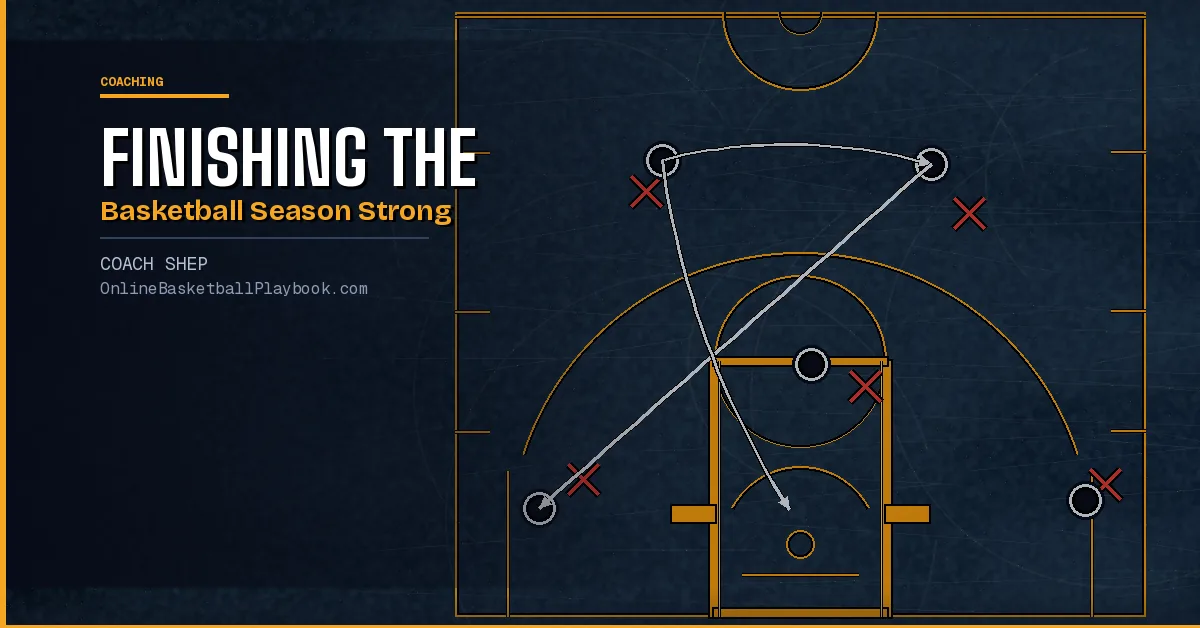
Late-season basketball is won by teams who own their footwork, trust their finish menu, and execute under pressure. Here is the coaching blueprint to peak at the right time.
Why Late-Season Execution Breaks Down
Ask any coach who has managed a team through conference play and into a postseason run and you will hear the same story: the team that showed up in November is not the team that needs coaching in March. Fatigue accumulates. Familiarity with opponents increases. Defensive pressure tightens. Referees let players play. Every weakness that was smoothed over by athletic advantage or early-season confusion now gets exposed under a spotlight.
The teams that fall apart late do not fall apart because they stop caring. They fall apart because the foundation was not drilled deeply enough to survive adversity. Footwork slips first. Players start reaching, floating, and drifting on shots they used to make cleanly. Finishing at the rim becomes one-dimensional. Guards who had three moves at the top of the year are down to one by February.
The fix is not to add more content. The fix is to sharpen what is already installed. The strongest late-season teams are the ones who do fewer things with greater precision. That starts with the individual-offense base: stance, stops, pivots, and a finish menu that works in traffic.
Sharpen the Footwork Foundation
Every offensive skill in basketball sits on top of footwork. Ball handling, shooting, finishing, screening. All of it breaks down the moment a player's base goes soft. The "Quick" stance described by Krause is the starting point: balanced, athletic, weight on the balls of the feet, head above the midpoint of the body. From that position, players can make four quick actions that determine every offensive action that follows: quick starts, quick steps, quick turns (pivots), and quick stops.
By late season, players develop bad habits in all four. They lunge into their starts instead of exploding off a balanced base. Their steps go lateral instead of attacking. Their turns lose their pivot-foot discipline. And their stops (the jump stop and the stride stop) become casual instead of controlled.
The jump stop is particularly worth revisiting in late-season practice. A proper two-foot landing simultaneously preserves the player's right to designate either foot as the pivot foot. That flexibility is a tactical advantage that most players throw away by landing softly on one foot out of habit. Running a 10-minute footwork session that re-emphasizes the jump stop, the pivot-foot commitment, and the inside-heel anchor for shooters pays dividends in every possession you play down the stretch.
The Inside-Heel Pivot: The One Shooting Cue That Fixes Drift
One of the most teachable footwork rules is the inside-heel pivot rule for shooters: when receiving a pass, a shooter should pivot off the inside heel of the inside foot (the foot closest to the basket at the moment of catch). Driving that heel down hard at the exact moment the ball arrives stops lateral momentum completely. It eliminates the two most common shooting drift errors: falling away from the basket and floating sideways through the release.
After the heel plants, the shooter swings the free (outside) foot around to fully square up. The entire motion creates a balanced, squared shot without any compensating upper-body adjustment. Antoine Walker's teaching cue captures it well: "Get my feet set; get my hands ready; get my legs up under me." That sequence (feet first, hands ready, legs loaded) is the late-season shooting reminder that most teams need more than they need any new play.
Build a Real Finish Menu
One of the clearest indicators that a team is not ready for a postseason run is a one-finish offense. When every player attacks with the same layup on the same hand regardless of where the help is coming from, good defenses take it away in a single game and the offense has no answer. A real finish menu means players have trained multiple options and choose based on the defensive reaction, not based on habit or comfort.
The finish family worth drilling before the season ends includes the regular layup, the opposite-hand layup, the power finish (two-foot gather, through contact), the reverse (using the rim as a shield from the weakside block), the floater or runner (off the proper foot, released before help arrives), and the Euro step (changing the gather angle to eliminate the primary help defender). These are not advanced moves reserved for elite players. They are the minimum menu a player needs to finish in traffic at any level.
The key coaching principle: train each finish with the defensive read that triggers it. The regular layup is for open lanes. The opposite hand is for when the primary defender stays with the drive. The power finish is for when help closes and contact is coming. The reverse is for when the helpside block-defender cheats across early. The floater is for when the rim-protector is positioned at the front of the rim. The Euro is for when help commits early to one side. Players who understand the reads (not just the moves) make the right decision without hesitation.
Live-Ball vs. Dead-Ball Clarity
One of the most undercoached distinctions in basketball is the difference between live-ball and dead-ball situations. A live-ball situation exists when a player has not yet used their dribble. In that state, they have access to their full offensive arsenal: jab-and-go, crossover, hesitation, change-of-direction into a shot, and every other attack move that requires an active dribble. A dead-ball situation exists the moment the dribble is killed. From that point, the player can only create with pivots, shot fakes, and step-throughs.
Late in close games, confusion about which state a player is in causes turnovers and broken possessions. Guards pick up their dribble under pressure without knowing they have done it, then try to attack, resulting in a travel or a desperate pass. Post players catch and immediately kill the dribble, surrendering all of their best options before the defense has even committed.
Teaching players to consciously recognize which state they are in (and what tools are available in each state) is one of the highest-leverage coaching interventions for a late-season team. Post it on the practice board. Name it in every drill. When a player makes a mistake in a scrimmage, ask them: "Were you live or dead?" Building that vocabulary builds the awareness that keeps possessions alive in the fourth quarter.
Before your next late-season scrimmage, spend five minutes walking through live-ball vs. dead-ball scenarios at half speed. Have guards catch, identify their state out loud, and make one deliberate move that matches that state. This simple narration exercise closes the gap between knowing the concept and executing it instinctively under game pressure.
The Three-Move Rule for Closing Games
A skills teaching framework offers one of the most practical late-season coaching ideas available: limit the live-ball curriculum to three moves and drill those three until they are automatic. The three moves are the direct drive, the crossover, and the jab-and-shot. Nothing else until those three are owned.
This sounds like a reduction. It is not. A player who can execute one move with perfect footwork, proper angles, and a read of the counter will consistently beat a defender who has six moves they cannot quite finish. The specific instruction is that the jab must be believable (head down as if you are going to drive) and the drive must cover ground in a straight line, not a curved one. The move ends with a one-count quick stop, not a drift or a float. Every detail tightens the move from a rough concept into a reliable late-game weapon.
The deeper principle is about concentration of skill. Teams that try to install new plays and new concepts in the final weeks of the season dilute what they already have. Teams that spend that time compressing their existing skill (fewer moves, better footwork, faster reads) arrive at the postseason sharper than they were in January. The goal is not to do more. The goal is to do less, better, faster.
Practice Design for the Final Weeks
Practice design in the final stretch of a season should reflect a clear priority: sharpen, do not expand. Every drill should connect to a skill already in the program's vocabulary. The goal is to execute what the team knows at a higher level of precision, not to introduce new material that players will only partially absorb.
Start each late-season practice with footwork. The Offensive Pivoting and Passing Breakdown Drill (three-person groups, a dribbler and defender and a pass receiver, running 55-second rotations for two rounds) gets the entire team working on passing footwork, defense, and shooting footwork simultaneously in six minutes. It is the most efficient multi-fundamental drill available for a pressed practice schedule.
Follow footwork with five to seven minutes of finish-menu work. Run each finish against a token defender so players are making reads, not just practicing moves in space. Move into your team offensive concepts with the expectation that individual footwork and finishing reads should now show up without being coached. When they do not, stop and trace the breakdown back to its individual root (a poor stop, a soft pivot, a one-handed finish choice) and correct it at that level rather than recoaching the play call.
The final week before a tournament or postseason bracket should include daily competitive reps with full officiating. Pressure in practice is the only reliable way to test whether the footwork and finishing skills are truly installed or only present in low-stakes conditions. Late-season teams need to know which situation they are in before they take the floor in the game that matters most.
- Re-install the jump stop daily: two-foot simultaneous landing preserves pivot-foot choice and forces body control before any finishing decision. Run it in every pre-practice warmup for the final three weeks.
- Drill finish menus with reads, not in isolation: pair each finish (regular, power, reverse, floater, Euro) with the specific defensive look that triggers it so players build decision-making alongside muscle memory, not instead of it.
- Restrict live-ball offense to three moves: direct drive, crossover, jab-and-shot. Demand perfect execution of each before adding any variation, because three well-owned moves beat eight half-owned ones in a tournament game.
- Name the state in every rep: players call out "live" or "dead" in practice scrimmages until live-ball vs. dead-ball awareness is automatic and turnovers from confusion are eliminated.
- Inside-heel cue for all shooters: drive the inside heel down hard at the moment of catch to stop drift and build the balanced, squared shot that holds up under late-season defensive pressure.
Want more basketball coaching strategies and drills?
Join the Online Basketball Playbook newsletter →
Draw this play free in the play drawer →
Membership: the full library, playbook packs, and Pro drawing tools →
Keep Building
Related breakdowns
Guard Workout: Handles, Reads and Finishing You Can Print
A guard workout you can print: a full session with its standards, plus handle work, jab, closeout and ball-screen reads, finishing and shooting off the dribble.
Basketball Finishing Drills: Read the Defender, Then Finish
Basketball finishing drills matched to the defender at the rim, from inside-hand and reverse finishes to the pro hop, contact drills and live progressions.
Individual Basketball Workouts Mid Season
Individual Basketball Workouts Mid Season