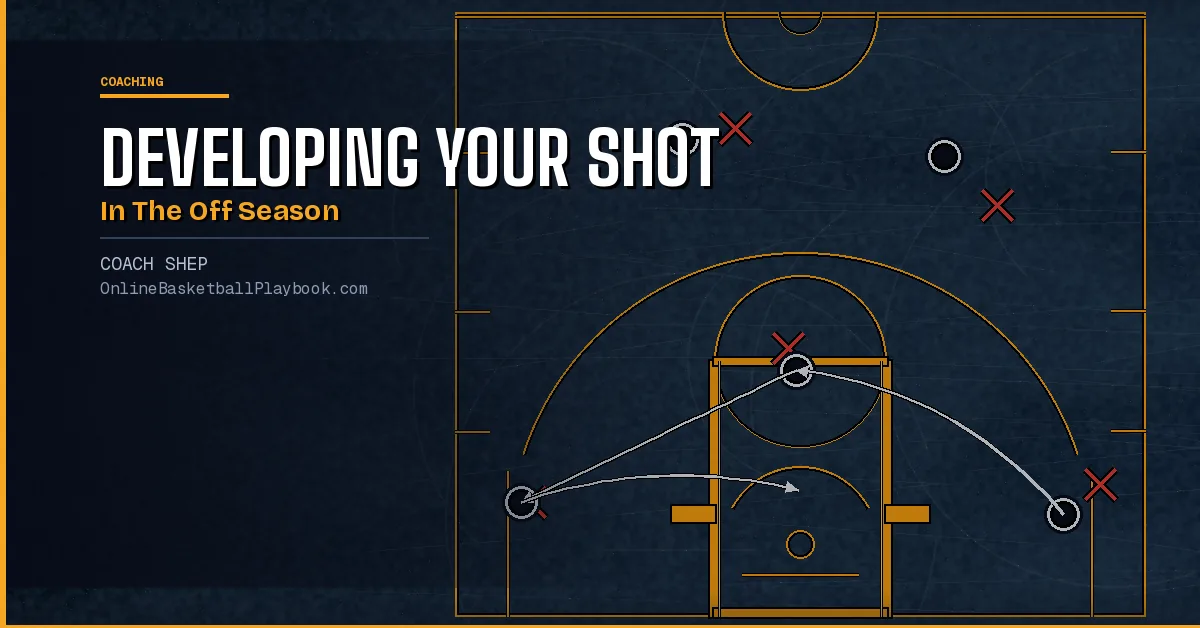
The off season is when shooters are made. Every rep you take between March and October (form work, scored drills, game-speed movement) determines how confident you feel when the lights come on.
Why Form Comes Before Volume
Most players begin an off-season workout by grabbing a ball and firing shots at full range. That approach hard-codes bad habits. Form must be established first, and the progression is simple: start without the ball, then move to a wall, then step up to the rim.
The foundation is four checkpoints: a balanced, athletic base, the guide hand under the ball like a "pizza waiter" carrying a tray, the elbow directly under the ball and over the shooting-side knee, and a full follow-through with the wrist flexed high (the "cookie jar" finish), fingers hanging toward the floor.
Jay Hernandez, one of the most respected individual-skill coaches in the country, opens every single workout with "Quarters", one-handed form shots taken close to the rim. Volume comes after form is confirmed, not before. Jay Wright at Villanova codified the same discipline into the first two drills of every practice: Set Lifts, where the player lifts and follows through without making rim contact, and the Bradley Drill, where the player holds the ball as high as possible to ingrain a high release point.
The teaching rhythm Wright uses is worth memorizing: "jumping and lifting, shooting on the way up." That phrase captures the timing relationship between the legs and the arm that most self-taught shooters never learn.
For younger players, the progression is identical but the language is simpler. "Pizza waiter" hand position and "cookie jar" follow-through are tactile cues kids can grab immediately. The underlying mechanics (elbow under, follow through high) are the same checkpoints you would give a college player. Form first, volume second, at every age and level.
Make Every Rep Competitive
The single biggest mistake in off-season shooting is volume without accountability. Going to the gym and gunning up two hundred shots over an hour feels productive. The problem is that most of those shots have no consequences, no time pressure, no opponent, and no score. They do not build competitive shooting ability. They build comfortable shooting ability, and those are not the same thing.
The fix is simple: every shooting block needs a winner. That means a clock, a partner, or your own previous record.
Shaka Smart's Texas drill bank makes this concrete. His "3-Minute" drill has a posted team record of 157 makes. The Evans drill has a record of 219. Every player walks in knowing the number they are chasing. Smart also uses a "Beat the Pro" head-to-head format where your miss is worth two points for the opponent, which is exactly the consequence structure that makes a drill feel like a game.
Jay Hernandez uses the same philosophy across his entire workout system. The Streak drill, the Star, Around the Horn, the M Drill, Personal Best (the "30-30" challenge), the Burner, Over-and-Back. Each one is structured to produce a number you write down. That number is the goal you chase next session.
John Beilein at Michigan took this to a formal standard: 7 makes out of 10 shots in 30 seconds, coming off a down screen and a flare screen sequence. Miss the standard. All three players in the group run. The screener is exempt. The accountability is built into the drill's structure, not applied after the fact.
Jay Wright at Villanova used a similar standard: 6 of 10 in 30 seconds in a three-man, two-ball shooting circuit. This is one of the most explicit competitive shooting benchmarks, and it has a clear consequence: everyone runs if the group misses.
The off-season is the right time to establish these habits before practice competition begins. Build the competitive mindset in July so it is automatic by November.
Train Game Shots at Game Speed
There is a version of shooting practice that produces a flawless stationary catch-and-shoot and does nothing for a player who has to come off a screen, catch, and fire in half a second while a defender closes out. That gap between practice shooting and game shooting is closed by one discipline: train game shots, from game spots, at game speed.
Kevin Eastman's framework puts it precisely that way: game shots, game spots, game speed. It is three words, but it represents a complete practice philosophy.
The Larry Brown / SMU system makes this even more specific. Every drill in that 25-drill bank starts with a realistic offensive movement before the shot: a zipper cut, a baseline drive and throwback, a drag screen, a ball-screen read. Players are always responding to a read before they pull the trigger. There is no standing still and catching. The action earns the shot.
Shaka Smart's "can't shoot the same spot twice, must move" rule captures the same principle in a single constraint. Moving to a new spot after each make forces players to re-set their footwork, re-find their balance, and re-target the rim, exactly what happens in a game.
The practical structure for a game-speed shooting block: mix "block" shooting (multiple reps from one spot to groove the form) early in the workout, then transition to "movement" shooting (off the catch, off the pull-up, off a screen action, into a new spot) for the majority of your reps. Add a contest or a defensive tag on the final rep of each set to simulate a closeout.
When you run movement shooting drills, add one bad pass every five reps. Real games deliver imperfect feeds: a ball that is slightly low, slightly wide, or coming harder than expected. Training to adjust your catch and still get a clean shot off is a skill that block shooting never develops. It takes thirty seconds to build into any drill structure.
The Pull-Up: Basketball's Most Undervalued Shot
The off season is the right time to develop the shot that most players skip: the pull-up from one or two dribbles, taken around the wing.
Rumjahn and Kelbick, in their Complete Guide to Motion Offense, call the pull-up and the hesitation "lost arts." That framing is accurate. Youth and high school players spend the overwhelming majority of their shooting work on stationary catch-and-shoot threes and layup finishes. The mid-range pull-up (which requires a player to create their own separation off the dribble and release before the defense can contest) is almost never trained systematically.
The player who can take one hard dribble left, plant, and pull up from the elbow is genuinely difficult to guard. The defense must respect the drive threat, which means they cannot shade toward the three-point line. That read, "can I pull up here, or do I keep attacking?" is exactly the kind of basketball intelligence that develops when the pull-up is practiced repeatedly, not occasionally.
The footwork is the foundation. On the pull-up, the player must gather balance on the last dribble, load the legs, and release on the way up. The same rhythm as any other jump shot, but now initiated off a dribble instead of a pass. Practice it from both sides of the floor. Practice it after a jab-step. Practice it off a live crossover where the defense overplays. The shot itself is not complicated; the footwork and the timing just require repetition to become automatic.
Include at least one pull-up series in every off-season workout. Treat it as a primary skill, not a warm-up variation.
Diagnosing and Fixing Common Shot Errors
Dr. Hal Wissel's diagnostic framework (developed over decades working with players at every level) gives coaches and players a structured way to fix shot errors instead of repeating a generic cue. The core discipline is this: when you miss consistently, work backward through the mechanics before prescribing a fix. The root cause is rarely what the player thinks it is.
Here are the most common off-season errors and their mechanical fixes:
Short shot. The release point is too low. The ball leaves the hand before full arm extension. Fix: hold the follow-through with the arm fully extended and fingers pointing toward the rim until the ball lands. Drill the finish before worrying about arc.
Guide-hand push (wide misses). The off-hand thumb pushes across the ball at release, sending the shot left or right. Fix: run one-handed form shots until the ball tracks straight. The guide hand comes off the ball before release. It does not apply force.
Flat arc (line drive). The wrist is flat at release and the elbow does not finish above eye level. Fix: pick a point on the gym ceiling above the front of the rim and aim the arc there. Players who shoot line drives immediately gain four to six inches of arc with this cue alone.
Inconsistent release timing (rushed shots). The player releases before the natural rise of the jump peaks, losing the smooth "sight-set-shoot" rhythm. Fix: three distinct beats: establish the target, pause at the set-point with the ball above the shooting shoulder, then release on the way up. Not one continuous blur.
Side spin. The shooting hand is cocked sideways at set-point. Fix: at the set-point, the elbow must be directly under the ball and over the shooting knee before the wrist snaps. Elbow-in alignment is the cause; side spin is the symptom.
Long shot (shooter leans back). The player leans back to "put more on it," transferring force from the legs to the arm. Fix: bend the knees deeper before the jump. Power comes from the legs unwinding upward. The arm is a guide, not the engine.
Free Throws Under Fatigue
Here is the mistake almost every off-season shooting plan makes: free throws get practiced fresh. Players shoot ten free throws at the beginning of a workout when their legs are loose, their breathing is easy, and there is no consequence attached to the result. Then they walk off the court having "worked on free throws."
Game free throws happen none of those ways. They happen after a hard drive to the rim, after a defensive sequence that left you gassed, in the fourth quarter when the score is tied. The only way to train for that is to practice free throws in exactly that state.
Rick Pitino's practice structure at Louisville baked free throws into the end of live 1-on-1 games when players were tired, and tracked the percentages. The data (shot under fatigue, recorded, competed against) is the only honest measure of free throw reliability.
Jay Hernandez builds free throws into his workout structure at two specific points: after the second rotation of drills and after the final drill of the session. Both points are intentionally chosen because the player is fatigued. Ten makes each time, counted against a target, not shot aimlessly.
One mechanical cue that applies at every fatigue level: ball and head over the free-throw line. Projecting the ball forward toward the rim (rather than releasing it flat or back) is the structural adjustment that keeps free throw percentage from dropping when the body is tired.
Build fatigue free throws into the off-season structure. Shoot them last. Count them. Record the percentage. That number will tell you more about your real free throw ability than anything you shoot fresh at the beginning of a gym session.
Building a Shooting Culture With a Record Board
The cheapest, highest-leverage culture tool available to any coach or program is a record board. Hang it in the gym. Put four or five named drills on it: Streak, Around the Horn, Star, the Purdue make-4-threes drill, whatever fits your system. Let players set records, sign their names next to them, and return every session trying to break them.
Shaka Smart's Texas program did this at scale. The "3-Minute" drill record of 157 makes and the Evans drill record of 219 are not abstract goals. They are signed numbers posted where every player sees them before they pick up a ball. The record board turns individual shooting work into team culture.
Tom Billeter's Purdue Drill formalizes the consequence: make four threes in a minute with a rebounder and passer, sprinting baseline to half-court between shots. Miss the target. The shooter runs for each point below four. The scored layer and the consequence layer are both present. That is why the drill works.
Jay Wright's "sloppy drills create bad habits" doctrine is the cultural counterpart to the record board. Bad reps are not neutral. They are actively harmful. Run fewer drills with complete discipline rather than more drills carelessly. Post the standard. Hold it. Every player who signs a record on that board earned it under those conditions, and they know it.
For individual off-season work without a team, build your own version. A notebook works fine. Write the drill name, the date, and the number of makes. Return to the same drills each week and try to beat the previous mark. The scoreboard does not have to be public to be motivating. Knowing your own number is enough to make the next rep matter.
- Form before volume, every session: Open each workout with one-handed form shots close to the rim: elbow under the ball, guide hand off at release, full follow-through finish with fingers hanging toward the floor.
- Every drill needs a score: Set a make target, a time limit, or a record to beat. Write the number down. Return next session and chase it. Unscored volume is the off-season's biggest time-waster.
- Train game shots with game movement: Earn the shot with an action (a cut, a screen read, a dribble) before every rep in at least half of your shooting blocks. No standing-still catch-and-shoot for the entire workout.
- Add the pull-up series: Include one deliberate pull-up shooting series from both sides of the floor every session. One or two dribbles, plant, and fire from the free-throw area. This is the shot most shooters never practice and defenses least expect.
- Shoot free throws tired and last: Build free throws into the final five minutes of every workout after the legs are gone. Count the makes, record the percentage, and compare session to session. That number is your real free-throw grade.
Want more basketball coaching strategies and drills?
Join the Online Basketball Playbook newsletter →
Draw this play free in the play drawer →
Membership: the full library, playbook packs, and Pro drawing tools →
Keep Building
Related breakdowns
Hook Shot Basketball: How to Do It and How to Teach It
Hook shot basketball for post players and coaches: the classic hook, sky hook and jump hook, the footwork steps, when to use it, the pivot foot rules and drills.
Basketball Shot Fake (Pump Fake): How to Do It and Teach It
The basketball shot fake, also called the pump fake, works when it looks like the real shot. The mechanics, the pivot foot footwork, the read and the drills.
Jump Shot Basketball: Footwork, Release and the Step-Back Jumper
The jump shot in basketball from the feet up: catch footwork, the lift and release, shooting off the catch or the dribble, the step-back jumper and fixing a miss.