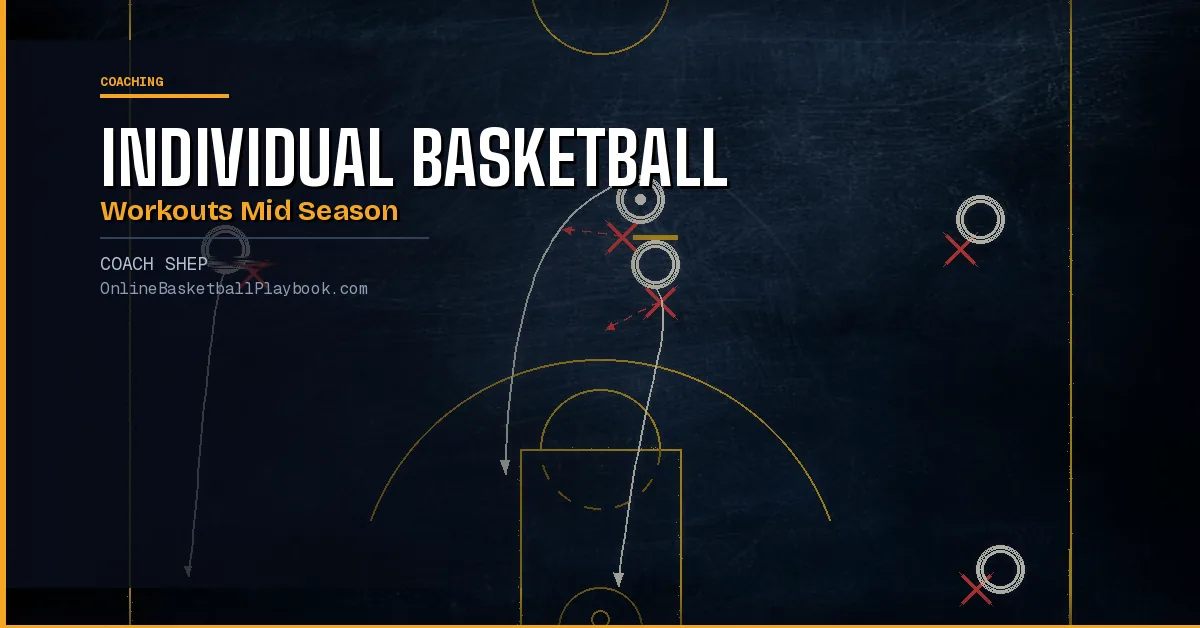
Mid-season is when players stop improving and start surviving. These individual workouts fix that: targeting the skill gaps that game film exposes, rebuilding habits under fatigue, and keeping players sharp heading into the stretch run.
Why Mid-Season Workouts Are Different
Pre-season individual work is about building. You have time, players are fresh, and the goal is installing fundamentals from scratch. Mid-season is an entirely different problem. By January or February, players have logged 20 or 30 games. Their bodies are carrying cumulative fatigue. Their mental bandwidth is split between school, practice, and the locker room. The last thing they need is a two-hour grind that destroys their legs before a Thursday game.
Mid-season individual workouts serve three specific purposes. First, they repair: game film exposes breakdowns that never showed up in pre-season drills, and targeted reps are the only way to fix them before they become permanent habits. Second, they maintain: players who stop getting quality repetitions on their skills will regress, especially under game-speed pressure. Third, they sharpen competitive edge. The player who keeps working individually while teammates coast is the one who makes the big play in February.
The structure has to change, too. Volume drops. Intensity stays high. A pre-season shooting workout might cover 400 makes. A mid-season session should focus on 150 to 200 quality makes with decision-making attached. Every rep should have a purpose that maps back to something you saw on film, not just sweat for sweat's sake.
Keep sessions between 30 and 50 minutes. Schedule them on lighter practice days or in the morning before school if you can. The goal is to add value without adding wear. A player who walks into Thursday's game feeling sharp and confident is worth more than one who has technically logged more reps but is dragging.
On-Ball Defense Reps: The Foundation
Defense breaks down mid-season for a predictable reason: players stop moving their feet. Early in the year, when everyone is fresh and the coaching staff is watching closely, footwork is sharp. By mid-season, fatigue causes defenders to reach, lean, and gamble rather than staying disciplined in stance. A short burst of individual defensive footwork each session rebuilds those habits before they calcify.
Start with the three fundamental tools every on-ball defender needs. The retreat step is the first. When the dribbler attacks, the defender drops the threatened foot back and opens the angle rather than backpedaling flat. This is the move that keeps a defender from getting blown by; it sacrifices a step of space to reclaim the correct angle. The advance step is the opposite: instead of waiting for the offense to set up, the defender attacks first, forcing the dribble before the ball-handler gets comfortable. The swing step handles drives toward the front foot: swing the opposite foot to cut off the angle rather than opening up and giving a lane.
Drill these in isolation for five minutes before any individual session begins. No ball needed. The coach signals left or right and the player executes the correct footwork response. It feels basic, but these three tools, taught in isolation and repeated under fatigue, are what allow a physically limited defender to stay in front of a faster player. Mid-season is exactly when players revert to just backpedaling. Five minutes of this work each session fights that regression.
Add the closeout drill next. Player starts at the nail, coach or manager holds a ball on the wing. Player sprints two-thirds of the distance, then chops short quick steps the final third, high hands the whole way, weight under control, low and wide at the end. The chop step matters because a defender who sprints all the way through the closeout blows past the shooter, gives up the drive, and creates a problem. The goal is to level off the dribble, contest the shot, and take away the straight drive. Dick Bennett's language is useful here: short choppy steps, high head, then settle into stance.
Ball Handling Under Fatigue
Ball handling workouts in pre-season feel comfortable. The gym is quiet, players aren't tired, and the dribbling looks crisp. Mid-season reveals the truth: how does a player handle the ball after 28 minutes of game action when the shot clock is running down and the defense is blitzing the pick-and-roll? That's the skill that needs training now.
The structure for mid-season ball handling is this: do it last, not first. After shooting and footwork work, when legs are tired, run the handling drills. You want the player to develop the feel of keeping the ball alive when they'd rather rest. Five minutes of stationary two-ball dribbling, then five minutes of chair-cone attack moves, then a one-on-one live rep against a manager. That's enough. The quality of those tired reps builds more real-world resilience than 30 fresh minutes on a perfect dribbling course.
Focus on two moves that matter most mid-season: the retreat dribble and the hesitation. The retreat dribble (stepping back on the dribble to reset space against pressure) is the play that breaks down when a player is tired, because it requires precise footwork under a crowded defense. Reps on this move mid-season sharpen the instinct when it's needed most. The hesitation with a change of pace is the other. Players who can only go fast have nowhere to go when a defense takes that away. Mix the pace on every rep.
One key principle: never drill a move without a decision attached. Don't just cone-dribble. Add a read at the end of each rep. The coach or manager holds up fingers, the player calls the number before finishing, then scores. This forces the brain to stay on during what would otherwise become autopilot. Mid-season individual work that doesn't demand attention doesn't transfer to games.
Shooting Off Reads, Not Habit
The biggest shooting mistake in mid-season individual work is running spot shooting. A player who catches-and-shoots from the same spot for 20 minutes is training a pattern, not a skill. Game shooting is never that clean. The shot comes after a screen, off a live dribble, following a hard cut, or out of a pump fake. Mid-season is the time to train shooting in context.
Three shooting structures work well in individual sessions at this point of the year. The first is the two-man shooting drill with a live read: player comes off a screen set by a coach or manager, reads ball or reject based on where the defender is (simulate this with a chair or cone), and shoots the correct option. The shot is different every single time: pullback three, step-in mid-range, or drive to the rim. This maps directly to how players actually score in games.
The second structure is the catch-and-go off the dribble. Player starts with a live dribble, attacks a specific cone, reads an imaginary closeout, and shoots or drives based on a coach signal. This builds the habit of reading closeouts rather than just shooting every catch, an important distinction for players who get trapped into hero ball late in the year when defenses adjust.
The third is free throw concentration reps. Mid-season is when free throw percentage often dips, partly from fatigue and partly from mental clutter. Add a simple concentration element to every free throw in individual work: player must say the target, take one breath, and shoot. No variation in pre-shot routine. The routine is what holds when pressure mounts in a close game, and mid-season is when you need to solidify it.
Track makes, not attempts. A player who shoots 6 of 10 from the wing in an individual session and walks away knowing their number has a concrete standard to meet next time. Vague volume ("we shot for 20 minutes") gives nothing to return to. Accountability to a specific number changes the quality of focus during every rep.
Footwork and Finishing at the Rim
Mid-season is when layup packages get sloppy. Players who had crisp footwork in October start floating, double-clutching, or getting blocked because they've stopped paying attention to contact and angles at the rim. The solution is targeted finishing work: short, specific, tied directly to the situations showing up on film.
Identify the two or three finishing situations where your player is struggling. If they're getting blocked on straight-line drives, work the euro step and the hop step with contact from a pad holder. If they're missing short pull-ups in traffic, work the two-foot stop into a mid-range off balance. If they're losing the ball on drives through traffic, work dribbling into contact with the non-dominant hand.
The most undercoached mid-season finishing skill is the left-hand layup at game speed. Most youth and high school players have a functional but weak off-hand finish. Mid-season, when they're tired and defenses are more physical, that weakness shows up consistently. Ten minutes of left-hand finishing reps (specifically at game speed with a body in the way) will show up in the box score within two to three games.
Footwork at the elbow is the other area worth targeting. Players who catch a post feed or a mid-range pass at the elbow often have sloppy pivot footwork: they travel, lose their balance, or give the defense time to recover. A few minutes of stationary footwork reps at the elbow position (front pivot, reverse pivot, shot fake into drive) sharpens the muscle memory that makes those live situations automatic rather than a scramble.
When you film individual workout sessions on your phone and show players the footage the same day, retention nearly doubles. Players correct footwork errors instantly when they see themselves. Verbal feedback alone rarely sticks the same way, especially mid-season when mental bandwidth is stretched thin across school and games.
Putting It Together: A 45-Minute Individual Session
A well-structured mid-season individual workout fits inside 45 minutes, covers all four skill areas, and leaves the player feeling sharper rather than drained. Here is a template that works at the high school and college prep level.
Minutes 1 through 5: defensive footwork. No ball. Retreat step, advance step, and swing step reps to a coach's signal. Finish with three closeout reps at game speed. This primes the feet and gets the defensive mindset locked in before anything else happens.
Minutes 6 through 20: shooting off reads. Two-man shooting drill for the first 10 minutes, player works on coming off screens with a live read at each rep. Final 5 minutes of this block is catch-and-go off the dribble with a coach signal. Track makes. End with 10 focused free throws using the locked-in pre-shot routine.
Minutes 21 through 35: footwork and finishing. Start with the specific finishing situations pulled from film. Target the real problems, not generic layup lines. Five minutes of left-hand finishing at game speed with contact. Five minutes of elbow footwork: front pivot, reverse pivot, shot fake, drive. Keep a coach or manager involved so there's always a read at the end of each rep.
Minutes 36 through 45: ball handling under fatigue. Now the legs are tired. That's the point. Two-ball stationary for two minutes, then attack-move reps off cones for five minutes, then one live one-on-one rep with a manager or coach to finish. Cool down with a brief conversation about what the session revealed and what the player needs to work on before the next game.
This structure respects the player's energy, gives each skill area real focused time, and ends with the player having done something hard when tired. That last part matters more than any specific drill. The mid-season player who keeps doing hard individual work when they could coast is the one who makes the big shot or the defensive stop in the fourth quarter of a playoff game. Routine builds the muscle that clutch moments call on.
- Five minutes of footwork before everything else: Retreat step, advance step, swing step to a signal. No ball required. Fight mid-season defensive regression before it becomes permanent.
- Track makes, not minutes: Give every shooting block a number target so the player has a concrete standard to return to next session. Vague volume doesn't build accountability.
- Film the session on your phone and watch it same day: Players correct errors instantly when they see the footage. Verbal feedback alone rarely produces the same retention.
- Do ball handling last, when legs are tired: Mid-season game situations demand the ball under fatigue, so that's exactly when you train it. Fresh handling reps don't transfer the same way.
- Every rep needs a read at the end: Hold up fingers, signal a direction, or make a defensive move. Removing the decision from practice trains autopilot, and autopilot fails in February games.
Want more basketball coaching strategies and drills?
Join the Online Basketball Playbook newsletter →
Draw this play free in the play drawer →
Membership: the full library, playbook packs, and Pro drawing tools →
Keep Building
Related breakdowns
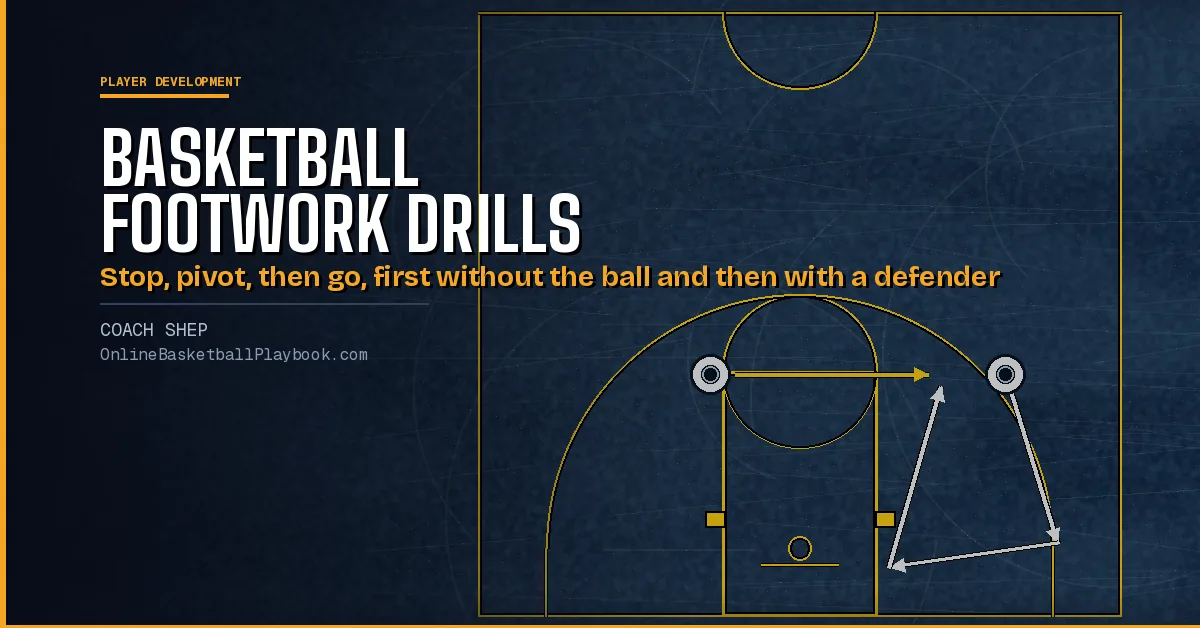
Basketball Footwork Drills for Teams and Individual Workouts
Basketball footwork drills for stops, pivots, cuts, jab moves and defensive slides, from the box drills to 30-minute workouts and where coaches differ.
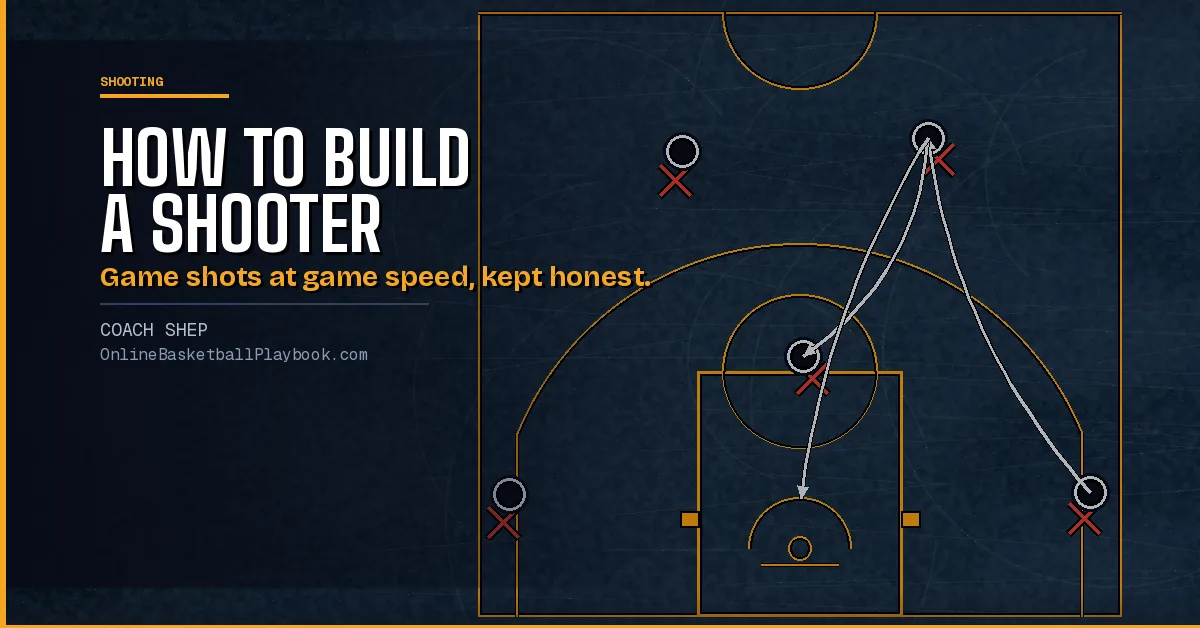
How to Build a Shooter: Individual Shooting Workouts That Actually Work
Game shots, game speed, a score on every rep, here's how to structure individual shooting workouts that turn gym time into real shooting ability.
Basketball Player Development: Workouts and Skill Progressions
Basketball player development runs on a plan, game speed and a make count. Learn the skill progression, scoring, error fixes, drills and how to program a season.