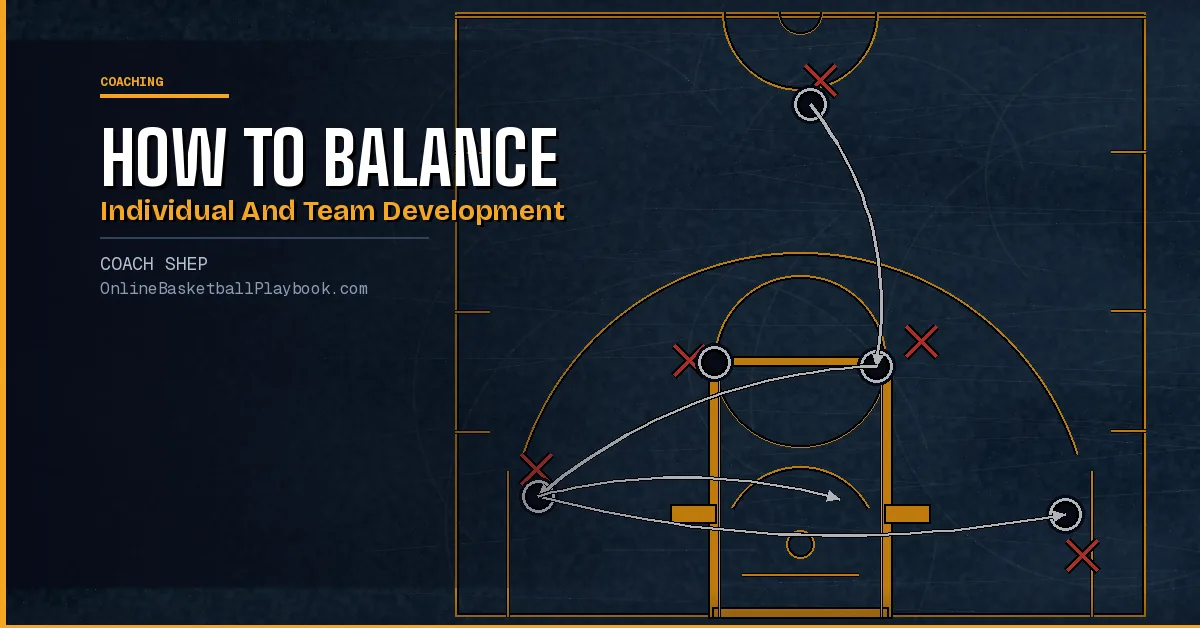
Every coach faces the same tension: your players need individual skill work, and your team needs system repetitions. You only have two hours a day. Here is how to build both without sacrificing either.
Why the Individual vs. Team Tension Exists
Coaches feel pulled in two directions because they are operating on two different timelines. Individual skill development is slow. Footwork, shooting mechanics, on-ball defensive stance. These take weeks or months to become automatic. Team systems are faster to install but require individual competence to run. If your players cannot guard their man one-on-one, your five-man defensive scheme is a floor plan built on sand.
The mistake most coaches make is treating these as competing priorities. They spend the first three weeks of the season on individual drills, then flip entirely to team concepts, and then wonder why their players lose their individual discipline the moment a system breaks down. The two tracks need to run together, but they need to be layered in the right order.
Steve Hawkins of Western Michigan captured the correct mental model in a single sentence that applies across every system: "Everything you do 1 on 1 should fit your 5 on 5." That is the answer. Individual work is not a detour from team development. It is the foundation of it. Every drill you run in isolation should mirror a decision your players will face in a game situation. When those two things align, practice time stops feeling like a tradeoff.
Start with Individual Skills in Isolation
Before players can execute anything as a unit, they need individual habits that do not require conscious thought. This is especially true on defense, where players are reacting to an opponent's decision rather than initiating the action. A player who has to think about his stance cannot also read the ball-handler's shoulders, communicate a screen, or locate his help position. The mental bandwidth is gone.
The three defensive footwork tools (the retreat step, the advance step, and the swing step) are a clear example. Each of these solves a specific problem: the retreat step prevents a straight-line drive when the offensive player attacks; the advance step forces the dribble before the offense sets up; the swing step cuts off the angle when the dribbler commits to the front foot side. Taught together in a team drill, players cannot distinguish between them. Taught in isolation, with a named cue and a specific trigger, each becomes automatic within a week.
The principle extends to offense. A player who has to think through his shot pocket mechanics in a pick-and-roll situation will always be a half-beat slow. A player who has put in hours of catch-and-shoot work at the wing (correct footwork, consistent release point, high follow-through) has freed up his attention to read the defense. Individual repetition is what buys collective bandwidth.
What Isolation Work Looks Like in Practice
Effective isolation work is not just free throw shooting or one-on-zero layup lines. It is structured, competitive, and tied to a specific game read. A closeout drill where the defender has to both close out correctly and then make a stance decision based on whether the offensive player can shoot. That is isolation work that will transfer. Five minutes of the Slide drill, where defenders in stance move laterally to a coach's signal without ever crossing their feet, builds the base for every team defensive concept you will install afterward.
The key is named cues. Every isolated skill needs a word or phrase the player can recall under pressure. "Nose on the ball" for on-ball defenders (tracking the dribbler's ball hand, not his hip or chest) is more actionable than "stay in front of him." "Short choppy steps, high head" for closeout defense is a full technique embedded in five words. Name the skill, drill it in isolation, attach the cue, then transfer it to team play.
The Bridge: Competitive 1-on-1 Work
The gap between isolated skill work and five-on-five team concepts is not a wall. It is a bridge, and the most reliable material for building that bridge is competitive one-on-one play under structured constraints.
One-on-one basketball is where individual technique is stress-tested against a live decision-maker. A player may execute perfect footwork in a mirror drill but collapse the moment a faster opponent attacks him. The competitive rep is what reveals the gap between mechanical knowledge and genuine habit. It is also where the player starts to understand why the individual skill matters, not because a coach told him but because he felt the difference when he used it correctly.
The constraints matter as much as the competition. Unlimited one-on-one basketball teaches bad habits just as quickly as it builds good ones. Set the starting position to match a game situation your team actually runs. Limit the number of dribbles to force decision-making. Define what counts as a win for the defender: not necessarily a steal, but a contested shot that took one extra second, or a pass that forced the offense to reset. Those constraints turn one-on-one competition into a rehearsal for team concepts rather than a detour from them.
Two constraints that pay off immediately: first, put the ball-handler at the three-point line and make the defender start in a closed stance. This rehearses closeout recovery, which is the most common breakdown in five-on-five defense. Second, when the dribbler picks up the ball, require the defender to belly up with both hands active. That is the "jam" moment in a live game. Practice it explicitly or it will never happen in a game.
Layering Team Concepts onto Individual Habits
Once individual habits are stable (not perfect but automatic enough that the player is not consciously managing them), team concepts can be layered on top. The order matters. Coaching team communication before individual positioning is like teaching players where to stand in a zone before they can guard their own man. The layer underneath is missing.
The clearest example is on-ball screen defense. You cannot teach players to navigate a ball screen as a team until each of them has the individual on-ball skills to hold their position through contact, communicate the screen coming, and make a quick decision about whether to fight over the top, go underneath, or switch. Any of those three is a team play, but it starts with the on-ball defender's individual read. Coaches who try to teach the team concept first spend most of their time correcting individual breakdowns. Coaches who build the individual skill first find the team concept clicks in one or two sessions.
The same is true on offense. Princeton-style action depends on players reading the defense, not running a memorized route. A backdoor cut only works if the cutter can read the defender's denial position in real time. That is an individual perceptual skill. Is the defender's weight on his front foot or his back foot? that has to be trained before the five-man sequence makes sense. Once players have the read, the action connects immediately.
Practice Structure That Serves Both Goals
A practice structure that builds individual skills and team concepts simultaneously is not about giving equal time to each. It is about sequencing correctly and designing drills that serve both purposes at once.
A reliable framework starts every defensive session with five minutes of named individual work before any team concept is touched. Five minutes of Slide drill. Five minutes of one-on-one closeout with the "short choppy steps, high head" cue. Five minutes of belly-up-on-dead-dribble reps. These are not warm-up drills. They are the foundation that everything else is built on. Players who skip this foundation and go straight to team defense are always one read behind. Their feet are solving a problem their mind already solved, which means they are using attention they need for team communication.
From individual work, move to two-on-two or three-on-three within a defined zone of the floor. This is where individual habits meet simple team coordination. The constraints (limited dribbles, defined help positions, required verbal communication) keep players focused on executing individual technique while also beginning to integrate with teammates. The coach's job at this stage is to freeze the action when an individual breakdown is causing a team failure, name the individual skill that was missing, and repeat the possession. Not as punishment but as a direct connection between the individual habit and the collective outcome.
Five-on-five work is the final layer. By this point, the individual skills that underpin your team system should be automatic enough that players can direct most of their attention to reading the team picture. The coach's focus shifts from individual correction to system reads: who rotated late, who called the screen, who took away the advantage at the right moment. Individual corrections in five-on-five should be brief. Pull the player, connect it to the named cue, put him back in.
Managing Playing Time and Development Together
One of the hardest tensions a coach navigates is between developing younger or less skilled players and winning games with the players who are ready right now. This is a real dilemma, not a philosophical one, and pretending otherwise does not help. But the development-to-winning tension is made much worse by a practice structure that separates individual skill work from system work. Players who are not yet ready for five-on-five roles can accumulate individual skill reps that make them system-ready faster if the practice is designed correctly. A player in the second rotation at the JV level who gets three hundred closeout reps per week and five minutes of Slide drill every day is developing faster than one who gets scattered five-on-five minutes without the individual foundation underneath. Track the reps, not just the possessions.
Setting Standards by Level
One of the most practical ways to balance individual and team development is to define explicit, written standards for each level of your program (what a player must master individually to meet the JV standard, and what additional individual skills are required at the varsity level). This does two things: it gives individual development a clear target, and it gives team standards a foundation in individual accountability.
A JV defensive standard built around on-ball skills might look like this: no blow-by straight to the rim; contest every shot; communicate screens verbally before they arrive; stay in stance for the duration of the possession. These are all individual skills, but each one is also the prerequisite for a team defensive concept. No blow-by is the individual version of "no straight-line drives," the team principle that keeps help defense honest. Contesting every shot is the individual version of showing discipline in the close-out system. When a player meets the JV individual standard, they are also ready to run your JV team defense. The two are not separate tracks. They are the same track, described from two different angles.
Varsity standards add complexity: fight over every screen on a shooter regardless of physical difficulty. No rhythm shots (every shot the opponent takes should require an extra movement or adjustment). Force the extra pass rather than reaching for a steal. Belly up immediately and with both hands when the dribbler goes dead. These are higher-level individual skills, but they are also exactly the requirements your varsity team defense depends on. A varsity player who fights over every screen on a shooter makes your switching or "fight through" help scheme work. A player who does not makes every screen a team problem.
Write the standards down. Post them in the gym. Review them in individual player conversations at the start and middle of the season. Players develop faster when they have a specific individual target rather than a general directive to "get better." And team development accelerates when every player in the program knows exactly which individual skills they need to master to earn the team's system trust.
Before your next practice, pick one individual skill that is breaking down in your five-on-five defense (a closeout, a belly-up on dead dribble, or a screen communication breakdown) and add five minutes of isolated repetition of that exact skill at the top of your practice. Watch how quickly the team-level breakdown resolves. The fix is almost always upstream of the five-on-five rep.
- Drill individual skills with named cues first. "Nose on the ball," "short choppy steps, high head," "belly up on dead dribble." A player who cannot name the cue under pressure does not yet own the skill. Five minutes at the start of every defensive session, every day.
- Design 1-on-1 constraints that match your system. Set the starting position, dribble limit, and win condition so that every competitive one-on-one rep rehearses a real read from your scheme. Unconstrained one-on-one builds individual ego, not system readiness.
- Write level-specific individual standards and review them mid-season. A player who knows the exact individual skills required to earn varsity minutes develops faster and with more ownership than one receiving general feedback. The standard is the roadmap; the coach's job is to help each player read it accurately.
- Layer team concepts only after individual habits are automatic. If you are correcting individual technique during five-on-five possession work, you have moved to team concepts too early. Back up one layer and run more two-on-two or three-on-three within a defined area of the floor.
- Count individual reps, not just possessions. A player who is not yet in your top rotation should be accumulating hundreds of individual skill reps per week (closeouts, stance drills, one-on-one reads) that build toward system readiness. Track it, acknowledge it, and connect it explicitly to the team standard they are working toward.
Want more basketball coaching strategies and drills?
Join the Online Basketball Playbook newsletter →
Draw this play free in the play drawer →
Membership: the full library, playbook packs, and Pro drawing tools →
Keep Building
Related breakdowns
How to Handle Player Development and Team Success
How to Handle Player Development and Team Success
How to Become a Basketball Coach: Paths, First Jobs and Steps
How to become a basketball coach: where coaches start, youth, school, club and college paths, entry jobs, coaching education, networks and mentors.
Basketball Scouting Report Template and How to Fill It Out
A printable basketball scouting report template with team, offense, defense, player and game plan sections, the questions to ask and how to brief players.