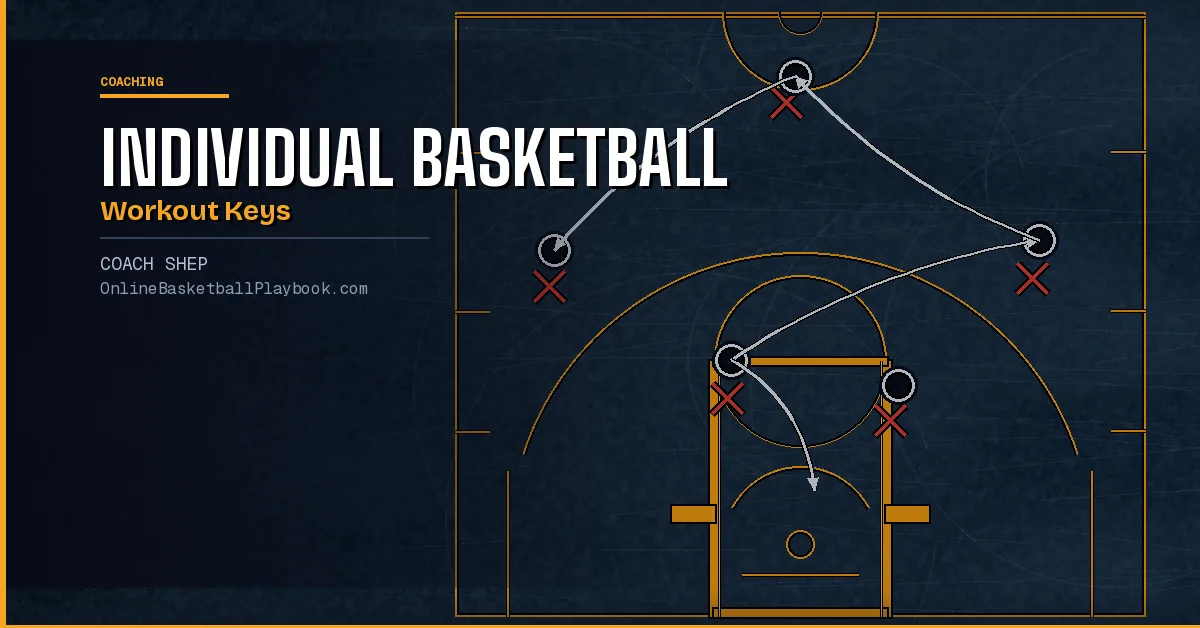
Most players put in gym time without a real plan. These are the principles that separate productive individual workouts from wasted hours: how to structure, score, and execute sessions that build real skill.
The Three Non-Negotiables of Every Workout
Before any drill, any move, any shooting block, three things must be true about your workout. Coach Mac's framework cuts to the core: every session must have a plan, run at game speed, and track the shots and reps. If any of those three is missing, you are not developing.
A plan means you walk into the gym knowing what you are working on, in what order, and for how long. Aimless gym time doesn't develop anyone. Players who drift from basket to basket, shooting whatever feels comfortable, are reinforcing habits they already have, not building new ones. The plan doesn't have to be complicated. A one-page workout card with five blocks, each with a make target, is enough. What matters is that the session has structure before the ball bounces.
Game speed is where most solo workouts fall apart. Players slow down to look good, to hit their make targets, to feel comfortable. But comfortable is not what the game is. Every drill that isn't run at the pace and physicality of a real possession is training a slower, softer version of the skill. The moment the defense shows up, the skill collapses, because it was never trained under realistic conditions. Game speed doesn't mean sloppy; it means the pace is honest.
Tracking shots and reps closes the loop. Without a number on paper, you have no idea if you improved. You can feel like you had a great workout and actually have regressed. Track attempts, track makes, track the make percentage. If you set a goal of 14 makes in 90 seconds and only got 11, you know exactly what to come back for next time. Without the number, you are guessing.
Score Everything: Makes Over Attempts
The single most overlooked discipline in individual workout design is scoring on makes, not attempts. The difference is enormous. A player who shoots 200 attempts in a session and makes 90 has told themselves a story about volume. A player who sets a goal of 100 makes and stops when they hit it has trained accountability and efficiency into the session from the start.
Make-count standards that show up across elite programs: 14 makes in 90 seconds, 300 makes in a session, 20 of each move before advancing to the next. These are not arbitrary numbers. They set a bar that creates honest self-assessment. You either hit the make target or you don't. There is no partial credit, no "I was close," no "the gym was cold." The number either happened or it didn't.
Mark Few's Gonzaga program adds a completion-rate gate on top of the make count: you do not move to the next move until you finish 8 of 10 against token pressure. That 80% standard is stricter than a raw make count because it ties advancement to quality of execution under mild resistance. Steve Smith at Oak Hill stacks a tempo target on top of that: a block might require 80 makes in 4 minutes, giving the workout a pace standard, a make count, and a completion percentage all at once. Together these three measures (makes, completion rate, and clock) give any workout block a complete accountability structure.
Scoring free throws inside the workout (not fresh at the end) is the other piece. Shooting free throws when you are tired, mid-session, with a make target attached, trains the skill under the exact conditions you will face at the end of a close game. Shooting them fresh after you are done is comfortable. Comfortable doesn't transfer.
The Part-to-Whole Progression That Builds Real Reads
The most durable framework for installing any individual skill comes from the Akser and Krause tradition: introduce the skill with no defense (1v0), then move to coach-guided reads (1vC), then controlled advantage situations (1v2), then live game situations. The numbers scale: 1v0 → 2v0 → 3v0, then repeat the same progression with defense added at each layer.
What this progression builds is reads, not routes. A player who only practices a move in 1v0 settings has memorized a pattern. They know where to go when nothing is in the way. The moment a defender shows up, they are operating on a script that doesn't account for what the defense is doing. The 1vC and 1v2 stages force the player to make decisions (to recognize the defensive cue and choose the right counter) before the full speed and pressure of a game situation arrives.
The form-to-move-to-game-shot order reinforces this within any individual block. Start with the form and footwork. Layer the move. Finish on a game shot off a real action: a catch off a cut, a shot off a live dribble, a finish after contact. "What you correct first is what you care about most." The order of the progression communicates priorities to the player before a word is spoken.
Signature moves must always include their counters. If you work a player's right-hand drive, you work the counter to the defender who takes it away. If you work the mid-post face-up, you work the drop step to the baseline when the defender goes under. A move without its counter is half a weapon. The defense will find the gap quickly, and the player will be left with nothing.
Error Detection: The Coach's Primary Tool
The ASEP and McGee diagnostic-first model reframes what a coach's job is during an individual skill block. The coach's primary role is not to re-explain what correct execution looks like. It is to identify which specific error is happening and apply the matched correction. That shift (from teacher to diagnostician) changes everything about how a workout runs.
Every technical skill has a predictable set of three to five common breakdowns. Dribbling: watching the ball, pumping the arm instead of the wrist, dribbling too high. Shooting: shoulders not square to the basket before the shot, elbow drifting out, no follow-through, rushing the shot before balance is established. Triple-threat position: not squaring to the basket, holding the ball away from the body, jab step with too much weight forward. Footwork: bending at the waist instead of the knees, jump stop with one foot landing before the other, lifting the pivot foot before releasing the ball.
The coach who knows these error patterns can watch a player for thirty seconds and diagnose the specific breakdown. The correction is then precise, "snap the wrist down," "eyes on the rim," "feet set before the catch", not a general reminder to "do it better." Precision corrections transfer. Vague encouragement does not.
The 1-to-5 component rubric extends this into evaluation. Instead of judging a skill by make-miss percentage alone, break the skill into its three to five key components and rate each. A player who makes 6 of 10 jump shots with a consistent elbow drift has a mechanical flaw that is temporarily hiding in a decent make rate. That flaw will surface the moment a defender contests. The rubric exposes what the make percentage conceals. Track the rubric score before and after a skill block. Track it at the start of preseason and again mid-season. The trend in the rubric score (not the shooting percentage) is the real player-development signal.
Before any skill block, run through the three to five most common errors for that skill in your head. Your job during the block is to watch for those specific breakdowns, not to demonstrate what correct looks like one more time, but to identify the exact error happening and give the matched one-line correction cue that fixes it.
Theme Days and the Weekly Development Arc
A common trap in individual programming is spending an entire week on one skill. A shooting week, a handles week, a finishing week. The logic feels sound. Deep repetition builds mastery. But the problem is that every other area of the game goes untouched for seven days, and players lose touch with the full range of their skill set.
The more durable structure assigns a named theme to each day of the week and holds that template for 8 to 12 weeks. Monday might be pick-and-roll fundamentals. Tuesday is pick-and-roll advanced reads. Wednesday is ball handling. Thursday is finishing. Friday is conditioning and toughness. Saturday is mid-range and open-court. The player touches every pillar of their game every single week. The routine itself becomes the habit.
Within each day the 101-to-201 ladder still applies. Foundational work on one day leads to advanced reads on the next day of the same theme. Progression lives inside the weekly structure rather than across weeks. A recurring mental-skills block (perhaps three to four days a week) compounds the mental game alongside the physical without requiring a separate session.
The Point Guard Academy model that underpins this approach demonstrates something that gets ignored in most programming discussions: consistency of structure is itself a development tool. When players know what Monday looks like, they arrive prepared for Monday. The cognitive load of figuring out what to work on is eliminated, and the full mental energy goes into the quality of execution.
Small Group Intensity Over Marathon Volume
Forty-five to sixty minutes with three or four motivated players, run at high intensity, is enough if the coach refuses to leave until the move is mastered. This is the Raca, Manouselis, and Chrysalas model, and it runs counter to the instinct that longer and more volume equals better development.
The pillars of a complete session in this model: footwork, ball handling, finishing, shooting, passing, and spacing. Cover those in a tight window with genuine intensity, then immediately place the offensive skill into body-to-body defensive pressure. The sequence matters. The skill is introduced without pressure, then immediately tested against contact. There is no comfortable middle phase where the player executes in a live-game context without a defender.
The NBA Basketball School Loads system extends this into any group or camp setting. Pair any skill game with five to ten pre-set escalating rule constraints ("Loads") so the challenge adjusts to the player without switching activities. A simple layup drill becomes a constraint game where the defender scores a point for each forced miss. The accountability stays constant; the pressure increases without disrupting the drill's learning objective. Close each individual skill block with a self-reflection prompt: what did I do well, what did I learn, what do I want to improve. Metacognition trained alongside the skill compounds over a season.
Pair Defense Into Every Offensive Block
The convergence across the Iowa coaching tree (Tom Crean, Steve Alford, Thad Matta, and Rick Majerus) is unmistakable. An individual workout is not an offense workout. Defense is a taught skill that belongs inside every block, not bolted on at the end when players are tired and time is short.
The Iowa workout card pairs every offensive category with a matched defensive drill. Dribble drives paired with shadow defense and take-away-the-first-step work. Motion shooting paired with baseline closeout slides. Post strength paired with defensive recover-and-contest. Rotation shooting paired with closeout, contest, and block-out. The same skill (reading the ball, moving your feet, making contact) shows up on both sides of the ball in the same workout block.
Matta ran 45 minutes of skill instruction at every practice, every day, all drills on the clock. Majerus threaded closeout work, charge-taking, and brick-wall defensive positioning through his shooting and skill blocks at the 2007 Coaching Academy session. These are not coaches who "also worked on defense." They treated the defensive skill drill as a non-negotiable partner to every offensive drill they ran.
The practical application: write your workout card with two columns. The left column is the offensive block. The right column is the matched defensive drill that runs in the same session. When you walk into the gym, both columns get executed. The workout is not done until both sides are logged.
Eastman's diagnostic lens adds one more layer to this. Instead of organizing training by position or drill type, build the workout around the most common weaknesses at each position (the things that get players beaten, removed from games, or left sitting on the bench). For guards: can't pass ahead, double-pumping on finishes, turning good shots into bad plays, not defending full court. For bigs: posting too deep, not screening bodies, not going after rebounds. For wings: not sprinting the floor, not preparing feet before catching, not post-feeding and cutting. The reframe is honest: design the session around what is costing players minutes, not around what they already do well.
- Have a written plan before the ball bounces: A one-page workout card with five blocks, each with a make target and a time block, eliminates aimless reps and sets the standard before the session starts.
- Score on makes, not attempts: Set a specific make target for each block (14 in 90 seconds, 20 of each move) and don't advance until you hit it. Attempts without accountability is comfortable practice, not development.
- Diagnose before you correct: Run through the three to five most common errors for any skill being trained before the block starts, then watch for those specific breakdowns rather than offering general feedback.
- Pair a defensive rep with every offensive block: Write your workout card with two columns. The defensive drill runs in the same session as the offensive block, not after everyone is tired.
- Use theme days, not theme weeks: Assign a named focus to each day of the week and hold that template for 8 to 12 weeks so players touch every pillar of their game every single week without losing repetition depth.
Want more basketball coaching strategies and drills?
Join the Online Basketball Playbook newsletter →
Draw this play free in the play drawer →
Membership: the full library, playbook packs, and Pro drawing tools →
Keep Building
Related breakdowns
Guard Workout: Handles, Reads and Finishing You Can Print
A guard workout you can print: a full session with its standards, plus handle work, jab, closeout and ball-screen reads, finishing and shooting off the dribble.
Basketball Footwork Drills for Teams and Individual Workouts
Basketball footwork drills for stops, pivots, cuts, jab moves and defensive slides, from the box drills to 30-minute workouts and where coaches differ.
Basketball Workout Plan: How to Build One by Position
How to build a basketball workout plan: the blocks to include, the order, how long, make counts and game speed, position work, tracking, and where coaches disagree.