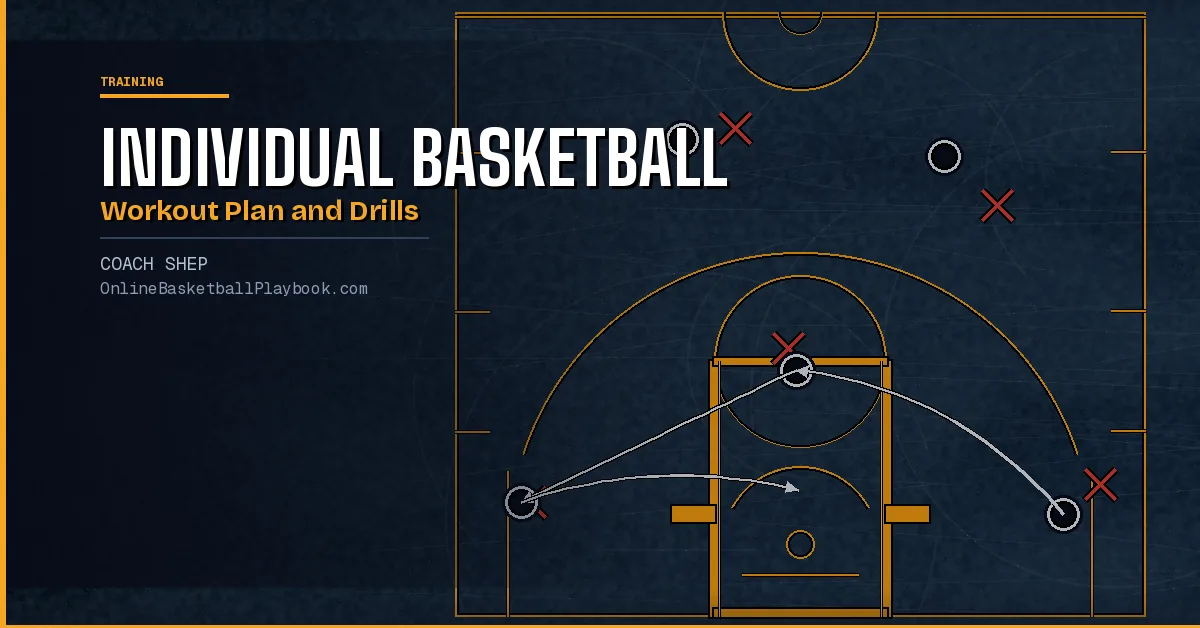
A structured individual workout trains the exact skills basketball demands: finishing under pressure, shooting off movement, and making reads at game speed, not just going through the motions alone on the court.
Build the Foundation: Footwork and Finishing First
Every productive individual workout starts on the inside and works outward. Before a player shoots a single jump shot, they need to own their footwork and finishing because every drive ends at the rim, and a broken layup wastes the whole possession.
The layup progression that research-backed coaches return to again and again follows a clear sequence: no ball first (to lock in footwork), then a carry, then one-line dribble-in, then two-line pairs, then contested finishes. The goal is both hands on both sides at game speed: straight layups, reverse layups, crossover finishes, and the jump-stop power layup used when a defender crowds the lane.
The jump-stop power layup deserves its own block in the workout. Most players only drill the layup on a clean run-in; games demand the finish through contact, off a spin move, or after an off-balance drive. Spend five minutes just on the power finish: drive the lane from the wing, two-foot jump stop inside the charge circle, go up strong off both feet. Switch sides. Then add a chair or cone as a token defender to force the finish decision.
Walberg's Finishing Sequence
The Walberg/Welling finishing framework that has filtered through NBA-level skill trainers is simple: drill the layup sequence before any team reads. The drive-and-kick is only as good as the finish. If a player can't convert at the rim, every penetration read collapses. The pass-out becomes hesitant, the second cutter doesn't get the ball, and the drive stops being a threat.
Apply this in your workout: spend the first 8 to 10 minutes exclusively on finishing. No shooting from the perimeter. Just footwork and layups, scored and timed. Set a make target (20 makes in 2 minutes, alternating sides) before you advance to the next phase.
Shooting Drills: Game Shots at Game Spots
The single standard that separates useful individual shooting work from wasted reps is captured in one phrase from the research: "game shots at game spots at game speed." If a player is standing still, shooting comfortable pull-ups from wherever they prefer, in no hurry, they are not getting better at basketball shooting. They are practicing a skill that doesn't exist in games.
The Field-Goal Progression is the best-documented daily warm-up shooting sequence in the literature. It runs: form slams into the backboard → TV shooting (on the back, to groove release) → self-fed catch-and-shoot form shots → the Hays Footwork Drill (elbow-to-elbow self-pass with a hop, simulating catch-and-shoot footwork) → soft-touch shots from close range → shots from a live pass → shots off the dribble. Each step has a purpose and a specific footwork standard: the hop from the basket-side foot into a quick stop is the same pattern for both catches and dribble pickups.
Five-Spot and Olympic Shooting
Five-Spot and Olympic shooting drills are the high-volume rep engines of an individual workout. In Five-Spot, the player sets five specific spots on the floor (corners, wings, and the top of the key) and completes a target number of makes from each before rotating. Olympic adds a conditioning element: the player must sprint to touch a line between each shot, forcing every catch to come while slightly winded and moving. Both drills require "lock and load" footwork, squared before the catch, not after it.
Track your makes, not your attempts. A player who takes 200 shots in an hour with no tracking of makes is not training. A player who completes 100 makes from five game spots, sprinting between each, has done a real shooting workout. The difference is accountability, and it mirrors what competitive drills with scoring do for team practice.
One-Dribble Pull-Ups and Shot Fakes
No individual shooting workout is complete without pull-up jumpers and shot-fake reads. Drill the catch-and-drive to a one-dribble pull-up from both sides of the elbow. Then drill the shot fake into a side dribble: catch at the wing, shot fake to freeze the close-out, one side dribble, rise into the mid-range jumper. These two moves (the pull-up and the shot-fake drive) cover the two most common responses a defender gives on a catch. Owning both makes a player difficult to guard.
Ball-Handling and Decision Drills
Ball-handling in an individual workout has one job: build confidence and control under pressure so the player stops thinking about the ball and starts reading the defense. Stationary dribbling drills have their place, but they should be brief and they should escalate quickly to moving, game-speed reps.
The 12-Second Drill is a competitive ball-toughness standard worth building your handling block around. The player dribbles through a sequence of moves (crossover, between the legs, behind the back, hesitation) without any break, for exactly twelve seconds at full intensity. Count makes, not style. The goal is to train the hands when fatigued, because game dribbling happens when players are already tired from a sprint or a cut.
The Spin-Pass Solo Move Drill
The Outside Moves Using a Spin Pass is the best-documented solo drill for training every perimeter move with realistic timing. The player delivers an underhand self-pass from slightly ahead, catches it in stride or off a hop, and executes: catch-and-shoot, catch-and-drive, pull-up jumper, shot fake into drive. Because the ball arrives at an angle and speed the player controls, every rep can simulate a different pass type: skip pass, drive-and-kick kick-out, post entry. Run through all moves on both sides. Three to five minutes of this drill touches every perimeter skill a guard or wing needs.
Small-Sided Drills That Install Real Reads
The most important shift in modern player development thinking is this: individual skill drills should include a read. A player who can shoot off movement but never practices reading a close-out will still hesitate in games. A player who drills the drive but never faces a help defender will stop after one dribble when the help arrives.
Small-sided live drills solve this. They require only one or two extra players (or a coach) and they install real decisions at game speed. The 1-on-1 drill from 15 to 20 feet is the simplest version: live defense, one offensive move to get past, finish or pull up. The constraint forces a decision every single rep. Add a second defender behind the first, and suddenly the player must read the help, the same decision they face in a real game drive.
The Penetrate and Pitch Drill
The Partner Penetrate and Pitch Drill is one of the most versatile two-player drills available for an individual workout with a training partner. Two players, 20 to 25 feet apart. The ball-handler attacks the basket on a live drive; the partner spaces to the guard-forward angle or the baseline-release spot. The driver reads the "defense" (the partner's position) and either finishes or fires the kick-out pass. Both players rotate roles every few reps. This drill trains the most common offensive action in modern basketball (the drive and kick) with a real spatial decision built in.
Pairs Shooting and Make-It-Take-It
Pairs shooting, attributed to Hubie Brown, is the standard for two-player competitive shooting work. Eight game spots on the floor. Catch in stance, ready to shoot before the ball arrives. A miss means rebound your own ball and finish. Make-it-take-it keeps possession until someone misses. The rule "every drill ends with a make" trains the finish. The player must earn the right to rotate by converting the shot, not just by taking it. This standard applies across every drill in the workout: shots are completed, not abandoned.
Conditioning Through Competitive Drill Games
The best individual workout plans do not separate conditioning from skill work. When conditioning is a separate block (sprints after skills) players mentally disconnect. The research-based alternative is to score everything and run losers. The drill is the conditioning, and the competition is the motivation.
Full-Court Speed Layups is the most widely cited individual conditioning standard: make 50 layups in two minutes, alternating sides, full-speed sprint every rep. The player who cannot do this is not conditioned to play at game pace. Once they can do it, add a contest: a partner stands under the basket and lightly contests every third layup. Now the finish is also a decision. Same time standard, same make target, real pressure.
The Chase Drill
The Chase drill addresses the most common failure in player conditioning: players learn to finish clean but collapse under fatigue and contest. In the Chase, the player drives the lane for a layup; a trailing coach or partner chases and arrives just as the ball goes up. The offensive player must either finish through the contest or absorb the late help and redirect. If the shot is contested and the player pulls it out, they run. If they finish (clean shot or tough make) they rotate. This drill trains exactly the finish players need in the fourth quarter.
Kentucky Shooting as a Conditioning Circuit
The Kentucky Shooting drill converts the weave-layup sequence into a scored conditioning circuit. Players run the three-man weave the full length of the court, finish the layup, then sprint back to the three-point line and catch-and-shoot two threes to a make target. Everything is scored and timed. The combination of a conditioning run, a layup finish, and two perimeter shots means every rep is a complete game-skill circuit, not a drill that trains one thing and ignores everything else.
When running individual workouts with a full squad, use the Livsey simultaneous shooting battery: structure drills so multiple players work at the same time from different spots (Backpedal, Pepper, and Crack Back as a five-minute rotation) instead of lining everyone up and waiting. More game-speed reps per minute, less standing, and every player gets the same work in half the time.
Putting the Workout Together
An effective individual basketball workout runs 60 to 75 minutes and follows a clear progression: finishing and footwork first, then shooting, then ball-handling and reads, then conditioning. The phases build on each other. The footwork from phase one shows up in every catch-and-shoot rep in phase two, and the decision-making from the small-sided drills in phase three carries into the conditioning games in phase four.
Here is a sample structure for a 60-minute individual workout:
Minutes 1–10: Finishing. Layup progression (no ball, then carry, then one-line dribble-in, then two-line). Target: 20 alternating-side makes in two minutes before advancing. Add the power jump-stop finish in the final three minutes.
Minutes 10–25: Shooting. Field-Goal Progression warm-up (five minutes), then Five-Spot shooting to a make target (five makes per spot before rotating), then pull-ups and shot-fake drives from both elbows (five minutes).
Minutes 25–40: Ball-Handling and Decision Work. 12-Second Drill (three rounds), Spin-Pass Solo Moves (three minutes per side), then live 1-on-1 if a partner is available or Partner Penetrate and Pitch (ten minutes).
Minutes 40–60: Conditioning Circuits. Full-Court Speed Layups (two minutes to 50 makes), Chase Drill (five minutes), Kentucky Shooting (two rounds). Finish every session with free throws, ten makes, not ten attempts. Validate the workout with pressure free-throw shooting.
The free-throw finish is not arbitrary. Free throws require focus when fatigued, and the make standard (ten makes, not ten shots) trains the mental discipline that separates players who finish games from those who struggle when it counts. As the drills research makes clear: "make a free throw to validate the score" is a constraint that coaches behavior without a single word from the bench.
As you advance the workout across a week, add one connected-action drill per session. The Hit-and-Get Ball Screen is the right progression once 1-on-1 reads are clean: start with one defender and a clear read, then add a second defender who changes the first read, then connect two or three actions so the player must keep playing after the first option is covered. This is how individual skill becomes team basketball, not by accident in live five-on-five, but by building the connections one read at a time in the workout.
Track every session. Write down makes, make targets hit or missed, and which drills you skipped. The players who improve fastest are not the ones who work hardest in a single session. They are the ones who measure their work and close the gaps week by week.
- Start every workout with finishing, not shooting. Spend the first 8-10 minutes on layup progressions and the power jump-stop finish before touching a jump shot. The rim is where possessions end.
- Count makes, not attempts. Every drill should have a make target (20 makes, 5 per spot, 50 in 2 minutes) because tracking attempts with no make standard is not training.
- Use constraints to coach decisions. Add a dribble limit, a forbidden zone (no mid-range), or a make-a-free-throw-to-validate rule instead of stopping to lecture. The rule teaches the read faster than the speech.
- Train every perimeter move on both sides. The Spin-Pass Solo drill covers catch-and-shoot, catch-and-drive, pull-up, and shot-fake drive. Run all four moves left and right so the non-dominant hand is never a weakness.
- End every session with free throws to a make standard. Ten makes when fatigued trains the mental discipline that separates players in close games, not ten attempts, ten makes.
- Add one connected read per week. Once single-action 1-on-1 reads are clean, advance to two-action reads (drive-and-kick, screen-and-roll, shot-fake-then-attack) so individual skill transfers directly to team basketball.
Want more basketball coaching strategies, drills, and tools?
Join the Online Basketball Playbook newsletter →
Draw this play free in the play drawer →
Membership: the full library, playbook packs, and Pro drawing tools →
Keep Building
Related breakdowns
Basketball Practice Plan: Template, Youth Plans and Examples
A basketball practice plan template you can copy, youth plans by age, high school orders from named coaches, rules for timing and scoring and where coaches disagree.
How to Run an Effective Basketball Practice: Plan, Pace, Score
How to run an effective basketball practice: write the plan, start on time, cap drills on a clock, score every rep, pick your pace and use film.