
Basketball conditioning is anaerobic — short bursts, sharp cuts, repeated sprints. The right cardio program trains that system directly, not a generic aerobic base that never transfers to the floor.
Why Basketball Conditioning Is Anaerobic
Most coaches default to long-distance running in the preseason. Run a mile, run two miles, build a base. It feels productive. The problem is that the energy system you are training — steady-state aerobic — barely shows up in an actual basketball game.
Basketball is a sport of repeated short bursts. A player sprints in transition, cuts off a screen, closes out on a shooter, and sprints back in transition again. Each of those efforts lasts under 15 seconds. Then there is a brief stoppage — a made basket, a foul, a timeout — before the next burst. That pattern is anaerobic by definition: high-intensity work with short recovery windows, repeated many times over 32 to 40 minutes of game action.
The energy system that powers those bursts is the anaerobic system, specifically the phosphocreatine and glycolytic pathways. When players are inadequately conditioned for anaerobic work, they accumulate lactate faster than they can clear it. Their legs get heavy. Their technique breaks down. Their shot mechanics fall apart in the fourth quarter. The fitness problem shows up as a skill problem, which is why coaches often misdiagnose it.
Training the aerobic system through long runs does not fix this. A player can run a comfortable 10-minute mile and still be gasping at the two-minute mark of a hard defensive possession. The aerobic base has a role in recovery between bursts, but the primary training target for basketball fitness is the anaerobic engine.
That means your conditioning program should look like the game: short, all-out efforts followed by structured rest, repeated enough times to drive adaptation.
Work-to-Rest Ratios and Lactate Threshold
The single most important variable in basketball conditioning design is the work-to-rest ratio. Get this wrong and you are either undertaxing your players (too much rest, no adaptation stimulus) or training them into the ground with no recovery (too little rest, chronic fatigue with no performance gain).
The target ratio for basketball conditioning is 1:2 to 1:3 — one part work to two or three parts rest. If a sprint or drill takes 30 seconds, the player should get 60 to 90 seconds of recovery before the next effort. Early in preseason, stay at 1:3. As fitness builds over several weeks, you can compress toward 1:2. The goal is not to eliminate rest — it is to make each work effort genuinely maximal.
Why does this ratio matter? Because the physiological target is the lactate threshold. Lactate is a byproduct of anaerobic metabolism. When intensity exceeds the body's ability to clear lactate in real time, it accumulates and creates the burning, heavy sensation players describe as "legs going." A higher lactate threshold means a player can sustain a higher work intensity before hitting that wall. That translates directly to staying sharp in late-game situations when other players are fading.
Raising the lactate threshold requires training at intensities that actually challenge it — which means all-out efforts of 60 seconds or less. Jogging does not get there. A player doing 17s (sprinting sideline-to-sideline 17 times in 60 seconds) is training the right system. A player running an easy mile is not.
The practical implication: every conditioning rep should be a genuine sprint, not a fast jog. If a player can hold a conversation during a conditioning drill, it is not conditioning — it is active recovery. Set a time standard, and hold it.
On-Court Conditioning Drills That Actually Transfer
The best conditioning drills for basketball look like basketball movements, because specificity of adaptation is real. A player who gets fit through lateral defensive slides will have more available capacity for lateral defensive slides in games than a player who got fit by running straight-line laps. Keep players on the court, moving in basketball patterns.
The Core Drill Library
These drills represent a proven bank of on-court conditioning work. Rotate through them based on the week's emphasis and where you are in the season.
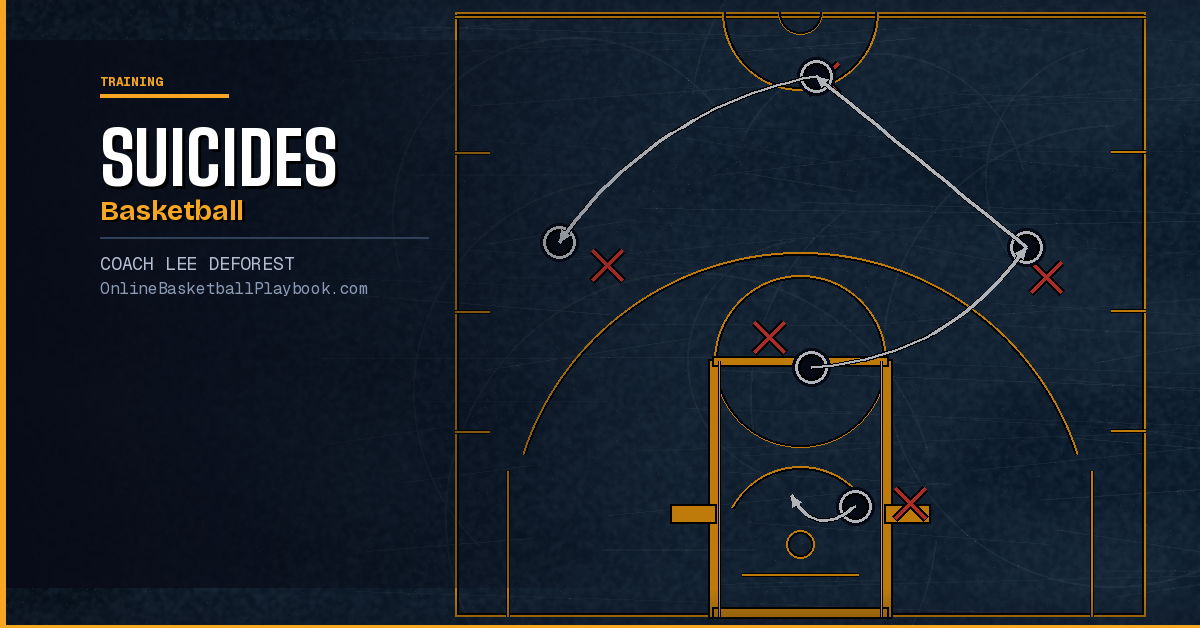
Suicides — the classic baseline-to-foul-line-to-half-court-to-far-foul-line-to-far-baseline-and-back. A full suicide takes a well-conditioned player about 28 to 32 seconds. That is the right duration for an anaerobic effort. Time every run and post the times. Players should be running at maximum effort, not pacing themselves.
17s — sprint sideline to sideline 17 times in 60 seconds. Variations include 9s (sideline-to-sideline 9 times). These are pure anaerobic runs with a clear time standard. Every player knows whether they made the cut or not.
Lane Slides — defensive slides across the lane for 15 seconds at a time. These train the specific muscular endurance needed to guard ball-handlers. The lateral push pattern is very different from straight-line running, and players who have only run straights will feel this.
Volleyball Runs — change-of-direction sprints that require planting and redirecting, mimicking the cut-and-recover pattern of defending off-ball movement.
30-Second Suicides — players mark where they reach at the 30-second mark and try to beat that mark the next time. This turns conditioning into a personal benchmark, which matters psychologically. Players compete against their own previous effort rather than each other, which keeps players of different fitness levels all genuinely working at maximum.
The 4-8-16 — a structured sprint ladder that builds volume within a single conditioning set. The changing distances force players to shift gears, which is more game-like than a fixed-distance sprint.
Each of these drills works best with a time standard, a visible scoreboard of results, and a clear expectation that every rep is an all-out effort. Remove those elements and you have a drill that looks like conditioning but produces far less adaptation.
Game-Pace Practice as the Best Cardio
The most efficient conditioning method available to any basketball coach is also the most underused: running practice at genuine game pace and keeping dead time out of it.
Coach Nate Oats at Alabama frames it directly at the start of every half-court practice day. His explicit message to players: we cannot develop the attitude that we are going to endure practice — that is a dangerous place. The directive is to attack every rep with the same energy as transition, no matter where you are in the session and no matter what is hurting.
That standard is a conditioning variable, not just a culture variable. When a half-court shooting battery or a shell drill is run at game speed, every player is conditioning. When players coast through the skill portion of practice and mentally clock out until the sprint block at the end, only the sprint block produces fitness. The rest of practice is wasted conditioning time.
On half-court days, Oats runs no dedicated sprint block. Conditioning comes from removing dead time between reps and running scored 4-on-4 segments back to back at game pace. The second half of practice is uninterrupted scrimmage. Players finish these sessions as tired as if they had run a sprint block — because they have been moving at game speed for 90 minutes.
For coaches who want to use this approach, the practical step is simple: name the energy standard before the first drill. Say it out loud — the energy we bring right now is the same as in transition. Players raised on compartmentalized practice, where the conditioning block is the only hard part, need the explicit reframe. It does not happen by implication.
Combine this with scored consequences — losers run, losers go again, the winning team earns rest — and players learn to compete through fatigue rather than manage it. That is a basketball skill as much as a conditioning outcome.
The best conditioning is the game played hard — push past exhaustion, play everything fast, and let losers run rather than tacking sprints on at the end.
— Conditioning & Fitness, Basketball Vault
Benchmarks: Testing and Tracking Fitness Gains
Conditioning that is not measured is conditioning that is assumed. Players and coaches both need to see the numbers move to know whether the program is working.
Two benchmarks give you the data you need without requiring expensive equipment.
The 300-Yard Shuttle is the gold standard for basketball anaerobic fitness testing. Players run 12 trips baseline to foul line. Run it twice with a rest period between. Average the two times. Re-test every three to four weeks. The average time drops as conditioning improves — and when it stops dropping, you know the program needs a stimulus change.
The 30-Second Suicide Mark is the accessible alternative that every team can use regardless of budget. Players sprint a standard suicide route for exactly 30 seconds and mark where they finish. The goal the next session is to get past that mark. This format turns conditioning into a personal competition with a visible, beatable number.
Tennessee's program under Pat Summitt used an identical approach — the 30-second suicide benchmark with the explicit instruction to mark your spot and beat it next session. The principle is simple: conditioning is measured, not assumed, and players see their own progress in a number they recorded themselves.
Beyond these court-based tests, coaches who have access to even basic jump testing can track countermovement jump height over the season as a fatigue and readiness indicator. A player whose jump height drops significantly compared to their baseline is carrying accumulated fatigue, and their conditioning load should be adjusted before their performance drops further.
Monthly retesting on one or both benchmarks keeps conditioning honest. Post the results. Let players see who improved and by how much. The competitive instinct will handle the rest.
Periodizing Cardio Toward the Season
The biggest mistake in basketball conditioning is running the same program in September that you run in March. Fitness needs to peak when games are being played, not when summer workouts begin.
A three-phase approach gives you a structure that builds toward the season without burning players out early.
Phase 1: Off-Season Strength Base
The UNC model makes a deliberate choice in the off-season: build strength and movement mechanics, and let pickup basketball handle aerobic fitness. No extra conditioning runs. The rationale is that players' legs need recovery time after a long season, and hammering them with sprint work in June extends fatigue rather than building on a recovered base. The strength work — three sessions per week with an emphasis on proper mechanics — sets up the platform that conditioning work will sit on.
Phase 2: Pre-Season Ramp
Six weeks before the season begins, the conditioning work starts in earnest. Court conditioning twice per week, weight room twice per week, basketball four to five times per week. Volume and intensity increase gradually, with the work-to-rest ratio compressing from 1:3 toward 1:2 as players adapt. The UNC Conditioning Test — 12 repetitions of 6 court crossings in 33 to 35 seconds — serves as the target for the ramp period. Players train toward that standard over the six weeks.
Phase 3: In-Season Maintenance
Once the season starts, the goal shifts from building fitness to maintaining it. Teams that stop lifting and conditioning in-season are physically at their weakest when they need to be at their strongest. Two weight room sessions per week, kept intense but short, preserve the strength base. Game-pace practice handles the anaerobic maintenance. The conditioning test benchmark becomes a monitoring tool — if scores drop significantly, the team is under-recovered and the load needs adjustment.
Within the season, theme your conditioning weeks. A physical toughness emphasis once per week — a harder sprint block, a more competitive conditioning game — keeps the fitness edge sharp without overloading players during a long schedule.
Conditioning should always have a winner and a number — use team relays, beat-your-time challenges, or scored consequence games like Gut Check (12-minute clock, one point per stop, losers sprint after each score). Players who compete through conditioning drills build the habit of competing through fatigue in games, which is where fourth-quarter fitness actually shows up.
- Work-to-rest ratio: Start preseason at 1:3 (e.g., 30 seconds of work, 90 seconds rest) and compress toward 1:2 as the season approaches — never skip the rest, because rest is what makes the next sprint genuinely maximal.
- Drill standard: Post time standards for every conditioning drill and hold every player to them — if a player makes the standard, they rest; if they miss it, they run again until they hit it.
- Monthly testing: Re-run your chosen benchmark (30-second suicide mark or 300-yard shuttle) every three to four weeks, post the results publicly, and use drops in performance as an early warning for player fatigue or illness.
- Game-pace practice: Name the energy standard before the first drill of every practice — say it aloud — and use scored segments with consequences so players compete through fatigue rather than coast through the skill portions and save themselves for the sprint block.
- Condition with the ball: Pair conditioning movements with basketball skills whenever possible — sprint to a catch and finish, slide to closeout, shoot under fatigue — so fitness transfers to the specific patterns that appear in games.
Want more basketball coaching strategies and drills?
Keep Building
Related breakdowns
Developing a Strong Basketball Conditioning Program
Developing a Strong Basketball Conditioning Program