
Basketball is an anaerobic sport. Your conditioning program needs to match that reality — short, all-out efforts, measured rest, tested benchmarks, and competition built into every sprint.
Why Basketball Conditioning Is Anaerobic
The single biggest mistake coaches make with conditioning is training the wrong energy system. Long, slow distance runs might look like hard work, but they develop aerobic endurance — and basketball barely uses it. The game runs on repeated explosive bursts: a sprint in transition, a hard closeout, a contested rebound, a full-court press trap. Each of those efforts lasts fewer than 60 seconds. Then there's a brief pause — a free throw, a dead ball, a substitution — and the cycle repeats.
That is the anaerobic system. And if you want your players to hold technique, stay aggressive, and compete hard in the fourth quarter, you have to train that system specifically. The goal is a higher lactate threshold — the point at which fatigue starts to degrade movement quality. The higher that threshold, the longer your players can sustain intensity before technique breaks down.
This means your conditioning runs should be all-out efforts of 60 seconds or less. They should feel hard. Players should need real rest before going again. That rest is not a reward for being weak — it is what makes the next rep as useful as the first.
Building the Right Work-to-Rest Foundation
The work-to-rest ratio is the core variable of any anaerobic conditioning program. For basketball, the target range is 1:2 to 1:3 — meaning if a sprint takes 28 seconds, the rest before the next effort should be 56 to 84 seconds. Early in the pre-season, when fitness levels are lower, lean toward 1:3. As the season approaches and fitness improves, compress the rest toward 1:2.
This ratio is not arbitrary. It maps to the physiology of the anaerobic energy system. Creatine phosphate — the primary fuel for explosive efforts — takes roughly 60 to 90 seconds to partially replenish. Cut that rest short and you are training a fatigued nervous system, not a conditioned one. Your players will slow down, get sloppy, and learn to survive rather than compete.
Coaches who skip the rest intervals are not making their program tougher. They are making it less effective. The challenge of anaerobic conditioning is not the distance — it is the quality of each effort. Every rep should be an all-out attempt. That requires adequate recovery between reps.
A practical structure for a conditioning session: six to eight runs, each lasting 20 to 32 seconds, with full work-to-rest intervals between. Keep a visible clock so players know the rest is timed and non-negotiable. The discipline of the rest interval teaches athletes to pace intelligently within a rep and recover efficiently between them — both critical in-game skills.
On-Court Conditioning Drills That Actually Work
The best conditioning drills happen on the basketball court, in basketball movements. Not on a track. Not on a treadmill. Every conditioning run should reinforce the same footwork, change of direction, and spatial awareness that the game demands.
Here are the most effective on-court conditioning formats:
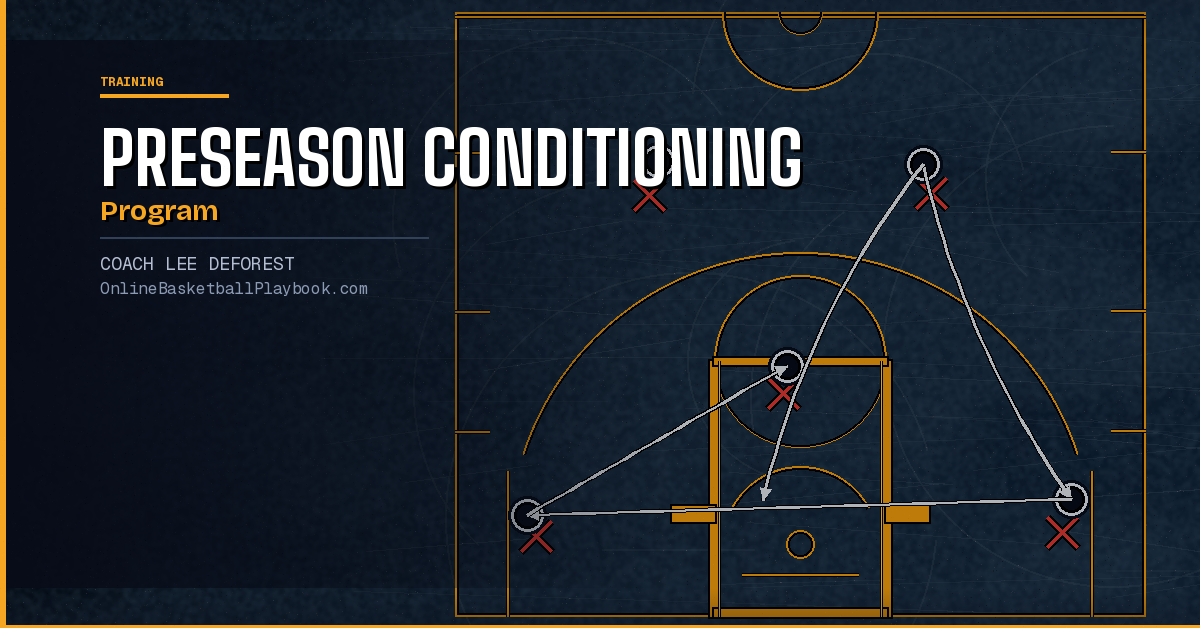
Suicides take roughly 28 to 32 seconds at full effort — right in the target window for anaerobic work. Run from baseline to the near foul line, back, to half court, back, to the far foul line, back, full court and back. Mark a time standard and hold players to it.
17s and 9s use the sideline width. Players sprint sideline to sideline — 17 times in 60 seconds for 17s, 9 times in 30 seconds for 9s. These are ideal for testing because the format is simple, repeatable, and competitive.
Lane Slides build defensive-slide conditioning specifically. Set a 15-second clock and slide baseline to baseline in the lane. This is conditioning that looks exactly like a zone defense press or a late-game stop situation.
30-Second Suicides are the most useful benchmark in youth basketball. The player runs for exactly 30 seconds, marks where they stopped, and tries to beat that mark the next time. The number improves over the season. Players can see it. That visibility matters — it connects effort today to a result they can point to.
The 4-8-16 is a ladder format: sprint four baselines, rest, sprint eight, rest, sprint sixteen. The rest intervals scale with the effort. This teaches players to manage intensity across a longer block of work — useful for building stamina without abandoning the anaerobic training model.
Volleyball Runs and cross-court patterns emphasize change of direction, not just straight-line speed. Use these when your team needs to build conditioning in the lateral and diagonal planes.
The underlying principle across all of these: every drill is on the floor, in basketball movements, with a number attached. Conditioning without a number to beat is just exercise. Conditioning with a benchmark is training.
Testing and Benchmarking Fitness Progress
A conditioning program without testing is a conditioning program without accountability. Players need to see the data. Coaches need to verify the work is producing results. Testing closes that loop.
Two benchmarks are the foundation of a practical basketball conditioning program. The first is the 30-Second Suicide mark. Run it at the start of the pre-season, record every player's mark, and re-run it monthly. The improvement is visible, personal, and motivating. A player who went from the far foul line to half a step past it three months ago and now reaches the opposite free-throw line knows their conditioning improved. That is more powerful than any coach speech about working hard.
The second benchmark is the 300-Yard Shuttle for older, more developed athletes. Twelve trips from baseline to the near foul line, two runs averaged together. This test mirrors the intermittent sprint demands of a full game. Set standards by position and age group, publish them at the start of the program, and re-test every four to six weeks.
The UNC Tar Heels use a court-specific benchmark called the UNC Conditioning Test: 12 repetitions of six court crossings, completed in 33 to 35 seconds, run in groups of players. The spirit of the test is the same as the 300-Yard Shuttle — a repeatable, timed challenge that the entire pre-season ramp points toward.
Whatever benchmarks you choose, commit to re-testing them consistently. Fitness does not improve in a straight line. Some players plateau, some surge late, some regress under in-season fatigue. The data tells you who needs more work and who is ready to compete. Testing is how you coach conditioning — not just how you measure it.
Conditioning Through Game-Pace Practice
There is a tension in basketball conditioning that every coach eventually faces: dedicated sprint blocks at the end of practice versus conditioning built into game-pace play. The answer is both — but the ratio matters, and the sequence matters.
Nate Oats frames it directly at Alabama: the best conditioning is the game played hard. When practice runs at full game pace — no dead time, transition after every make and miss, scored 4v4 and 5v5 segments back-to-back — the conditioning effect is real. Players' heart rates stay elevated. The change-of-direction demands are specific to what they will face in games. The mental fatigue of decision-making under physical stress is built in.
The critical point Oats makes is about attitude. He opens every half-court practice segment with an explicit standard: "The energy we bring right now is the same as in transition." Players raised on compartmentalized practice — sprint block equals conditioning, skill block equals rest — need that reframe said out loud. If the tempo drops in a shooting drill or a shell defensive rep, the conditioning benefit collapses alongside the skill acquisition.
For youth teams, this integration is especially valuable. Scored small-sided games — where every possession counts, losers go again, and the competitive stakes keep intensity up — generate real cardiovascular work without the monotony of end-of-practice sprints. Add a short dedicated benchmark run (the 30-second suicide mark) to chart progress, but let game-pace play carry most of the conditioning load during the competitive season.
The standard is not to endure practice. Enduring is the failure mode. The goal is to attack every rep, every drill, every transition with the same energy as a fast-break possession. When the energy standard becomes part of practice culture, conditioning stops being something that happens at the end of practice and starts being the texture of every minute inside it.
Periodizing Your Program Across the Season
Conditioning is not something you build once in August and then maintain. It requires a structured plan — what sports scientists call a macrocycle — that sequences the right type of work at the right time across the full year.
The UNC Tar Heels model separates the year into two distinct phases. In the off-season, the focus is almost entirely on strength development: three lifting sessions per week, movement mechanics, functional movement patterns. They deliberately avoid conditioning runs in the off-season. The logic is sound — players' legs need an opportunity to recover from the previous season's cumulative load, and pick-up basketball handles whatever aerobic maintenance is needed. Running players through conditioning all summer does not produce fitter athletes; it produces tired ones.
The pre-season is a six-week ramp. Court conditioning twice per week, weight room twice per week, basketball four to five times per week. Volume increases gradually toward the conditioning test, which becomes the target that organizes the entire ramp. Coaches can see exactly which week each player should hit a given benchmark based on the ramp's structure.
During the competitive season, in-season lifting — once or twice per week — is what separates programs that hold their physical edge through March from programs that fade. Teams are physically at their weakest when they need to be at their strongest. The solution is maintaining the strength base with regular but brief lifting sessions throughout the season, not abandoning it after the first game.
The broader S&C framework follows this order of operations: needs analysis first, then screening and performance diagnostics, then strength and power development, then plyometrics and speed-agility work, then endurance and flexibility, all organized within a periodization structure. Each phase builds on the last. Jumping to plyometrics before building a strength base is how you get injured athletes, not fit ones.
Competitive Conditioning Games
The most effective conditioning drills are not drills at all — they are competitions. When conditioning has a winner and a number attached, players compete through fatigue instead of managing it. That distinction produces a different kind of fitness: the kind that shows up in the fourth quarter.
Gut Check, developed at Illinois, uses three teams of three to four players on a 12-minute clock. One point per defensive stop, 20-second possession limit. After a score, the scoring team sprints to the far foul line and back before they can play defense. The sprint is a penalty inside a real competition — not a post-practice add-on. The conditioning effect comes from competing hard to avoid the sprint, then executing the sprint when you earn it.
Full Court Cut Throat requires the defense to earn three consecutive stops. The losing team on every possession sprints outside the court to the far end. Maximum effort on every possession because any loss costs a full-court sprint. There is no coasting. There is no waiting for your turn to run. The sprint is the consequence of losing the moment.
WAR Drill — named for the toughness it demands — is a daily rebounding competition. Five defenders inside the lane, offense on the baseline. Coach intentionally misses a shot. Offense attacks the glass. Defenders must cut out each offensive player, knock them back on their heels, then find the ball. This is not the standard "box out and track" technique — it is an aggressive, contact-heavy drill that builds rebounding toughness and anaerobic conditioning simultaneously. The drill earns its reputation from two things: players take pride in it, and coaches run it every single day.
The principle connecting all three drills is that conditioning must be inseparable from competition. When the sprint is the consequence of losing, players bring the same intensity to the conditioning work that they bring to game situations. That transfer is the whole point.
Basketball is anaerobic — insist on all-out efforts of 60 seconds or less with a work-to-rest ratio of 1:2 to 1:3, targeting a higher lactate threshold that delays the fatigue which breaks technique under pressure.
— Conditioning & Fitness, Basketball Vault
Never use running as punishment. When conditioning is attached to failure, players learn to resent the work. Every conditioning rep — every sprint, every benchmark run, every competitive drill — should have a number to beat or a team consequence at stake. Make conditioning feel like competing, not suffering, and players will bring real intensity to every rep instead of just surviving until it's over.
- Start with the 30-Second Suicide mark: record every player's distance on day one of pre-season and re-test monthly — the improvement is visible, personal, and more motivating than any coach speech about effort.
- Protect the work-to-rest ratio: 1:2 to 1:3 is non-negotiable early in the program; cutting rest short does not make conditioning harder, it makes each rep less effective and teaches athletes to pace instead of sprint.
- Run WAR Drill every day: low setup cost (one coach, one ball, one missed shot), high toughness payoff — daily repetition builds the glass-crashing aggression and anaerobic capacity that decide close games.
- Condition the bench during rotation segments: use game-like ball-in-every-drill circuits for non-rotation players during live 5v5 segments so every player gets a hard basketball-specific workout, not dead standing time.
- Lift in-season once or twice per week: teams lose their physical edge when they abandon the weight room after the first game — hold the same effort standard on the weight-room floor as on the basketball court.
Want more basketball coaching strategies and drills?
See it drawn up
Related diagrams
Keep Building
Related breakdowns
Developing a Long-Term Vision for Your Basketball Program
Developing a Long-Term Vision for Your Basketball Program
Developing the New Players in Your Basketball Program
Developing the New Players in Your Basketball Program