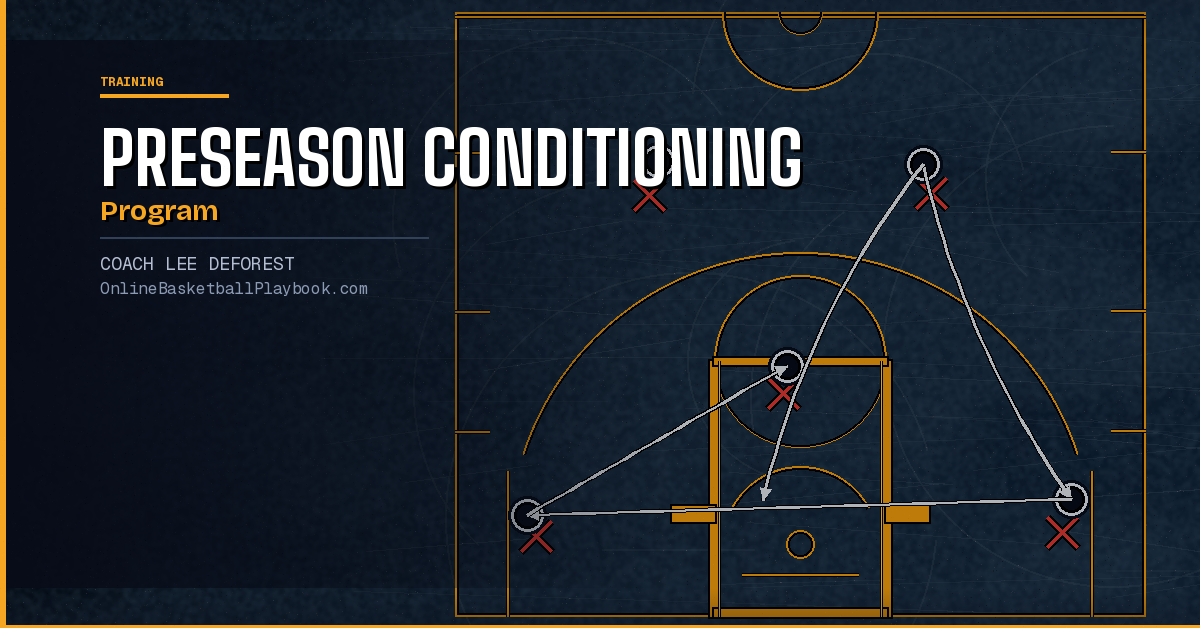

Preseason conditioning separates teams that fade in the fourth quarter from teams that dominate it. This guide gives you a structured, basketball-specific program to build the anaerobic engine your players need before the first practice tip-off.
Why Basketball Conditioning Is Anaerobic
Most coaches understand that basketball players need to be in shape, but far fewer think carefully about what kind of shape. Long, slow distance running — the default for many preseason programs — trains the aerobic system. Basketball almost never uses the aerobic system as a primary energy source.
A typical basketball possession lasts 10 to 24 seconds of explosive effort: a sprint in transition, a closeout, a post battle, a cut. Then there's a stoppage, a walk to the other end, a time-out, a foul shot. The real demand is repeated short bursts with incomplete rest. That is anaerobic conditioning by definition.
The goal of a preseason program isn't simply to make players tired — it's to raise their lactate threshold, which is the point at which fatigue and muscular tightness begin to degrade technique. A player with a low lactate threshold gets sloppy on defense in the third quarter. A player with a high lactate threshold maintains his footwork, his stance, and his decision-making late in games. When you understand that framing, your entire conditioning philosophy shifts from "run them" to "train the right energy system deliberately."
This matters especially for your basketball conditioning drills — the movements you choose should mirror what happens in a game. Straight-line jogging does not prepare a player for the lateral demands of help defense. Basketball footwork drills done at game speed, however, train both the skill and the energy system simultaneously.
The Core Conditioning Runs
A well-designed preseason program draws from a library of on-court conditioning runs, all done in basketball movements and timed for accountability. Here are the foundational ones every program should include:
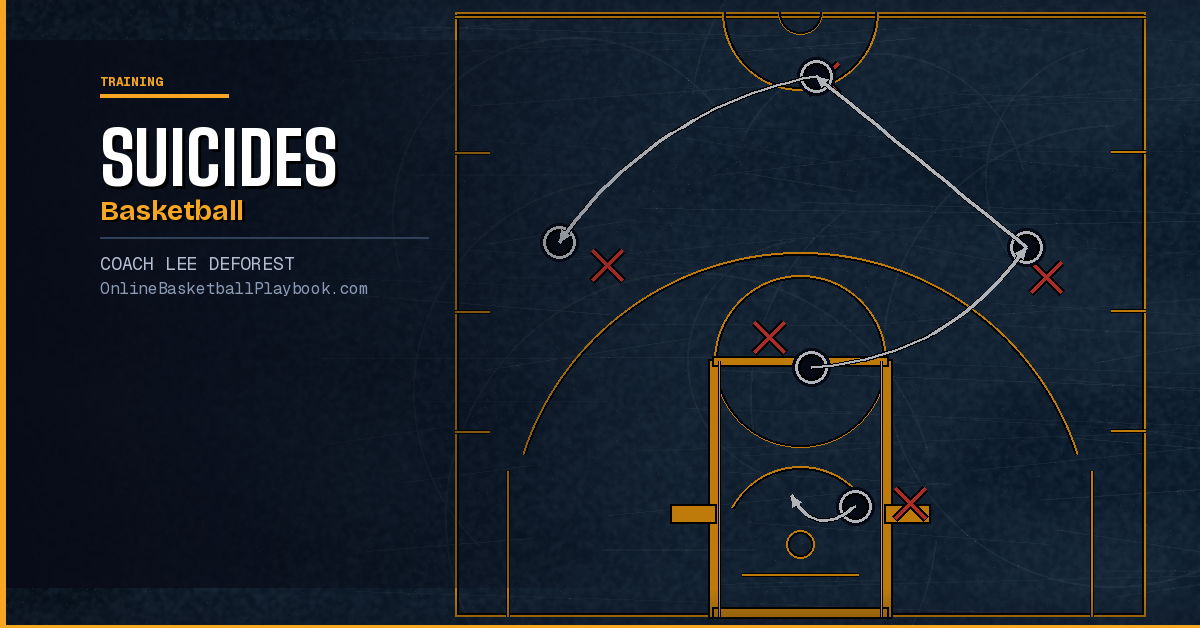
Suicides
The classic. A good full-court suicide should take a fit player roughly 28–32 seconds. Run from the baseline, touch the near foul line, return, touch half-court, return, touch the far foul line, return, touch the far baseline, return. That's the full trip. Time every run and post the results so players compete against their own marks.
17s and 9s
17s are sideline-to-sideline sprints: cross the full width of the court 17 times in under 60 seconds. 9s use the same format but cut it to 9 reps in 30 seconds. Both are outstanding for lateral conditioning when players run through the line rather than stopping short. Use these early in preseason when players are still building base fitness.
Lane Slides
Defensive slides from one lane line to the other for 15 continuous seconds. The key is maintaining a low, proper defensive stance throughout — if a player stands up, the rep doesn't count. This run doubles as skill reinforcement: you're conditioning and drilling stance simultaneously.
30-Second Suicides
Run a suicide and mark your spot on the floor. Every time you run it, your goal is to beat that mark. This is the most competitive format in the library because players have a personal benchmark to chase. Use it as a weekly anchor run — it motivates honest effort and gives you measurable progress data.
The 4-8-16
Sprint four lengths of the court, rest briefly, sprint eight lengths, rest, then sprint sixteen consecutive lengths. The volume climbs as the rest periods compress. Use this run in weeks four through eight of the preseason when players have base fitness and need to push lactate threshold harder.
Volleyball Runs
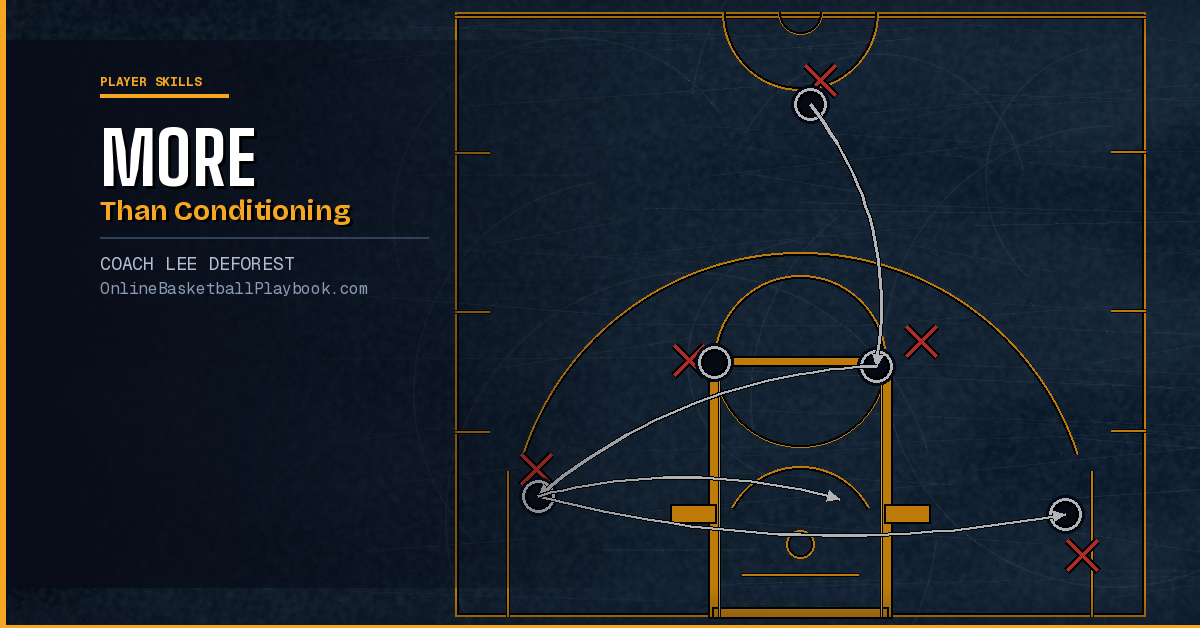
Change-of-direction sprints that mimic the chaotic start-stop patterns of live basketball. Players sprint a short distance, plant, change direction, sprint again — simulating what happens on every possession. These are particularly valuable because straight-line speed is only part of basketball athleticism; the plant-and-go is where players get hurt if they're not conditioned for it.
"Basketball is anaerobic — train it that way."
— Basketball Vault
Testing and Benchmarking Fitness
Conditioning is measured, not assumed. If you aren't testing fitness with repeatable benchmarks, you don't actually know whether your program is working — you're just hoping your players are getting in shape.
Two tests anchor a serious preseason program:
The 300-Yard Shuttle
Set up cones at the baseline and the foul line (a distance of roughly 25 yards). Players run 12 trips — down and back six times — as fast as possible. Time each run and average two attempts with a three-to-five minute rest between them. The 300-yard shuttle is one of the best anaerobic capacity tests in sports because it mirrors the repeated-burst nature of basketball and it's simple to administer with a stopwatch.
Run the shuttle at the start of preseason, at the four-week mark, and again at the end of preseason. If your program is working, times will drop. Share those numbers with players — athletes respond to measurable progress.
The 30-Second Suicide Mark
Track each player's 30-second suicide distance over the course of preseason. Where do they reach at the 30-second mark? Baseline to first foul line? Half-court? The far foul line? Chart it. A player who reaches the same spot week after week isn't improving — and that's a conversation worth having.
Periodizing the 12-Week Plan
A preseason conditioning program should not look the same in week one as it does in week twelve. The work-to-rest ratio, the volume, and the intensity all need to shift as players build fitness. This is called periodization, and it's the difference between a program that peaks players at the right time versus one that burns them out or leaves them underprepared.
Weeks 1–4: Building the Base (1:3 Work-to-Rest)
Early preseason, start with a 1:3 work-to-rest ratio. If a run takes 30 seconds, rest 90 seconds before the next effort. This longer rest lets players recover fully, which means they can give maximum effort on each run. Running hard on short rest before players have base fitness doesn't build conditioning — it just accumulates fatigue.
During this phase, use the 17s, lane slides, and basic suicides. Keep total conditioning volume moderate. The goal is teaching the movements, establishing benchmark times, and beginning to stress the lactate system without breaking players down.
Weeks 5–8: Building Capacity (1:2 Work-to-Rest)
Compress the rest to a 1:2 ratio and increase the volume of runs. Introduce the 4-8-16 and volleyball runs during this phase. Players should be noticeably more fit than week one — their 300-yard shuttle times will confirm it. Push the intensity here; this is the hardest stretch of the preseason program.
This is also when you should begin incorporating basketball practice plan sessions that run at game pace. Conditioning done inside drills and scrimmages during this phase reinforces fitness gains made in the dedicated conditioning runs.
Weeks 9–12: Sharpening for the Season (1:2, Maintained Volume)
Hold the 1:2 ratio but begin to taper total volume in the final two weeks so players arrive at opening day fresh rather than beaten up. Use the 30-second suicide mark runs in this phase — they're competitive, motivating, and they give players a final fitness benchmark to chase heading into the season.
Also schedule one "Physical Toughness" day per week in the final month. Use that session to push players past their comfort zone deliberately: run them when they're tired, have them compete under fatigue, make the conditioning purposefully uncomfortable. The goal is to simulate fourth-quarter conditions before the fourth quarter ever arrives in a real game.
Designate one practice day per week as a Physical Toughness day throughout preseason. This themed structure prevents conditioning from being an afterthought added at the end of practice when players are already fatigued and coaches are rushing to finish.
Building Conditioning Into Practice
Dedicated conditioning runs are necessary, but they're not sufficient. The best preseason programs also build fitness into the flow of practice itself — through pace, competition, and consequence.
Coach Bill Oats put it plainly: pace is a product of how you practice. If you allow players to walk between drills, jog when they should sprint, and take soft reps during live segments, you are actively training them to be slow. Practice at game speed is conditioning. Practice at half-speed is not.
Several structural choices in practice design drive this:
Losers run. In competitive segments — 4v4, 5v5 scrimmages, competitive drills — the losing team runs. This stakes every rep. Players compete harder under fatigue, which is exactly what they need to do in the second half of real games.
Push past exhaustion in practice. When players are gassed at the end of a competitive segment, don't stop and give a long water break. Run one more set. Ask for one more effort. The physiological adaptation happens at the edge of exhaustion, not before it. Players learn they have more left than they thought — a critical mental lesson for late-game situations.
Scored live segments are conditioning. A game-pace 5v5 segment with full defensive rotations, transition, and press breaks is one of the most demanding conditioning activities you can run. The movement patterns are basketball-specific, the effort is maximal, and the mental engagement is complete. Pair live scrimmages with your dedicated conditioning runs rather than treating them as separate categories of practice.
For teams learning a pressing defense, the conditioning demand is particularly high. Running a full court press defense correctly requires sustained effort at both ends — guards trapping, bigs rotating, everyone sprinting back on a break. That kind of defensive scheme will condition your team if it's drilled at game pace consistently.
Athletic Base and Injury Prevention
Most youth basketball breakdowns are athletic, not tactical. A player who rolls an ankle on a hard cut doesn't have a basketball problem — he has an athletic base problem. Preseason is the right time to address it.
Three areas deserve dedicated attention in every preseason program:
Ankle Strength and Balance
Single-leg balance work — standing on one foot with eyes closed, progressing to single-leg squats and single-leg jumps — builds the stabilizing musculature around the ankle and knee. Five minutes of this work at the start of each preseason practice pays enormous dividends over a season. Ankle sprains are the most common injury in basketball, and many of them are preventable with consistent balance training.
Fast Feet and Quickness
Tennis-ball reaction drills and fast feet around a cone develop the neurological patterns that make players quick, not just fast. There's a difference: raw speed is how fast you run in a straight line; quickness is how fast you start, stop, and change direction. Basketball rewards quickness. Ladder sprints and short change-of-direction agility work belong in preseason even when they don't look like "conditioning."
Functional Movement
Hip mobility, proper squat mechanics, and lateral lunge patterns build the movement foundation that keeps players healthy over a long season. A player who can't get into a proper defensive stance because his hips are tight isn't a defensive problem — he's a movement problem. Address it in preseason before the season reveals it in competition.
Coaches building complete basketball player development programs integrate this athletic base work alongside skills and conditioning from the first day of preseason. It signals to players that the coaching staff cares about their bodies, not just their basketball output.
- Work-to-rest ratios: Start at 1:3 early preseason, compress to 1:2 as fitness builds — don't skip the rest in week one.
- Benchmark every four weeks: Run the 300-yard shuttle and 30-second suicide at the start, midpoint, and end of preseason; chart and share the results.
- All-out efforts under 60 seconds: Basketball is anaerobic — every conditioning run should be a sprint, not a jog; if a player can hold a conversation, the pace isn't right.
- Losers run in every competitive segment: Stakes every live rep and teaches players to compete and execute technique under fatigue.
- Include one Physical Toughness day per week: Theme it, push past exhaustion, and make it deliberate — the mental adaptation is as important as the physical one.
- Train ankle balance daily: Five minutes of single-leg work at the start of practice prevents the most common injury in basketball and pays off across the full season.
Get free play diagrams, drills, and coaching guides delivered weekly.
Keep Building
Related breakdowns
Developing a Strong Basketball Conditioning Program
Developing a Strong Basketball Conditioning Program