Suicides are the most widely used sprint drill in basketball and one of the most misunderstood. Run them right, with proper rest and a number to beat, and they build real anaerobic fitness fast.
What Suicides Are and Why They Work
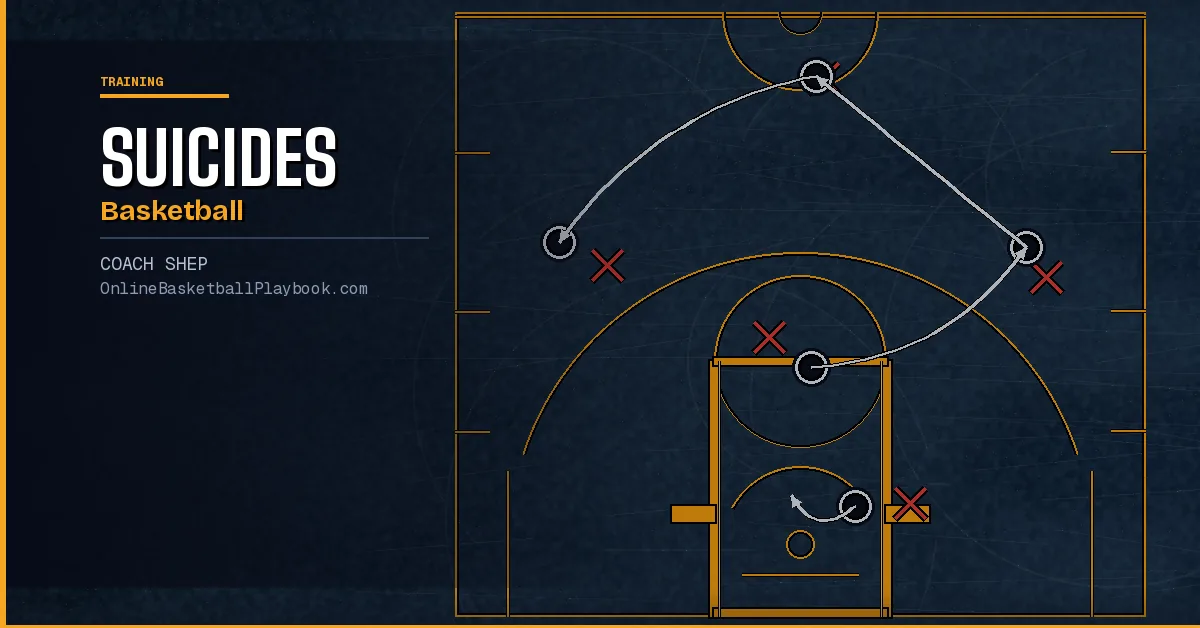
A suicide (sometimes called a "line drill" or "sprint drill") is a baseline-to-line-and-back sprint that accumulates distance in short bursts of acceleration and deceleration. The standard basketball version starts on the baseline, sprints to the near foul line and back, then to half-court and back, then to the far foul line and back, and finally to the far baseline and back. The total distance is roughly 280 to 320 feet depending on court dimensions, completed in approximately 28 to 32 seconds by a conditioned player.
That timing is not an accident. Basketball is an anaerobic sport. The critical plays (a breakout run after a turnover, a closeout sequence, a full-court press rotation) happen in all-out bursts of 10 to 20 seconds, with incomplete rest before the next one. Suicides train exactly that energy system. They are short enough to demand genuine sprint effort, long enough to stress the lactate threshold, and repeated often enough to push the body to buffer lactic acid more efficiently over time.
The goal is not to survive the drill. The goal is to raise the ceiling, to delay the fatigue and muscle tightness that causes technique to break down late in games. When a guard's first step slows in the fourth quarter or a big man stops moving on cuts, it is rarely a skill failure. It is an anaerobic fitness failure. Suicides address that failure directly.
How to Run Suicides Correctly
Most coaches run suicides the wrong way, not wrong in structure but wrong in execution standard. The drill only works if every rep is an all-out sprint. A player jogging through a suicide is not doing conditioning. They are practicing jogging.
Set the standard before the first rep: every line is a full-stop touch, every sprint is maximum effort, and no player finishes behind their teammates without a consequence. Compete from rep one.
The Standard Execution
Start on the baseline, feet behind the line. On the whistle:
- Sprint to the near foul line (touch with the hand, not a foot drag) and sprint back to the baseline.
- Sprint to half-court. Touch. Sprint back.
- Sprint to the far foul line. Touch. Sprint back.
- Sprint to the far baseline. Touch. Sprint back to the start.
Time every rep. Post the times where players can see them. A well-conditioned high school player should complete a full suicide in 28 to 32 seconds. Use the 30-second mark as a baseline benchmark. Record it at the start of pre-season and re-test monthly. Players who see their time drop by two seconds in six weeks understand what conditioning actually means.
Calling the Touches
The most common form error is not touching the line. Assign a coach or manager to each group to call missed touches. A missed touch means the rep does not count. Restart. This is not punitive; it is the standard. A line drill where players skip touches teaches players that cutting corners under fatigue is acceptable. That is the wrong lesson.
Work-to-Rest Ratios: The Variable Coaches Miss
The single biggest mistake coaches make with suicides is not the drill itself. It is ignoring rest. Most programs run players through suicides back to back, giving 10 to 15 seconds between reps. At that rest interval, the second sprint is not a sprint. It is a shuffle. And the third is barely a controlled jog.
Basketball conditioning research points to a clear guideline: anaerobic training requires a work-to-rest ratio of 1:2 to 1:3, especially early in the conditioning cycle. For a 30-second suicide, that means 60 to 90 seconds of rest before the next rep. This feels uncomfortable to coaches who equate less rest with harder conditioning. The opposite is true. Less rest produces slower reps, which trains a slower athlete. More rest produces true sprint effort on every rep, which builds a faster, more resilient one.
Early in pre-season, err toward 1:3 (90 seconds of rest per 30-second sprint). As the team gets fitter across four to six weeks, compress toward 1:2. By mid-season, the same players who needed 90 seconds of recovery will be ready to go again in 60. That progression is the adaptation. It is measurable and it is real.
Variations That Keep It Fresh and Specific
The standard suicide is the foundation, but it is not the only tool. Once players know the base pattern, introduce variations that hit different movement demands and prevent the mental staleness that comes from running the same drill every session.
Cross-Court Suicides
Instead of running the full court length, run sideline to sideline across the court width. The shorter distance means faster reps (typically 8 to 12 seconds) with higher change-of-direction frequency. This variation emphasizes lateral acceleration and deceleration, which maps directly to defensive positioning and help-side rotations.
30-Second Suicides (Mark Your Spot)
Run a suicide at full effort for exactly 30 seconds, then mark where you stop. At the next session, beat that mark. This variant turns conditioning into a personal competition with a measurable goal, which is far more motivating than a time standard imposed from outside. Coaches at Tennessee's women's program used this drill as a regular benchmark, and it shows up consistently across high-level conditioning programs for exactly this reason: a player competing against their own previous effort never needs to be told to try hard.
Volleyball Runs
A variant that adds reactive change of direction. The coach or a player calls the cut point, and the sprinting player must adjust mid-run. This builds the decision-making-under-fatigue quality that a straight-line suicide cannot address. Use it in the middle of a conditioning block, not at the start, so players are already warmed and slightly fatigued when the cognitive load hits.
Team Relay Format
Split the team into groups of three or four and run suicides as relays. The losing team goes again, or the winning team earns a rest round. The relay structure naturally enforces full sprint effort because a player jogging costs their teammates a win. Social accountability is one of the most reliable effort levers in team conditioning.
Testing and Tracking Progress
Conditioning without measurement is guesswork. Two benchmarks cover the core anaerobic fitness picture for most programs:
The 30-Second Suicide Mark
Run a full suicide at max effort. Time it. Record the distance reached if the player does not finish in 30 seconds, or record the time if they do. Re-test every three to four weeks throughout the pre-season and early regular season. A player who goes from reaching the far foul line to completing the full sprint in 30 seconds has made a measurable, meaningful anaerobic improvement. Post results in the locker room or the team chat. Make the progress visible.
The 300-Yard Shuttle
A higher-volume benchmark used at the collegiate and advanced high school level: 12 trips from the baseline to the near foul line and back. Run two attempts, take the average. The 300-yard shuttle is more demanding than a single suicide and should not be introduced until players have a conditioning base. For younger or less-conditioned players, the 30-second suicide mark is the appropriate starting point.
Charting the Data
Log every benchmark on a shared sheet, not just the team average, but every individual time or mark. Players care about their own number. A team-average improvement means nothing to the kid who went backward. When conditioning data is individual and visible, accountability shifts from the coach to the player. That is where you want it.
Run your first suicide benchmark in the first week of pre-season before players have had any structured conditioning. The initial numbers will be ugly, and that is the point. Those numbers become the baseline that everything else is measured against, and the improvement over six weeks is what makes the conditioning meaningful to the kids doing it.
When to Use Suicides and When Not To
Suicides are a dedicated conditioning tool. They belong in a specific part of the practice schedule and the season calendar, not everywhere, and not as a reflex.
Use Suicides For
Pre-season conditioning blocks where building the anaerobic base is the explicit goal. Early in the week when legs are fresh enough to actually sprint. At the end of a skill segment when you want to add a short tested run, the 30-second benchmark version works well here. Any time you have five minutes, a baseline, and a whistle.
Do Not Use Suicides As Punishment
Running as punishment teaches players to associate hard physical effort with negative consequences. Over a season, that association corrodes effort in conditioning and undermines the culture you are trying to build. If a player or team needs a consequence for a mistake, find one that is not conditioning. Reserve running for fitness so that when you do run, everyone knows it counts.
Do Not Replace Game-Pace Conditioning
Suicides build the anaerobic base. They do not replace game-like conditioning. The best conditioning tool available is a scored 4v4 or 5v5 segment run at genuine game pace with a consequence for the losing team, played hard, back to back, with no standing around. Suicides and game-pace conditioning work together: suicides build the engine, game-pace practice teaches it to perform under tactical pressure. Use both.
Sequence by Season Phase
Early pre-season: higher volume of suicides with longer rest, building the base. Mid pre-season: compress rest intervals, add variations. In-season: drop to one or two tested suicide reps per week, use game-pace conditioning as the primary tool. The goal at mid-season is maintenance, not construction. Players need their legs for games, not for sprint volume.
- Time every rep. A suicide without a clock is just running. A timed suicide is a measurable training stimulus that players can compete against.
- Rest 60–90 seconds between reps. Early pre-season, err toward 90 seconds; compress to 60 seconds as fitness builds over four to six weeks.
- Enforce the line touch. A missed touch means the rep does not count. Hold the standard from rep one so players do not learn to cut corners under fatigue.
- Benchmark monthly. Record the 30-second suicide mark at the start of pre-season and re-test every three to four weeks so players see real anaerobic improvement in a number they own.
- Make it competitive. Relay format, beat-your-mark, or losers-go-again. Conditioning with a winner produces more effort than conditioning with only a coach watching.
Want more basketball coaching strategies and drills?
Join the Online Basketball Playbook newsletter →
Draw this play free in the play drawer →
Membership: the full library, playbook packs, and Pro drawing tools →
Keep Building
Related breakdowns
Fun Basketball Games for Practice: Scored Games for Any Team
Fun basketball games for practice at any level: shooting games, defense-only scoring, rebounding contests and passing games, with scoring rules and records.
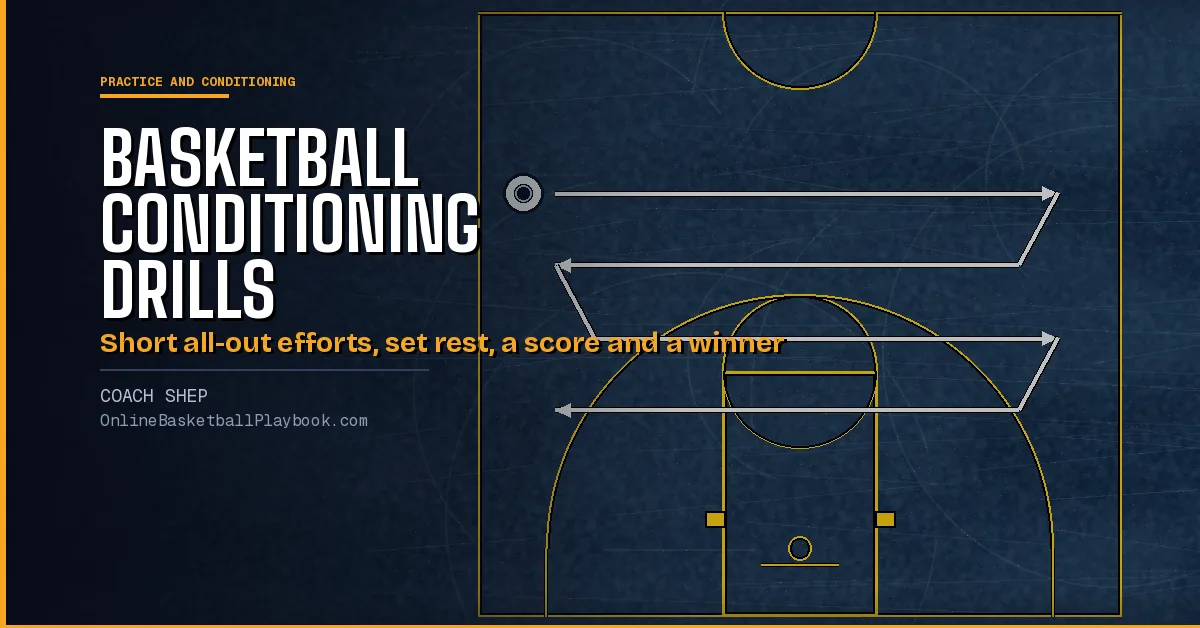
Basketball Conditioning Drills for Teams: Runs, Games and Tests
Basketball conditioning drills in three styles, timed runs, conditioning inside skill drills and scored games, with the tests and yearly plans coaches use.
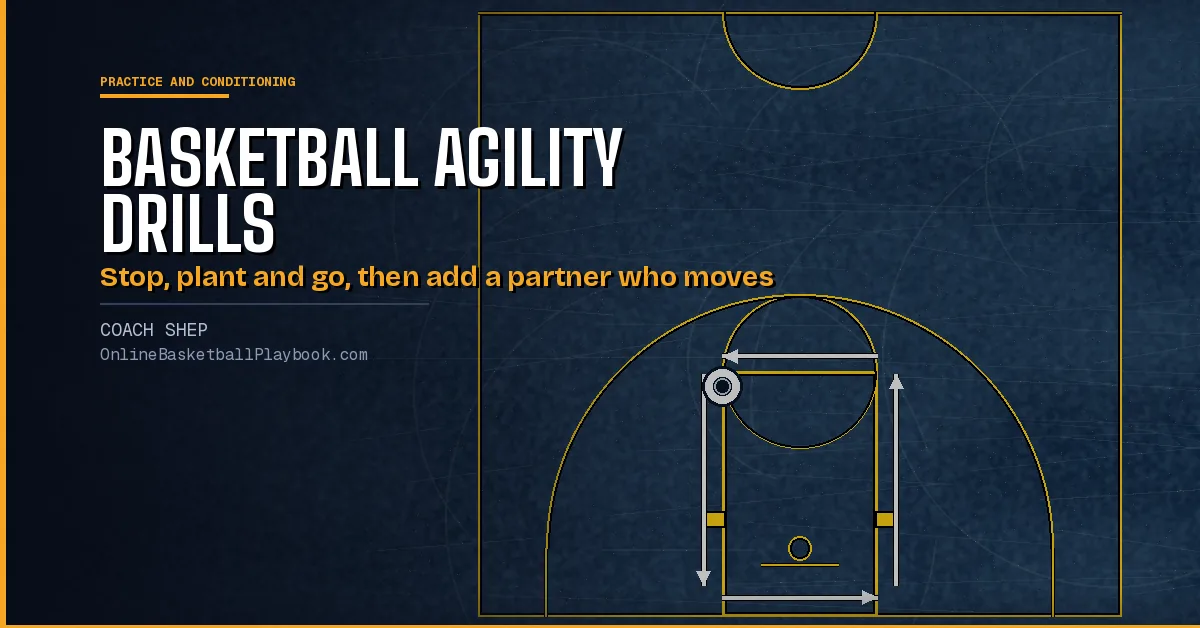
Basketball Agility Drills: Cone, Reaction and Ladder Drills
Basketball agility drills from timed cone tests to reaction, mirror and ladder drills and defensive circuits, with schedules and where coaches differ.