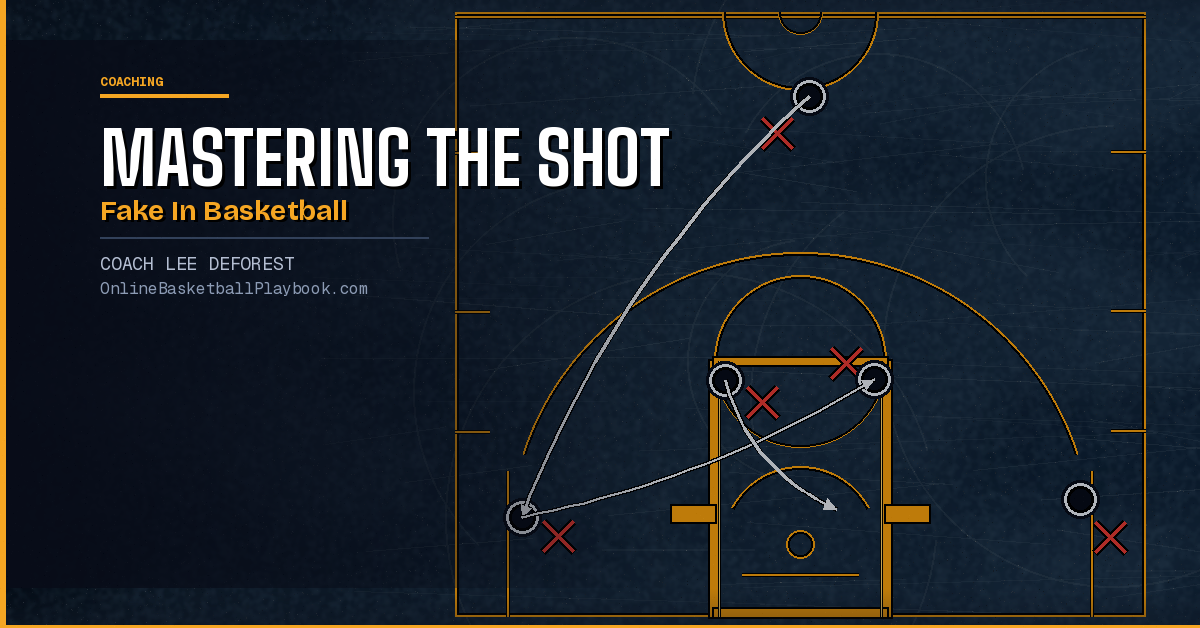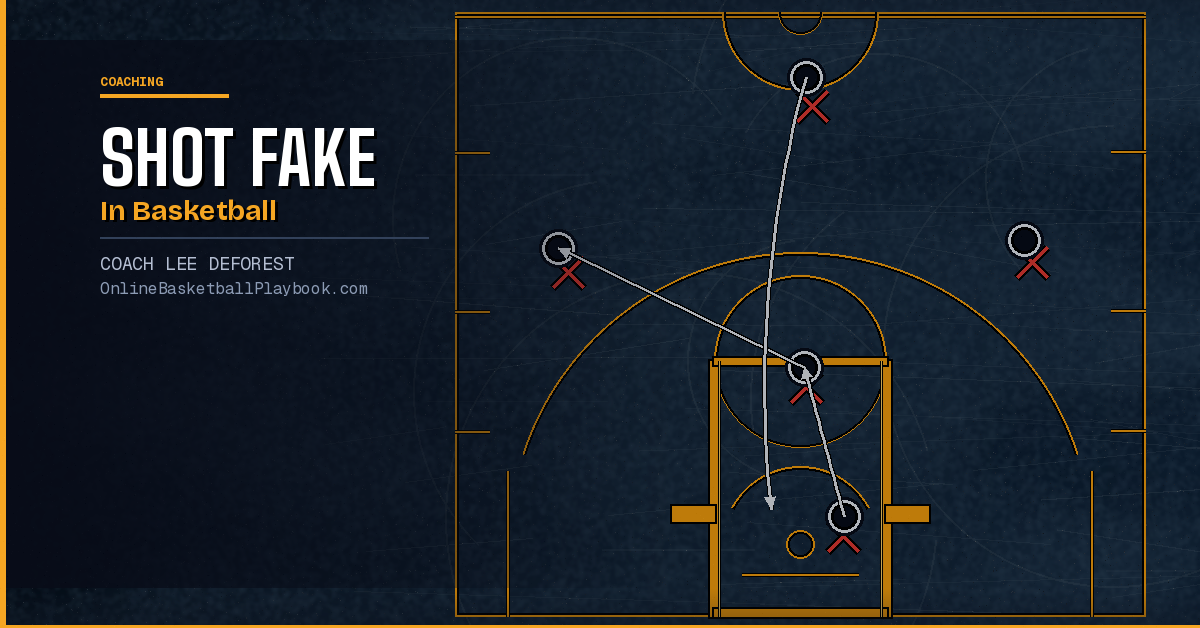

The shot fake is one of the simplest moves in basketball and one of the most misused. Done right, it freezes the defender and creates an open layup or mid-range shot. Done wrong, it just wastes a dribble.
What a Shot Fake Actually Does
A shot fake works because of how defenders are trained. Good defenders close out hard on shooters. That closeout instinct — the one coaches spend hours drilling — is exactly what the shot fake exploits. When you rise up with the ball, a defender who is doing their job will leave their feet. The moment their feet leave the floor, you have won the exchange.
The key word is believable. The shot fake has to look like a real shot attempt. That means using your actual shot mechanics — the same ball lift, the same shoulder dip, the same head and eyes rising toward the target — not some abbreviated pump that every experienced defender will ignore. Defenders read your eyes and your ball position. If either one gives away that you have no intention of shooting, the fake fails and you have wasted your chance.
Think of it this way: a shot fake is only as good as your actual shot. If you are not a shooting threat, defenders will not bite. This is why coaches who build great shooters also produce better offensive players overall. Once a player is respected as a shooter, every drive, every fake, and every hesitation becomes more dangerous. The shot fake is the dividend paid by hours of shooting work.
How to Execute the Shot Fake — Step by Step
The mechanics of a good shot fake break down into four connected parts. Each one builds on the last, and skipping any of them kills the deception.
1. Catch with your feet already set
Before the fake even begins, you need to be in a position where a shot is genuinely possible. Catch the ball with your inside foot planted and your body squared to the basket. A defender who sees you catch off-balance already knows a shot is unlikely. Starting in triple threat — knees bent, weight balanced, ball in front of your chest — gives the fake a realistic foundation. The threat must be real before the deception can work.
2. Drive the ball upward with real shooting motion
The ball must travel upward along the same path it would take on an actual shot. That means lifting with your shooting hand under the ball, guiding with the off hand, and extending upward toward your release point. You do not have to go all the way to your full release, but you have to go far enough that a close-out defender cannot tell the difference in that split second. The shoulders rise. The eyes go to the rim. Everything reads "shot."
3. Keep your feet on the floor
This is where most players ruin it. They do the fake and then jump. The moment you leave the floor, you have used your vertical space and your live-dribble option is gone. Keep your pivot foot down. Your feet staying planted is what gives you the choice: you can shoot off the fake if the defender doesn't bite, drive baseline or middle if they do, or reset and swing the ball if another defender rotates. Feet on the floor means options. Feet in the air means you committed early.
4. Attack immediately when the defender bites
When the defender leaves their feet, do not hesitate. Put the ball on the floor and attack the direction that the defender's momentum has taken away from them. If they jumped toward your right shoulder, drive left. If they went straight up, go straight at them — they are in the air and have no way to contest a layup or a pull-up. Speed is the point here. The window closes the moment the defender lands and recovers. The best players in the world use the shot fake and are already two steps past the defender before the fake is even finished in the viewer's eye.
The pull-up and the hesitation are "lost arts" — a player who takes one or two dribbles and pulls up around the free throw line is as valuable as a pure three-point shooter.
— Shooting Development: Core Principles, Basketball Vault
When to Use the Shot Fake
Timing determines whether the shot fake is a weapon or a wasted possession. There are specific moments in every game where the move has a high success rate, and others where it gives the defense exactly what they want.
Use it against a closing defender
The classic setup: you receive a pass on the wing or at the elbow, and a defender is sprinting to close out. They are moving fast, their momentum is committed forward, and their instinct is to challenge your shot. Wait for them. Let them almost arrive. Then rise with the ball. They will jump. You will go. This is the highest-percentage shot fake situation in basketball because the defender has no choice — a coach who sees them stay flat-footed on a closeout will pull them from the game.
Use it in the mid-range area
The mid-range is shot fake territory because defenders guard it differently than they guard the arc. At the free throw line extended or at the elbow, defenders are close enough to care about a shot but far enough inside the arc that their coach will not panic if they give up a drive. That tension — close enough to bite, but not desperate enough to think clearly — makes them highly susceptible. A hard rise from the elbow produces a lot of foul opportunities when executed at game speed.
Use it less often on the perimeter against sagging defenders
Against a team that is deliberately giving up the outside shot — daring you to shoot — the shot fake often accomplishes nothing. The defender is already back, already watching your feet, and they have no urgency to close. A fake against a sagger is like yelling "boo" at someone who saw you coming. Read the defense. If they are sagging, shoot the open shot rather than faking into a crowded paint.
Use it in the post
The shot fake is just as powerful in the low post as it is on the perimeter. A post player who catches the ball on the block, faces up, and rises with the ball will often get the defender off their feet — and a post player who can draw that foul or get to the glass with one decisive step is worth far more to an offense than a post player who simply spins and prays. Post shot fakes also draw the helper out of position, creating skip-pass opportunities to the weak-side corner or wing.
Common Mistakes and How to Fix Them
Most players who struggle with the shot fake are making one of a handful of correctable errors. Here is what to look for and how to address each one.
Faking with the arms only
If the ball moves but the body doesn't, defenders see through it immediately. The shot fake is a full-body motion. The head rises, the eyes go to the basket, the shoulders elevate, the knees extend slightly. The whole package has to sell the idea that a shot is coming. Work on this in stationary form — practice the fake motion in front of a mirror or a coach and watch whether your whole body reads "shooter" or just your arms.
Jumping during the fake
Already covered above, but worth repeating because it is so common: leaving the floor during the fake eliminates every option you had and puts you in a worse position than before you faked. Drill the fake explicitly with a "feet stay down" rule and make players conscious of it. In a live drill, have a coach call out "you jumped" whenever they see it. Awareness fixes it faster than any mechanical cue.
Faking too slow or too fast
The speed of the fake matters. Too slow and the defender has time to recognize it as a fake and reset. Too fast and they may not even register it as a shot attempt. The right speed is just slightly faster than your actual shot release — fast enough to force a reaction, slow enough that the motion is recognizable as a shooting motion. This is something players need to feel through repetition, not just hear explained. Get reps with a live defender so they can calibrate against a real reaction.
Not attacking after the fake
The fake is only half the move. Players who fake and then hesitate — looking around for what to do next — give defenders time to recover. The attack must be decided before the fake happens. Know which direction you are going, and when the defender bites, go there without a second thought. Indecision is the shot fake killer. Drill the decision in advance: "I am faking, and then going left" or "I am faking, and then pulling up at the free throw line."
Shot Fake Drills to Build the Habit
The shot fake has to be automatic. In a game, there is no time to think through the mechanics — the defender is there and gone in less than a second. These drills are designed to make the move instinctive through progressive repetition.
Stationary mirror drill
Stand in front of a mirror or a glass door in triple threat position. Execute shot fakes — real ones, full body — and watch yourself. Check that your head rises, your ball path goes upward along your actual shooting line, and your feet stay planted. Do ten in a row. Then switch to catching and faking in one motion, as if a pass just arrived. This builds body awareness before adding the pressure of a defender or a dribble.
Partner closeout-and-react drill
One player is the shooter, one is the defender. The defender stands at half court. The shooter catches the ball at the wing. The defender sprints to close out. The shooter reads the closeout speed and either shoots (if the defender is late) or fakes and attacks (if the defender is arriving fast). This trains the decision, not just the mechanic. Run it 10 times per player, alternating sides. Track makes and fouls drawn — scored practice beats aimless reps every time.
Elbow jab-fake-drive series
This is drawn from the Billeter scored shooting series: at the elbow, receive the ball, execute a jab step to one side, then a shot fake, then a drive off the fake. The sequence is jab → fake → drive → finish at the rim. Run it to both sides. Progress by adding a pull-up option — if the help defender steps up, pull up at the free throw line instead of going all the way to the rim. This builds the multiple-read version of the move that works against organized defenses.
Live one-on-one, shot fake required
Simple constraint drill: in any one-on-one live action from the wing or elbow, the offensive player must incorporate a shot fake before attacking. This forces players to use the move under real defensive pressure rather than rehearsed conditions. The defender knows a fake is coming but still has to react to it — and they will still bite when it is executed correctly. After a week of this constraint, remove the rule and watch players use the fake naturally in their offensive game.
When you introduce shot fakes in practice, pair them with real shooting accountability. If players know they will pull up and shoot after the fake, they execute both moves with more conviction. Defenders who know the pull-up is real will bite on the fake harder, making the drill more game-realistic and giving the offensive player a better feel for the timing.
Teaching the Shot Fake to Young Players
Young players often struggle with the shot fake for two reasons: they jump during the fake, and they have no sense of when to use it. Both are coachable.
Start by teaching the concept, not the move. Ask your players: "Have you ever seen someone jump when they shouldn't have?" Most kids have a story about a sibling or a friend getting tricked. Use that. Explain that the shot fake does the same thing — it tricks the defender into jumping before the shooter does. That story makes the logic stick before you ever show the mechanic.
Then drill the mechanic without a defender. Have players stand at the free throw line and practice the fake motion. Cue: "Rise up like you are going to shoot — but keep your feet on the ground." Walk the court and physically put your hand on their pivot foot if they pick it up. Physical feedback is faster than verbal for young players, especially on a motor skill this specific.
Introduce the defender last. Pair players up for the closeout drill only after the stationary mechanic is clean. Young defenders will overreact to fakes, which is actually ideal — it gives the offensive player an early win and builds confidence in the move. As players get older and defenders get smarter, the standard for what counts as a believable fake will rise, but the foundation is the same.
One more thing for youth coaches: connect the shot fake to shooting commitment. A player who has a real shot — who a defender genuinely respects — gets maximum value from this move. Players who are not shooting threats rarely get fakes respected. This is the deeper argument for building shooting form and volume early. The shot fake is not a trick to compensate for an inability to shoot; it is a weapon that flows naturally from being a legitimate scoring option.
- Feet stay down: Drill this as a non-negotiable — jumping during the fake eliminates all your options and hands the advantage back to the defender.
- Decision before the fake: Know where you are going before you rise with the ball — left, right, or pull-up — so there is zero hesitation once the defender bites.
- Full-body sell: Head, eyes, shoulders, and ball all rise together; arm-only fakes are ignored by any experienced defender.
- Attack the momentum: Drive away from whichever direction the defender leaned or jumped — their momentum cannot reverse in time to stop a clean attack.
- Earn the fake with your shot: Defenders who do not respect your shooting will not react to your fakes; building a real shooting reputation makes every fake more dangerous.
Want more basketball coaching strategies and drills?
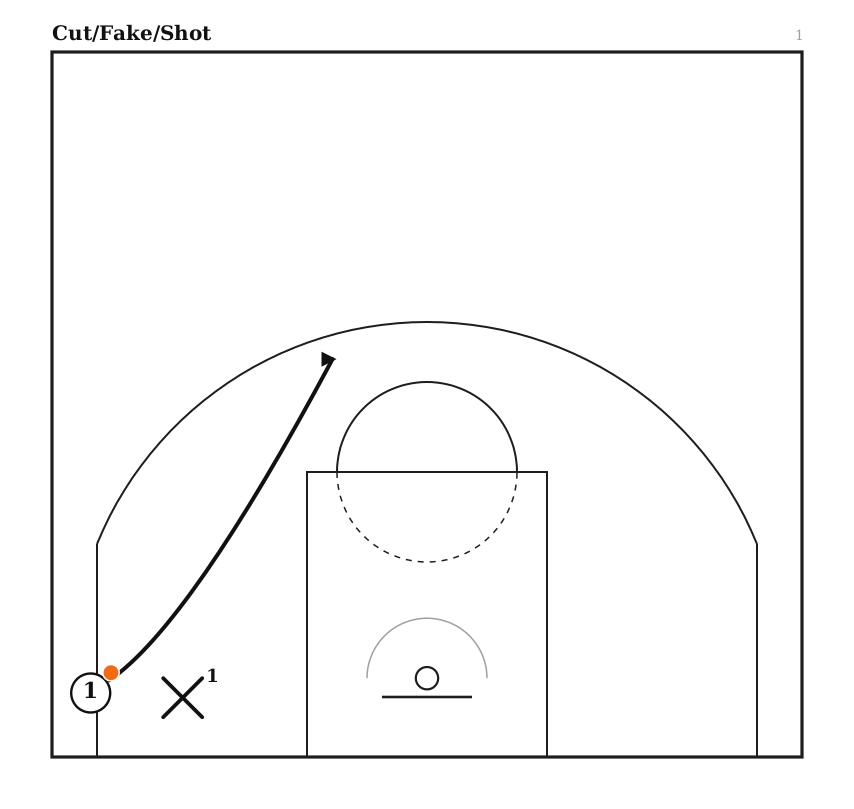
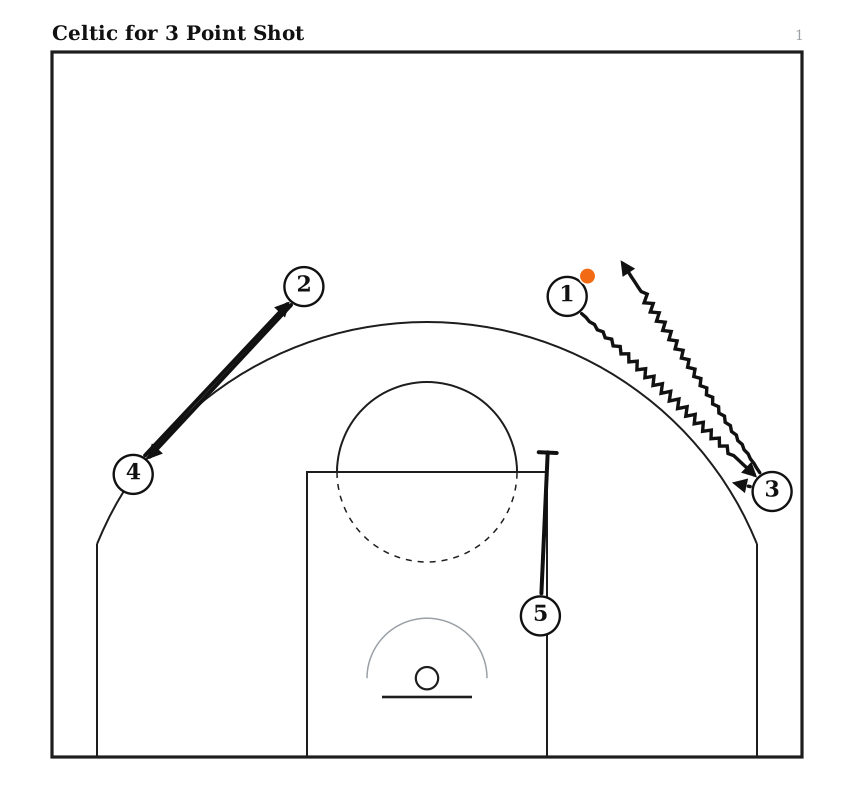
See it drawn up
Related diagrams
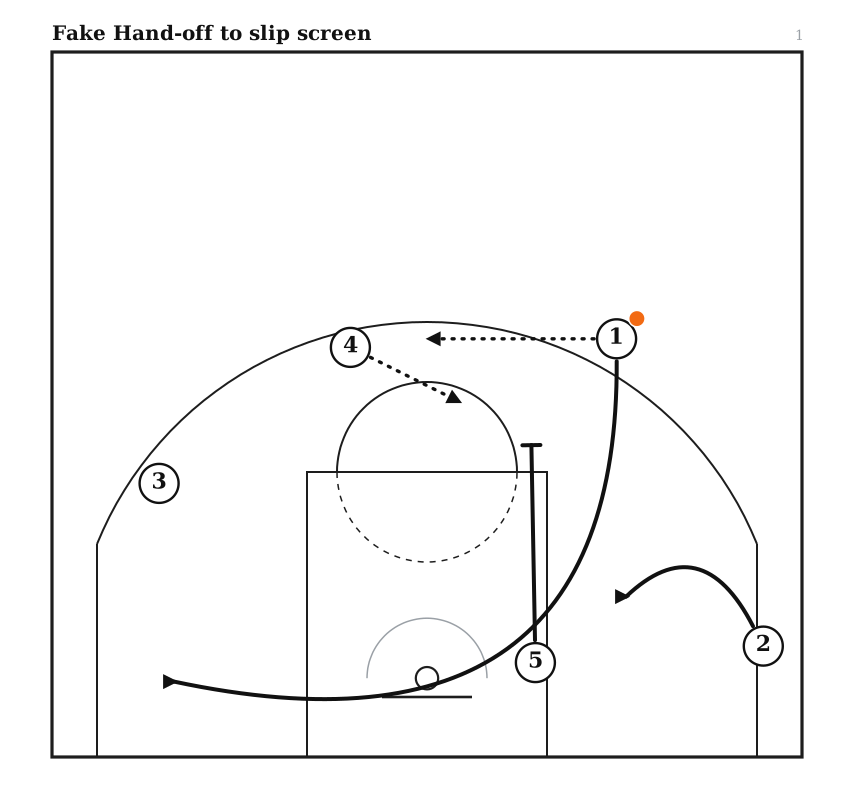
Keep Building
Related breakdowns
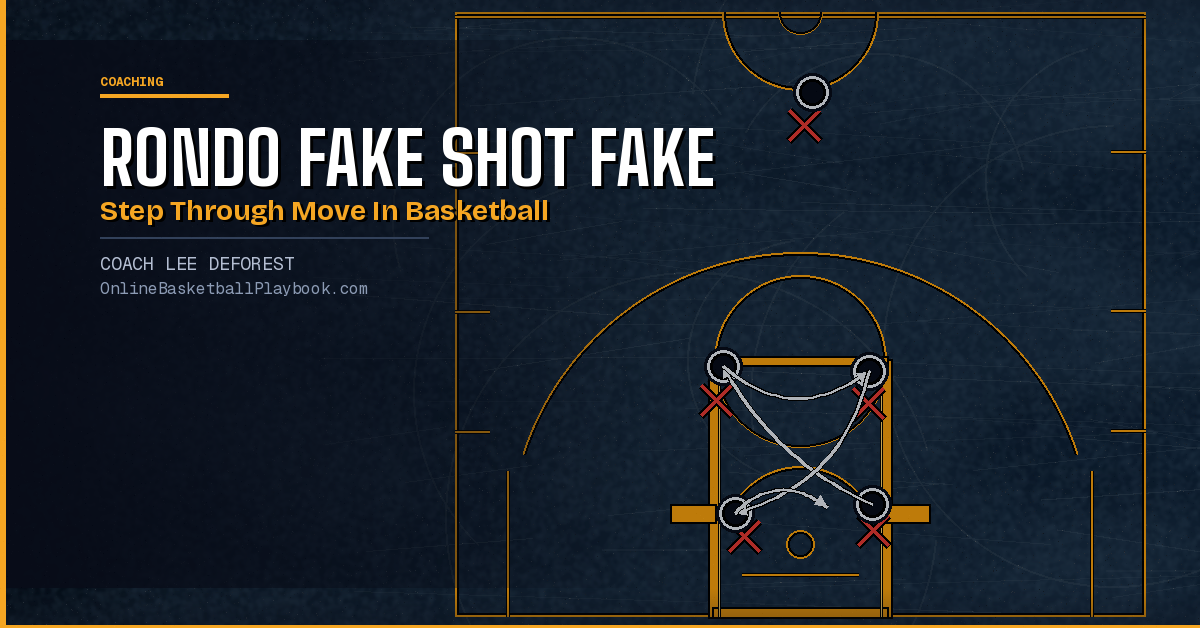
How to Do a Rondo Fake Shot Fake Step Through Move in Basketball
How to Do a Rondo Fake Shot Fake Step Through Move in Basketball
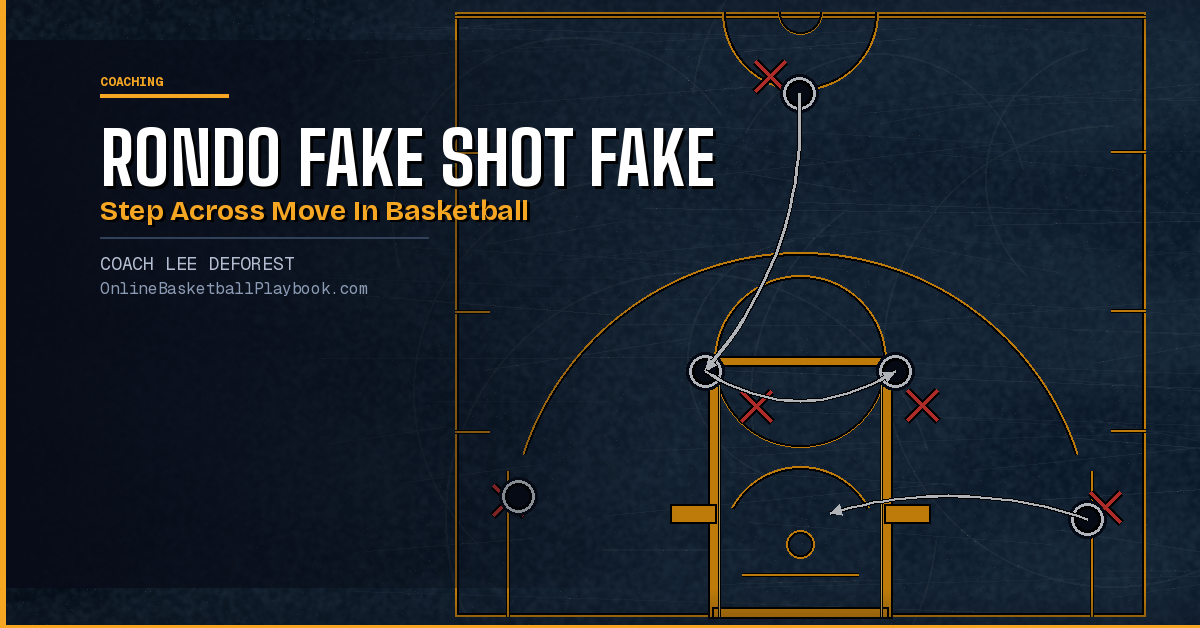
How to Do a Rondo Fake Shot Fake Step Across Move in Basketball
How to Do a Rondo Fake Shot Fake Step Across Move in Basketball