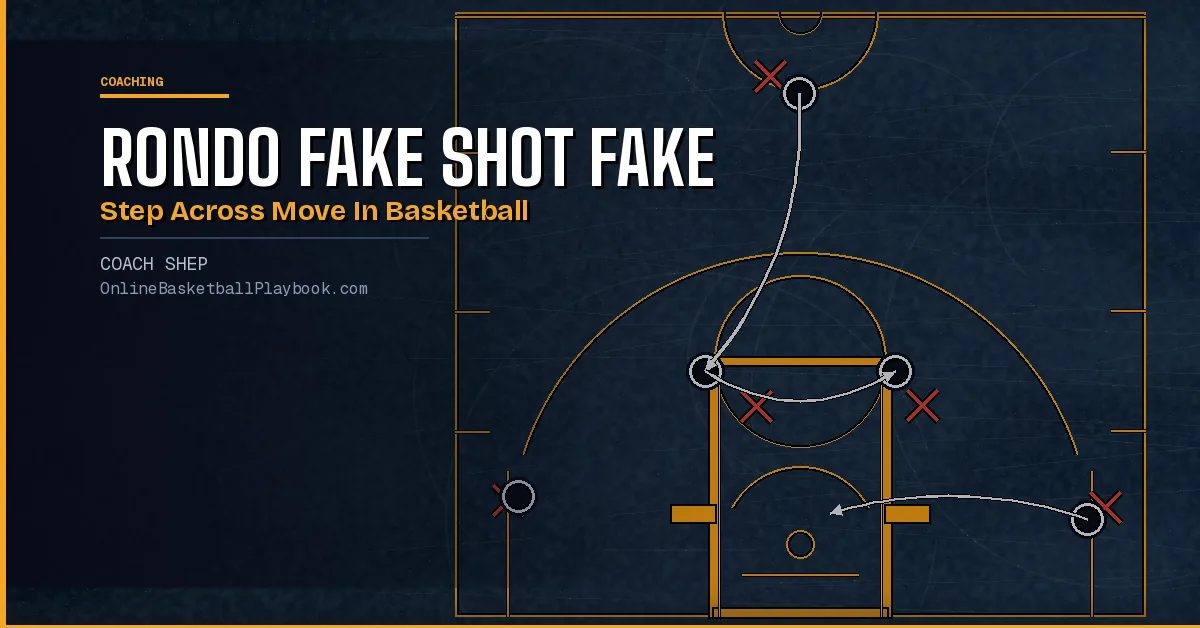
The Rondo fake shot fake step across is a two-fake hesitation move that stacks a shot fake on top of a lateral step to completely freeze the defender and open a clean driving lane or mid-range pull-up.
What Is the Rondo Fake Shot Fake Step Across?
Named after Rajon Rondo (the former NBA All-Star point guard known for his deceptive footwork and ability to break defenders with misdirection rather than pure athleticism), the fake shot fake step across is a two-part hesitation sequence executed while holding the ball in triple-threat position or at the top of a dribble gather.
The move has a clear two-beat structure. First, the player lifts the ball aggressively into a shot fake, selling the shot with the eyes, the shoulder dip, and the upward ball movement. Second, instead of shooting or driving immediately, the player plants the outside foot and takes a lateral step across, crossing the body's center line toward the defender's hip, before attacking the now-frozen defender. The double deception is what separates it from a simple shot fake.
A standard shot fake commits the defender to lunging or going airborne. The step across then exploits the moment the defender is off-balance or has fully committed. What makes the Rondo version distinct is the intentional pause between the two fakes (a half-beat of stillness that resets the defender's weight a second time before the final attack). Rondo used this pause masterfully to create mid-range pull-ups and straight-line drives to the rim in situations where stronger, more athletic defenders were at a physical disadvantage.
This is not a move that requires exceptional leaping ability or elite quickness. It requires timing, body control, and the patience to hold the second fake a beat longer than feels comfortable. That patience is exactly what most players skip and exactly what makes the move effective at any level from high school through professional play.
Why This Move Works: The Science of Defender Commitment
To understand why the Rondo move is so effective, you need to understand how defenders process and react to offensive threats. A defender in a stance is constantly reading the offensive player's hips, shoulders, eyes, and ball position. Their primary job is to eliminate straight-line drives to the basket, so they are trained to react quickly to any upward ball movement that signals a shot.
When you lift the ball into a shot fake, you are triggering the defender's shot-contest instinct. A disciplined defender will stay down, but even disciplined defenders shift weight slightly onto their toes when a shot fake goes up. Their body prepares to close out or contest. The moment their weight shifts forward, their lateral quickness is temporarily compromised. Most offensive players try to blow past them in that exact moment, which gives the defender just enough time to recover if they are athletic enough to match.
The step across changes the calculus entirely. Instead of driving immediately after the shot fake, you plant the outside foot and step laterally. This small but deliberate foot action forces the defender to read a second threat. Do they honor the step across as a jab step signaling a drive to the side? Do they shuffle laterally to cut off the new angle? That second read takes time (usually no more than a quarter second) but at game speed, a quarter second is more than enough to create a driving lane or open up a clean mid-range look.
The move also exploits a fundamental weakness in how defenders guard experienced ball-handlers. Defenders are taught to key on the offensive player's midsection and hips, not the ball or the feet. When the shot fake goes up, the midsection does not move. It just rotates slightly upward. The step across then moves the midsection laterally. Two reads in rapid succession, both using different cues, is cognitively taxing for the defender. The hesitation between the two fakes compounds the problem by making the sequence feel unnatural and hard to time.
Step-by-Step Technique Breakdown
Execute this move from a solid triple-threat stance (weight balanced on the balls of your feet, ball held at hip level with both hands, eyes looking at the rim). Here is the full sequence broken into repeatable steps.
Step 1: The Shot Fake
Lift the ball explosively from hip height toward your shooting pocket. Your eyes go to the rim. Your shooting shoulder dips slightly and then rises. The ball reaches shooting height, approximately forehead level, and your legs bend as if loading for a jump. The key is making this look like a real shot attempt. Sell it with your whole body. A lazy shot fake with just the hands is easy to ignore. A fake that involves the eyes, the shoulder, the legs, and the upward ball path is much harder to dismiss.
Step 2: The Pause
This is the step that most players skip. After the shot fake, hold the ball at shooting height for one deliberate beat, not so long that you reset your position, but long enough that the defender who stayed down has to make a new decision. This pause is where the Rondo sequence earns its name. It reloads the defender's decision-making process and forces a second commitment.
Step 3: The Step Across
From the held-fake position, plant your outside foot firmly and take a deliberate lateral step with your lead foot across the midline of your body, crossing toward the defender's inside hip. This is not a jab step to the side. It is a step that angles across the defender's body, cutting off their recovery path. Keep your ball low and protected as you make this step. Your eyes should now shift back toward the basket to read the defender's new position.
Step 4: The Attack
Once the defender reacts to the step across, shifting weight laterally or dropping the hips to cut off the new angle, drive aggressively in the opposite direction or straight to the basket through the lane you have opened. Common finishes are a straight-line drive to the rim, a pull-up jumper at the elbow or free-throw line, or a kick-out pass to a shooter on the weak side if the defense collapses.
When and Where to Use This Move on the Court
The Rondo fake shot fake step across is most dangerous from three specific positions on the floor: the mid-post area (elbow to block), the high post at the top of the key, and the wing at the three-point line. Each position creates different finishing options off the move.
From the elbow, the move opens drives down the baseline or into the lane, with the pull-up mid-range jumper as the primary read if the defender goes under. This was Rondo's signature location, catching a pass at the elbow, executing the two-fake sequence, and either attacking the rim or pulling up for a floater or mid-range shot.
From the high post, the step across naturally opens the lane for a drive to the opposite block. If you are a guard catching a high-post feed in pick-and-roll continuity or in a Princeton-style read, this is where the move integrates most cleanly into team concepts. The step across reads exactly like a drive trigger to the slot defender, pulling them out of the lane before you attack.
From the wing, the move sets up drives to the baseline or the middle depending on which direction you step. Wing usage requires awareness of where your support players are. A skip pass or a kick-out to the corner are both live options if the drive gets cut off. The move should always be connected to a secondary read, never run as an isolation endpoint with nowhere to pass if the drive closes.
Use this move primarily in the first half of the shot clock when you have time to let both fakes breathe. Do not try to execute it in late-clock situations where the pace demands an immediate decision. The pause between the two fakes will feel forced and the defender will read it as a stall rather than a genuine threat. In transition, the move works best when you have caught a defender in a retreating stance because their weight is already moving backward, which makes the shot fake's vertical lift particularly disruptive.
Common Mistakes and How to Fix Them
Players learning this move make a small set of consistent errors. Recognizing and correcting them early is what separates a move that works in practice from one that works in games.
Rushing the Pause
The most common mistake is eliminating the pause and treating the move as a single two-count sequence rather than a true double fake. When the pause disappears, the two fakes blur into one and defenders read it as a single jab-step series that they can game-plan against. Fix: In practice, count the pause aloud. "Up, hold, step, go." The verbal rhythm forces the beat to stay in the sequence. When the move feels slow in practice, it is correctly paced for a game.
Losing Ball Security on the Step Across
After the shot fake lifts the ball high, players often carry ball momentum forward into the step across with the ball still held high. This creates a turnover risk. Any defender who times the reach correctly can strip it. Fix: As you plant the outside foot for the step across, pull the ball down to your hip in a single controlled motion. Ball low, protected with the body, before you step.
Over-Selling the Shot Fake
Some players so overcommit to the shot fake that they come off the floor slightly or completely displace their weight backward. If your weight is backward when you plant for the step across, the step across has no power and the drive that follows is easily cut off. Fix: The shot fake lifts the ball and bends the legs, but the feet stay planted and the weight stays centered over the balls of the feet. Think of the fake as a vertical movement of the arms and shoulders, not a weight transfer.
Skipping the Eyes
A shot fake without the eyes going to the rim is not a shot fake. It is a ball lift. Defenders at the high school level and above read eyes constantly. If your eyes stay on the defender during the shot fake instead of going to the rim, the fake does not register as a genuine threat. Fix: Pick a spot on the back of the rim and look at it during every shot fake in practice. The habit carries into games.
Telegraphing the Direction of the Attack
After the step across, players often telegraph the drive direction by leaning or shifting their shoulders before planting the attack dribble. A defender who reads the shoulder lean has a half-step head start on closing the lane. Fix: Keep the shoulders square until the attack dribble hits the floor. The drive direction decision should happen with the first dribble, not with the pre-dribble body movement.
Drills to Build the Rondo Move Into Your Game
Building the Rondo fake shot fake step across into your skill set requires isolated repetition before adding defenders or game-speed pressure. Use the following drill progression.
Mirror Drill (No Ball): Stand in front of a mirror or a glass wall. Execute the shot fake, hold the pause, take the step across, and freeze. Check your body position at each stage without a ball in your hands. This forces you to feel the mechanics without the distraction of ball control. Ten slow repetitions on each side before touching a ball in skill work.
Form Reps Against a Chair: Set a folding chair in front of you to represent a stationary defender. Execute the full sequence (shot fake, pause, step across) and finish with a drive around one side of the chair. The chair gives you a physical reference for where the defender's body is without adding live pressure. Fifty reps per session, alternating directions on the final drive.
Live Pairs (Half Speed): Work with a teammate who is instructed to react genuinely to the move at half game speed. The live defender adds unpredictable timing to the second fake, which is something a chair cannot replicate. Start at half speed, then move to seventy-five percent before full-speed reps. The goal is not to blow by the defender. The goal is to feel the moment the defender commits and make the correct decision on the finish.
Scored Repetitions: Add a consequence layer to make the reps competitive. Player executes the move from five designated spots on the floor. Each made shot off the move scores one point. Each time the defender stays down and takes the charge scores the defender two points. First to ten wins. The scored format forces the offensive player to execute the fakes with genuine conviction rather than going through motions.
When teaching this move to younger players, have them verbalize the sequence aloud during every practice rep: "up, hold, step, go." The verbal count forces the pause to stay in the sequence, and prevents the common error of rushing both fakes into a single motion that defenders can read and ignore. Once the timing is locked in, remove the verbal cue.
- Eyes to the rim on the shot fake: A fake without the eyes going to the target is just a ball lift. Defenders read eyes constantly and will not bite unless your gaze commits to the shot.
- Ball comes down before the step across: After the high shot fake, pull the ball back to hip level before planting the lateral step or you risk a strip from any defender with good hands and timing.
- Hold the pause one count longer than comfortable: The pause between the shot fake and the step across is where the double deception lives. Rushing it collapses the move into a single readable sequence.
- Stay centered and do not transfer weight backward on the shot fake.: Your feet stay planted and your weight stays over the balls of your feet throughout both fakes so the step across has full power and the drive that follows is under control.
- Always have a second read before you run the move: Know where your skip pass or kick-out option is before you start the sequence so a collapsed defense never leaves you stranded with no finish available.
Want more basketball coaching strategies and drills?
Join the Online Basketball Playbook newsletter →
Draw this play free in the play drawer →
Membership: the full library, playbook packs, and Pro drawing tools →
Keep Building
Related breakdowns
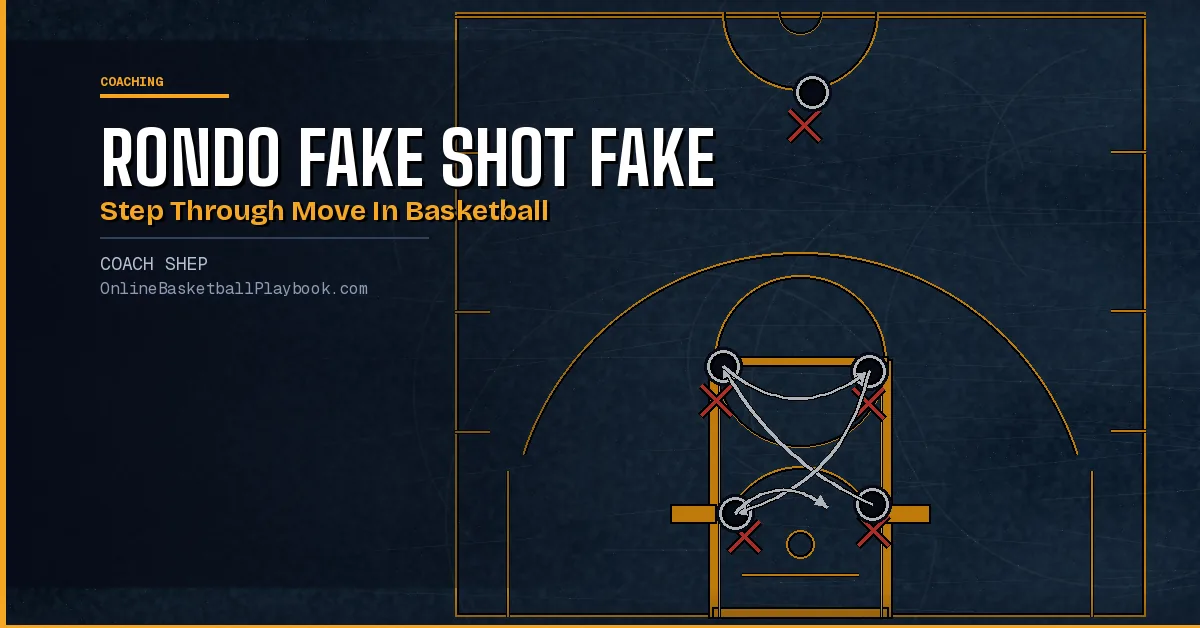
How to Do a Rondo Fake Shot Fake Step Through Move in Basketball
How to Do a Rondo Fake Shot Fake Step Through Move in Basketball
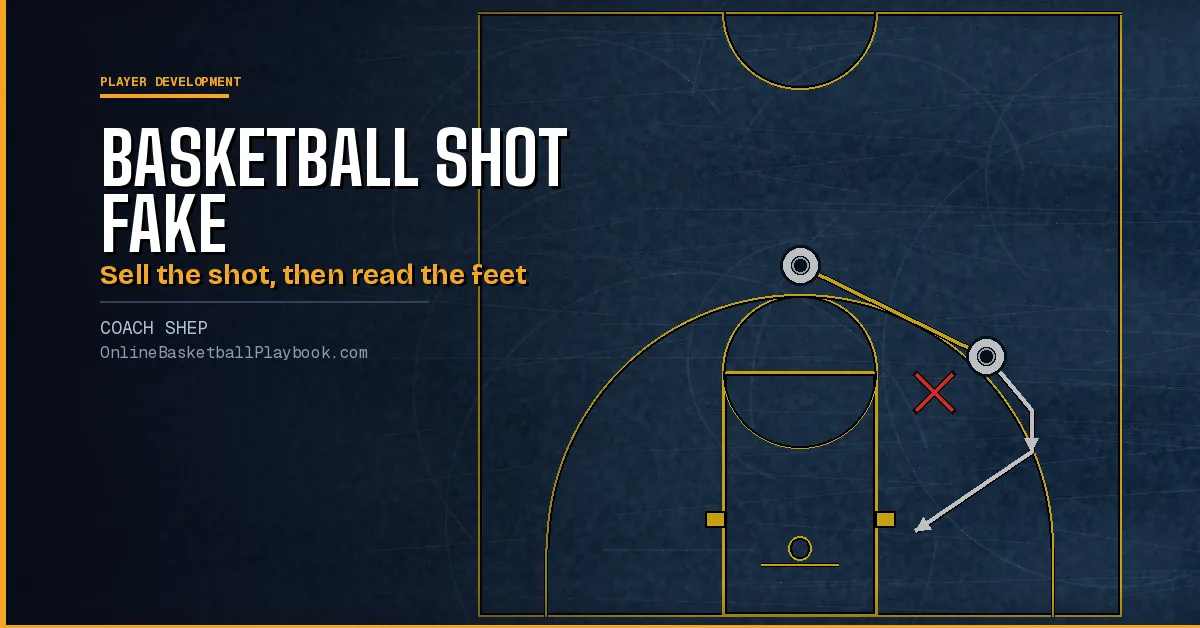
Basketball Shot Fake (Pump Fake): How to Do It and Teach It
The basketball shot fake, also called the pump fake, works when it looks like the real shot. The mechanics, the pivot foot footwork, the read and the drills.
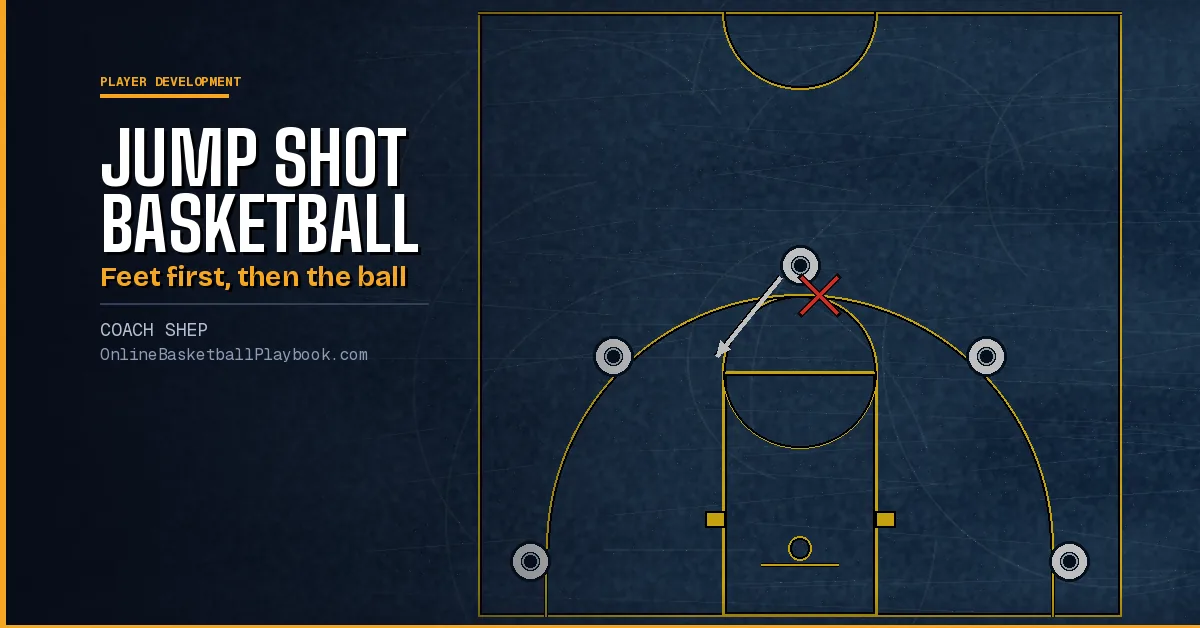
Jump Shot Basketball: Footwork, Release and the Step-Back Jumper
The jump shot in basketball from the feet up: catch footwork, the lift and release, shooting off the catch or the dribble, the step-back jumper and fixing a miss.