Here's the problem with most defensive practice: the moment you tell your players "today we're working on defense," their energy drops. They tune out. They go through the motions.
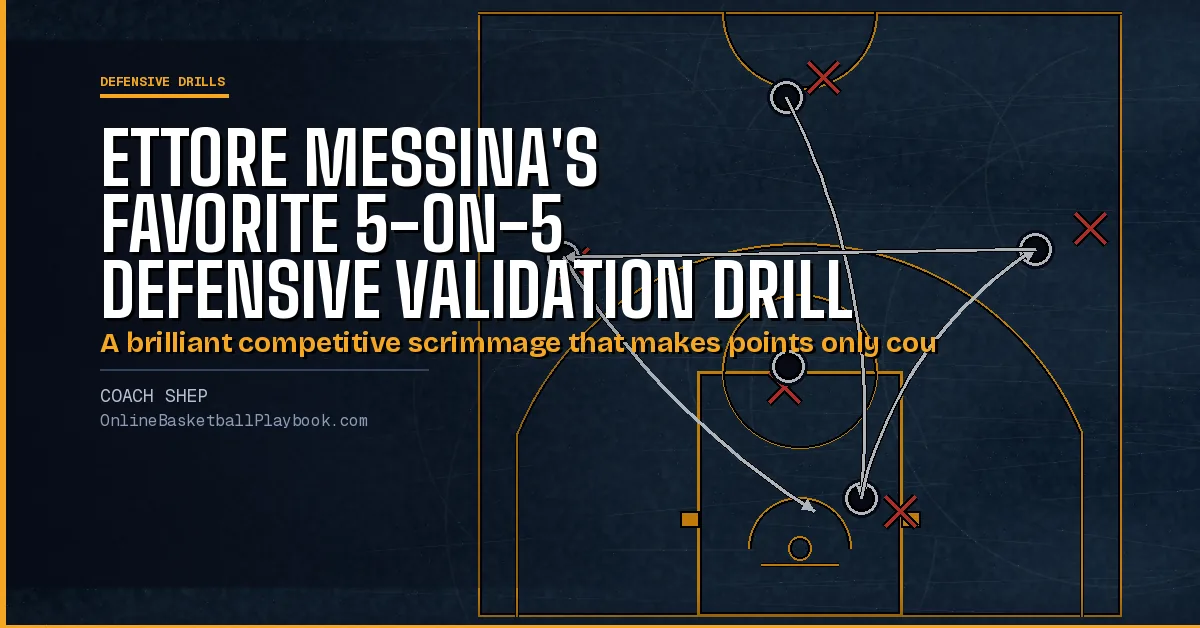
Ettore Messina (four-time Euroleague champion, longtime Spurs assistant under Gregg Popovich, and head coach of Olimpia Milano) solved this problem with a single scrimmage rule. He calls it 5-on-5 Defensive Validation, and it's one of the cleverest competitive drills I've ever seen.
The genius is in the framing. Players think they're competing to score. They are. But the rules force them to defend like their lives depend on it because every bucket they score is worthless until they validate it with a stop.
"Playing scrimmage games like this automatically puts the emphasis on defense without telling the players directly we are working on defense today."
Why This Drill Works
To understand why Defensive Validation is so effective, you have to understand Messina's broader defensive philosophy. He builds his entire defense around three non-negotiable commitments:
- No fastbreak layups. "If you cut this off, you can hold teams to under 60 points."
- No offensive rebounds.
- No open 3PT shots. Force midrange pull-ups instead.
Every one of those commitments shows up in this drill, but the players don't realize they're being coached on them. They just know that a missed box-out, a leaked-out transition layup, or a blown closeout means the bucket they just scored doesn't count.
The Core Concept: A score is "temporary" until the defense validates it. If you score and then give up a score, you've netted zero. The only way to actually move the scoreboard is to play defense at a high level on the very next possession.
That's a completely different mental model than traditional scrimmaging. In a normal scrimmage, scoring a basket gives you a dopamine hit and a sense of accomplishment. In Defensive Validation, scoring just raises the stakes. Now you have something to lose if you don't get a stop.
The Drill: 5-on-5 Defensive Validation
Drill 13: 5-on-5 Defensive Validation
Players needed: 10 (two full teams)
Area: Full court
Length: First team to 5 or 7 points
Focus: Competitive defensive emphasis through scoring rules: transition defense, defensive rebounding, half-court stops
The Rules (Straight from Messina)
- Regular 5-on-5 full court scrimmage.
- Play to 5 points or 7 points.
- The only way a team scores is if they make a free throw or field goal then get a defensive stop on the next possession after scoring.
- If the scoring team allows a score on the next possession, the original points do not count.
That's it. No clock manipulation, no weird substitution rules, no special starting positions. Just one rule that completely changes how players approach every possession.
Walking Through a Possession
Let me show you exactly how this plays out, because the rule sounds simple but the in-game dynamics are deep.
Team A hits a three-pointer. The score is temporarily 3 to 0. Team A now has to stop Team B on the next possession. If Team B scores, Team A does not get those 3 points.
Now think about what happens in the heads of the players on Team A in that moment:
- They just scored, but they haven't earned anything yet.
- They have to sprint back in transition because a fastbreak layup wipes out their three.
- They have to match up, communicate, and contest. No lazy closeouts.
- They have to box out and finish the possession with a rebound.
Compare that to a normal scrimmage where, after hitting a three, players often trot back, take the next possession a little casually, and treat each trip as independent. In Defensive Validation, nothing is independent. Every possession is chained to the next.
What Happens on Team B's Side?
Team B has its own motivation. They're trying to erase Team A's score. Every defensive possession after the opponent scores becomes a chance to invalidate their points. That's a powerful psychological lever. Players who would normally jog back in transition suddenly sprint.
Messina's Coaching Points
1. Use This as a Game-Day Tone-Setter
This is not a teaching drill. It's a competitive validation drill. Run your shell drills, your breakdown work, your closeout drills, your PNR coverage drills earlier in practice. Then end with Defensive Validation to put everything in a live, high-stakes context.
2. Don't Over-Coach During Live Play
Messina is famous for letting players play and reading what they show him. In this drill especially, resist the urge to stop the action constantly. The scoreboard does the coaching for you. If a team gives up a transition layup and loses their three points, they'll learn the lesson without you saying a word.
"Good defense must know when to be aggressive and when to be containing."
3. Watch for the "Anti-Foul" Behavior
One of the beautiful byproducts of this drill: players stop fouling on jumpers. Why? Because sending a shooter to the line gives the opponent a chance to validate. You'll see your team naturally close out under control, contest with hands up, and avoid the dumb reach-in fouls that plague young teams.
4. Connect It to Your Three Commitments
Before you start the drill, remind your team of Messina's three defensive commitments: no fastbreak layups, no offensive rebounds, no open threes. Then tell them: "Every time you score, you have one possession to honor those three rules, or your points disappear." Now the abstract becomes concrete.
Variations & Implementation
Variation 1: Two-Stop Validation
For older or more advanced teams, require two consecutive stops After a score for it to count. This puts even more weight on sustained defensive effort. One good possession isn't enough.
Variation 2: Stop-Score-Stop (Drill 12)
Messina pairs this with another scrimmage variation called Stop-Score-Stop. The drill ends only when a team gets a defensive stop, then a score (or foul), then another stop. Both drills make defense the gating mechanism, but Validation rewards sustained competition, while Stop-Score-Stop rewards back-to-back execution sequences.
Variation 3: Possession-Limited
If you're short on time, play to 3 points instead of 5 or 7. The shorter format creates more urgency on every possession because there's less room to recover from a missed validation.
When to Run It in Practice
I like to use this drill in two specific spots:
- End of a heavy defensive practice day: To validate (pun intended) everything we've taught.
- Day before a game: Short, sharp, competitive. Ends practice with defensive focus locked in.
Get Free Coaching Notes
Join the Online Basketball Playbook newsletter for new playbook breakdowns, drills, and practice-ready install ideas.
Get Free Coaching NotesDraw this play free in the play drawer →
Playbook packs: printable PDFs for zone attack, press break, out of bounds and more →
Final Thoughts
What I love about Defensive Validation is that it works at every level (middle school through pro). The rule is simple enough for 12-year-olds to understand, but the strategic implications are deep enough that NBA coaches use the same concept.
It also embodies something I've believed for 25 years: players don't change behavior because you tell them to. They change behavior because the consequences make them. Messina built a drill where the consequence of bad defense is having your points erased in front of your teammates. That's a coaching tool you can't replicate with a clipboard speech.
Steal this drill. Run it next week. And don't tell your players it's a defensive drill. Let them figure that out on their own.
Keep Building
Related breakdowns
Ettore Messina's Defensive Philosophy: 3 Commitments That Hold Teams Under 60 Points
A four-time Euroleague champion and longtime Popovich assistant explains the three non-negotiable rules that have anchored his defenses for 30 years, and the off-ball positioning system that makes them work.
Ettore Messina's Pick-and-Roll Defense Drills: Drag Screen & Side PNR
Two 2-on-2 drills from Messina's clinic notes that fix the biggest reason teams give up easy buckets in transition: letting the ball handler reach the arc before the screen arrives.
Defensive Basketball Drills: Slides, Closeouts, Shell and Games
Defensive basketball drills in teaching order, from stance and defensive slide drills to closeouts, pass denial, shell and scored games, with the versions coaches split on.
More from Online Basketball Playbook
How to Coach Defensive Rotations
5-on-5 validation exposes rotation breakdowns in real time. Here’s how to coach them.
How to Build a Defensive Identity
What Messina validates in 5-on-5 is defensive culture as much as technique.