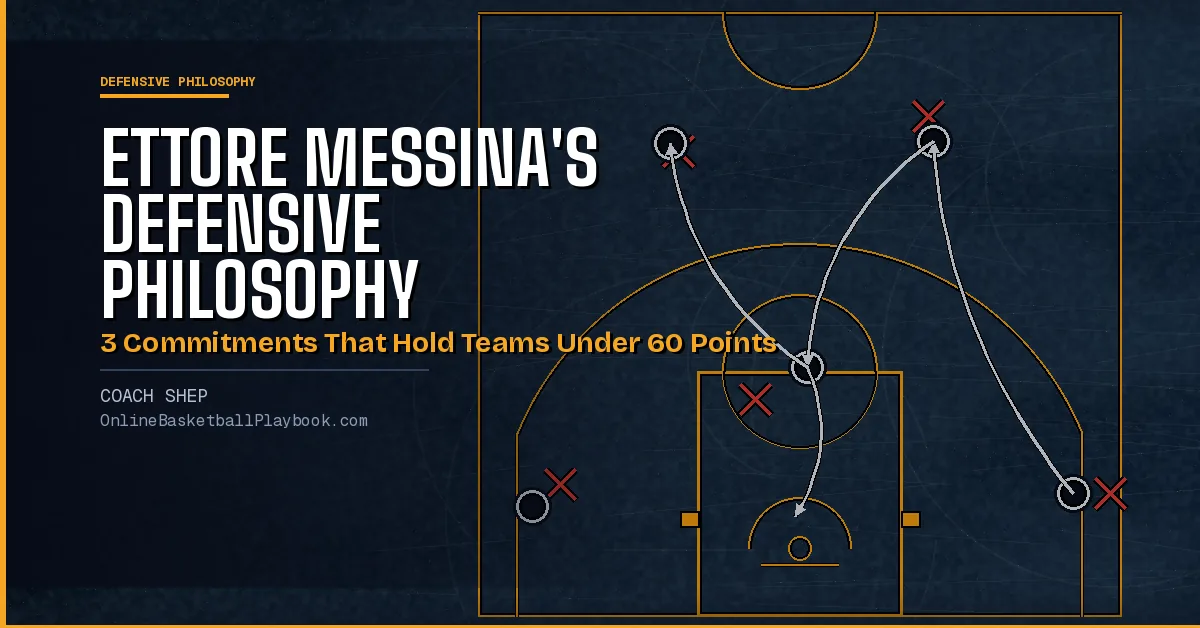
Every staff says defense wins championships. We talk about effort, communication, and toughness, then walk into practice and try to coach 17 different things at once.
That's why I keep coming back to Ettore Messina's clinic notes. Messina has won four Euroleague titles, coached CSKA Moscow and Olimpia Milano at the highest level in Europe, and spent years on Gregg Popovich's staff in San Antonio. The man has seen everything. And when he talks about defense, he doesn't give you 17 priorities. He gives you three.
Three commitments. That's it. And if you can get your team to honor those three things on every possession, Messina says you'll hold opponents under 60 points.
"Don't let the opponent do what they want to do."
In this post we're going to break down those three commitments, the philosophy underneath them, and the off-ball positioning system Messina uses to make them happen. This is the foundation everything else in his system is built on. Before you teach a single drill, your players have to understand this.
Purpose on Defense: Anticipation Over Reaction
Before we get to the three commitments, you need to understand the mindset Messina builds them on. His opening line at the clinic was simple: "Don't let the opponent do what they want to do." But that's not just a slogan. It's a teaching framework.
Messina argues that good defense starts before the offense moves. It starts with understanding and anticipating. He gives two specific reads we should be teaching:
- The offensive player will often look right at the person they are going to pass to. If your defenders aren't reading eyes, you're playing reactive defense.
- Offensive players don't change direction well, so force them to crossover. This is huge. We're not just trying to stop the ball; we're trying to make it switch hands.
This connects to Messina's definition of basketball IQ, which is one of the best I've ever heard:
"When developing the player, first develop their understanding of the game then develop their technical skills."
Coaches, read that twice. Most of us do it backward. We drill stance and slides for weeks before we ever talk about why. Messina flips that.
The 3 Defensive Commitments
Here are the three things Messina commits to defensively. He doesn't waver on these. Everything else in his system serves them.
Commitment #1: No Fastbreak Layups
This is the big one. Messina specifically calls out "fastbreak points, especially layups" as the thing he refuses to give up. And he makes a remarkable claim about it:
"If you cut this off, you can hold teams to under 60 points."
Think about that. He's saying the single biggest separator between good defenses and great ones isn't half-court scheme. It's transition. If you eliminate easy run-out layups, the math of an opponent's offense collapses. They have to score in the half court against a set defense, and that's hard for anyone.
Commitment #2: No Offensive Rebounds
Second possessions kill defenses. You can play 22 seconds of perfect defense, force a contested midrange jumper, and if you give up the offensive board, none of it mattered. Messina treats the defensive rebound as the end of the defensive possession, not the shot.
Commitment #3: No Open 3-Point Shots
The third commitment is what makes the math work. Run shooters off the line. Force everything else: drives that you can contain, midrange pull-ups, kickouts to teammates who aren't shooters. Messina has a fascinating reason for this:
Messina runs players off the 3PT line "and make them pass to their teammates, which in Messina's opinion is the weakest fundamental in modern basketball." Translation: today's players don't pass well off the catch under pressure. Force them to. The next pass is the breakdown point.
Why Messina Wants You in the Midrange
If you eliminate fastbreak layups, offensive boards, and open threes, what's left? Midrange pull-ups. Contested midrange pull-ups, to be specific. That's the shot Messina is happy to give up every possession, all night long.
Coaches, this matters for how you teach closeouts. Messina's closeout isn't a generic "high hands sprint." It's a closeout designed to take away the three and the drive, leaving only the midrange. The footwork, the angle, the hand position. It's all built around forcing that one shot.
The Three Commitments Are a System. Each one supports the others. No transition layups means your defense gets set, which means you can contest threes. Contesting threes funnels the ball to midrange. Midrange shots are lower percentage and easier to rebound. Rebound clean and you start your own transition. The whole thing is one connected loop.
Off-Ball: Up the Line vs. Man-and-Basket
Here's where Messina forces every coach to make a choice. He says you have two options for off-ball defense, and you must pick one and build your entire system around it:
- "Up the line": Denial position, between your man and the ball
- "Between the man and the basket": Sag position, between your man and the rim
"Must adapt your entire defensive system to that concept."
Messina picks up the line. He wants his players to jump to the ball and play in a ball-you-man alignment (meaning your body is positioned between the ball and your man, not between your man and the basket).
This is a big deal because it's the opposite of what most American youth and high school coaches teach. Here's why Messina chooses up-the-line, in his own words:
- Prevent the pass and face cut. If you're up the line, the cutter can't slip behind you on a face cut to the rim.
- See the backscreen coming. "You can see it coming better plus it allows you to go ball side of the backscreen to catch up with your assignment." Backscreens kill teams that play behind.
- The ball can't be easily passed to your man. Period. You're in the passing lane.
- Cut the triangle pass. This one is critical for any team that plays Princeton, motion, or any post-oriented offense. Up-the-line denies the wing catch that feeds the triangle pass into a sealed post.
- Force a higher catch. If you're up the line, the receiver has to come meet the ball higher than they wanted to. "Now you disrupt their flow."
- Discourage early penetrating drives. Pressured catches don't lead to comfortable rip-throughs.
"Defensively, we want to cut the triangle."
Read those reasons again. Every single one is about making the offense do something it didn't want to do: Which is the whole purpose of defense in Messina's framework.
Line of the Ball + Line of the Pass
Here's where most coaches who try to teach denial defense fail: they teach the position without teaching the movement. Messina is very specific about this:
"Players must move when the ball is in the air, so they get to their final, proper position when the ball arrives at the receiver." If your defenders are still adjusting after the catch, you're a step late on everything: closeouts, help, deny. The ball is in flight for almost a full second on most passes. Use it.
Proper positioning, according to Messina, equals the line of the pass plus the line of the ball. Those are two reference lines:
- Line of the pass: The imaginary line between the ball and your man. You want to be on or just inside this line.
- Line of the ball: The imaginary horizontal line across the court at the ball's level. You shouldn't let your man drift above the line of the ball without consequence.
The intersection of those two lines is your home base on any given possession. Teach your players to find it every time the ball moves.
The Diagonal Drop (Not Straight Back)
This is the detail that separates coaches who say they play up-the-line from coaches who actually do it well. When the ball is passed away from you and you have to drop into help, how you drop matters enormously.
Messina's rule: drop diagonally, always staying close to the passing line. Don't drop straight back.
Why? Because dropping straight back leaves a clean skip pass available, and the recovery angle is brutal. If you drop diagonally, you stay near the passing lane the whole time, the skip pass is harder, and your recovery angle to your man is much shorter.
The Skip Pass Test: Take a video of one of your defensive possessions. Pause it when the ball is on the opposite wing. Where are your weakside defenders? If they're sagging straight back toward the rim, an NBA-quality skip pass eats you alive. If they're on a diagonal (closer to the passing line, ready to recover), you're playing Messina-style defense.
One more detail worth highlighting from Messina's notes: "Make the player you are defending move to a new point higher on the court and closer to an area where you can recover faster in the event of a skip pass." In other words, your positioning shouldn't just react to where your man is. Your positioning should force your man to move to a worse spot for the offense. That's anticipation defense.
How to Apply This to Your Team
Coaches, here's the part I always come back to. Philosophy is great, but how do you actually install this with your team next Monday? Here's the progression I'd recommend:
Step 1: Teach the Three Commitments First, Verbally
Before any drill, before any slide, sit your team down and tell them the three things. Write them on the locker room wall. "We don't give up fastbreak layups. We don't give up offensive rebounds. We don't give up open threes." Make it identity, not strategy.
Step 2: Pick Your 2 Benchmarks
Messina says you can't watch five things at once as a coach. Pick two things you're going to track and correct on every possession in practice. His are: (1) at least one defender in the paint at all times, and (2) the ball and the defender arrive at the same time on every closeout. Yours can be different, but pick two and live by them.
Step 3: Drill the Diagonal Drop
Run a basic 3-on-3 shell where the ball moves from wing to top of the key to opposite wing. Stand on the baseline (Messina's recommendation) so you can see all five defenders. Blow the whistle randomly and freeze the action. Check: are your weakside defenders on a diagonal? Or straight-back?
Step 4: Build Drills That Reward the Commitments
Once players understand the principles, every drill should be evaluated by whether it serves the three commitments. We'll break down Messina's specific drills (Drag Screen 2-on-2, Shrink & Spread, Defensive Validation, and others) in later posts. But everything you teach should ladder up to: no transition layups, no offensive rebounds, no open threes.
Get Free Coaching Notes
Join the Online Basketball Playbook newsletter for new playbook breakdowns, drills, and practice-ready install ideas.
Get Free Coaching NotesDraw this play free in the play drawer →
Playbook packs: printable PDFs for zone attack, press break, out of bounds and more →
Final Thoughts
What I love about Messina's philosophy isn't its complexity. It's that there isn't any. Three commitments. One off-ball stance. Two reference lines. Diagonal drops. That's the whole foundation.
But underneath that simplicity is something most defensive systems lack: internal consistency. Every choice supports every other choice. Up-the-line denial discourages drives, which protects against fastbreaks, which gets you set in the half court, which lets you contest threes, which funnels to midrange, which leads to defensive rebounds, which start your transition. It's a closed loop.
Steal what you need. Adapt it to your personnel. But before you start drawing X's and O's on the whiteboard, make sure your team knows the three things you will not give up. Then build everything backward from there.
That's how you hold a team to under 60.
Keep Building
Related breakdowns
Ettore Messina's Favorite 5-on-5 Defensive Validation Drill
A brilliant competitive scrimmage that makes points only count when followed by a defensive stop, putting the emphasis on defense without ever saying the word "defense."
Ettore Messina's Pick-and-Roll Defense Drills: Drag Screen & Side PNR
Two 2-on-2 drills from Messina's clinic notes that fix the biggest reason teams give up easy buckets in transition: letting the ball handler reach the arc before the screen arrives.
Defensive Basketball Drills: Slides, Closeouts, Shell and Games
Defensive basketball drills in teaching order, from stance and defensive slide drills to closeouts, pass denial, shell and scored games, with the versions coaches split on.
More from Online Basketball Playbook
How to Build a Defensive Identity
Messina’s three commitments ARE a defensive identity. Here’s how to build yours.
How to Coach Defensive Rotations
The second and third commitments only work with disciplined rotation. Here’s how to coach it.
Defensive Stance in Basketball
The first commitment starts with stance and positioning (the foundation Messina insists on).