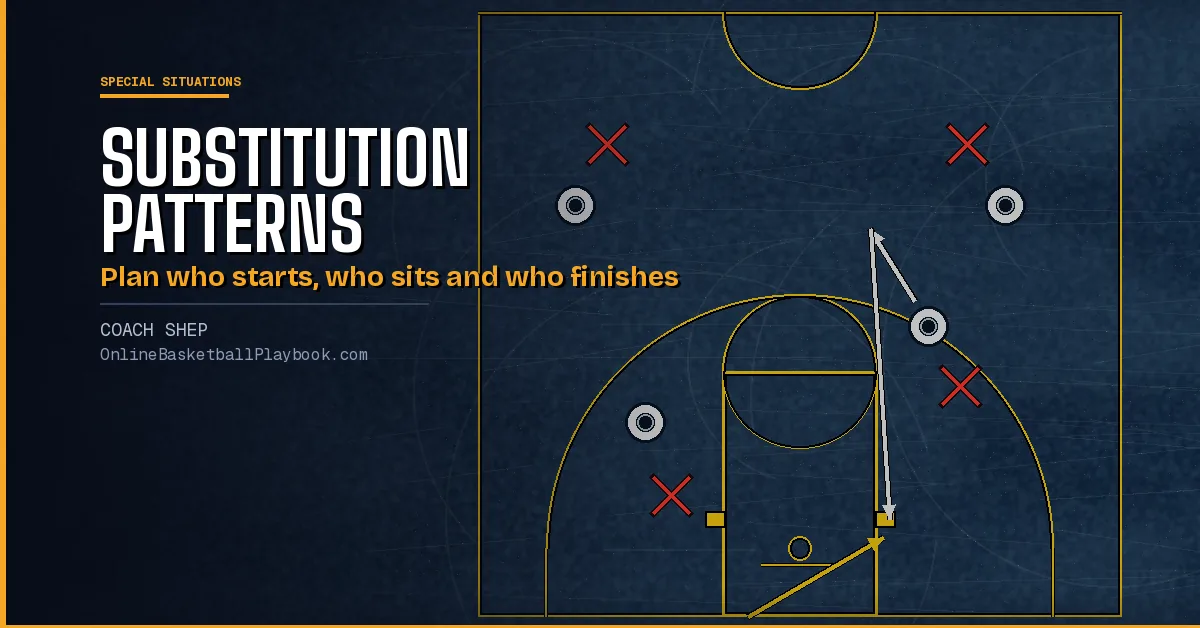
Basketball substitution patterns are the plan for who starts, who plays with whom, how long each stretch lasts, how players come in and out, and who is on the floor at the finish. A coach builds the pattern before the season, writes it down before each game and adjusts it on the bench. The answers differ by system. A pressing team plays ten or more in short bursts, while a tighter rotation rides a top eight.
The late-clock side of subbing, fouls to give and the last possession are on basketball clock management and basketball late game situations. When to stop the game instead is on when to call a timeout, and every late-game guide is under special situations.
Write the Substitution Plan Before Tip
Put the pattern on paper before the game and tell the team. A player who knows he is the first sub can be on ready alert and use his bench time to scout: who drives, who spots up, who posts, who screens, who rebounds, and whether the defense is man or zone and where its open shots are. Stay flexible, since early foul trouble or an injury breaks any plan.
- Name a sub for every player. Dean Smith had a designated sub ready to go in for each player.
- Hand the pattern to an assistant. With a deep bench, an assistant tracks fatigue and matchups and the head coach overrides for special situations. With six or seven players, the head coach can run it himself.
The plan is only a plan once the players have heard it.
Who Starts and Who Finishes
Coaches pick the starting five on very different rules, and some deliberately keep the best five apart at the tip. The idea underneath is that who finishes the game matters more than who starts it.
- Never start the best five. Vance Walberg's plans start three skill players and the two toughest, or the seventh and eighth men for a couple of minutes, and finish with the best players on the floor for the last three or four minutes.
- Start the defensive leaders. The five players with the most points on a defensive grading sheet start the next game.
- Win the shirts. The starters wear one color in practice, the second unit fights for those shirts every day, and the five wearing them at the end of practice start the next day.
- Rotate the youth starters. Every player starts at least one game a season.
- Start the seniors in a rebuild. Then substitute freely when the underclassmen need minutes.
Walberg's full set of start, shift and foul rules is on dribble drive system philosophy.
Pick a starting rule you can explain to the player who does not start.
Basketball Substitution Patterns by Shift Length
Match the length of a shift to the system. Pressing and pace teams build depth into the plan and sub often.
- Hockey shifts. Grinnell College's run-and-gun system replaces players after 35 seconds to 1 minute, when they are spent, in groups of five. Its notes run three groups of five or two groups of seven or eight, with 1:00 shifts cut to :40 when players tire.
- Two to three minutes, then rest. Walberg's plans give his best players stretches of about two to three minutes followed by about 30 seconds of rest. For his press he subs constantly because, in his words, "most players can't play hard for more than 2 minutes," while the opponent's starters stay in and tire.
- Starters out five or six times. Dean Smith's starters usually came out five or six times a game.
- Coach a top eight. A tight rotation moves players in and out of an eight-man group as they earn it.
The pressing side of this is on Vance Walberg's full court press.
Choose the shift length your defense needs, then build the bench to fill it.
Unit Subs and Skills That Stay on the Floor
When the bench is deep, sub in groups. When it is not, protect the skills the team cannot play without.
- The Blue Team. Dean Smith's players 8 through 12 enter as a unit, always in the first half, for at least a minute or two. The first team rests and comes back harder, and the opponent has prepared for the starters, not the subs.
- Waves of three. Walberg's first wave comes in three at a time.
- Three of the best five. Walberg keeps three of his best five on the floor, and one of his top two guards and one of his top two shooters.
- A ball handler and a big. For youth teams, keep one ball handler and one interior rebounder and defender on the floor together. At any level, keep a scorer and a ball handler on.
A press needs bodies too. Walberg carries three players who can play his Controller job because foul trouble is planned for.
Know which two or three skills must always be on the floor, and sub around them.
Foul Trouble Rules
Set the foul-trouble threshold before the game so it is a rule, not a gut call. The rules differ, so pick one and use it every night.
- Two, then three. Sub on the second personal foul in the first half and on the third early in the second half, and sub automatically on any behavior technical.
- Two first-half fouls sit. Walberg's rule in his 2005 notes. By 2007 he wanted fouls taken in the backcourt instead of on drives and shooters.
- Stay below the quarter. A player's fouls stay below the number of the quarter: no second foul in the first quarter, no third in the second.
- Two in a segment. In youth games played in six-minute segments, two fouls in a segment sit the player for the rest of that segment.
Two warnings go with any rule. A coach can foul out his own player by benching him too long with four fouls. And when key players are in foul trouble, a pressing team can drop the press and a coach can use a zone to protect the player instead of sitting him.
Disqualification comes at a fifth foul in NFHS and NCAA play (personal fouls plus Class A technicals in NCAA men's play), a sixth personal foul in the NBA and a fifth foul in FIBA.
In FIBA a player with five fouls must be replaced within 30 seconds (Art. 19.3.6), and the NCAA women's book charges a bench technical when a disqualified player is not replaced within 15 seconds (Rule 10-12). NFHS and the NCAA women's book allow 15 seconds and NCAA men 20 seconds to replace a disqualified player, so check your league. Have his replacement named before it happens. The foul types themselves are on the basketball fouls list.

Teach the players the foul arithmetic too. Every player should expect three fouls he cannot control: a bad call, a charge or block call that goes against him, and a strategic foul. So one careless foul is really the fourth. A post defender in foul trouble ends up playing behind his man with his hands up, as in the diagram, and the offense goes right at him. Post coverage itself is on post defense.

Late in a close game the rule turns around. Sub in players who can afford a foul, so a starter is not disqualified on a must-foul possession, and put the foul-trouble players back in once the clock has stopped.
Kansas lost a comeback chance when two defenders in foul trouble would not foul during a trap, and the ball was passed out and carried across half court before anyone fouled. How to foul on purpose is on intentional foul in basketball.

Decide the foul rule before the second foul, not after it.
Get the next coaching guide in your inbox
One email when a new guide or diagram set goes up. Free.
Subbing After a Mistake
Coaches split hard on whether a mistake should send a player to the bench. Whatever the rule, the player hears it before the season.
- Never on a mistake. Dean Smith's team rules say never substitute on a mistake and encourage the player instead, because "if a player is trying, what more can you ask?"
- Wait for a positive play. Leave the player in until he does something positive or gets a touch, then sub, so players are not afraid to make a mistake.
- Sub often, not for mistakes. Use plenty of situational subs early to keep players alert, and ask how a team builds energy if every mistake brings a sub. Players must know why a sub happens. Quick out, quick in.
- Sub for named breaches. Walberg subs a player for a pull-up mid-range jumper and will bench a star who will not work hard. Loafing back in transition is another breach that brings a sub.
- Pull a player who loses control. A player who turns frustrated, abusive or looks for excuses comes out at once and is reminded to play through it.
- Sub the player before the scheme. If a player or an action is beating you, do it harder, do it better, sub the player out, and only then change the scheme.
Pick the mistake rule in the summer, when no game is on the line.
The Sub as a Tactical Tool
A substitution can do a timeout's job and set up the next possession. Plan these the same way as the rotation.
- Adjust with a sub, save the timeout. Early in the game, make the change with a substitution instead of a timeout.
- Sub on a free throw to set a press. The stoppage lets the right five set up the press or the defense.
- Trade specialists late. Alternate offensive and defensive specialists on free throws and timeouts in the last minutes.
- Warm up the closer. Give a player some first-half minutes before using him in a close finish.
- Add a ball handler against pressure. Put an extra ball handler on the floor against full-court pressure, as in the diagram below. Breaking the press itself is on basketball press break.
- Tie subs to stops. Let a group play until the opponent scores a set number, for example 6 points for the starters and 4 for the reserves, so the incentive is stopping the other team.

Every sub should change something on the floor, even if it is only fresh legs.
Bench Roles and the Sub-Out Routine
Every player who comes out sits next to the coach or an assistant and hears why, even if it is only a rest. Write the routine down.
- High-five, water, assistant. He high-fives every bench player, takes water from the manager and sits next to an assistant, never at the end of the bench.
- The fist signal. Dean Smith's players raised a fist when they were tired.
- The self-sub rule. A player who takes himself out, by tugging his shirt, decides when he goes back in. When the coach makes the sub, the coach decides.
Name a role for every reserve, too:
- Sixth person. Red Auerbach's Celtics made the role famous. The sixth person needs better skills and leadership than some starters, often plays several positions, and must make the lineup stronger, not weaker.
- Defensive stopper. His job is to stop the other team's best player, not to score.
- Designated inbounder and free-throw shooter. Both decide late games. A sub can also defend more aggressively than a starter, since fouling out costs less.
More on keeping reserves ready is on managing bench players.
A player who knows his role knows why he is on the floor.
Playing Time and Youth Minimums
Past youth ball, the promise is equal opportunity, not equal playing time. Varsity and competitive club teams will not split minutes evenly, while participation teams try to. Keep playing time a player-coach conversation, not a parent-coach one, and say so at the preseason meeting. The parent side is on basketball parent communication.
Youth leagues set minimums instead:
- Half the game. Every child plays at least half the game and never sits two straight six-minute segments.
- Half of every game for the youngest. A program for ages 4 to 7 plays everyone at least half of every game, with no cuts.
- A nine-minute floor. At least 9 minutes, a quarter and a half, in a game of four 6-minute quarters, tracked by an assistant.
- A written policy. All kids play, but unexcused absences can cost minutes, and the policy goes in the first-practice handout.
More youth guidance is on coaching youth basketball.
Write the playing-time promise down, then keep it.
Rehearse It and Review It
Rehearse the rotation, then grade it after the game.
- Sub in practice. Use frequent in-practice substitutions so the reserves rehearse the game rotation, or let a top eight sub themselves in practice.
- Earn the way in. A scrimmage rule credited to John Wooden makes a player hit ten straight free throws before he subs in. Another sends a waiting defender in whenever a man's opponent scores. Formats are on basketball scrimmages.
- Read the lineup report. After the game, check the most used lineup, the most productive one, the best stop group and the best turnover-forcing group, not just the box score.
The offense matters too. A rules-based motion offense keeps working through substitutions where set plays break.
Practice the subs you plan to make, and grade them like any other part of the game.
Questions Coaches Ask
What are basketball substitution patterns?
The plan for who starts, who comes in first, how long each stretch lasts, how players rotate in and out and who finishes. Coaches write it before each game and tell the players the order.
How many players should be in a basketball rotation?
It depends on the system. Pressing teams play deep with short shifts, from hockey-style shifts of under a minute to Walberg's two to three minute stretches, while a tighter rotation plays a top eight.
When should you sub a player in foul trouble?
Set the rule before the game. Common choices are the second foul in the first half and the third early in the second, or keeping the foul count below the quarter number. Do not bench a player with four fouls so long that he never plays again.
Should you take a player out after a mistake?
Coaches split. Dean Smith never subbed on a mistake, others wait until the player makes a positive play, and others sub only for named breaches such as loafing back on defense.
Want the printable playbook packs?
OBP Pro members get the premium playbook packs: the zone attack, out of bounds and practice plan PDFs, plus each new pack as it is finished. The membership page lists what is in each one. Or draw your own version free in PlayDraw.
See what OBP Pro includesMore Game Day and Shooting Guides
- Game Day Routine for Basketball Coaches: Shootaround to Tip
- How to Fix Common Shooting Errors: Read the Miss, Fix the Cause
- Catch and Shoot Basketball: Hop or 1-2 Footwork and Drills
Back to Basketball Clock Management and every Special Situations page.
Keep Building
Related breakdowns
Basketball Late Game Situations: Decisions, Fouls and Clock
Basketball late game situations settled before tip-off: the score math, timeouts, fouling up three and behind, the last shot, protecting a lead and daily practice.
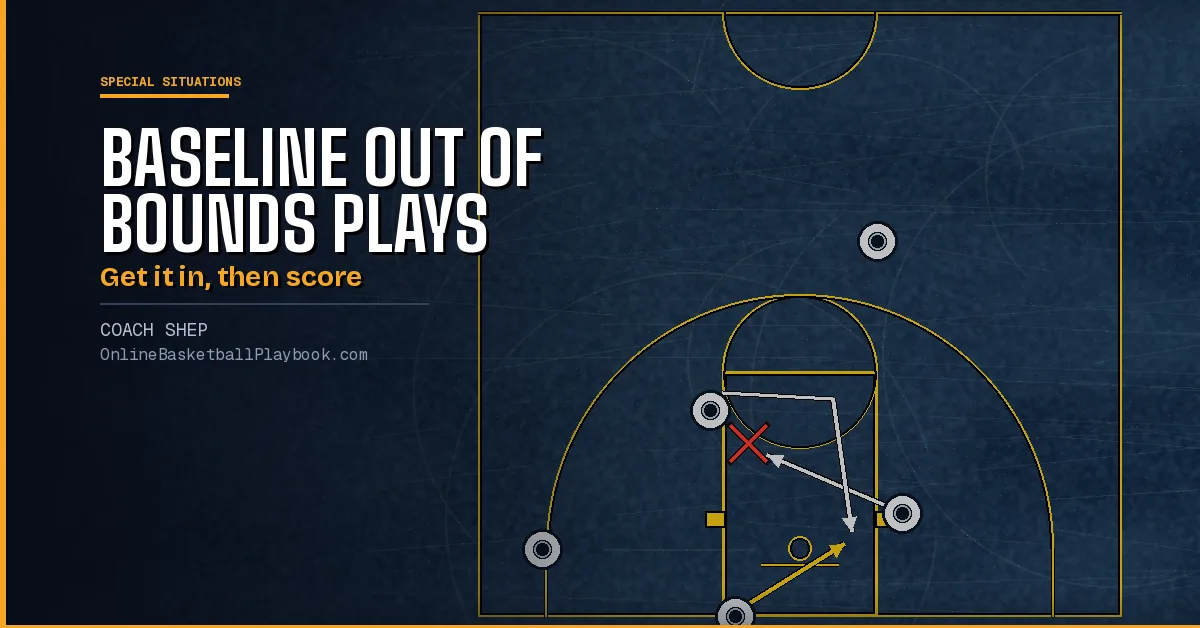
Baseline Out of Bounds Plays: Sets vs Man, Zone and for Youth
Baseline out of bounds plays drawn step by step: a box back screen and roll, Pick the Picker, the double stack, a 2-3 zone play, youth one-pass plays, the rules and the reads.
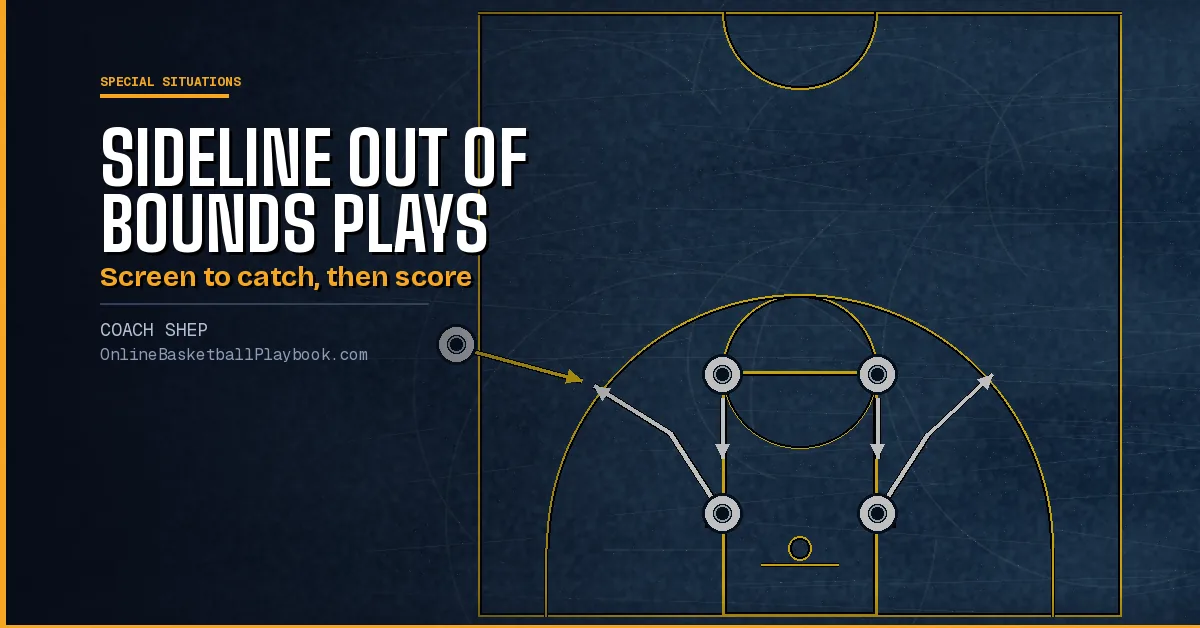
Sideline Out of Bounds Plays: SLOB Sets, Reads and Practice
Sideline out of bounds plays for coaches: SLOB sets from a box, stack and line, the inbounder's reads, plays against zone and denial, the clock and practice.