When to call a timeout in basketball is a decision coaches settle before the season, not in the moment. A timeout can stop a run, change a defense, set up a late play or advance the ball. Spent early, it is gone when the clock matters most.
This guide lays out the reasons coaches give for calling one, the three ways they budget them, the case for playing on instead, how a huddle is run, and how many timeouts each level allows. Where coaches disagree, each option sits side by side.
How Many Timeouts in Basketball, by Level
Each level sets its own number of timeouts, their length and who may ask for one, and the full rules, level by level, are on basketball timeout rules.
A few more rules shape the strategy.
- Two mandatory in the NBA. The NBA has two mandatory timeouts in every period.
- Too many timeouts. A timeout beyond the allowed number is a technical foul in the NBA, with the ball going to the opponents, and an administrative technical in NCAA men's play. Hubie Brown tells his own story of a technical for a sixth timeout when he was a college sophomore.
- No timeout after your own late basket in FIBA. The scoring team may not take a time-out after its own basket with 2:00 or less left in the fourth quarter or overtime unless a referee has stopped the game.
Advancing the ball after a late timeout
Three levels let a timeout move the ball.
- NBA. In the last two minutes of the fourth period or overtime, a team that takes a timeout with the ball out of bounds in its backcourt, or right after a backcourt rebound or change of possession, may throw in at the 28-foot hash mark in its frontcourt.
- NCAA women. The same option holds in the last 59.9 seconds of the fourth quarter or overtime, with the throw-in 28 feet from the end line, and the head coach tells the officials before the timeout is reported.
- FIBA. The head coach has the choice of the frontcourt throw-in line with 2:00 or less in the fourth quarter or overtime.
- NFHS and NCAA men. There is no such rule, so at those levels a late timeout stops the clock but does not move the ball.
Know before the game whether your level lets a late timeout move the ball.

The full clock rules for the end of a game, including when the clock stops after a made basket, are on basketball clock management.
When to Call a Timeout in Basketball: The Reasons
Coaches write different lists, and the lists overlap more than they differ. Five reasons come up often.
- Stop a run. A timeout cools the other team and its crowd and lets your players refocus before a short run becomes a game-deciding one.
- Make a big change. Dropping a zone press that is not working for man-to-man, or starting a post double, is hard to explain on the fly, especially to young players.
- Draw up a late play. A set drawn in the huddle has a better chance than one the defense has already seen and scouted during the game.
- Rest a tired star. A timeout gives him a breather without taking him out of the game.
- Wake a sluggish team. A flat start can call for a timeout no matter what the score is.
The list grows longer in the last minutes.
- Ten last-minute reasons. A last-minute list runs to ten reasons, among them stopping the clock, making a defensive change and making the opposing free throw shooter think about the shot. Stan Van Gundy says icing the shooter has not been shown to help.
- Get a designed basket. Use a timeout during the other team's 10-0 run to get a designed basket.
Coaches also set rules for when not to call one.
- Not in frustration over a bad call. It wastes the timeout and fixes nothing, so make early adjustments with a substitution instead.
- Not to criticize. Criticism in the huddle only makes a poor stretch worse, so a timeout called while the team is struggling delivers an adjustment and confidence.
The whole-game substitution plan is on basketball substitution patterns.
Write your reasons down before the game, and call the timeout for a reason on that list.
Basketball Timeout Strategy: Save, Spend or Draw a Line
The budget is where coaches split most clearly. Three approaches are on record.
| Approach | What it does |
|---|---|
| Save them | Keep at least two for a close finish and make the other team use theirs first. John Wooden and Pete Newell refused to call the first timeout of a game, and Stan Van Gundy saves timeouts. Try to bank two or three for the final minutes, and know they do not always last that long |
| Spend them | Don Meyer: "don't bank timeouts." Use all of them and call them before fouls to stop the clock late |
| Draw a clock line | No timeout to save a possession before the last two minutes unless the head coach says so, one of a set of automatic late-game rules |
None of these is the one right answer. Pick one, write it on your call sheet and tell your assistants. The late-game decisions that use these timeouts are laid out on basketball late-game situations.
The Last Possession: Timeout or Play On
The biggest timeout decision comes in the last possession. Coaches disagree on whether to stop and set up or to go before the defense is set.
Play on
- Trust the practice. Dean Smith usually did not call a timeout with the ball and a tied score late, because his team had practiced the situation and a stoppage lets the other coach set his defense and substitute.
- Go before the defense sets. Stan Van Gundy says no one will criticize a timeout on a full-court play after a made basket or free throw, but going without one seems more effective because the defense cannot set.
- Drill the last shot. Drill the last shot until the bench call works without a timeout, since a timeout to set up the last shot risks a stolen inbound.
- One exception. A defensive rebound with 5 or 6 seconds left is worth a quick timeout.

Stop the clock and set up
- Half court, then timeout. Inbound to half court and call timeout with under 4 seconds left, and take a timeout with 1 to 3 seconds left. Prefer advancing to midcourt and calling timeout over a longer full-court try when the clock allows.
- Hail Mary. Tied or down 1 or 2, with 3 or 4 seconds and one timeout left, throw to half court and call timeout at once, with an assistant warning the referee beforehand, so only about one second is lost.
- Gain possession, then timeout. Call timeout as soon as the team gains possession in the last 5 seconds when tied or behind, then throw to half court for one more.

Use an 8-second line
A fixed rule settles it. With more than 8 seconds left, the team goes. With fewer than 8, it calls timeout.
After your own late score
- Call timeout after your own score. Call timeout after scoring with under 10 seconds left so the defense can set, accepting that the other team can then draw a play too.
- Push the ball. Push the ball right after the other team scores, because most teams relax for a moment after a basket.
The plays you run out of a timeout are on after timeout plays, and the late inbounds sets are on last second basketball plays.
Pick go or stop for the last possession before the game, and practice it.
Timeouts That Help the Defense
A timeout is not only for the team with the ball. Hubie Brown's rule is "Never call time out in the back court and let the defense dictate the tempo."
His example is a late-game back-court timeout that let the defense change its look and take the point guard out of the inbound, so the ball went to a player who did not want it. He also says never call one when the other team scores to go ahead late, because a great defensive team will come at you the length of the floor with something you have not seen.

The defense can use a timeout on purpose too.
- Call it after they line up. Call timeout after the other team lines up for an inbounds play, which forces a different play call that may confuse them.
- Ice the shooter. Use a timeout to ice a free throw shooter late, the move Van Gundy doubts.
Defending the play that comes out of a timeout is covered in how to defend inbounds plays.
Never hand the defense the tempo, and use the timeout when it helps you.

Running the Huddle
Players remember little of what is said in a timeout, so keep the message short.
| Approach | How it runs |
|---|---|
| 30 and 30 | The first 30 seconds of a full timeout are for water and towels, the last 30 for the coach. The coach alone speaks, with eye contact first, and gives one to three adjustments that were already drilled. Nothing new |
| One team point | One clear point for the team, because players remember the last thing said. Single-player corrections happen on the bench |
| Stand or sit | For a 30-second timeout the five stand on the court lined up by position, point guard to center, so the coach can talk to each by spot. For a full timeout they sit, with managers handing out and collecting water and towels |
| Seat the five in front | Hubie Brown seats the five in the game in front of the board, the rest behind, so he sees anyone who cannot go as the huddle breaks |
| Praise, prompt, leave | Don Meyer names one thing going well and why, one thing to do better, then leaves the players to do it |
| Ask what they see | The coach asks players what they see before giving the plan |
Hubie Brown also carries a checklist into each kind of timeout.
- On offense. The play on the board, the number of timeouts left (the inbounder must know it), no one-handed inbound pass, and when to break the huddle.
- On defense. Who are their best offensive rebounders, who are their three-point shooters, are they in the penalty, what is their favorite play in this situation, and how will we guard it.
The 30-and-30 huddle adds two warnings. Nothing undrilled gets done well out of a timeout, so call only plays the team has run in practice. And a drawn play works only if players can read a diagram. The symbols are on how to read a basketball play diagram. For more on how a coach talks in the huddle, see communication in coaching.
Say less, and say only what the team has practiced.
Get the next coaching guide in your inbox
One email when a new guide or diagram set goes up. Free.
Tracking Timeouts and Fouls
Losing count of timeouts or fouls costs games. The bench can split the jobs.
- Check with the scorer. An assistant checks personal fouls and timeouts remaining with the official scorer at every timeout, because a scorer's mistake is easy to fix early and hard to fix late.
- Tell the huddle. Every player leaves that huddle knowing the timeouts left and the team foul count, since games have been lost by using the last timeout and then having no foul to give.
- Split the bench jobs. One assistant tracks fouls and timeouts, one watches the other team's lineup changes, and the coach who wrote the scouting report helps the head coach most because he knows the opponent best.
The foul count that goes with the timeout count, including fouls to give, is on basketball fouls list.
Give the count to one person and check it every timeout.
Practicing Timeouts
Late-game timeouts can be rehearsed. Make the scrimmage look like a game, with coaches on the bench, timeouts, substitutions, a clock, officials and the occasional bad call. Timed scrimmages give each team a fixed number of timeouts:
- A situation tournament with one timeout per situation and a manager on the clock.
- A down-8 and up-8 game of 3 minutes with one timeout and the double bonus.
- A delay drill where one team shoots a one-and-one down 8 with 2 minutes left and one timeout, and the other breaks pressure into its delay game.
Sean Miller's fixed scenarios include a 4-second situation with no timeouts left. More situation formats are on how to incorporate game situations into practice, and the full late-game decision set is in the special situations section.
Rehearse the timeout until the team treats it like any other drill.
Questions Coaches Ask
When should you call a timeout in basketball?
Common reasons are to stop a run, make a big strategic change, draw up a late play, rest a tired star without subbing him, and wake up a flat team. Decide your reasons before the game.
How many timeouts do you get in high school basketball?
The NCAA's comparison of the rulebooks lists three 60-second and two 30-second timeouts for NFHS games, and a player or the coach may request one. Overtime timeouts are in your state association's rulebook.
How many timeouts are there in college basketball?
NCAA men have four 75-second and two 30-second timeouts without the media format, and three 30-second plus one 60-second when there are at least three media timeouts in a half. NCAA women have three 30-second and two full timeouts without the media format, and three 30-second and one full with it.
Should you save timeouts for the end of the game?
Coaches split. John Wooden and Pete Newell would not call the first timeout of a game, and Stan Van Gundy saves them. Don Meyer said not to bank timeouts. A clock-line approach allows no timeout to save a possession before the last two minutes unless the head coach says so.
Should you call a timeout before the last shot?
Dean Smith usually played on because his team had practiced it and a timeout lets the defense set. Staffs that stop the clock advance to half court and set up. An 8-second line goes with more than 8 seconds left and calls timeout below 8.
Can you advance the ball after a timeout?
In the NBA, NCAA women's games and FIBA, yes, late in the game and only in set situations. NFHS and NCAA men have no such rule.
Want the printable playbook packs?
OBP Pro members get the premium playbook packs: the zone attack, out of bounds and practice plan PDFs, plus each new pack as it is finished. The membership page lists what is in each one. Or draw your own version free in PlayDraw.
See what OBP Pro includesMore Rules, Terms and Game Guides
- Basketball Terms: A Glossary for Coaches and Players
- How to Read a Basketball Play Diagram: Symbols and Lines
- Basketball Shot Clock Rules: Length and Resets by Level
- Basketball Free Throw Rules: Lane, Rim and Violations by Level
Back to Special Situations and every Special Situations page.
Keep Building
Related breakdowns
Fouling When Trailing: When, Who and How by Time and Score
Fouling when trailing late: when to start by possessions and seconds, the bonus and clock rules by level, how to foul, who to foul, down 3 and the rebound.
Late Game Plays When They Deny Your Best Player
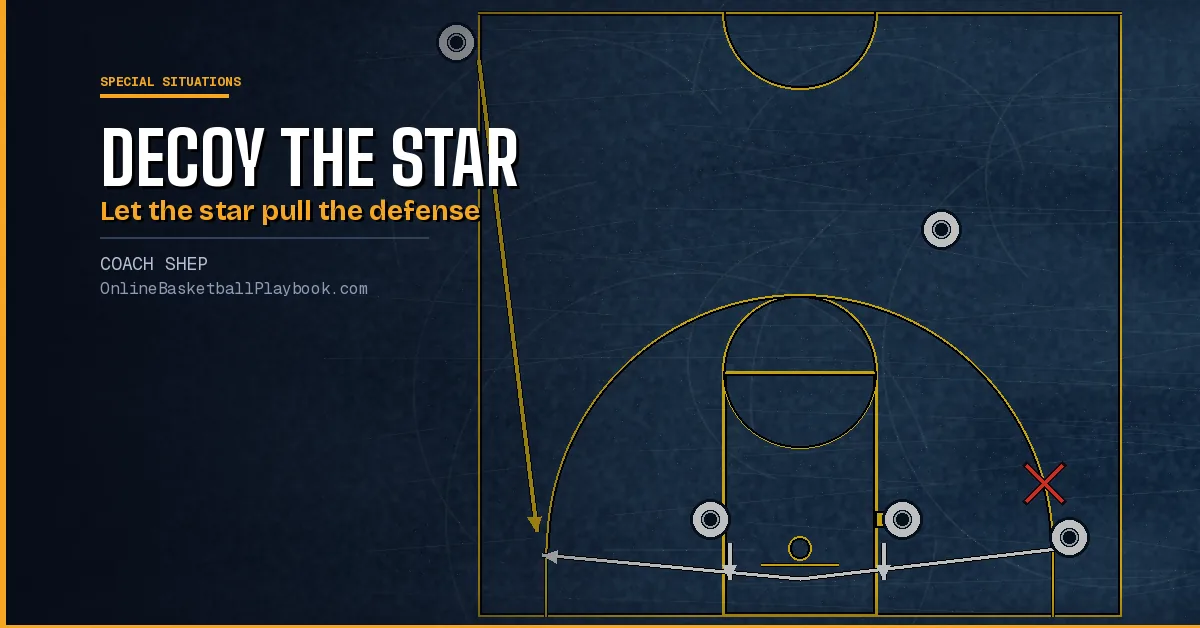
Late game plays for when the defense denies your best player: decoy the star, where he starts, reads for the sag and the deny, the open inbounder and the back door.
After Timeout Plays: ATO Sets by Score, Clock and Spot
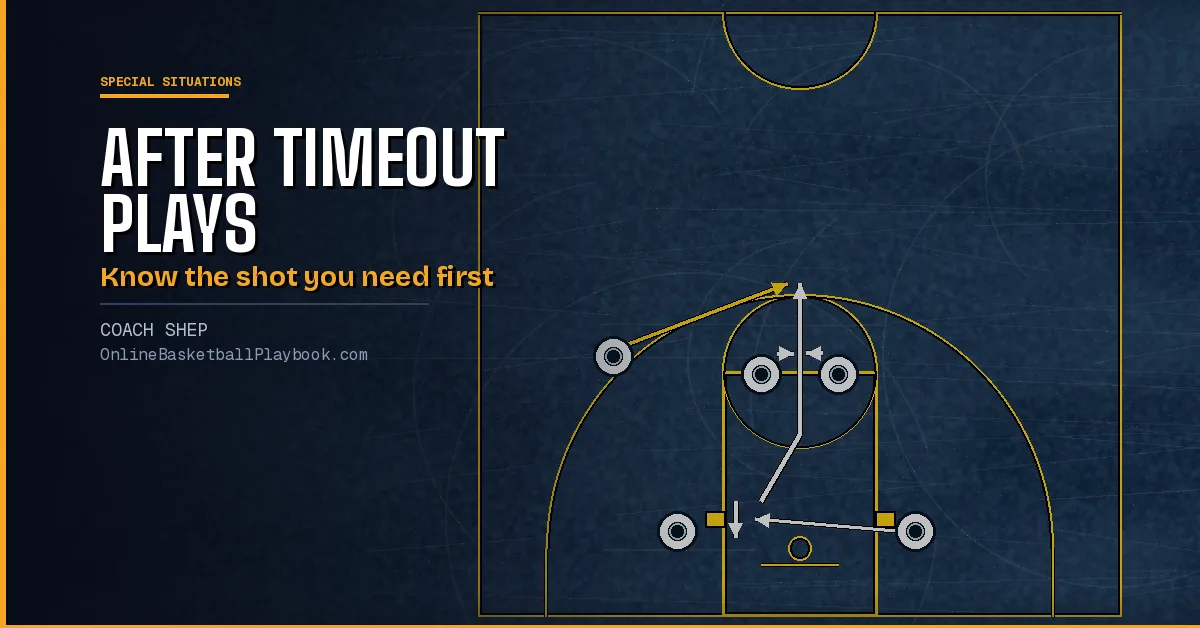
After timeout plays sorted by situation: need a three, need a two, stop a run, sideline or baseline, man or zone, with the fake, the counter and the huddle rules.