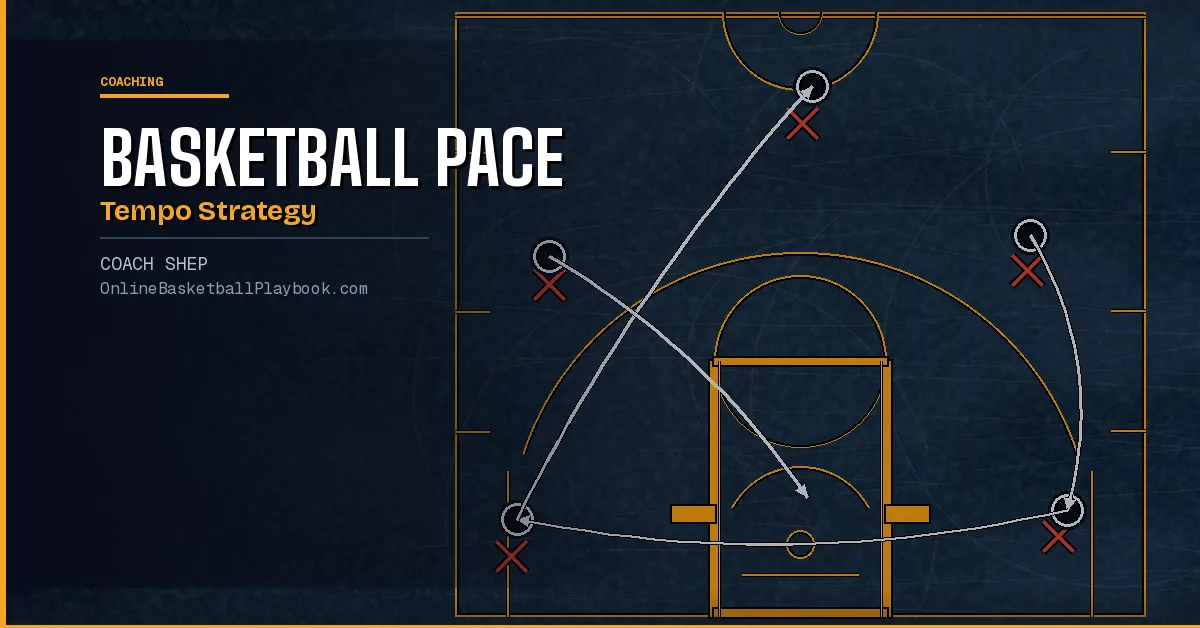
Pace and tempo are among the most undercoached decisions in basketball. How fast you play, and when you slow down, shapes your shot quality, conditioning edge, and ability to exploit a defense before it sets.
What Pace and Tempo Actually Mean
Coaches use "pace" and "tempo" interchangeably, but they point at different things. Pace is about how many possessions your team generates in a game, which is how fast the game runs. Tempo is about how quickly you make decisions within a possession: how long it takes to cross half-court, how soon your first action starts, and whether your offense initiates before the defense has matched up.
A team can rank high in pace (many possessions) but operate slowly within each one, wasting the early-clock advantage on a slow walk-up and a late-arriving set. Conversely, a team can play a deliberate pace (fewer possessions) but attack with sharp early reads the moment the ball crosses half-court. The coaches who use pace as a weapon understand both levers and know how to press each one based on personnel and game situation.
The strongest modern argument for pushing tempo comes from shot selection analytics. Shots taken in the first seven seconds of a possession (the open layup, the immediately open three) rank among the most efficient in the game. Every second you add before the shot puts more bodies between your players and the basket. The early clock is free money; the question is whether your team is organized enough to cash it.
The 3–5 Second Rule: Attacking Before the Defense Sets
The foundational principle in early offense is getting the ball over half-court in three to five seconds. That window is when defenders are scrambling, match-ups are disorganized, and the easiest baskets live. Every team gives it up for free on every made basket, every live-ball rebound, every turnover recovery. Most teams leave that advantage on the floor.
The clock starts the instant a player rebounds or secures the ball. The outlet must be immediate. The rebounder turns in the air toward the outside and pitches to the guard on the wing (not 28 feet, not at half-court, on the wing, so the guard already has momentum toward the basket). The point guard's job is not to catch and assess. The job is to push and read as the ball moves up the floor.
Lanes fill by rule, not by feel. The weak-side forward runs wide (baseline-to-baseline) and trusts the ball is coming if they are open. That trust has to be earned in practice: the guard must deliver when the wing is open, and the wing must sprint even when they doubt the pass is coming. Bust those habits in drills before you ever run it live, or the early break dies every time the first option is closed.
Hubie Brown's rule is direct: never pass back on the break. If you throw a pass backward in transition, you have erased the advantage and handed it to the defense. The only direction is forward.
Freedom Off Stops, Structure Off Makes
One of the cleanest organizing rules for early offense comes from Dan Hurley: freedom off stops, structure off makes. Two different situations, two different responses, and mixing them up kills both.
When your team gets a stop (a rebound off a missed shot, a turnover, a deflection), the defense is scrambling back. That is not the moment to run a called play. Guards who earn a numbers advantage in transition must win one-on-one. Blast the ball ahead, attack the paint, drive-and-kick. Do not call a ball screen. The drag ball screen in transition has become a crutch that kills the advantage: it gives the defense three full seconds to recover, removes the guard from a one-on-one matchup they should be winning, and stunts the development of ball handlers who need to learn to beat a scrambling defender without a pick.
When your team gives up a made basket, the defense has a head start. They are already running toward their spots, and any advantage you generate from pure speed is smaller. That is when you run a called action: a pistol, a wide pin, a dribble hand-off, a step-up. Structure creates the advantage that speed cannot. Named secondary-break actions (Early Go, Early Drag, Early Kick) are the bridge between the full-court sprint and the half-court offense, and they keep both parts of your attack connected rather than leaving a dead zone in the middle.
The practical implication: practice these as two separate systems with different triggers. Players need a clear read ("we got a stop, so I am attacking the paint") before they ever see it in a game. Run freedom-off-stops in competitive 3-on-2 and 4-on-3 drills where guards are graded on whether they generated a layup or open three without a pick. Run structure-off-makes in walk-through and half-court work so the named actions are sharp. Keep them separate long enough that the reads become automatic.
Shot Diet in Transition: Threes and Layups Only
The shot-diet rule for early offense is not optional: layups and threes only. No pull-up mid-range shots in transition. No floaters from 12 feet. No contested twos off a broken play. This sounds simple until you watch a guard catch a kick-ahead pass at the elbow with a defender closing hard and pull up for a 15-footer, a shot that, statistically, is one of the worst in basketball.
Bill Oats's analytics framework puts it directly: the early open three is worth six points, not three, because it arrives in the first seven seconds of a possession and is uncontested. A contested mid-range pull-up from a closely guarded guard is worth less than 0.8 points per possession. Those two shots are not in the same category. Treating them as equivalently acceptable options is a coaching failure, not a player mistake.
The rule also applies as a filter on the break itself. If a 7-second possession clock is running and the only available shot is a difficult two, the play is not to take the shot. The play is to skip it, reverse the ball, and flow into the half-court offense. That requires discipline and the expectation, set clearly in practice, that an unforced transition turnover in pursuit of a bad shot is worse than a controlled entry into your half-court sets.
George Karl's "Gap Offense" philosophy lands in the same place from a different direction: run every possession, give room to the ball, attack the paint, but the only acceptable shots are layups, open threes, and free throws. Tough twos are not in the vocabulary. Getting to that standard requires coaches to chart transition shot type during practice and hold players accountable for the shot they took, not just whether it went in.
When to Control Tempo Instead of Pushing It
Pace is not the answer for every roster or every game situation. Dick Bennett built one of the most respected defensive programs in college basketball by doing the opposite: slowing possessions to a crawl, forcing opponents into contested half-court decisions, and grinding the game into a shot-quality contest where preparation and execution beat athleticism. That works. The question is whether your personnel and your opponent make it the better choice.
The push-or-control decision depends on four factors. First, your own personnel: an athletic, deep roster gets better in a fast game because conditioning and depth become advantages. A thin roster with skilled but slower players often benefits from controlling tempo because fewer possessions means fewer breakdowns. Second, the opponent's tempo preference: pushing pace against a team built to run often plays into their strength. Slowing them down forces half-court execution they may not be ready for. Third, foul trouble and game situation: late in a game with a lead, controlling tempo is basic game management. Fourth, your transition defensive discipline: if your team consistently gives up easy baskets in transition, pushing pace creates a tradeoff where your easy baskets are offset by theirs.
The Princeton offense sits at the control-tempo end of the spectrum: patience, shot quality, passing rhythm, and execution over speed. That philosophy has produced winning programs for decades. The lesson is that pace is a deliberate choice, not a default. Coaches who push tempo without understanding when to slow down are not using pace as a weapon. They are just playing fast because it feels good.
A deep, athletic roster built for conditioning should push every miss and every make. Flow into early attacks and use bench depth to wear opponents out in the fourth quarter. A thinner, more skilled roster should take the Bennett approach: take the clock down, hunt the good shot, and make possessions count individually rather than in volume.
Installing Pace: Drills and Teaching Cues
Pace is a habit before it is a system. The reads that produce early-offense baskets (the outlet to the right spot, the lane filled by the right player, the decision to attack paint versus kick to a corner three) cannot be figured out in the flow of a game. They have to be automated in practice, ideally in what Matt Painter calls "dry offense": running the break without defense so the reads are clean and players learn the decision, not just the reaction to pressure.
The Scramble drill installs the basic 3-on-2 outlet and push. Three offensive players against two defenders; the rebound triggers the outlet, the push, and the attack. The goal is a layup or an open three in fewer than five seconds from the rebound. Anything longer means the defense recovered. Restart and go again. Grade every rep on shot quality and clock time, not just whether the ball went in.
The Texas drill extends that to 4-on-3 and 5-on-4, progressively adding defenders so players learn the reads as coverage gets more complex. The principle stays the same: push fast, fill lanes by rule, attack paint, and do not settle for a mid-range shot when a layup or an open three is available.
John Brannen's timing gates give players clear benchmarks: ball up by 27 seconds on makes, 26 seconds on misses, all players in the frontcourt by 24 seconds, paint touch by 23 seconds. That level of precision turns a general concept ("play faster") into a measurable standard every player can track in real time. Post those numbers in the gym. Chart them in practice. The team will know exactly how they are doing without a coach yelling from the sideline.
The transition defense installation lives in the same practice. Transition offense and transition defense are one decision: who crashes the offensive glass and who gets back governs how fast you can push on the other end. Hubie Brown's "3-to-the-glass" rule (who crashes is determined by who shot) makes that decision a rule rather than a guess. The point guard goes to the offensive glass but immediately becomes the outlet if the rebound is secured; if the outlet goes elsewhere, the guard sprints to ball level. Build those habits in drills before they have to happen in a game.
Before your first live scrimmage of the preseason, run at least three dry-offense transition sessions with a stopwatch. Players need to see the timing gates (ball over half-court in 3–5 seconds, shot within 7 seconds) as concrete numbers they hit, not vague direction about "playing faster." The habit has to be clean before you add defensive pressure.
- 3–5 second push rule: The rebounder turns in the air and outlets immediately; the point guard receives on the wing, not at half-court, to preserve momentum toward the basket.
- Freedom off stops, structure off makes: After a stop, guards attack paint one-on-one. No ball screen. After a made basket, run a named secondary-break action (Early Go, Early Drag, Early Kick) that flows into the half-court offense.
- Shot diet enforcement: In transition, only layups and open threes are acceptable. Chart shot type in every practice and hold players accountable for shot selection, not just the outcome, on every break attempt.
- Lane filling by rule: The weak-side forward runs baseline-to-baseline on every push. That player must trust the ball is coming if they are open; the guard must deliver. Build mutual trust in drills before running it live.
- Timing gates: Ball over half-court by 26-27 seconds, all players in the frontcourt by 24, paint touch by 23. Post these numbers in the gym and track them during practice. Convert a concept into a measurable habit every player can own.
Want more basketball coaching strategies and drills?
Join the Online Basketball Playbook newsletter →
Draw this play free in the play drawer →
Membership: the full library, playbook packs, and Pro drawing tools →
Keep Building
Related breakdowns
Mentorship Program for Young Coaches: Match, Meet, Review
How to build a mentorship program for young coaches: set goals and a length, match on style and time, meet on a schedule, give one real job and review it.
AAU vs High School Basketball: How Coaches Work Together
A school coach's guide to AAU vs high school basketball: how the two seasons differ, how to place players and plan the summer, and how to coach an AAU team well.
European Basketball Principles American Coaches Should Steal
European Basketball Principles American Coaches Should Steal