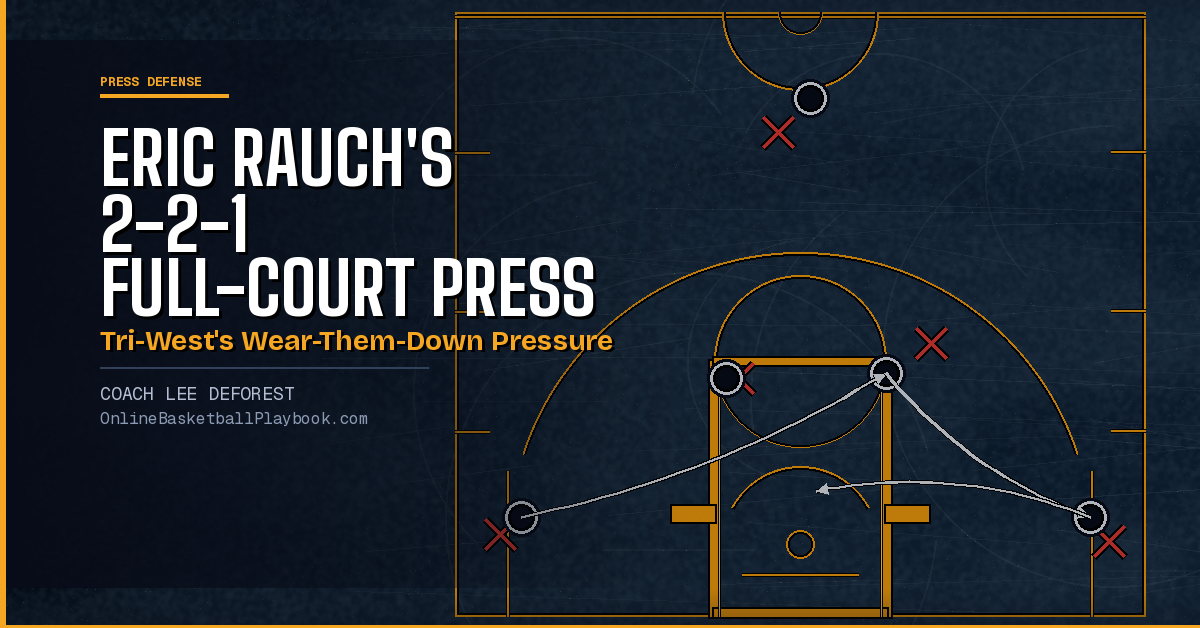
Most presses trade buckets. You trap, the ball skips up the sideline, and now you are chasing a layup the other way. The fix is not more gambling — it is a disciplined 2-2-1 that forces the slow pass and never fouls.
Eric Rauch presses at Tri-West because it does more than create steals. It sets the tempo from the opening tip, it lets a team make a run or two every game, and it puts a mental tax on an opponent who would rather walk the ball up and run their stuff in comfort. Pressure is the point as much as turnovers are.
The 2-2-1 also fits teams that are not the most athletic group on the floor. Two guards up top, two forwards on the line, one center protecting the rim — it keeps a back-line safety at all times, so the worst-case rep is a contained dribble, not an uncontested basket. That safety net is what lets you press for 32 minutes instead of one panicked possession.
"When guarding the ball be deceptive and bait the passer so you can get a tip."
Coach's Cheatsheet
- Use this when: you want to dictate tempo, wear a team down by the second half, or pressure a team that would rather walk it up and run their offense.
- Core teaching point: guards move together, forwards move together — pressure the ball and keep it out of the middle of the floor at all costs.
- Trap rule: force the ball handler to the sideline and trap when he crosses half court into the trapping zone; close with active hands and do not foul.
- The pass to force: over or under but never through — make them throw a lob or a bounce pass, because those take the longest to complete.
- Correction cue: get a touch, don't foul — a deflection does the work, and a cheap reach just hands them free throws and resets the clock.
- Practice install: build it small-to-big — 1-on-1 control, 2-on-2 movements, 2-on-1 trap, then 4-on-3 rotation — before you ever press five live.
Why the 2-2-1 — Tempo, Runs, and Wear
Rauch's case for the press is not just turnovers. It is the four things constant pressure buys you across a game: it lets you make a run at least once or twice, it wears mentally on the other team because no player enjoys being pressured, it sets the tone and pace from the opening possession, and — the underrated one — players enjoy pressing, so you get effort for free.
That fourth point matters more than coaches admit. A defense your players want to run is a defense they will run hard in the fourth quarter. The 2-2-1 gives them a reason to sprint, trap, and talk, and it turns defense into the fun part of practice instead of the punishment.
Sell the "wear them down" idea to your team early. The press rarely steals the game in the first quarter — it steals it in the third, when the other team's guards are tired of getting bumped, hurried, and trapped every trip. Tell your players the turnovers come later, so they keep the pressure honest even when the early steals do not show up on the stat sheet.
The Alignment: Five Jobs in the 2-2-1
The 2-2-1 sets two guards across the front, two forwards on the line behind them, and a center as the back-line safety. Every spot has a clear job before the ball is even inbounded.
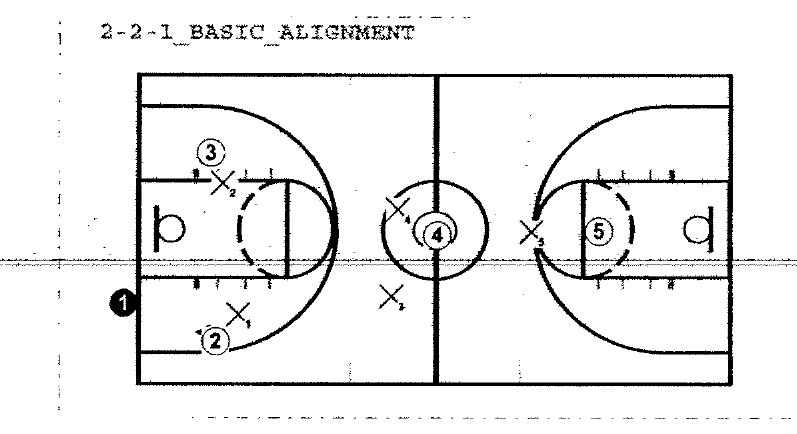
Guards (1-2)
- Make the offense catch in front of you. Never let the ball be received behind you — start within an arm's length of the closest man.
- Steer to the dead man's corner. Try to make them receive the inbounds in the corner, where the sideline and baseline help you trap.
Forwards (3-4)
- Play on-the-line, up-the-line. Match the man closest to you and never allow the ball to be caught in the middle of the floor or behind you.
- Anticipate the next pass. Watch his chest, read where he is facing, and cheat a step toward the pass you know is coming.
Center (5)
- Own the back line. Do not allow a long pass from out of bounds, and start on the strong side because the basket itself defends the weak side.
- If you gamble, finish it. If you go for a steal, make sure you get a hand on it — a half-commit from the safety is how you give up the layup.
The Key Principle: the press lives and dies on the middle of the floor. Keep the ball on the sideline and out of the middle, and the trap is a question of when, not if — let it leak to the center and the whole press is broken.
The Basic Rules That Make It Trap, Not Foul
The alignment is the easy part. The rules are what turn the 2-2-1 into a disciplined ambush instead of a track meet you lose. Rauch's list is short and blunt, and it starts with the loudest one.
The non-negotiables
- Talk, talk, talk. The press is a five-man conversation. A quiet 2-2-1 is a broken 2-2-1.
- Contain the dribbler. Pressure the ball so they worry about keeping it more than finding a teammate.
- Guards move together; forwards move together. The two pairs are tied at the hip — when one guard slides, the other mirrors.
- Keep the ball out of the middle. Everything funnels to the sideline.
- The back man can't give up a layup. The safety is the last line, and the press is built so he is never wrong to protect the rim first.
"Keep ball out of the middle of the floor."
The pass rule is the one that protects you from yourself. You do not try to deny every pass — you steer them into the slow ones. Over the top or a bounce pass underneath both take longer to complete and give your rotation time to arrive. The only pass you truly take away is the fast, direct one up the floor.
Drill the phrase "over or under but never through" until your players can recite it. A press that allows a direct pass up the sideline is just a slow man-to-man that gives up easy advances. When the trap forces a lob or a bounce pass, your weak-side defenders get the half-second they need to jump the catch — and that half-second is the entire steal.
The Sideline Trap and the Rotation Behind It
The trap is not a guess — it has a trigger and a place. As the ball is dribbled up the sideline, the weak-side guard keeps the handler pinned to the sideline and forces him across half court into the trapping area. That is where the second defender arrives.

Who does what on the trap
- Weak-side guard (2): keep the ball on the sideline, force him over half court, and work with the weak-side forward to trap. Do not foul. Get a touch on the ball.
- Weak-side forward (4): rotate up and trap when the dribbler hits the trapping zone, close with active hands, and partner with the guard to seal the sideline.
- Strong-side forward (3): drop back, replace the center, and play safety — do not give up a layup, read, and anticipate.
- Center (5): rotate up and fill the spot the weak-side forward just vacated, then read the passer and anticipate the next pass.
- Strong-side guard (1): take away the middle reversal and read the passer's chest to know where the ball is going.
Notice the chain reaction: the trap pulls one defender out of the back, so everyone behind him rotates up one spot. The forward becomes the safety, the center fills the forward's lane, and the press never leaves the rim or the middle naked. That rotation is the difference between a trap that creates a steal and a trap that creates a 3-on-2.
Teach the rotation before you teach the trap. Players want to leave their feet and go for the steal, but the steal only matters if the man behind them has already filled. Run the trap in slow motion first and make the back-line rotation automatic — then add speed. If the rotation is late, kill the rep and reset, because a late rotation is how a pressing team gets buried by a single skip pass.
When the Ball Is Reversed
Good teams will try to beat the press by reversing the ball and attacking the other side. The 2-2-1 answers it with symmetry: the roles simply flip. The strong-side guard now drops to the middle and anticipates the reversal, the weak-side guard becomes the on-ball pressure, and the forwards swap their trap-and-safety responsibilities to the new strong side.
The one rule that overrides everything on a reversal is the middle. If the ball ever gets to the middle of the floor, the guards collapse hard and get it out of there, while the forwards anticipate and fill the sideline passing angles. The press will survive a reversal all day — it will not survive a catch in the middle with numbers.
Practice Install: Your Monday Plan
Here is how I would install the 2-2-1 with a team that has never pressed before. Build it small-to-big so the trap and the rotation are habits before you ever play it five-on-five. One full-court block, about 30 minutes.
Block 1 (6 min) — 1-on-1 Full-Court Control
Start with the single most important habit: contain. One defender, one dribbler, full court. The defender's only job is to steer the handler to the sideline and never get beat to the middle. No traps yet — just teach the body position that makes every later trap possible.
Block 2 (8 min) — 2-on-2 Tandem Movements
Now pair them up — both guards together, then both forwards together. Drill the "move together" rule so the two defenders stay tied at the hip as the ball moves. Your only correction is spacing: if one slides and the other does not, the middle opens, so reset and repeat.
Block 3 (8 min) — 2-on-1 Trap, Get a Touch
Add the trap in isolation. Weak-side guard forces the dribbler to the sideline trap zone, the partner arrives, and they seal him with active hands. The only thing you are grading is whether they get a touch and never foul. Run it from both sidelines until the trap arrives on time and clean.
Block 4 (8 min) — 4-on-3 Rotation and Anticipation
Finally, add the back line. Play it live but cap it at four-on-three so the rotation is exposed and obvious. On every trap, the back defenders rotate up one spot and read the passer. End the rep the instant the offense advances the ball cleanly past the trap, so players feel the urgency of arriving on time.
Variations and Progressions
Progression 1: Deny the Inbounds
Once the base press is solid, add a full-denial inbounds look. Guards face-guard the first pass to make the entry itself a battle, which speeds up the offense's clock before they ever cross half court. Drill 2-on-2 and 3-on-3 denial out of bounds so the deny does not leak a backdoor catch.
Progression 2: Tandem Guards for a 1-3-1 Look
Stack the two guards in tandem to show a 1-3-1 front. It is the same back line and the same vocabulary, but the changed picture forces a prepared press-break team to re-read the front line on the fly — and re-reading is where you steal possessions against a team that thought it had you solved.
Progression 3: Contain Without Trapping
Some nights you want to slow the game down, not speed it up. Keep the 2-2-1 shape but contain without trapping — pressure the ball, deny the middle, and force a long possession instead of a turnover. It is the same press dialed to a different tempo, useful when you are protecting a lead.
Get Free Coaching Notes
Join the Online Basketball Playbook newsletter for new playbook breakdowns, drills, and practice-ready install ideas.
Get Free Coaching NotesDraw this play free in the play drawer →
Membership: the full library, playbook packs, and Pro drawing tools →
Final Thoughts
The 2-2-1 is not complicated on paper: two guards, two forwards, one safety, and a trap that springs on the sideline past half court. What makes Rauch's version work is the discipline wrapped around it — keep the ball out of the middle, force the slow pass, get a touch instead of a foul, and rotate the back line up on every trap.
Press to set the tone, trap without fouling, and trust that the turnovers come in the second half when the other team is worn down. Do those things, and your 2-2-1 will wear teams out and set the pace — instead of handing back the layups you worked so hard to prevent.
Keep Building
Related breakdowns
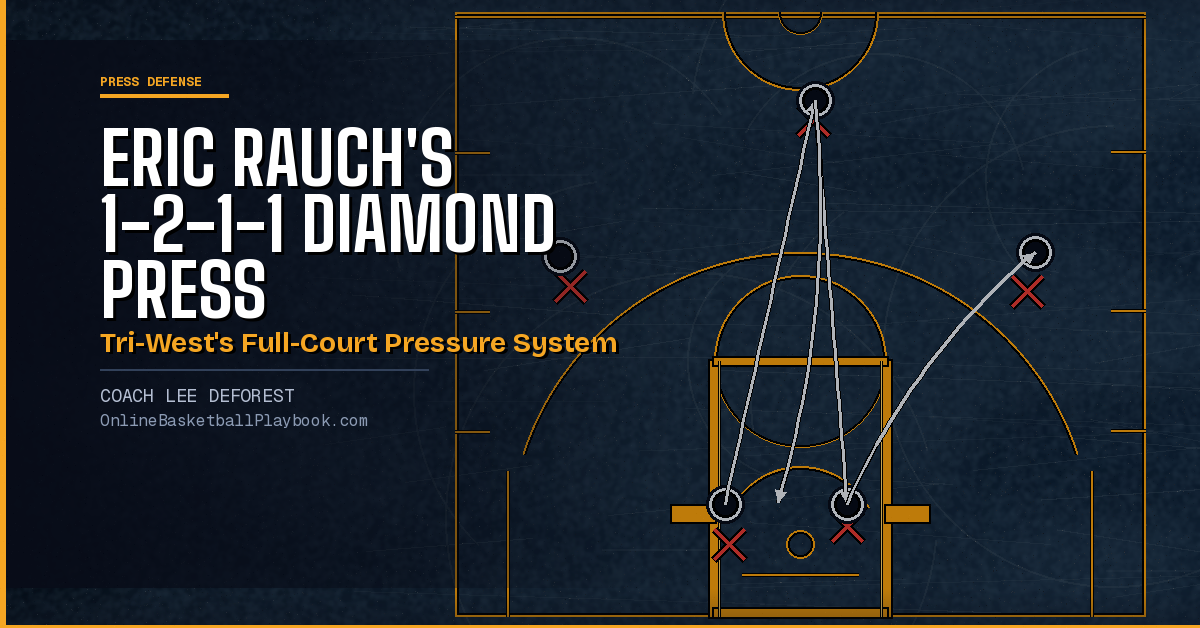
Eric Rauch's 1-2-1-1 Diamond Press: Tri-West's Full-Court Pressure System
A complete full-court press from the Tri-West Bruins — the alignment, the eleven rules that make it trap without fouling, and how to install it so it creates points instead of giving up layups.
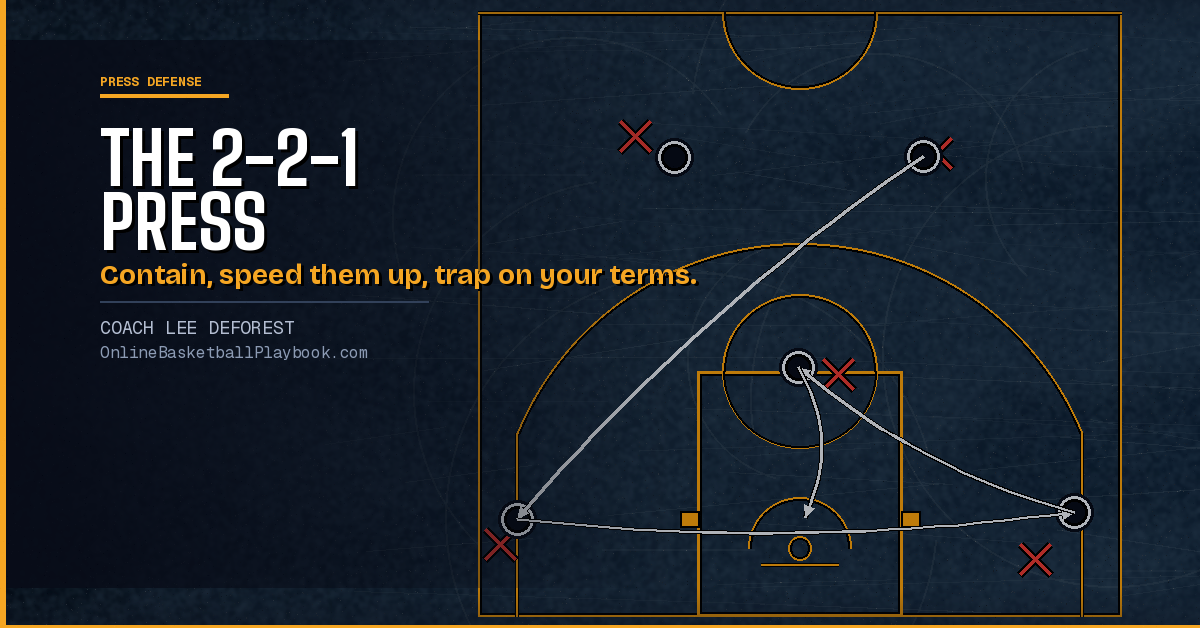
How to Coach the 2-2-1 Full-Court Press (Complete Guide)
The containment press that speeds opponents up and forces turnovers on your terms — without gambling your back end on every possession.
Winchester's Becoming a Pressing Team: Chip Mehaffey's Full-Court Press Philosophy
Chip Mehaffey builds Winchester into a pressing team with one identity goal — trap the backcourt every possession — plus the rules, daily skills, and drills that make it hold up.
More from Online Basketball Playbook
Basketball Pace & Tempo Strategy
The 2-2-1 controls pace — understand how tempo manipulation sets up the press.
How to Coach Defensive Rotations
When the 2-2-1 trap is beaten, the rotation behind it determines the outcome.
Basketball Substitution Patterns
Full-court pressure burns legs — a smart rotation plan keeps the press sharp.