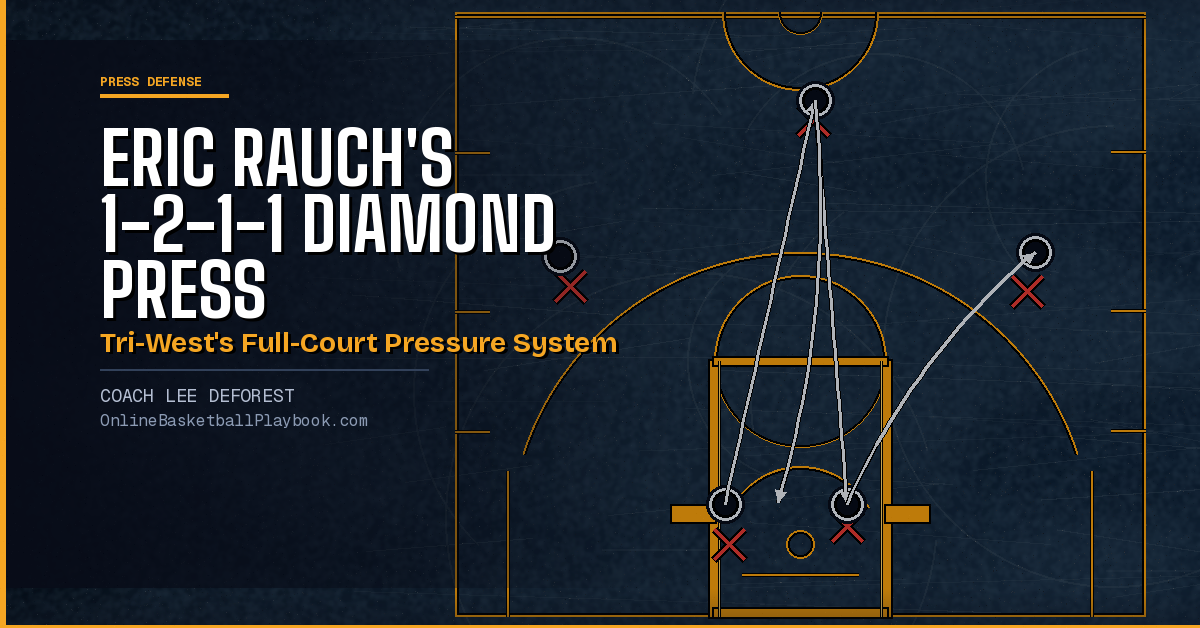
Most full-court presses give up more layups than they force turnovers. The defense traps, the ball skips one pass ahead, and now it's four-on-three going the other way. Coach Eric Rauch's 1-2-1-1 diamond press is built to stop exactly that.
Rauch runs the diamond at Tri-West because it does two jobs at once: it speeds up the game against an athletic team, and it hides behind a 2-2-1 look when his team isn't the more athletic group. The press isn't a gimmick to him — it's a way to set the tone in the full court and take the ball out of the other team's best player's hands.
"The diamond can really produce a lot of points in a short period of time."
This breakdown gives you the alignment, the eleven rules Rauch teaches to trap without fouling, the five jobs by position, and a Monday practice plan to install it so your press forces turnovers instead of surrendering easy baskets.
Coach's Cheatsheet
- Use this when: you want to dictate tempo, attack a weak ball handler, or speed up a game your half-court defense won't win.
- Core teaching point: always play the ball — on any ball movement, move with the pass and fill the nearest lane before you guard your man.
- Trap rule: two on the ball with high hands on the sideline; the other three zone up between the four remaining offensive players.
- The pass to force: over or under, but never through — make them throw a bounce pass or a lob, because those take the longest to complete.
- Correction cue: "Get a touch!" — a hand on the ball cuts down on fouling and lets a teammate finish the steal.
- Recovery: one forward pass beats the press, so on a completed pass up the floor, sprint back into man-to-man — "one and done."
Why the Diamond — and When Rauch Switches to 2-2-1
Rauch's first principle is honest self-scouting: the press should fit the team you actually have. When his group is more athletic than the opponent, he pressures with the diamond. When the matchup is even or he's at an athletic disadvantage, he favors the 2-2-1, which gives up a little pressure for a lot more safety.
The two presses share a back line and a vocabulary, so he can flip between them mid-game to confuse a team that thought it had the look solved. Either way, the goal is the same: make the opponent do something they don't practice much, and make your team the aggressor.
The Key Principle: a press is a tempo decision, not a personnel flaw. Press when you're more athletic to speed the game up; fall back to the 2-2-1 when you're not, so you keep the pressure without trading it for layups. Pick the look that fits tonight's team, not last year's.
The Alignment: Five Jobs in the Diamond
The 1-2-1-1 sets a diamond over the inbounds: a point man on the ball, two wings, a middle man, and a deep safety. Each spot has a clear job.
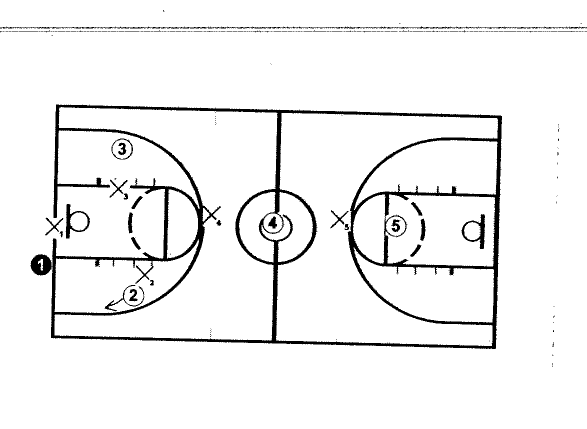
- Point man (1) — usually your long-armed athlete. Stagger your body to steer the inbounds to the strong side (the shortest distance to run a trap). Be big, arms out, but stay in a stance.
- Wings (2 and 3). Keep the guards in front of you, encourage the catch in the trapping zone, and influence the receiver right away so he never feels in control.
- Middle man (4). Play on-the-line, up-the-line; don't allow the flash to the ball; be ready to intercept the lob over the top of the wings.
- Deep man (5). Play the safety. If no one is back, communicate up into a 1-2-2 look — but always be hunting a zone position between two offensive players.
The Eleven Rules That Make It Trap, Not Foul
The reason most presses fail isn't the alignment — it's the trap. Rauch's rules turn the trap into a disciplined, no-foul ambush instead of a wild gamble.
"Over or under but never through. Make them throw a bounce pass or a pass over the top, because they take the longest to complete."
Two defenders trap on the sideline with high hands; the other three zone up between the four remaining attackers. The trap doesn't try to win with reach — it wins by taking away the easy pass and forcing the slow one.
The single most important rule is the one that protects you: get a touch on the ball, and never foul when trapping. A deflection or a redirected pass does the work, and "fouling negates hustle" — a cheap reach turns your aggression into free throws and a reset clock. Trap to disrupt, not to gamble.
The rest of the rules keep the picture clean: control the dribble, force the long pass, never let the ball go up the floor on a direct pass, move as the ball is in the air rather than when it's caught, and sprint low out of every trap so the next rotation arrives on time.
One and Done: The Recovery Rule
A press is only as good as its bail-out, and Rauch's is simple. The diamond is designed to make the first pass hard. Once the offense actually completes a pass that beats the front line, you don't keep gambling — you convert.
"One and done — one forward pass and you get back into your man-to-man defense."
That one rule is what separates a press that creates points from one that gives them up. The deep man and middle man are always splitting two players and reading the safety, so when the ball is advanced, the back line already has numbers to retreat into a set half-court defense.
Practice Install: Your Monday Plan
Here's how I'd install the diamond with a team that has never pressed before. One full-court block, about 25 minutes.
Block 1 (5 min) — Walk the Diamond, No Offense
Set the five spots and name the jobs out loud. Walk the point man's stagger, the wing's influence, the middle man on-the-line, and the deep safety. Players have to know their starting spot before they can read a pass.
Block 2 (8 min) — Trap Two, Zone Three
Add a ball and inbound it live. Drill only the first trap: two on the ball with high hands, three zoning up between the remaining four. Your only correction is "get a touch, don't foul." Reset and repeat from both sideline spots.
Block 3 (8 min) — Live to "One and Done"
Play it full and live, but the rep ends the instant the offense completes a forward pass past the front line. On that pass, the defense yells "one and done" and sprints into man-to-man. You're teaching the press and the recovery in the same rep.
Block 4 (4 min) — Show the 2-2-1
End by walking the same back line into the 2-2-1 look so players feel how the two presses share a vocabulary. Being able to flip looks mid-game is the whole point — the offense beats the diamond once, you show them the 2-2-1, and now their press break is solving the wrong problem.
Variations and Progressions
Progression 1: 1-2-2 Drop
When the deep man sees no one is back, he communicates the team up into a 1-2-2 alignment. Drill the call so the rotation is automatic and you never get caught with the safety out of position.
Progression 2: Deflection Points
Score the press by touches, not just turnovers. Award a point for every deflection so players are rewarded for active hands in the trap — the habit that makes "get a touch" real instead of a slogan.
Progression 3: Disguise the Front
Start in the diamond and switch to the 2-2-1 after the first dead ball, or vice versa. Forcing the offense to re-read the front line on the fly is where the press earns its turnovers against a prepared team.
Get Free Coaching Notes
Join the Online Basketball Playbook newsletter for new playbook breakdowns, drills, and practice-ready install ideas.
Get Free Coaching NotesDraw this play free in the play drawer →
Membership: the full library, playbook packs, and Pro drawing tools →
Final Thoughts
The 1-2-1-1 diamond isn't complicated. Four trapping spots and a safety, two defenders on the ball, three zoning the rest. What makes Rauch's version work is the discipline around it: force the long pass, get a touch instead of a foul, and get out after one completed pass.
Press to set the tone, trap without fouling, and live by "one and done." Do those three things and your press will produce points in a short period of time — instead of giving them away.
Keep Building
Related breakdowns
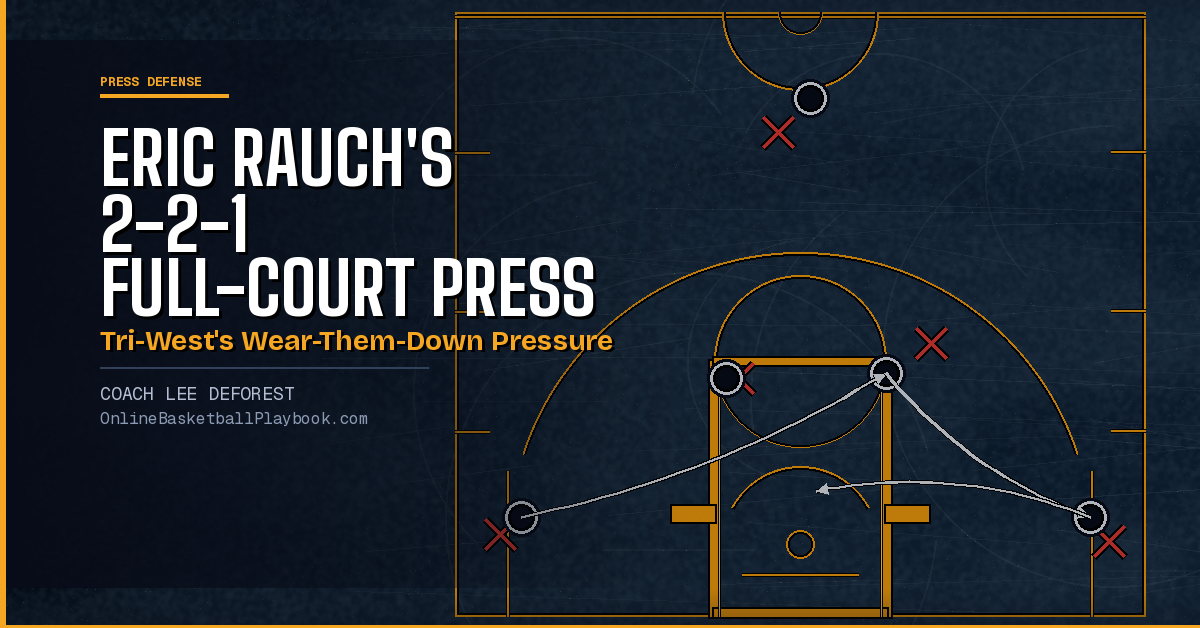
Eric Rauch's 2-2-1 Full-Court Press: Tri-West's Wear-Them-Down Pressure
Constant full-court pressure that sets the pace, forces second-half runs, and wears teams down — without fouling your way to the free-throw line.
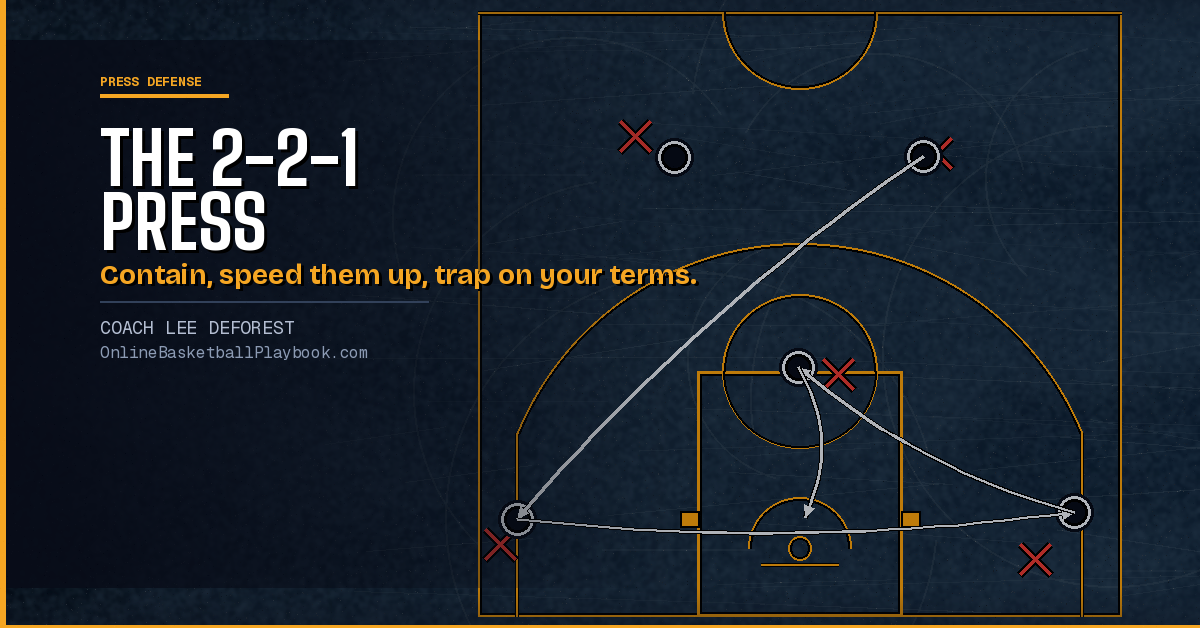
How to Coach the 2-2-1 Full-Court Press (Complete Guide)
The containment press that speeds opponents up and forces turnovers on your terms — without gambling your back end on every possession.
Winchester's Becoming a Pressing Team: Chip Mehaffey's Full-Court Press Philosophy
Chip Mehaffey builds Winchester into a pressing team with one identity goal — trap the backcourt every possession — plus the rules, daily skills, and drills that make it hold up.
More from Online Basketball Playbook
How to Build a Defensive Identity
A press only works when players are committed to it all 32 minutes — build that identity.
Basketball Substitution Patterns
The diamond press is energy-intensive — have a rotation plan ready before tip-off.
Basketball Conditioning Programs
The diamond press requires elite conditioning — here’s how to build it in preseason.