Teaching players to break a press is really about teaching poise, spacing, and decision-making at full speed. These drills build each skill in isolation before you put it all together under live pressure.
Why Drilling Press Break Beats Diagramming It
You can draw a beautiful press break on a whiteboard and have every player nod, and then watch the first trap cause complete chaos. That's because breaking the press is not a scheme problem. It's a reads-under-pressure problem. Players panic, pick up their dribbles too early, throw the ball away, or stand flat-footed while the defense runs to them. No diagram fixes that. Repetition at game speed does.
The goal of every press break drill is the same: get players so comfortable with their spacing and their reads that the right decision happens automatically. That means you need drills that isolate the skill (outlets, dribble escapes, middle reads) before layering in defenders. Once the skill is there, you add pressure. Once pressure is handled, you add the full break.
This approach mirrors the way good coaches build any complex skill: walk before you run, and always tie the drill back to a game scenario. When players understand why they're doing the footwork or the spacing, the learning sticks. If you're building your broader basketball practice plan, press break work should have its own block, not be jammed in after conditioning when players are too tired to think.
The other thing drills do that diagramming cannot: they expose which players are truly the problem. Maybe your point guard panics on the catch. Maybe your wing can't throw a skip pass under pressure. Maybe your big just won't run the floor. Drills show you the real issue, and once you see it, you can fix it.
Spacing and Outlet Drills
Before you run any full-court press break drill, players need to know how to create a proper outlet. The inbounder-outlet relationship is the first thing a press breaks down, and it's the first thing you should train.
The Three-Outlet Drill
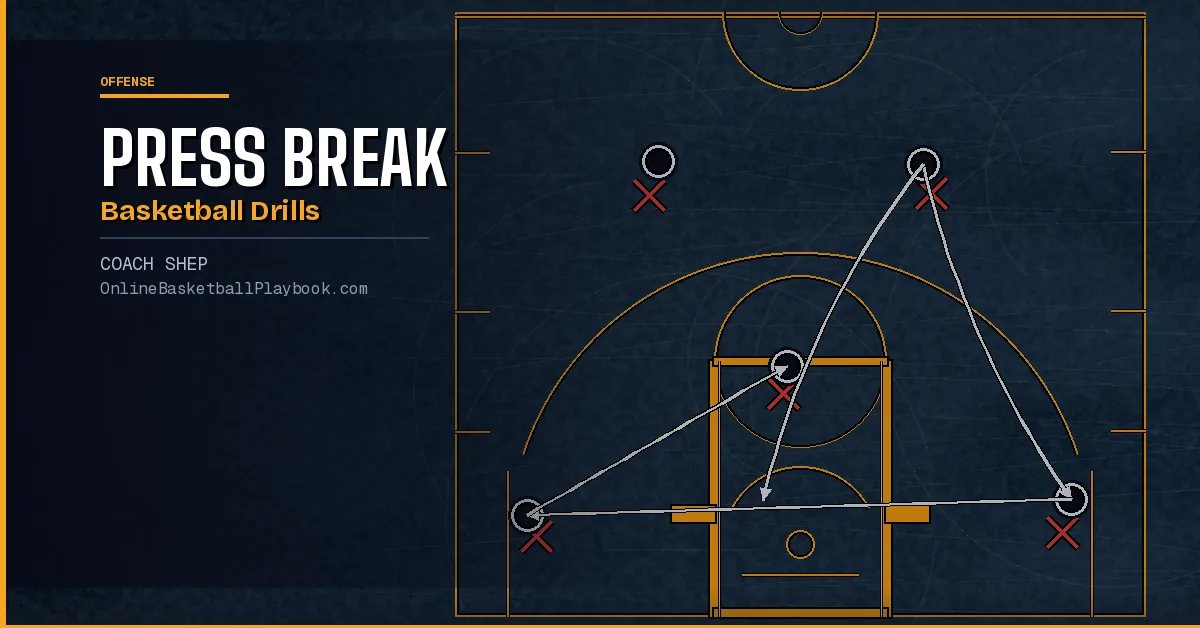
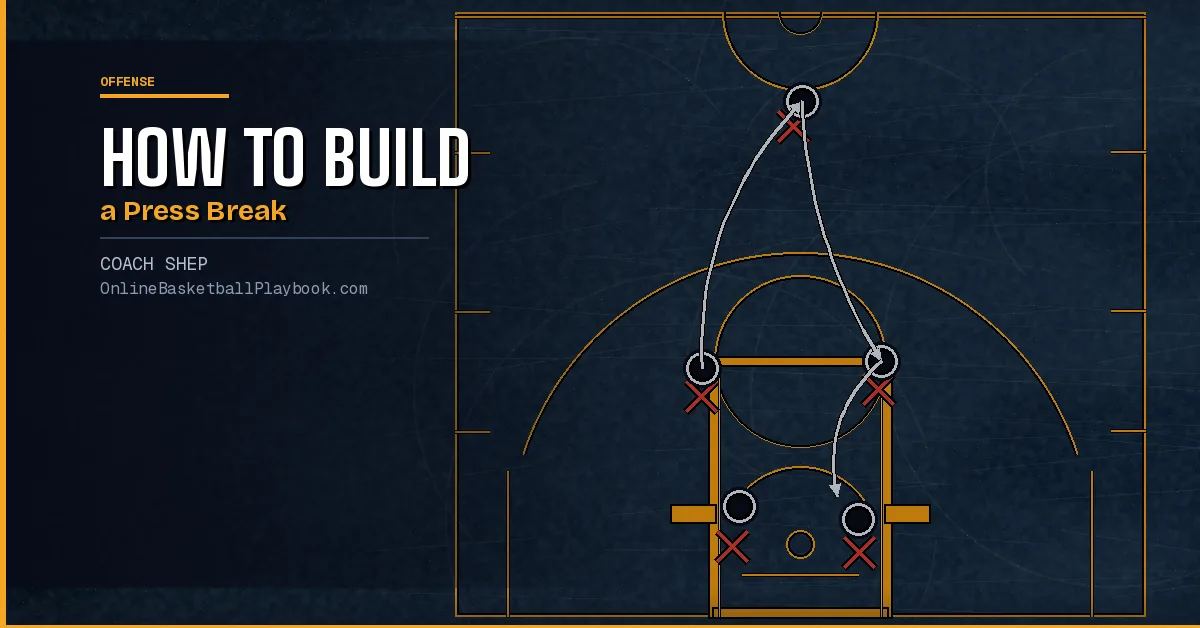
Set up with an inbounder out of bounds under your own basket. Place three players in outlet spots: one on the sideline (your safety valve), one in the middle of the floor at the free-throw line, and one who reverses back toward the ball when pressure comes. No defense yet. The inbounder throws to each outlet in sequence, calling "sideline," "middle," or "reverse" as they release. The receiving player catches, turns, and makes a two-hand overhead pass back. Run this for three minutes until the movement is automatic.
Progress it: add a token defender on the sideline outlet. Now the inbounder must read which outlet is open and hit them. The point of the drill is to establish the habit of always having three options (sideline, middle, and reverse) before the ball is ever inbounded.
The Pull-Back Dribble Drill
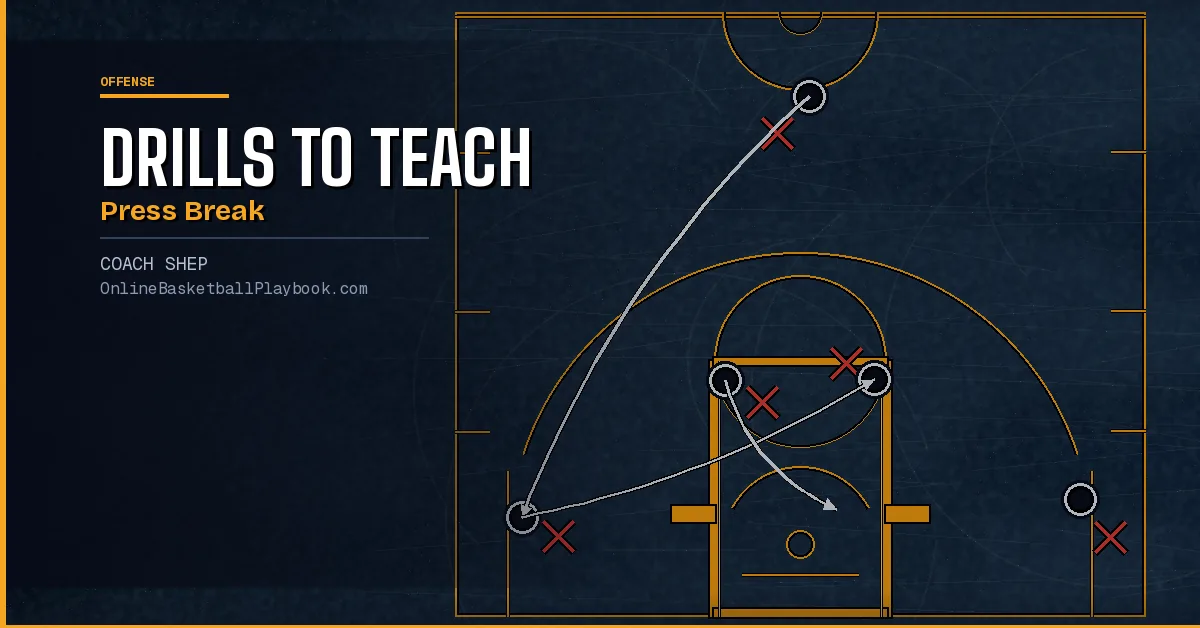
Many press breaks fall apart not on the inbound but on the first or second dribble when a trap closes on the ball handler. The pull-back dribble is the escape. Line players up at half court. On the whistle, each player simulates a trap closing. Two coaches or managers step toward them with pads or just hands up. The player uses a pull-back dribble (chin to top shoulder, big push-steps backward, eyes up the whole time) to create separation and then swings the ball to a teammate stationed behind them.
This drill is boring to watch and critical to master. Run it daily for two weeks when you first install the press break. You want the pull-back dribble to be an instinct, not a choice.
Five-Spot Outlet Passing
Place players at five spots across the full court: inbounder, sideline outlet near the ball, middle safety, a wing above half court, and a trailer. Run the ball up the floor without dribbling, only passes. This forces every player to see the floor, sprint to their spot, and deliver crisp passes. Time it. Your target is eight seconds from inbound to layup. When you beat it consistently, reduce to six. This drill also builds the conditioning required for press break basketball: You can't execute it if you're gulping air every time you catch.
Reading the Trap: Live Progressions
Once players know their outlets and their pull-back escape, you teach them to read what the defense gives them after the trap. This is where most teams stop short. They teach "escape the trap" and never teach "now attack."
2-on-1 Trap Read Drill
Start with the ball at half court. Two defenders trap the ball handler. Three offensive players are spread behind the trap, one on each sideline wing and one in the middle. The ball handler must read which defender commits and throw to the open man. That player catches and pushes into a 2-on-1 against a single deep safety. You are teaching the arithmetic of the press: a two-man trap always creates a numbers advantage if you see it and attack it.
Run this at three-quarter speed first. Players need to see the reads clearly before they try to make them at game pace. Gradually add tempo until defenders are going full speed on the trap and the ball handler has two seconds to decide.
3-on-2 Fast Break After the Break
Connect the press break to the fast break. After the ball escapes the trap in your outlet drill, run a 3-on-2 into the scoring end. This conditions players to sprint, no walking after a good pass, and teaches them that the press break doesn't end at half court. If you're also working on how to run the fast break, this is a natural bridge between the two skills.
Live 3-on-3 Half-Court Trap Reads
Before going full court with defenders, use half-court 3-on-3 trapping sessions. Two defenders trap the ball, one plays the passing lane. Three offensive players must escape, reverse the ball, and score. This is the hardest drill in the progression because there's nowhere to hide. Every player must read and react. Keep this drill short and high-intensity: four-minute windows maximum.
Full-Court Press Break Drills
Now you're ready for the full-court press break in a drill format. These progressions go from structured to live.
5-on-0 Walk-Through
Run the full press break alignment, your 1-4 or whatever system you run, at walking speed with no defense. Every player calls out their role as they fill it. This is not a drill for athleticism; it's a drill for communication and habits. Do it at the start of every press break session so players arrive to the live portions with the movements already in their bodies.
5-on-2 Pressure Drill
Add only two defenders, one on the inbounder's target and one as a roamer. Five offensive players run the full break. The limited defense creates just enough disruption to test reads without overwhelming inexperienced players. Use this drill when you're first installing the break with younger or less experienced teams.
5-on-5 Press Break Live
Full-court, full defense, live reps. Set a rule: the offensive team scores a point every time they get a layup directly off the break. The defensive team scores a point every time they force a turnover or a half-court pullback. This scoring system creates the right competitive incentive because offensive players want the layup, not just to cross midcourt.
Vary the press each day. Run it against a full court press defense look one day and a run-and-jump look the next. Your players need to recognize different looks and adjust, not just run a memorized pattern.
The Scramble Drill
This is a chaos drill. The coach blows the whistle at a random moment during 5-on-5 to signal "press break", even if the offensive team has the ball in the half court. Offensive players sprint back, one player takes it out of bounds, and they run the full break against a defense that is already set. This simulates the real game: a made basket, a timeout, a change-of-possession where the press comes at you before you're organized. Composure under chaos is what this drill teaches.
Putting It Together in Practice
How you sequence these drills inside your practice matters as much as the drills themselves. Here is a structure that works at every level from middle school to college:
Day 1 (Installation): Three-outlet drill (no defense), pull-back dribble drill, 5-on-0 walk-through. Spend the whole session on form and communication. Don't rush to live.
Day 2 (Reads): Three-outlet drill with one token defender, 2-on-1 trap read drill, 3-on-2 fast break conversion. Players are now seeing reads and finishing them.
Day 3 (Pressure): 3-on-3 half-court trap reads, 5-on-2 full-court drill, 5-on-5 live with the scoring system.
Ongoing maintenance: Once the break is installed, you need only ten minutes of press break work per practice, five-spot outlet passing and one live rep window. If you're running a comprehensive basketball player development program, press break work also builds ball handling, passing under pressure, and court vision simultaneously, so the time investment pays double dividends.
One coaching point that gets overlooked: your inbounder matters. Most coaches throw their worst player out of bounds and focus on the four players on the floor. Your inbounder sets the tone. They must be poised, able to read two or three outlets simultaneously, and able to deliver a hard, accurate pass under pressure. Treat inbounder as a real skill position and train it that way.
Most press break breakdowns trace to one of three causes: the wrong player catching the inbound (no footwork, no poise), a ball handler who picks up the dribble too early before reading the trap, or receivers who don't sprint to their outlet spots and arrive late. Address these in that order: the outlet catch first, the ball handler second, the spacing third.
Common Mistakes and How to Fix Them
Even teams that run press break drills regularly make the same errors. Identifying them early saves you from embedding bad habits that are hard to unlearn later.
Picking Up the Dribble Too Early
This is the most common mistake. A player catches the ball, sees pressure coming, and picks up the dribble immediately. Now they're a passing liability with no escape. Fix it in the pull-back dribble drill. Require players to stay live until they actually pass the ball. If they pick up early in a drill, restart the rep.
Standing Still on the Wing
Outlet players stand at their spot and wait. Defenders run to them while they're flat-footed. The fix is a simple rule: if you're not catching the ball in the next two seconds, you are moving. Always moving, either deeper to create a passing angle or back to the ball to shorten the pass. A moving target is much harder to deny.
Not Finishing the Break
Players cross half court and relax. The press break ends with a basket or a good half-court possession, not with "we got past midcourt." This is a mindset issue as much as a skill issue. Use the 5-on-5 scoring system that rewards layups to create the right incentive. If players are content surviving the press, the defense will figure that out and press harder.
No Communication
Silent press breaks fail. Every player should be talking: calling their spot, calling for the ball, warning the ball handler about a trap. Make calling loudly a requirement in every drill, not just games. If players are quiet in the three-outlet drill, stop the rep and start over.
Over-Relying on One Player
Teams that depend on their best ball handler to break every press are one substitution or one foul trouble situation away from disaster. Every guard in your program should be able to receive the inbound and push the ball up the floor. Use the pull-back dribble drill and the five-spot outlet drill with different players in the point position each day. Press break competence should be distributed, not concentrated.
- Three outlets every time: sideline, middle, reverse. Drill until players set them up automatically before the ball is inbounded.
- Pull-back dribble daily: run the escape dribble drill every practice for two weeks on installation; weekly maintenance after that.
- Inbounder is a skill position: train your best available passer here, not your weakest ball handler.
- Reward the layup, not just the advance: use the scoring system in 5-on-5 live reps so players hunt the basket off the press break.
- Vary the press look: run break reps against man, zone, and run-and-jump looks so players read and react rather than memorize a pattern.
- Communication is mandatory: require verbal calls in every drill rep; silent reps get restarted.
- Install in three sessions: form and alignment first, reads second, full live pressure third. Don't compress the progression.
Get free play diagrams, drills, and coaching guides delivered weekly.
Draw this play free in the play drawer →
Membership: the full library, playbook packs, and Pro drawing tools →
Keep Building
Related breakdowns
Press Break Basketball: Alignments, Reads and Drills
Press break basketball guide with the 1-4, 80-60-40 and 4-across alignments, reads against the 2-2-1, diamond and 2-1-2 press, and where coaches disagree.