A press break offense isn't just about crossing half court. It's about attacking full-court pressure for layups. Learn the spacing rules, alignments, and reads that turn traps into scoring opportunities for your team.
Why Attack the Press, Not Just Survive It
Most teams treat the press like a storm to ride out. They tell their players to be calm, hold the ball, and just get it across half court. That approach almost guarantees the press works because the defense faces zero consequences for applying it.
A true press break offense flips the mindset entirely. The goal is to score early, attack the numbers advantage created by the trap, and make the opponent pay for gambling with full-court pressure. When you build your press break around scoring opportunities rather than ball advancement, the defense has to choose: keep pressing and give up layups, or retreat and let you play your offense.
This philosophy matters at every level. Youth teams get pressed constantly because opponents know a scrambled dribbler under pressure leads to turnovers. High school teams face sophisticated full-court press defenses designed to create chaos. College and elite programs use trapping systems that take weeks to install. Your press break has to be built to score, not merely to survive.
The press also exploits one psychological tendency: panic. A player who gets trapped and looks down at the ball, or who throws the ball away under pressure, isn't making a technical mistake. They're making a mental one. Building a press break offense means building players who see the floor under pressure and recognize that the trap itself has created an advantage for their team.
Think about what a two-man trap actually costs the defense. Two defenders converge on the ball handler. That leaves three offensive players matched against three or fewer defenders, and often fewer, because the weak-side help has to shift to cover trap responsibilities. A team that can read this in real time and move the ball to the open man will score more often than it turns it over.
The Sideline-Middle-Reverse Spacing Law
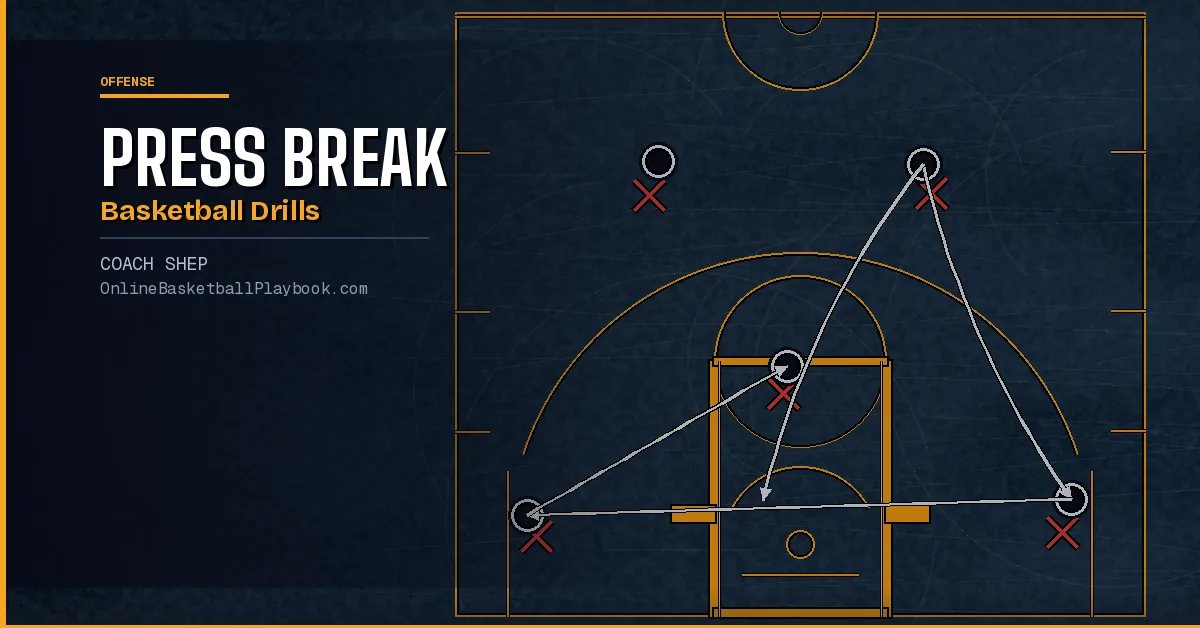
The foundation of every successful press break is what coaches sometimes call the anti-trap spacing law. Whenever the ball is in a position to be trapped, the handler must have three outlets available: a sideline option, a middle option, and a reverse option.
This principle destroys the trap by making it mathematically indefensible. Two defenders cannot trap the ball and simultaneously cover all three outlet options. The moment they commit to the trap, one of those three looks becomes open. The handler's job is to stay poised, chin up, and identify which of the three is available. Then make the pass before the trap fully closes.
Spacing execution requires discipline from all five players. The ball handler has to create the angle (through footwork, a pull-back dribble, or a pivot) to see the floor. The wings and trailers have to occupy the exact spots on the floor that correspond to the three outlet options, not bunch up near the ball, and not sprint ahead so far that they're out of range for a crisp pass under pressure.
The pull-back dribble is a critical skill in this system. When a trap closes, the handler turns their shoulders, brings their chin to their top shoulder to see the floor, and takes big push-steps backward. This buys angles and a half-second of time. Teammates respond by coming back slightly to shorten the pass. The result: the handler has space and options, and the trap is now broken.
Coaches who teach this system spend significant time on the passing drills that make it work. The passes in a press break are mostly short, two-handed, push passes (not lobs, not bounce passes that travel too slowly). Players need to build the habit of delivering the pass before the trap fully closes, not after they've already been double-teamed.
The 1-4 Alignment: One Look for Every Press
One of the biggest mistakes teams make with their press break is installing a different alignment for every press they face. One set for a 1-2-1-1, another for a 2-2-1, another for a man press. Players end up confused mid-game when they're not sure which look the defense is in, and by the time they figure it out, they've burned a timeout or thrown the ball away.
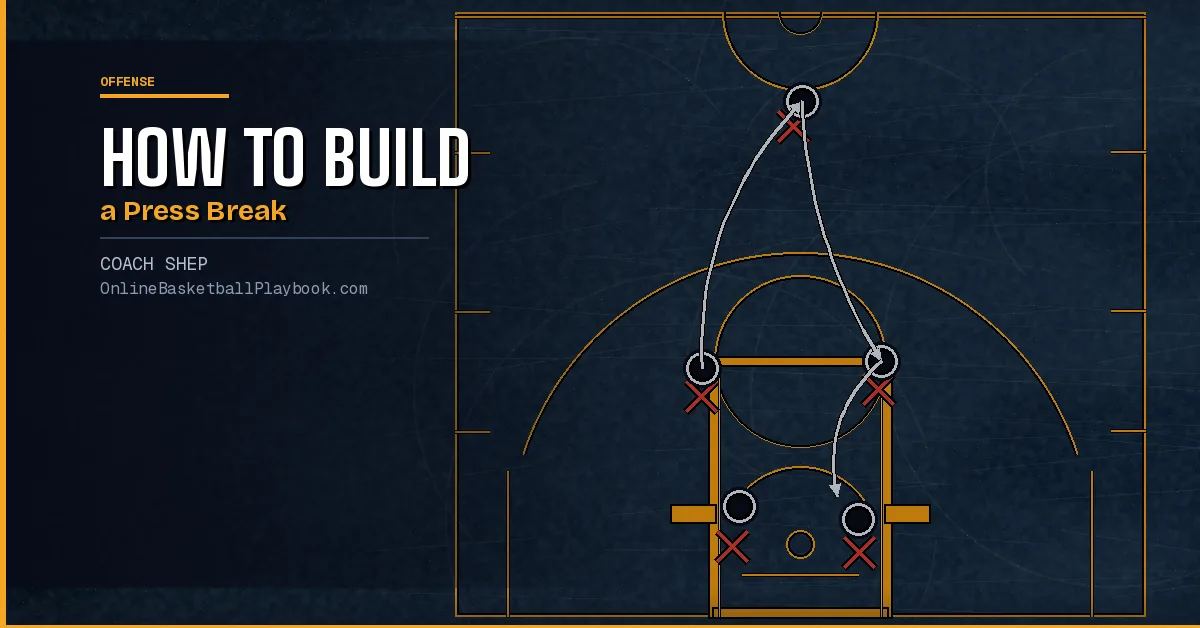
The 1-4 press break solves this problem. It puts the point guard at the inbound position, two wings spread wide in the backcourt, and two players at the half-court line. One at the middle of the floor and one at a wing. This alignment creates immediate spacing at every level of the court, which means it works against any press, man or zone, without requiring a sideline call.
The point guard receives the inbound and serves as the engine of the break. They are not looking to dribble through the press alone. They are looking to initiate the spacing, read the first trap, and move the ball to whichever outlet is open. The two backcourt wings give immediate sideline options. The middle player at half court gives the reverse option and the deep threat for a quick score if the press sends too many defenders to the ball.
One of the greatest advantages of the 1-4 alignment is what it does with the deep safety. Every press has a player assigned to stop the easy layup, usually a slow center or a back-line defender. When your alignment is right and the ball moves quickly, that deep safety is often stuck in a 1-on-1 or 2-on-1 situation. A press break that attacks this mismatch consistently will score more than it turns over.
Teaching the 1-4 also improves your team's basketball IQ because players have to read the defense and react, not just run a scripted action. They're learning to identify who's trapping, who's rotating, and where the open man is. Skills that transfer to every other part of your offense.
Reading Traps and Finding the Advantage
A trap is not a crisis. A trap is an opportunity, if your players understand what it creates on the other end of the floor.
When two defenders trap the ball, they have removed themselves from their assignments. The math is immediate: three offensive players now face two or fewer defenders somewhere up the floor. The only question is whether your team can identify which defender cheated to form the trap, and attack the gap they left.
The key read happens at the moment the second defender commits to the trap. The handler, through the pull-back dribble and eyes-up positioning, identifies which of the three outlets is open. If the sideline help has cheated to cover the middle, the reverse is available. If the reverse defender has rotated to the trap, the ball can skip to the wing. The defensive rotation always leaves something open.
Once the first pass out of the trap is made, the team needs to attack immediately. This is not the time to slow down and reset. The defense is scrambling to recover, and a quick second pass usually leads to an open look near the basket or at the elbow. Teams that pause after beating the first trap give the defense time to recover and negate the advantage. Teams that attack with the second pass consistently find easy baskets.
This read-and-attack approach is closely related to transition defense principles from the other side. Both situations demand that players identify numbers advantages quickly and execute before the other team recovers. Building press break IQ and transition awareness in tandem makes your team harder to stop in open court in both directions.
Teach players that the trap is the green light, not the red light. When two defenders collapse on the ball, the right response is not to panic. It's to make the quick pass and sprint to the basket, because someone just opened up behind the trap.
Breaking Man Press vs. Zone Press
While the 1-4 alignment works against both man and zone pressure, understanding the differences between the two helps players make smarter reads on the fly.
Against a man press, the defense is focused on denying the inbound and staying attached to individual players. The best tool here is back-cuts. If your wing is being full-denied on the sideline, they cut hard to the ball, right behind their defender. This turns the denial into a straight-line pass for an easy catch. Man press also breaks down faster when the ball gets to the middle of the floor, because man defenders have to cross paths covering their assignments, creating natural screening and switch confusion.
Against a zone press, a 1-2-1-1, 2-2-1, or diamond press: The spacing principles are even more important. Zone presses are designed to funnel the ball to the sideline and spring the second defender for a trap. The answer is to attack the middle early. A pass into the high post or a dribble penetration through the middle of the zone gaps the entire press, because zone defenders are covering areas rather than people, and the middle is almost always short-staffed.
Against either type of press, the inbound pass sets the tone. A clean, crisp inbound to a player already in motion, not standing still, immediately puts the press on the defensive. The ball handler should never catch the inbound pass flat-footed. A simple rule: catch the ball already moving away from where you received it, and the trap is already a half-step behind.
Coaches who drill both scenarios teach their players to identify the press type within the first two seconds of the possession. A single look at the defensive setup, where the second and third defenders are positioned, tells an experienced player whether they're facing man or zone pressure and which outlet to prioritize first.
Press Break Drills and Practice Structure
Installing a press break offense takes dedicated time in basketball practice, not just a whiteboard session. Players have to build the habits under game-speed pressure before they can execute them when it counts.
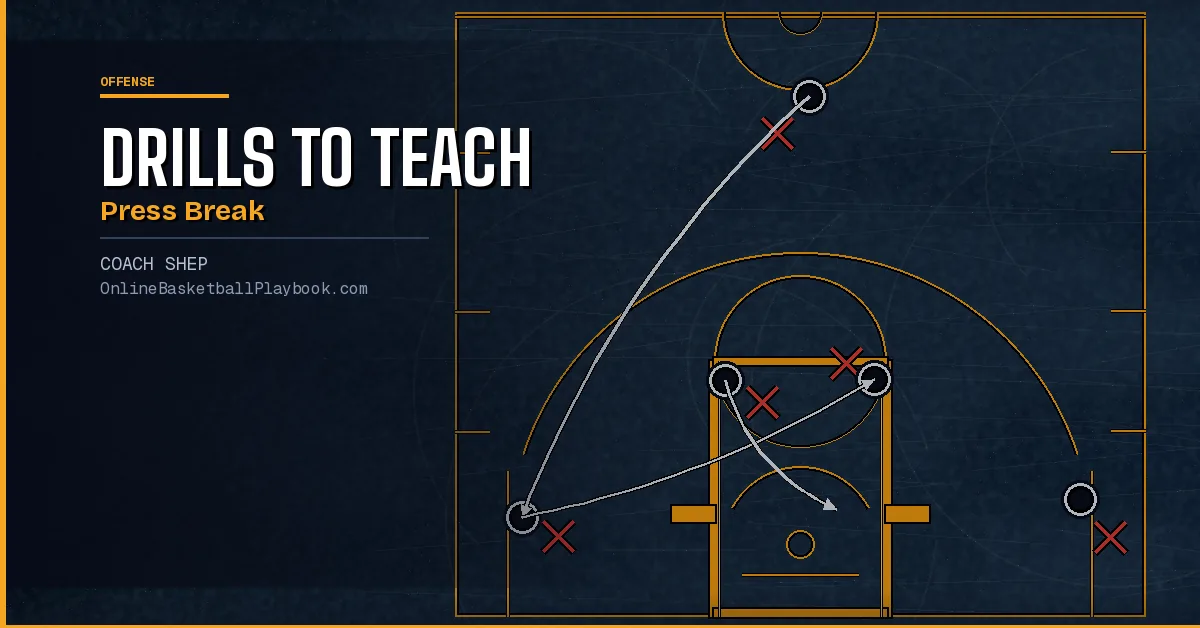
Start with 2-on-1 drills that isolate the pull-back dribble and the first pass out of the trap. Two defenders trap; one ball handler practices creating angle, finding the chin-to-shoulder read, and making the pass before the trap closes. This drill builds individual poise and eliminates the most common error: freezing under pressure.
Progress to 3-on-2 drills that add a receiver and a second defender. Now the ball handler is making the pass, and the receiver is immediately making the decision to attack or swing. This teaches the sequential reads, first pass out of the trap, second pass into the advantage, without the complexity of a full-court 5-on-5 situation.
Full-court 5-on-5 press break live reps should happen at least twice a week during the season. The defense applies full pressure, any press, called or free, and the offense runs the 1-4 break. Track scoring rate versus turnover rate. If the offense is turning it over more than 15% of the time, the spacing has broken down somewhere and needs to be addressed with individual skill work before returning to team reps.
One drill that accelerates press break development faster than almost anything else is the "score-or-nothing" constraint: if the press break doesn't result in a layup or open three within six seconds of crossing half court, the possession is counted as a loss even if the team scored. This forces players to move the ball quickly, attack the advantage immediately, and not settle for contested pull-up jumpers after the press has recovered.
Developing individual ball handling away from team settings also accelerates press break performance. The pull-back dribble, the pivot under pressure, the eyes-up catch. These are skills that have to be automatic before a player can execute them under full-court defensive pressure with two defenders closing on them. Build the individual tools first, then install them into the team system.
- Three outlets, always: sideline, middle, and reverse must be available any time the ball can be trapped. No exceptions, no bunching.
- Pull-back dribble as the default escape: teach it before any press break scheme. Players who panic and pick up their dribble early kill every possession.
- Attack after the first pass: the second pass is where layups come from; teams that slow down after beating the trap give the defense time to recover.
- Use the 1-4 for every press: one alignment against all pressure types reduces confusion and speeds up player decisions at game speed.
- Back-cuts against man denial: when the inbound is denied, the receiver cuts hard to the ball, straight-line cut, not a curl, to get free immediately.
- Track press break efficiency in practice: score rate versus turnover rate tells you whether spacing and reads are working before a game situation reveals the problem.
Get free play diagrams, drills, and coaching guides delivered weekly.
Draw this play free in the play drawer →
Membership: the full library, playbook packs, and Pro drawing tools →
Keep Building
Related breakdowns
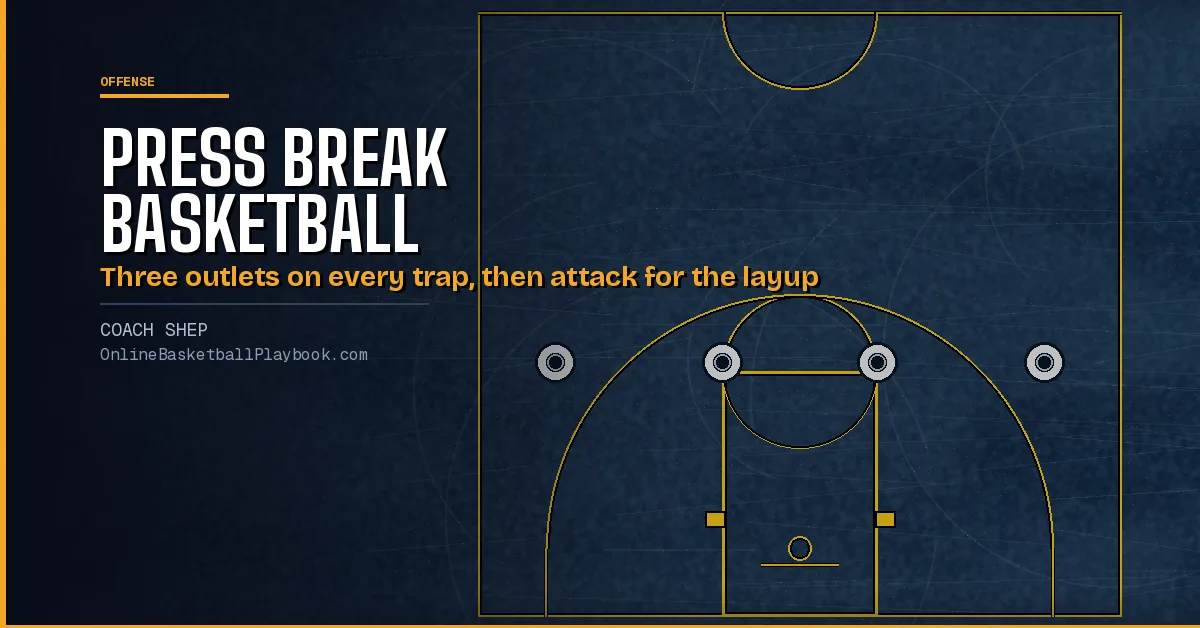
Press Break Basketball: Alignments, Reads and Drills
Press break basketball guide with the 1-4, 80-60-40 and 4-across alignments, reads against the 2-2-1, diamond and 2-1-2 press, and where coaches disagree.