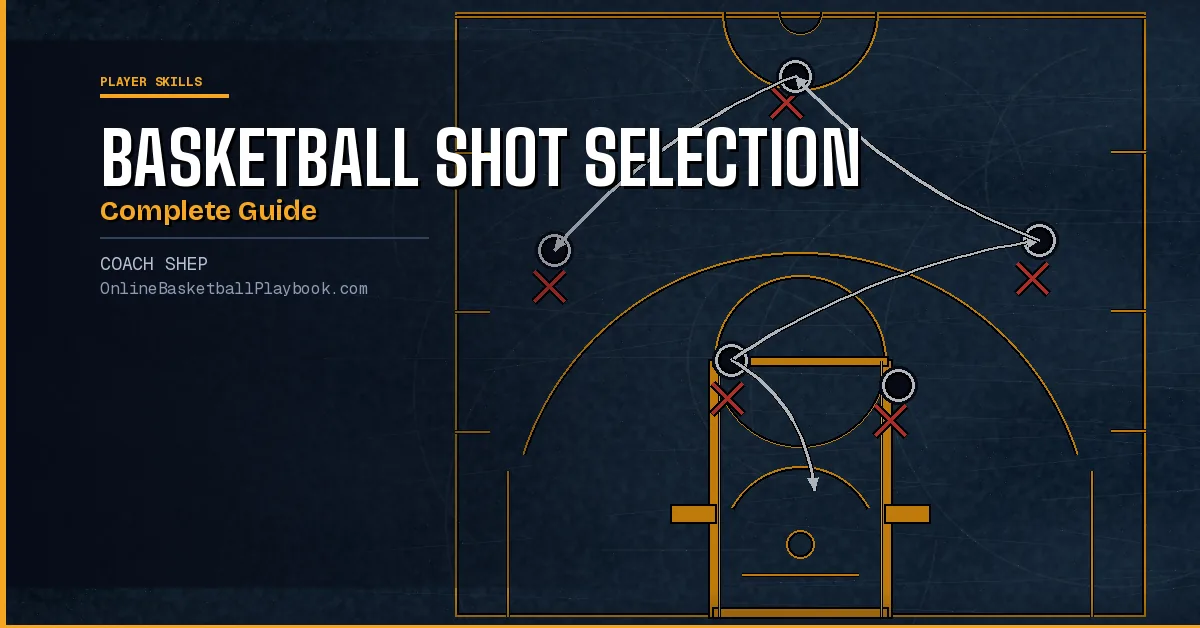
Good shot selection separates winning teams from talented ones. This guide breaks down the decision-making framework, practice habits, and coaching cues that help players take the right shot. Every possession, every game.
What Is Shot Selection?
Shot selection is the decision a player makes (often in under a second) about whether to shoot the basketball, pass, or drive. It sounds simple. It is not. Every offensive possession eventually ends in a shot attempt, a turnover, or a foul. The quality of that final shot attempt is the single biggest variable a team controls.
Bad shot selection is not just one missed shot. It is a missed shot early in the shot clock, a long rebound that ignites the opponent's transition, and a possession that never put the defense under any real pressure. One ill-advised pull-up mid-range jumper early in the clock can erase a perfect ball-screen action and a full seven seconds of movement. Multiply that by forty possessions a game and the compounding effect is enormous.
Great shot selection, on the other hand, creates what coaches call "good looks", attempts that a player converts at a high rate from that specific spot, off that specific type of delivery, against that level of contest. The goal is not to find the open shot; it is to find the high-percentage open shot that fits the offensive structure.
Understanding basketball IQ development is the foundation here. Shot selection is a cognitive skill before it is a physical one. Players who read the defense early, anticipate help rotations, and know their own shooting data make better decisions than players who simply react to what they see at the last moment. IQ and shot selection are inseparable.
The Decision-Making Framework
Every coach talks about shot selection. Very few give players a clear framework for making the decision in real time. Here is one that works at every level.
The Three Filters
Before releasing a shot, a player should (ideally unconsciously through training) pass the attempt through three mental filters:
Filter 1: Is this shot within my range and skill set? A player who shoots 28% on pull-up mid-range jumpers in games should not be pulling up mid-range. This sounds obvious. But until players see their own shot-chart data (and coaches show it to them) most players genuinely believe they shoot better than they do from certain spots. Track shot zones in practice. Post the numbers. Players will self-correct.
Filter 2: Is this the best shot available right now? An open corner three is a good shot for a capable shooter. But if a driving lane just opened and the player pump-faked to a close-out and now has a clear path to a layup, the corner three is no longer the best shot. It is a step down. Shot selection requires ranking options, not just clearing a minimum threshold. Motion offense in basketball trains players to read secondary and tertiary options before making that final call.
Filter 3: Is this shot within the offense and within the game context? A step-back three with 18 seconds on the shot clock, your team up 12, with two other shooters ready on the wings is a different shot than the same three with 3 seconds on the clock and your team down 2. Context matters. Coaches must explicitly teach situational shot selection and then build it into drills with live game scenarios rather than just talking about it.
The Pre-Shot Read
The best shot selectors start reading before they catch the ball. They know where the nearest help defender is. They know if the player guarding them closed out high or low. They know whether the corner is occupied. All of that information shapes what action they take the instant the ball arrives. Teaching players to read before the catch (not after it) is one of the highest-leverage coaching interventions there is.
Shot Quality by Zone
Not all shots are equal. Decades of data at every level of basketball point to clear hierarchies. Coaches who teach shot selection without teaching shot value are leaving decisions half-finished.
Highest Value: Rim Attacks and Corner Threes
Layups and dunks convert at rates well above 60% for most players. Corner threes are the shortest three-point attempt on the floor and typically convert at rates that rival or exceed mid-range jumpers at a fraction of the shot clock cost. A team that consistently generates rim attempts and corner threes is generating efficient possessions regardless of which players are on the floor.
Solid Value: Above-the-Break Threes and Short Floaters
Above-the-break threes carry more difficulty than corner looks but still outperform most mid-range attempts when taken by capable shooters. The floater (a shot that has exploded at every level over the last decade) converts at high rates near the restricted area when defenders are present because it goes over the outstretched hands of shot-blockers. Learning how to shoot a basketball correctly, including the mechanics of the floater and the pull-up, pays direct dividends here.
Situational Value: Mid-Range
The mid-range shot is not dead. It is misunderstood. A well-executed mid-range pull-up off a ball screen at the right moment (say, a short-roll jumper at the elbow with a scrambling defense) is a high-value shot for a player who genuinely makes it. The problem is that mid-range shots are frequently taken by the wrong players, at the wrong times, off the wrong actions. Teach the mid-range to players who earn it in the shot-chart data, then deploy it in the right moments.
Low Value: Long Twos and Heat-Check Threes
The long two (a jump shot from 16 to 22 feet that does not clear the three-point arc) is statistically the worst shot in basketball. It requires more difficulty than a layup and the same difficulty as a three, but awards only two points. Unless a player is elite from that zone by documented data, this shot should be deprioritized in any offensive scheme. The "heat-check three" (a contested three taken early in the shot clock off minimal ball movement) belongs in the same low-value category. Teams that take a lot of these shots lose more than they should even when they have talented rosters.
Building a Shot-Selection Culture
The most important thing a coach can do for shot selection is make it a measurable, visible team standard rather than a concept that gets mentioned in film sessions and then ignored when it matters. Culture is what happens when no one is watching. Build systems that make good shot selection the default, not the exception.
Track It
Post shot-zone data where players can see it. Run a shot-chart review after every game or every scrimmage. When a player sees that she is shooting 19% on step-back mid-range attempts, the conversation changes from "trust your shot" to "let's find your best shots." Numbers remove the ego from the discussion.
Reward It
Design drills and competitive games where taking and making the right shot scores more than just making a basket. Award extra points in competitive shooting drills for corner threes or for refusing a bad shot and swinging it to an open teammate. Reward the process, not just the outcome. A well-structured basketball practice plan should have at least one competitive shooting drill per session where shot quality (not just makes) determines the winner.
Name It
Give players shared language. "That's a green-light shot" versus "that's a red-light shot". Terms like these become team vocabulary. When a player hears "red" from a teammate mid-scrimmage, it communicates in one syllable what would otherwise require a three-sentence coaching correction. That shared vocabulary speeds up learning and keeps the message reinforced between possessions, not just at timeouts.
Demand Accountability
Shot selection is one area where the best teams hold each other accountable without the coach needing to be the enforcer. When teammates start saying "hey, we practiced that. Take the corner three next time," you have a shot-selection culture. That peer accountability layer is one of the markers of a mature team, and it does not appear unless the coach has built the vocabulary, the data, and the competitive practice environment to support it. For more on building that environment, see our guide to building accountability in your program.
Shot selection improves fastest when players can connect their choices to real outcomes. Post shot charts, run film on possession endings, and give players a clear standard to chase. The data does the teaching you can't always do live on the floor.
Drills and Competitive Reps
Shot selection cannot be trained by talking about it. It must be trained in reps where there are consequences for making the wrong choice. The following drill structures all include a decision-making layer that forces players to evaluate shot quality in real time.
Catch-and-Decide Drill
Three players on the perimeter. A passer in the paint. The passer enters to one player who must immediately read a defender (coach or manager with a hand up or down) and decide: shoot if the hand is down, drive or skip if the hand is up. Rotate. The constraint (the read has to happen before the catch) builds the pre-shot habit. This is the foundational drill before any scheme-specific shooting workout.
Green-Light / Red-Light Shooting
Run any standard shooting station drill (elbow series, wing series, corner series) but assign each player a "green-light zone" based on their shot-chart data. They can only shoot in those zones. Any make outside the green-light zone counts for the opponent. It forces zone awareness and makes the data personal without requiring a film session.
Competitive Five-Possession Scrimmages
Short live segments where the offensive team must meet a shot-quality standard to count a make. A designated coach or manager calls "green" or "red" after each attempt. Red makes count as turnovers. This is uncomfortable at first and then suddenly becomes normal, which is exactly when you know it is working. Improving basketball shooting form in tandem with these competitive reps ensures players are building real game mechanics, not just isolated spot-shooting patterns.
Pull-Up and Floater Development
The pull-up off one or two dribbles in the mid-paint and at the free-throw line is undercoached at every level. Build this shot explicitly. Start stationary, progress to a single dribble, then off a ball screen, then in a two-on-two live setting. Players who own the pull-up have an extra tool for situations where the defense takes away their primary options, and that tool reduces panic decisions and late-clock heaves.
- Post shot-zone data publicly after every game. Numbers change behavior faster than any speech.
- Assign every player a "green-light zone" based on documented shooting percentage, then drill inside those zones.
- Teach the pre-shot read: players should know where help is coming from before the ball arrives.
- Build competitive drills where the wrong shot (even if it goes in) counts against the offense.
- Develop the pull-up and the floater as named, practiced skills. They are the shots that bail out broken possessions without becoming bad ones.
- Review possession endings in film specifically for shot selection, not just play execution. Make it a weekly standard.
Common Mistakes and How to Fix Them
Even well-coached teams develop bad shot-selection habits. Here are the patterns that show up most often and the corrections that actually work.
Mistake: Settling Early in Possessions
A player catches on the wing, pump-fakes, the defender recovers, and (rather than driving or resetting) they shoot a contested mid-range anyway. The fix is not telling the player to "make a better decision." The fix is building more possessions in practice that reward patience. Run drills where a make only counts if it comes after at least two passes or one drive-and-kick. Patience becomes a habit when impatience never earns points in the gym.
Mistake: Shot-Clock Panic
Players hear the count (or see the clock) and take whatever is available at that moment, which is often a low-percentage attempt. The fix is training late-clock possessions explicitly. Run five-second offense: give the offense the ball with five seconds on the clock, defense with hands up. Force players to find real shots under pressure, not just throw up a desperation attempt. This is a drill most coaches skip and most teams desperately need.
Mistake: Ignoring Shooter Identity
Not every player should take the same shots. A 38% three-point shooter should look different from a 24% three-point shooter in terms of shot frequency and selection. Coaches often preach general shot-selection rules when they should be teaching player-specific standards. Build individual shot profiles for each player. What are their three best shot types and locations? Give them permission to hunt those and to pass up everything else unless the defense gifts them something easier.
Mistake: Rewarding Bad Shots That Go In
This is the most common coaching error. A player takes a step-back, off-balance, contested three with 15 seconds on the clock (it goes in), and the bench goes wild. That positive reinforcement undoes ten possessions of teaching. Coaches must separate shot quality from shot outcome. Acknowledge the make. Then, privately or in film, address the quality. A bad shot that goes in is still a bad shot. Good shot selection is about process, and the process must be evaluated independent of whether the ball goes through the net.
Teams that develop elite shot-selection habits do not arrive there by accident. They build systems (tracking, vocabulary, competitive drills, and accountability frameworks) that make the right shot the natural choice. Every possession is a decision. Train the decision.
Get free play diagrams, drills, and coaching guides delivered weekly.
Draw this play free in the play drawer →
Membership: the full library, playbook packs, and Pro drawing tools →
Keep Building
Related breakdowns
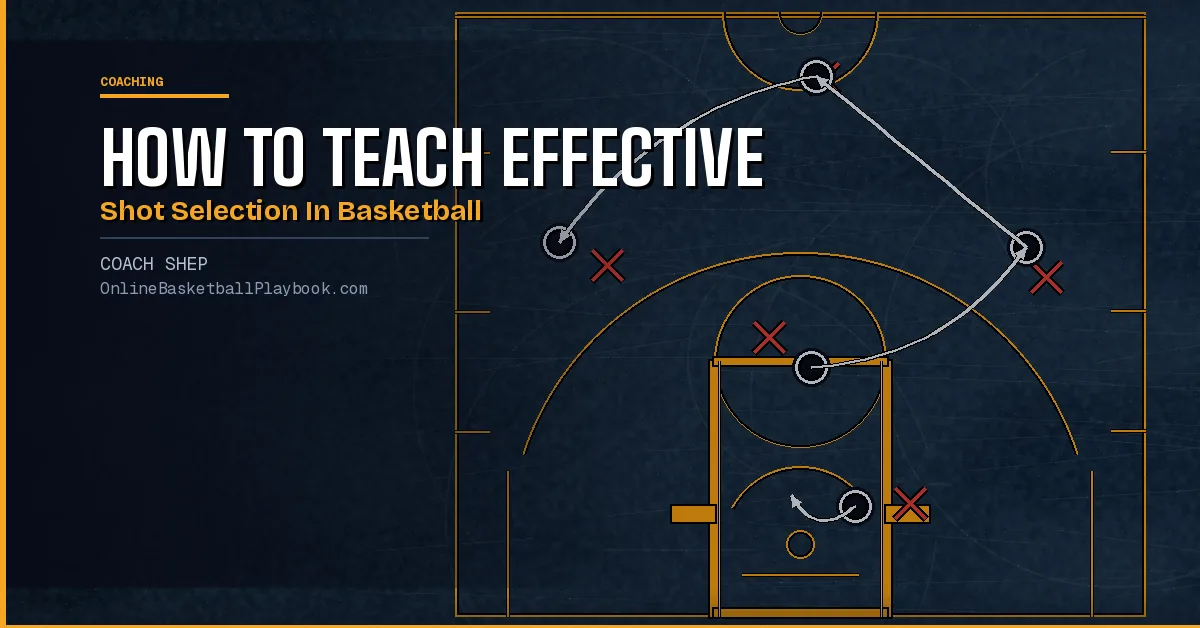
How to Teach Effective Shot Selection in Basketball
How to Teach Effective Shot Selection in Basketball
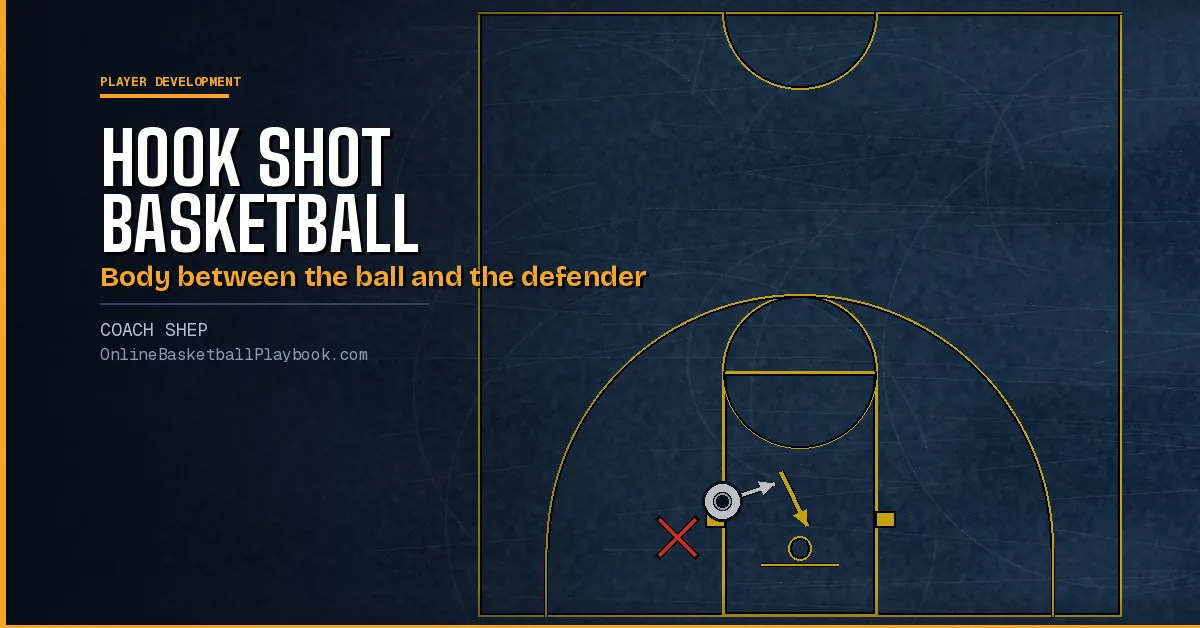
Hook Shot Basketball: How to Do It and How to Teach It
Hook shot basketball for post players and coaches: the classic hook, sky hook and jump hook, the footwork steps, when to use it, the pivot foot rules and drills.
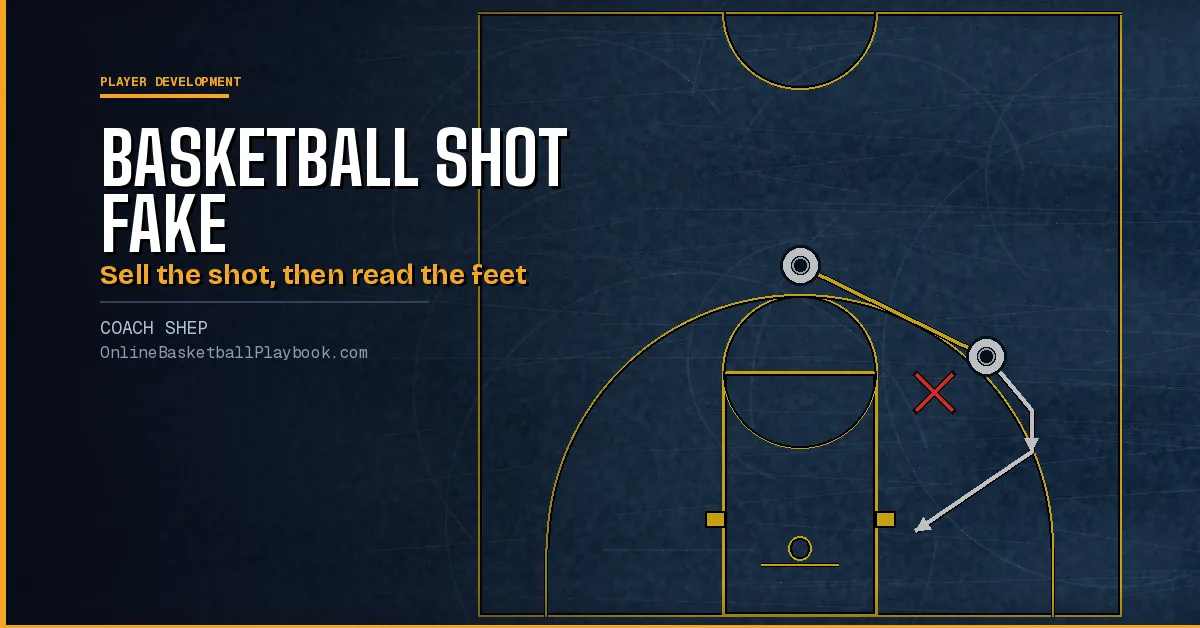
Basketball Shot Fake (Pump Fake): How to Do It and Teach It
The basketball shot fake, also called the pump fake, works when it looks like the real shot. The mechanics, the pivot foot footwork, the read and the drills.