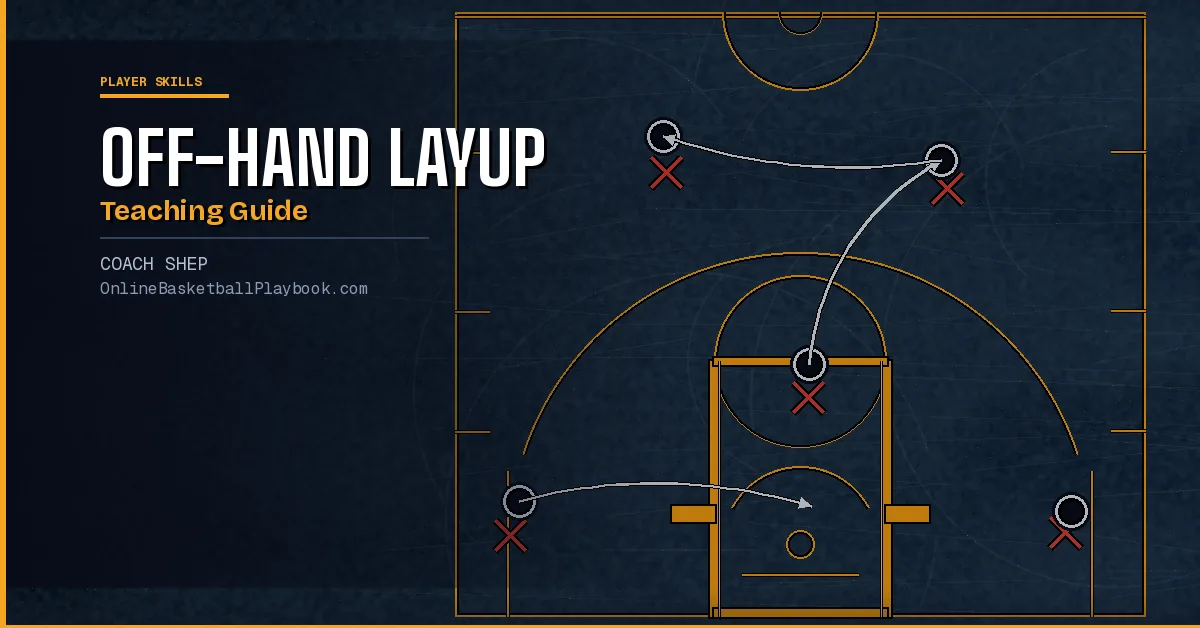
The off-hand layup is one of the most undertrained skills in youth basketball. Players who finish with both hands attack the rim from any angle, evade shot-blockers, and score in traffic. This guide covers the footwork, progressions, and drills to build it.
Why the Off-Hand Layup Matters
Watch most youth and high school players attack the basket from the left side. The majority pick up the ball and either scoop it awkwardly with their dominant hand, pull up short, or get the attempt blocked because they telegraphed the finish before they even left the ground. The off-hand layup, finishing with the left hand when attacking from the left, and the right hand from the right when the strong hand is contested, is what separates players who can only score going one direction from those who threaten the basket from everywhere.
Defenders know this. A player who can only finish with one hand gets funneled to that side. Once the scouting report says "take him left," he becomes predictable. A player who finishes confidently with both hands forces defenders into a genuine choice, and that hesitation is all a good offensive player needs.
Beyond one-on-one situations, the off-hand layup shows up constantly in transition, off screens, and on dribble-penetration reads. In how to run the fast break, the wing filling the lane on the left side needs to finish with the left hand, or she kills the angle and moves into traffic. In pick-and-roll scenarios, the ball handler often attacks a gap that takes her baseline, requiring a weak-hand finish under the rim. Teaching this skill is not optional for players who want to play at competitive levels.
The other reason to prioritize it: the off-hand layup uses the rim as a shield. When a defender is coming from behind or from the strong-hand side, rolling the ball off the glass from the opposite side of the rim gives the offense a natural buffer. Coaches at every level preach "use the backboard" for a reason. It is the largest target in the paint, and finishing off it reduces the margin for error on contested attempts.
The Footwork Foundation
You cannot separate the off-hand layup from the footwork that sets it up. Players who struggle with the weak-hand finish almost always have a footwork problem, not a hand problem. The two-step approach is the engine, and it has to be trained in isolation before players can execute it at speed under pressure.
The traditional right-hand layup follows a left-right two-step: left foot plants first, right knee drives up, right hand extends the ball to the board. Reverse that for the left-hand layup: the last two steps are right-left, the left knee drives up, and the left hand delivers the ball. That foot-opposite-hand pairing is the fundamental law of the layup, and it applies regardless of which direction the player is driving.
Body control is the prerequisite. Players who arrive at the basket out of control cannot execute the correct footwork because they are trying to slow themselves down instead of attacking the rim. This is why the basketball footwork drills That develop balance, stopping mechanics, and jump-stop technique belong in every pre-season developmental block. They are the platform that finishing skills rest on.
The Jump Stop as an Entry Point
For younger players still ingraining the pattern, the jump stop is a useful starting point. From a dribble, the player jumps off two feet, lands simultaneously with the ball raised to protect it, and then chooses a pivot foot. From that controlled position, she can step into a left-hand layup with the correct footwork without the timing pressure of a full two-step approach at speed. Once the mechanics are correct from the jump stop, progress to the full running approach.
Opposite Knee Drive
The knee drive is the cue most coaches overlook. When teaching the left-hand layup, the emphasis belongs on the left knee driving upward through contact, not just the left hand reaching for the board. The knee drive generates lift, creates space from the defender, and naturally sets the shoulder angle that aligns the hand with the glass. Players who reach with just their arm and neglect the knee collapse into the defender and lose the angle.
Teaching Progression
The most effective teaching progressions move from stationary to slow to game-speed, always keeping mechanics correct before adding complexity. Rushing to full-speed reps before the pattern is grooved is the most common mistake coaches make when teaching the off-hand finish.
Step 1: Stationary Wall Work
Start at a wall, no basket required. Players stand two feet from the wall, left hand on the ball, and practice rolling it against the wall at the correct angle: off the fingertips, with backspin, using the same spot they would target on the backboard square. This isolates the hand position and release without any footwork variables. Run this for two to three minutes at the beginning of sessions during the early teaching phase.
Step 2: One-Step from the Block
Players stand on the left block, one step from the basket. Without any dribble, they take a single right-foot step, drive the left knee, and lay the ball up with the left hand. No approach, no dribble. Just the release mechanics and the correct opposite-hand, opposite-foot relationship. Coaches can see immediately whether the footwork and hand are paired correctly. Run ten reps, then switch to the right side with the right hand to build symmetry.
Step 3: Two-Step from the Lane Line
Move back to the elbow or lane line extended. Players take two walking steps, right-left, and execute the left-hand finish. Walking speed lets them concentrate on the correct sequence without the timing challenge of a running approach. Once this is consistent, move to a jog, then to game speed.
Step 4: Off the Dribble
Now add a dribble. Players start at half court or the three-point line and drive left, using the correct two-step to finish with the left hand. The dribble creates the timing challenge that makes this difficult. The gather has to happen at the right moment so the footwork falls naturally into the right-left pattern. Players who struggle here are usually picking up the ball too early or too late; the fix is to isolate the gather point.
Step 5: Contested Finishes
Add a passive, then an active, defender. A passive defender stands in the lane, hand raised, as a target to finish over and away from. An active defender closes out or trails the ball handler, forcing a decision between the off-hand finish and an adjustment move. This is where the skill becomes basketball, not just a drill.
Essential Off-Hand Layup Drills
These drills target the specific skills that make the off-hand layup reliable under pressure. Rotate them throughout the season rather than running the same drill every day. Variation forces players to adapt and builds a more durable skill.
Mikan Drill
The Mikan drill is the classic foundation. Players alternate left-hand and right-hand layups continuously, catching the ball out of the net or off the board and immediately attacking the opposite side. No dribble. Catch, step, finish, catch, step, finish. The value is high-volume repetition of both hands in a short time window, and the rhythm forces correct footwork because the player has no time to reset between reps. Set a target of 25 makes from each side before moving on.
Power Mikan
Same concept as the standard Mikan but using a two-foot jump stop before each finish. Both feet hit the floor simultaneously, and the player explodes off both feet into the layup. This version builds the strength to finish through contact, develops the power layup mechanics, and is particularly useful for post players and guards who need to finish in traffic. The two-foot base makes it harder for a defender to undercut the ball handler.
One-Dribble Pull-Under
Players start at the right elbow with the ball in their right hand. They take one hard dribble baseline, gather, and finish with the left hand from the left side of the rim, using the rim as a shield. This simulates the real-game scenario where a guard beats a closeout and needs to change hands mid-drive to avoid the help defender. It is one of the highest-frequency off-hand situations in organized play and deserves dedicated reps. See basketball player development resources for how to structure this into individual workouts.
Cone Series Layups
Set five cones in a straight line from half court to the basket at three-foot intervals. Players weave through the cones with a speed dribble, gather at the last cone, and finish with the off hand. The cones add a navigation challenge that simulates the body control required when driving through a gap in a live defense. Vary the last-cone position, sometimes left of center, sometimes right, so players are reading and reacting rather than running a predetermined pattern.
Two-Ball Mikan
For advanced players, hold a second ball in the non-shooting hand while executing Mikan drill reps. The added weight and distraction amplify the difficulty and build the kind of hand independence that makes the off-hand finish feel natural. This is a six-week progressive drill. Start with a lighter ball in the non-shooting hand and build to a standard ball once the mechanics hold.
Spin-Out Off-Hand Series
The player spins the ball out to herself, simulates a catch, makes one dribble left, and executes the left-hand finish. The spin-out creates an open-court rhythm that closely mimics receiving a pass in transition and attacking immediately. It also allows a solo player to get high-quality reps without a partner. In a basketball practice plan, this drill pairs well with the transition offensive segment.
Common Mistakes and How to Fix Them
The same errors appear at every level when players are learning the off-hand finish. Identifying them early and applying the right correction keeps bad habits from locking in.
Finishing with the Wrong Hand
The most visible error: the player drives left and finishes with the right hand, reaching across her body. This happens because the right hand feels more secure, and when players are moving fast and the finish is contested, they default to comfort. The fix is not to yell "wrong hand". It is to slow the drill down until the correct footwork is automatic, and the correct hand follows naturally. The footwork and the hand are linked. Fix the feet first.
Flat Trajectory
A flat ball hits the back of the rim. Players who are not getting enough knee drive on the opposite leg produce a flat release because their shoulder angle is too low. The cue is "knee to sky". Exaggerating the knee drive forces the hips under the player and angles the release upward toward the backboard square. Have players watch their own film on this. Most are surprised how low their knee actually travels on the drive versus how high it feels from inside the movement.
Over-Dribbling to the Finish
Players who take too many dribbles before the gather disrupt the two-step timing and arrive at the basket with the wrong foot forward. Teach a specific gather point. For most players, this is two dribbles outside the lane line. Past that point, the ball stays in the hands and the footwork takes over. Put tape on the floor at the gather point during early drilling.
Releasing Too Early or Too Late
The ball should leave the hand at or near the peak of the jump, not on the way up (releases too hard off the glass) and not on the way down (no control or arc). Video feedback is the fastest correction for timing errors. When a player can see her own release point on video, she self-corrects much faster than when a coach is describing it verbally from the sideline.
Most off-hand layup failures are footwork failures, not hand failures. Before adjusting the release, check whether the player's last two steps match the correct right-left (for left-hand) sequence. In the majority of cases, fixing the feet fixes the finish.
Integrating Into Practice
The off-hand layup does not develop from an occasional drill run once per month. It requires consistent repetition built into the structure of every practice. The good news is that many of the best teaching vehicles are also excellent conditioning and ball-handling tools, so they earn their practice time twice.
At the start of every practice warm-up, run five minutes of Mikan drill before any other finishing work. Make it a non-negotiable part of the warm-up sequence the same way most coaches make shooting stretches or dribbling warm-ups automatic. Five minutes of daily Mikan reps builds the pattern faster than a 25-minute session once a week.
Within your offensive team periods, require that players finishing from the left side of the floor use the left hand. Do not allow the dominant-hand crossover finish during teaching periods. If a player reaches across with the wrong hand, stop play, send her back to the three-point line, and run the rep again. Consistency in the teaching environment is what closes the gap between drill success and game application.
For individual player development outside of team practice, build a three-day-per-week off-hand finishing block into the player's development calendar. Day one: Mikan and power Mikan. Day two: one-dribble series and cone layups. Day three: contested finishes and two-ball Mikan. Rotate through this three-day sequence across the season and track makes-per-minute to measure progress objectively.
In competitive scrimmage situations, point-based incentives accelerate adoption. Some coaches give an extra point for any finish with the off hand during live scrimmage. Players respond immediately to the incentive, and what started as an artificial rule becomes a natural habit within two to three weeks.
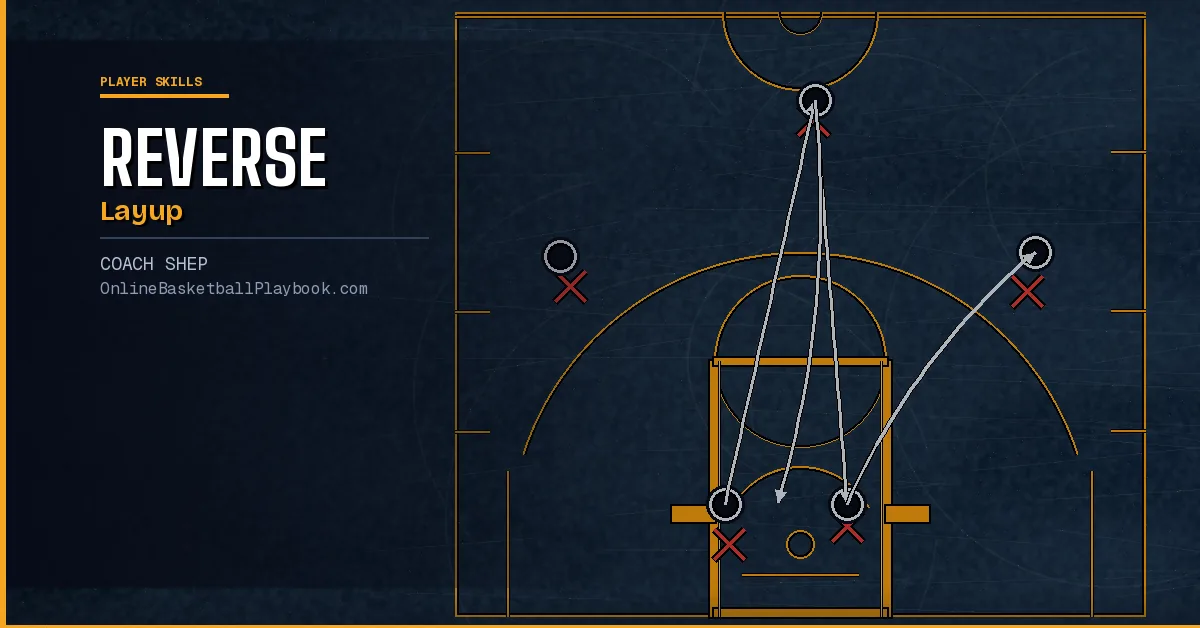
The off-hand layup also connects directly to the broader finishing menu that every complete player needs. Once the basic left-hand and right-hand layups are reliable, expand into the reverse layup, the floater off the off hand, and the Euro step finish. Each of these extensions uses the same foundational footwork and hand mechanics, so they build faster once the base is solid. This full finish menu is what makes a player truly difficult to defend in the paint. No matter which side the help comes from, she has an answer.
- Mikan daily: 5 minutes at the start of every warm-up. Alternate left and right hand continuously, no dribble, correct footwork every rep.
- Feet before hands: When a player misses the off-hand layup, check the last two steps first. The wrong foot forward is almost always the root cause.
- Opposite knee drives lift: Cue "left knee to sky" on left-hand finishes. The knee drive creates the arc, the shoulder angle, and the separation from the defender.
- Gather point discipline: Mark the floor where players must pick up their dribble. Too many dribbles past the gather zone is what destroys the two-step timing.
- Enforce in live play: During teaching scrimmages, require the off hand on the correct side. Stop and redo the rep if a player defaults to the dominant hand on a left-side drive.
- Track makes, not just reps: count left-hand makes per minute in your baseline drill to measure progress across the season and give players an objective benchmark.
Get free play diagrams, drills, and coaching guides delivered weekly.
Draw this play free in the play drawer →
Membership: the full library, playbook packs, and Pro drawing tools →
Keep Building
Related breakdowns
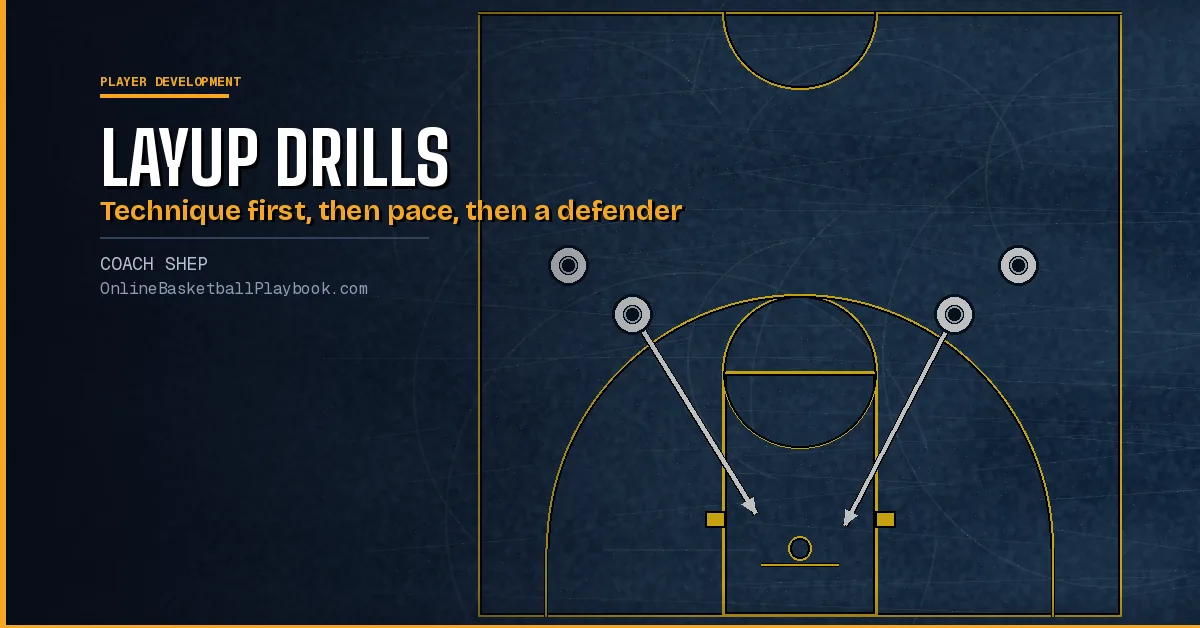
Layup Drills for Every Level, From One Step to Full Court
Layup drills for youth and teams, from footwork and the Mikan drill to layup lines, full-court drills with a made-shot goal and finishing against a defender.
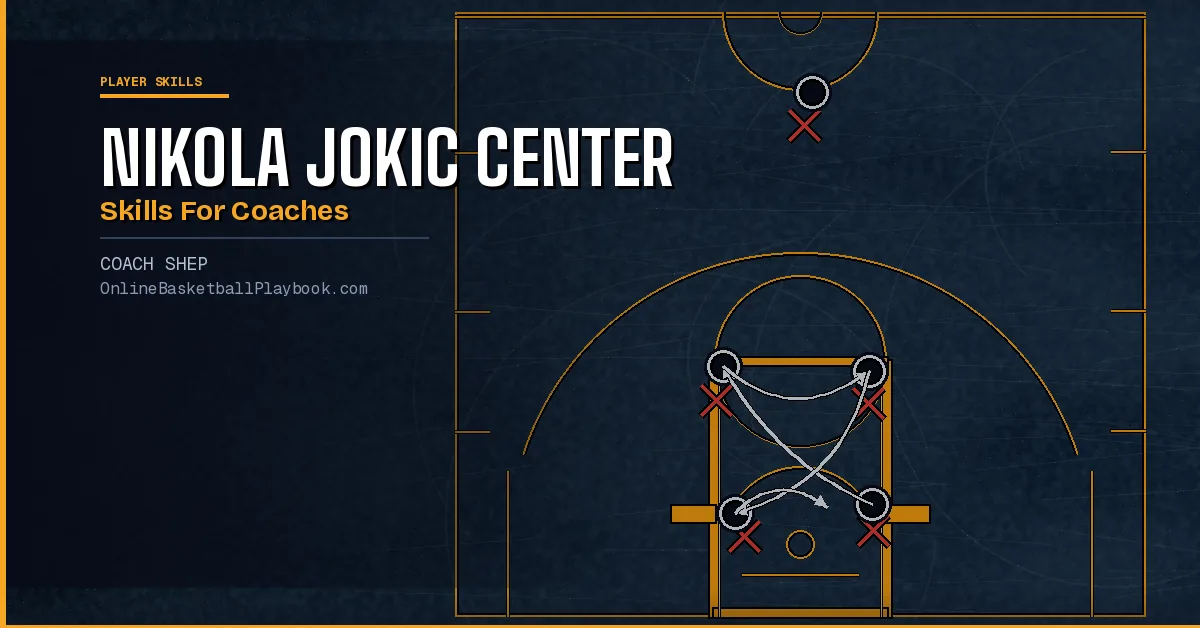
Teaching Nikola Jokic Big Man Skills to Your Centers
Teaching Nikola Jokic Big Man Skills to Your Centers