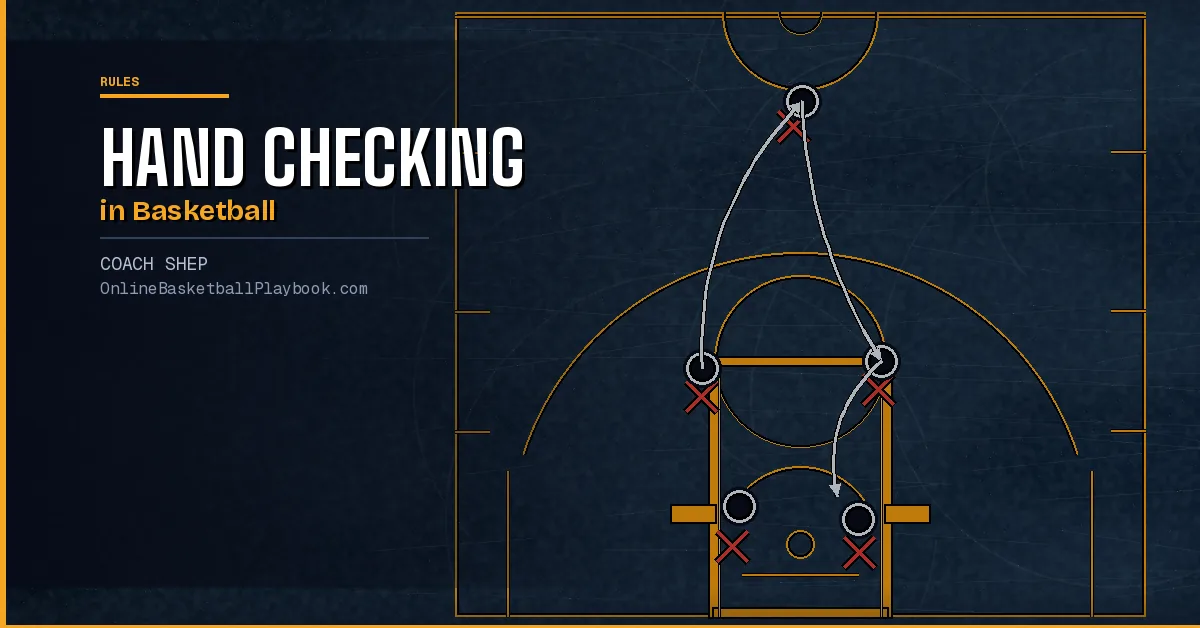
Hand checking is when a defender uses one or both hands to impede a ball handler's movement. The NBA banned the technique in 2004. That single rule change opened the floor, boosted scoring, and reshaped how every level of basketball teaches perimeter defense.
What Is Hand Checking?
Hand checking refers to a defender placing one or both hands on a ball handler to track, slow, or redirect their movement. The contact is typically applied to the hip, back, or arm of a dribbler as they attempt to advance toward the basket or change direction. At its most aggressive, it looked less like defense and more like wrestling, with defenders grabbing, bumping, and steering offensive players away from preferred angles.
The technique was especially prevalent at the professional level through the 1980s and 1990s. Physical defenders used hand checking to neutralize quick guards who depended on change-of-direction moves. If a player couldn't create separation, they couldn't create shots. The defense was effective, sometimes brutally so, but it also slowed the game to a crawl and made perimeter attacks nearly impossible for players who weren't strong enough to overpower defenders.
At the youth and high school level, hand checking still shows up regularly, often because players have not yet learned proper footwork to stay in front of quicker opponents. A hand on the hip can substitute for a well-timed slide step. Coaches need to recognize this habit early and replace it with legitimate defensive technique before it becomes a crutch that gets exploited at higher levels.
History and the Rule Change
The NBA did not eliminate hand checking overnight. The league had prohibited placing a hand on a player's back as early as 1994, but enforcement was inconsistent, and players and coaches adapted around the rules as written. By the early 2000s, the combination of illegal defenses, holding, and physical perimeter play had pushed scoring averages down significantly. The 2003-04 season produced some of the lowest scoring in league history.
Before the 2004-05 season, the NBA introduced a sweeping set of rule changes that included a strict ban on hand checking anywhere on the court. Referees were instructed to call any contact initiated by the defender that impeded the progress or movement of a ball handler. Combined with the removal of the illegal defense rule and the introduction of the defensive three-second violation, these changes fundamentally rewired how NBA offenses and defenses were constructed.
The results were immediate. Scoring jumped. Guards who had been physically bottled up suddenly had room to operate. The era of the perimeter-dominant offense (shooters spacing the floor, pick-and-roll attacks, and isolation plays for quick guards) accelerated sharply after 2004. Understanding defending the pick and roll became a critical coaching priority precisely because hand checking was no longer an option to stall ball handlers coming off screens.
Why It Was Banned
The case against hand checking rested on several concerns. First, it made the game less watchable. Half-court offense became a slow, grinding affair as defenders clamped down on ball handlers and prevented them from reaching preferred spots on the floor. Second, it created a physical mismatch that benefited bigger, stronger defenders at the expense of skilled but smaller guards. Third, it opened the door for referee inconsistency because the line between legal and illegal contact under the old guidelines was blurry enough that enforcement varied from crew to crew and arena to arena.
There was also a player safety dimension. Repeated contact along the arms and torso during perimeter play could accumulate into wear over a long season. The league wanted to protect players while also improving the quality of the product on the floor.
For coaches at every level, the lesson from the ban is straightforward: physical shortcuts in defense eventually get called, and players who rely on them never develop the footwork and positioning habits that hold up in real competition. Teaching help defense principles that don't depend on contact is a more durable investment in any player's development.
Impact on Modern Defense
The elimination of hand checking forced coaches and players to develop new defensive frameworks. Zone defenses became more common as teams searched for ways to limit perimeter penetration without relying on physical contact. The 2-3 zone defense gained renewed interest at every level because it allowed teams to protect the paint without needing individual defenders to lock down elite ball handlers one-on-one.
Man-to-man defense also evolved. The focus shifted from physical engagement to positioning, angles, and anticipation. Defenders learned to influence where ball handlers wanted to go by cutting off driving lanes with their feet rather than their hands. Closeout technique became a critical teaching point because approaching a shooter too aggressively left a defender out of position and susceptible to a drive. Proper basketball closeout technique means arriving under control with hands up, not reaching forward to initiate contact.
Switching defenses became more popular at the pro level after the rule change. If a defender could no longer rely on holding a ball handler in place while a help defender rotated, then building a roster where multiple players could guard multiple positions offered a structural answer to the new rules. This trend eventually trickled down to college and high school programs looking to emulate professional principles.
Legal vs. Illegal Contact
Understanding exactly where the line falls helps players and coaches make smarter decisions in practice and games. The key distinction is who initiates contact and whether it impedes movement.
What Is Legal
Defenders are permitted to maintain a legal guarding position and may incidentally make contact with an offensive player in that position. A defender who has established a stance in a ball handler's path and absorbs contact may draw a charge rather than a foul. Brief, non-impeding contact where the defender's hands are used to feel a screen or maintain spacing can fall within legal guidelines depending on the officiating level and context.
Deflecting a pass or shot with an active hand is legal as long as the defender is going for the ball and not using a hand to hold or push. Defenders are also permitted to use an arm bar in the post, within limits. A forearm in the lower back to feel where a post player is moving is accepted at many levels, though this too has tightened over the years.
What Is Illegal
Any contact initiated by the defender that slows, redirects, or impedes a ball handler is a foul. Placing a palm on a dribbler's hip and pushing is illegal. Grabbing a jersey, hooking an arm, or bumping a player off their line of attack all fall into the hand checking category. Even a momentary grab that doesn't visibly affect the play can be called at higher levels where the rules are enforced strictly.
Referees at the youth level often allow more physical play than the rules technically permit, which can build bad habits. Players who move up to competitive high school or college programs and have never learned to defend without contact will struggle in their first season under tighter officiating.
Teaching Perimeter Defense Without Hand Checking
Eliminating hand checking from a player's game requires replacing it with techniques that accomplish the same goal, controlling a ball handler's movement, through legal means. This is a teaching priority that pays dividends at every level of the game.
The foundation is stance and footwork. A defender in a proper defensive stance (knees bent, weight on the balls of their feet, chest up) can react laterally without needing to reach. The moment a defender's feet stop moving and their hands go out, they are a step behind. Teaching players to stay low and stay moving is the first correction most coaches need to make when eliminating hand checking habits.
Cutting off angles is the second layer. Defenders should shade the ball handler toward help rather than guarding straight up. Forcing a player to their weak hand or toward a waiting help defender takes away their best options without requiring physical contact. Running shell drills, the foundational defensive team concept, builds this spatial awareness by putting defenders in situations where they must communicate and rotate correctly. Consistent work with the shell drill is the fastest way to install these habits in a team setting.
Active hands in passing lanes also substitute for hand checking. A defender whose hands are up and moving is harder to pass around and forces the offense to be precise. This is very different from hands that are grabbing or pushing. It's an athletic posture rather than a physical control technique.
Finally, help defense is the systemic answer. When one defender gets beat off the dribble, a help defender needs to arrive on time and in position. Building that communication and trust across all five defenders reduces the temptation for any one player to hand check, because they know help is coming if they get beat. Investing practice time in building solid man-to-man defense from the ground up is what separates teams that give up easy drives from teams that can defend without fouling.
When a player hand checks repeatedly in practice, slow the drill down and ask them to guard with their hands clasped behind their back. It forces them to use their feet and learn to influence ball handlers through positioning alone. After a few repetitions this way, their lateral quickness and defensive angles improve noticeably.
- Hand checking is any defender-initiated contact that impedes a ball handler's movement. It's a foul at every organized level of play.
- The NBA banned hand checking in 2004 along with a package of rule changes that opened the floor and dramatically increased scoring league-wide.
- Replace hand checking habits with low defensive stance, active feet, and disciplined angle work. The goal is the same, the method is legal.
- Shell drills, closeout work, and man-to-man rotations build the team-wide habits that reduce any one defender's need to grab or push.
- Youth players who hand check regularly are masking slow feet. Attack the root cause with footwork drills before it becomes a crutch they can't drop.
- Help defense is the systemic answer: when every defender knows help is coming on time, the temptation to hand check drops because players aren't gambling alone.
Get free play diagrams, drills, and coaching guides delivered weekly.
Draw this play free in the play drawer →
Membership: the full library, playbook packs, and Pro drawing tools →
Keep Building
Related breakdowns