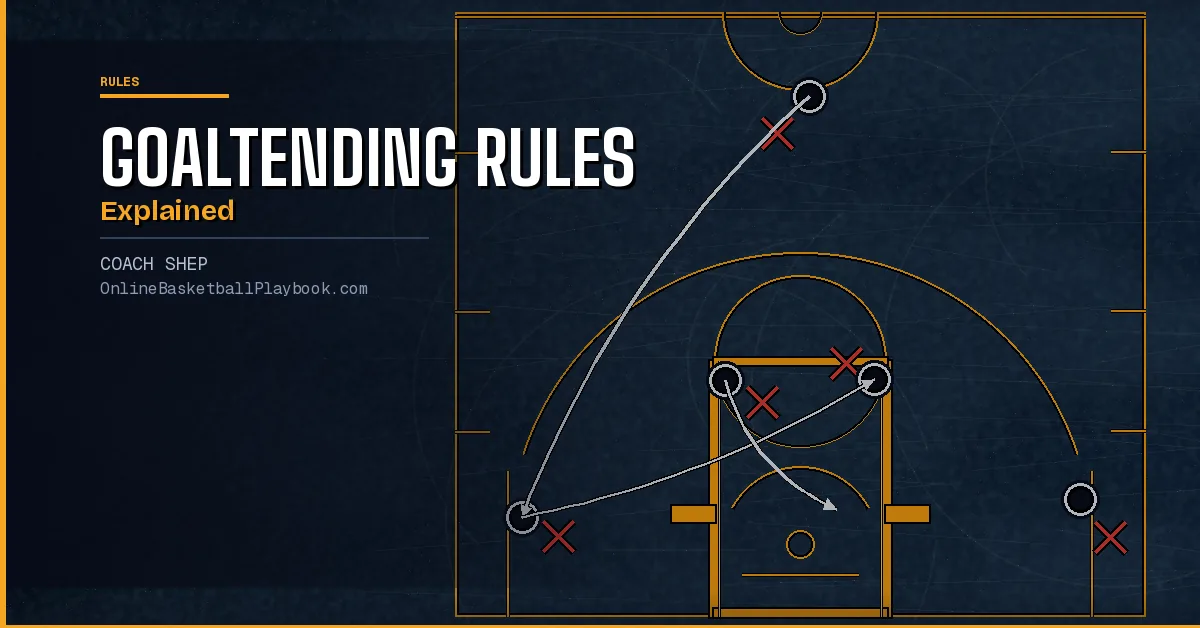
Goaltending is one of basketball's most misunderstood calls. Whether you coach youth players or watch the NBA, knowing exactly when the rule applies, and why, prevents confusion, disputed calls, and costly violations.
What Is Goaltending?
Goaltending occurs when a defender, or sometimes an offensive player, illegally interferes with a shot while the ball is on its downward arc toward the basket, is on or directly above the cylinder above the rim, or is on the rim itself. The rule exists to protect the integrity of shot attempts and prevent defenders from simply swatting shots out of the air at any point during their flight.
The rule traces back to the early days of organized basketball when tall players discovered they could simply stand near the basket and knock away any attempt that came close. The rulebook was updated to level the playing field and ensure that a well-executed shot attempt has a fair chance of going through the net. Without goaltending rules, rim protection would mean something entirely different. And the entire offensive structure of the game would collapse.
Understanding goaltending starts with the concept of the imaginary cylinder. Picture an invisible tube extending straight up from the rim. Once the ball enters that cylinder on a shot attempt, no defender may touch it. Additionally, once a shot starts coming down, meaning it has passed its peak and is now descending toward the basket, no defender may touch it. Both conditions matter independently, and a ball only needs to satisfy one of them to be protected.
For coaches building sound man-to-man defense, teaching players to time their block attempts correctly is just as important as teaching them where to position. A perfectly timed block on the way up is legal; the same block half a second later on the way down is goaltending.
When Goaltending Is Called
Referees call goaltending under three primary conditions. First, a player touches the ball while it is on its downward arc toward the basket. Second, a player touches the ball while it is entirely within the imaginary cylinder above the rim. Third, a player touches the rim, backboard, or net while a shot attempt is in the air because that contact can vibrate the ball off course even without directly touching the shot itself.
The downward arc condition is the one that trips up most players. Players often assume that as long as the ball hasn't reached the rim yet, it can be blocked. That assumption is wrong. The moment the ball crests its peak and begins descending, it is protected, regardless of how far it still is from the basket. A defender standing ten feet away who swats a descending three-point attempt has committed goaltending just as clearly as one who swats a ball directly over the rim.
The "on or over the rim" condition is more intuitive. Once the ball is sitting in the cylinder or resting on the rim, it cannot be touched by any player, offensive or defensive, until it either falls through for a score or bounces away entirely. This prevents defenders from knocking the ball off the rim at the last moment and prevents offensive players from pushing the ball through the cylinder.
Goaltending is an automatic award. When a defender goaltends, the offensive team is awarded the points that shot would have been worth: two points for a shot inside the arc, three points for a shot from beyond the arc, and the corresponding number of free throw points on foul shots. The defensive team does not get possession; the basket simply counts.
NBA vs. College vs. Youth Rules
The definition of goaltending is broadly consistent across levels of basketball, but there are meaningful rule differences that coaches and players need to understand when transitioning between levels or coaching players who watch professional basketball and try to apply pro rules at the youth level.
In the NBA, there is an additional concept called basket interference that covers the cylinder rule separately from the goaltending rule, though in practice most fans and players refer to both violations as goaltending. More importantly, the NBA has a rule that once the ball strikes the backboard on a shot attempt, it is considered to have completed its flight and can be played by any player. This means an NBA player can grab a missed shot off the backboard and score. Even if a defensive player knocked the ball off the backboard, it is not goaltending because the shot already struck the board.
College basketball under NCAA rules is stricter. Once a shot strikes the backboard, it is still considered in flight and therefore protected. A defender who touches the ball after it bounces off the backboard, if the ball is still in the cylinder, has committed goaltending. This catches college players off guard when they transition from watching NBA games where backboard-to-player plays are legal.
At the youth level, the rules generally follow NCAA guidelines, but enforcement is softer because referees prioritize flow and development over strict technical calls. Coaches who work with young players should teach the NCAA standard, since that is what most youth leagues, high school basketball, and college programs follow. Teaching players the NBA exception creates bad habits that will get called at every other level.
The practical coaching takeaway: use the college rule as your default teaching standard. If the ball has touched the backboard, tell your defenders to treat it as off-limits until it fully clears the cylinder and comes to rest on the rim or bounces away. Better to be overly conservative than to get called for goaltending at a critical moment.
Offensive Goaltending
Goaltending is not exclusively a defensive violation. Offensive goaltending, often called basket interference, occurs when an offensive player touches the ball while it is in the cylinder above the rim or touches the ball or net while the ball is on the rim. The most common scenario is when a big man tries to tip in a shot attempt before it has the chance to fall through or bounce away.
The key to understanding offensive goaltending is the cylinder rule. An offensive player cannot reach into the cylinder and guide the ball into the basket. Even if the ball is clearly on its way down and likely to score, the offensive player must wait until it either drops through the net or clears the rim entirely before touching it. Tipping a ball down from inside the cylinder, no matter how certain a score it appeared, is a violation and results in a turnover. The defense gets possession.
Offensive goaltending also applies on putbacks. If a player goes up for a putback and touches the ball while it is still on the rim or in the cylinder, it is a violation regardless of intent. The play is dead the moment the violation occurs. This is one of the trickiest calls in basketball because offensive players are trained to pursue every rebound aggressively. Players who develop good rebounding instincts need to also develop the discipline to wait a split second to confirm the ball has fully left the rim.
One common scenario at the youth level: a player misses a shot, the ball bounces on the rim, and a teammate reaches in and taps it through the net while the ball is still in contact with the rim. The basket does not count. The official whistles offensive goaltending and the defense gets the ball. Teaching this to young players requires repetition because their natural instinct is to reach for any ball near the basket.
The Cylinder Rule and Backboard
The cylinder is the invisible column of space that rises directly above the rim. Its diameter matches the diameter of the rim itself, 18 inches in the NBA and at virtually every other level of organized basketball. Any ball that enters this space on a shot attempt is protected from interference by any player, offensive or defensive.
The cylinder rule creates the framework for understanding almost every goaltending call. Once you can visualize that 18-inch column of air above the rim, you can mentally track whether a block attempt is legal or illegal in real time. A ball five feet above the rim but directly over the cylinder is protected. A ball sitting at rim level but six inches to the side of the cylinder can be legally played.
The backboard adds another dimension. The backboard is considered part of the playing surface during a shot attempt up until the point where, depending on your ruleset, the ball strikes it. As discussed in the previous section, the NBA treats a ball that hits the backboard as having completed its flight, while NCAA and youth rules continue to protect it as long as it remains in the cylinder.
Coaches who design their help defense principles around rim protection need to include cylinder awareness as a teaching point. A shot blocker who contests shots correctly from the side, approaching the ball from outside the cylinder rather than reaching down into it, can be enormously effective without risking goaltending calls. The elite rim protectors in basketball have learned that contesting the arc on the way up is always safer than trying to swat the ball on the way down.
The practical teaching cue: when your defender goes to block a shot, tell them to think "contest the launch, not the landing." If they're reaching up and forward to block the ball at or before its peak, they're in legal territory. If they feel like they're reaching down or over the ball, they've waited too long.
Coaching Defenders to Avoid Violations
Goaltending violations are almost entirely avoidable with proper technique and awareness. The players who get called for goaltending most often are the ones who react to the ball rather than anticipate the shot. A reactive shot blocker is always a step behind. They see the shot go up, they judge the arc, and by the time they arrive, the ball is already on its way down.
The solution is to contest shots early and from the right angle. Teach your defenders to close out hard on shooters before the shot leaves the hand, not after. A defender who arrives at the shooter at the moment of release can legally alter the shot without touching it and never needs to chase the ball into protected airspace. This is the foundation of good closeout technique: Arrive early, contest the release, and come straight down after your contest.
For interior defenders, the timing challenge is different. A shot blocker under the basket must develop a feel for where shots peak. Taller players with long wingspans can block shots legally because they can reach the ball before or at its peak without jumping as high. Shorter defenders who try to block shots by jumping late will consistently be touching the ball on the way down.
Drills that develop shot-blocking timing include:
- Self-toss block timing: player tosses the ball up against the backboard and practices blocking it only on the upward portion of its flight, stopping and resetting if they catch it on the descent
- Partner shot-fake drills: offensive player uses a shot fake to train the defender to stay down, then goes up for a real shot. Develops discipline to wait and contest at the right moment
- Rim trace drill: defender stands at the rim and practices identifying when a tossed ball enters and exits the imaginary cylinder, building spatial awareness without any blocking attempts
- Contested closeout reps: defender closes out from the elbow, contests the jump shot, and must land and recover without fouling. Builds muscle memory for legal contest positioning
- 3-on-3 shell work: defenders practice rotations and help-side positioning at game speed, focusing on contesting shots within the rules rather than gambling for blocks
The most costly goaltending calls happen in close games with elite shot blockers who try to do too much. Teach your best defenders that a legal contest that alters a shot is worth more than a spectacular block that gets called back. Protect the basket within the rules, and the wins will follow.
Common Misconceptions
Several persistent myths about goaltending circulate at every level of basketball. Clearing these up saves arguments with officials and helps players understand the rule correctly from the start.
Myth 1: You can block a shot anywhere as long as you don't hit the shooter. This is wrong. The ball's position and arc matter, not just the shooter's body. A clean block with no body contact is still goaltending if the ball was on its downward arc.
Myth 2: As long as the ball hasn't reached the rim yet, it's legal to block. Also wrong. The downward arc rule applies wherever the ball is in space, including when it is still far from the basket. A defender standing near the three-point line who swats a descending shot has committed goaltending.
Myth 3: Goaltending only happens at the rim. Goaltending calls on the backboard, on balls in the cylinder ten feet above the floor, or on balls halfway across the lane all occur regularly. The rule protects any shot attempt that satisfies the arc or cylinder conditions, regardless of where the ball is horizontally on the court.
Myth 4: If the shot was clearly going to miss, there's no goaltending. The referee cannot know with certainty whether a shot would have gone in. The rule does not require the shot to be on-target. Any shot in the protected zone (downward arc or cylinder) is awarded as a made basket if goaltended, regardless of apparent trajectory.
Myth 5: Offensive players can freely play the ball off the rim. This is the most dangerous misconception for big men. Offensive goaltending calls are just as costly as defensive ones. The difference is that instead of awarding points, the ball is turned over. Teaching your post players to wait the extra fraction of a second before pursuing putbacks is essential.
For coaches building basketball IQ in their players, goaltending rules are a perfect teaching tool. Understanding not just what the rule says but why it exists helps players internalize it rather than treat it as an arbitrary restriction. When players understand that the rule protects the integrity of every shot attempt, they stop trying to find loopholes and start developing the timing and technique to block shots the right way.
Get free play diagrams, drills, and coaching guides delivered weekly.
Draw this play free in the play drawer →
Membership: the full library, playbook packs, and Pro drawing tools →
Keep Building
Related breakdowns