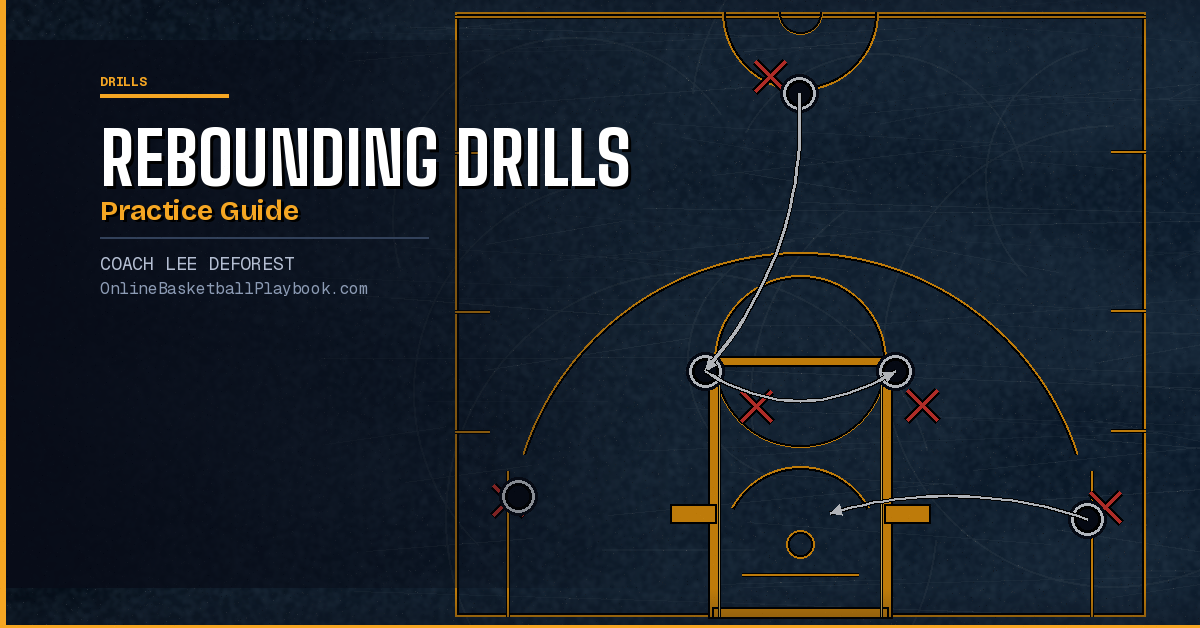

Rebounding wins possessions. Every missed shot is a 50-50 ball — and the team that systematically drills box-out technique, pursuit, and outlet passing will own that battle night after night.
Why Rebounding Drills Matter
Teams that control the defensive glass eliminate second-chance points. Teams that crash the offensive glass generate extra possessions without running a play. Rebounding is the highest-leverage repetitive skill in basketball because it shows up on nearly every shot attempt — and it is almost entirely a function of effort, positioning, and habit, not size alone.
The problem is that most programs treat rebounding as a character trait rather than a trainable skill. Coaches yell "box out!" but rarely allocate structured drill time to actually teach it. Players understand the concept but lack the footwork pattern to execute it under pressure when a ball is in the air and adrenaline is high.
Dedicated rebounding drills solve this by building the habit at game-realistic intensity in a controlled environment. The footwork, the contact, the pursuit — all of it can be drilled in isolation, then assembled in competitive team situations. This is the same whole-part-whole model that works for every other skill in basketball: show the complete picture, break it into trainable pieces, drill those pieces at game speed, then reassemble.
When you build rebounding drills into your daily practice structure — even just eight to ten minutes — you will see the results within a week. Players stop watching the ball and start moving their feet. The box-out becomes reflexive rather than a conscious decision made half a second too late. And your team stops giving up second shots that should never happen.
"Whole-part-whole. Show the entire system, break it into pieces, drill the pieces, reassemble."
— Defensive Breakdown Drills, Online Basketball Playbook Vault
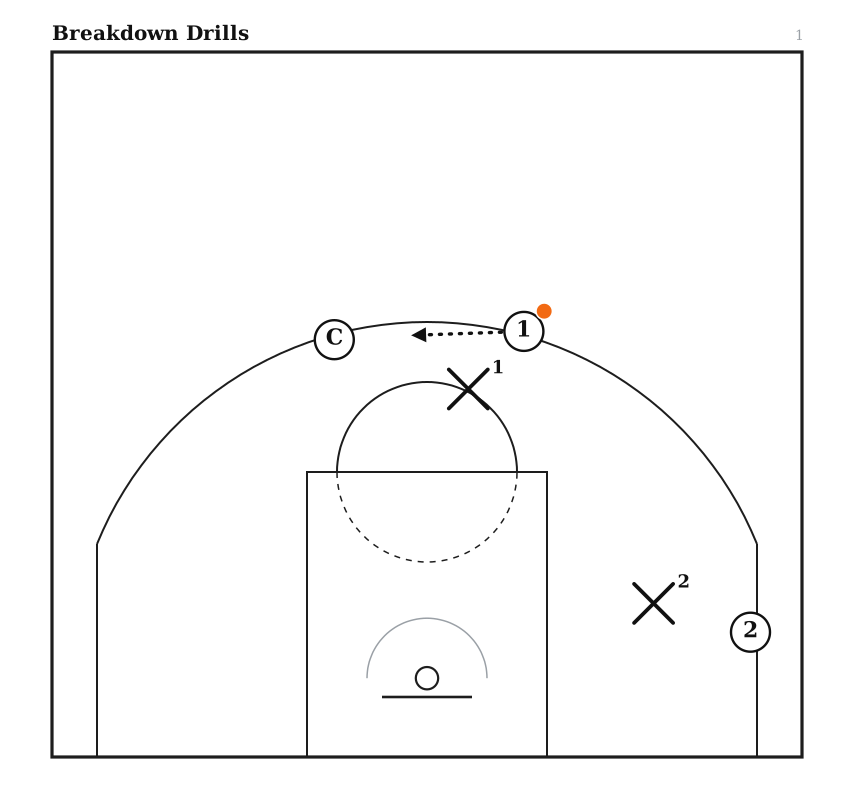
Rebounding follows this same logic. Show players what a possession-winning defensive rebound sequence looks like from box-out contact through outlet pass. Then drill the individual pieces. Then put it back together in live 5-on-5.
Box-Out Fundamentals
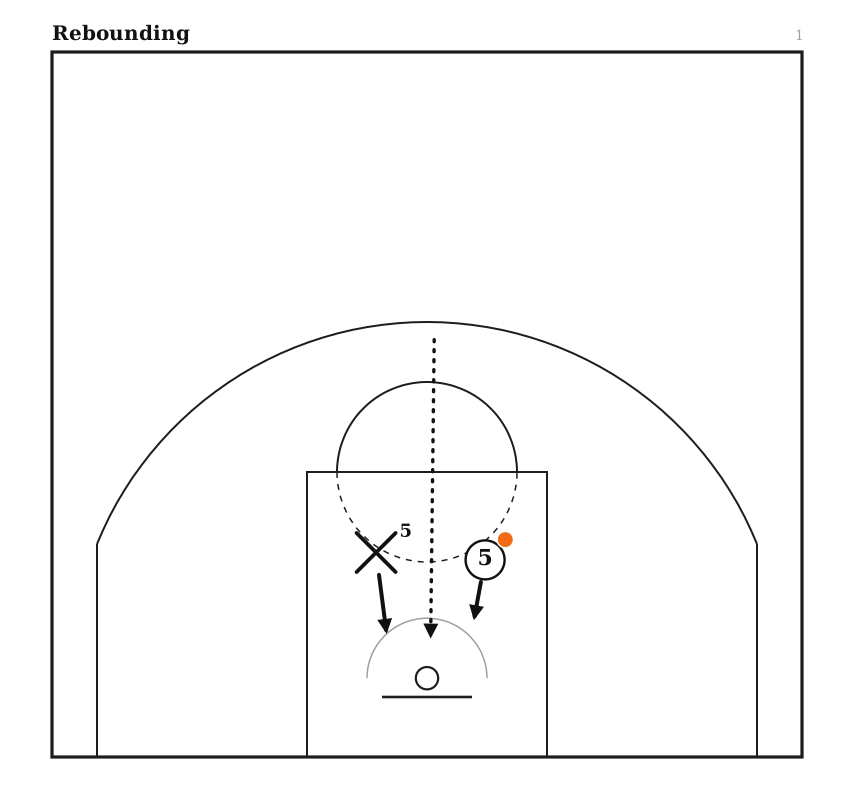
Before you run a single rebounding drill, players need to understand the three contact points of a proper box-out: rear end to thighs, forearms across the body, wide base with feet beyond shoulder width. These three things create a wall. An offensive player cannot go through a wall — they have to go around it, and going around it costs them time and positioning.
The most common box-out error is players who turn and watch the ball instead of sealing their man. The ball will come down somewhere. Your job in the first half-second after a shot goes up is not to track the ball — it is to find your man and put a body on him. Once you have contact and your man is sealed, then you can locate the ball and go get it.
The Wall Drill
Start with a simple wall drill to build the habit of contact-before-ball. Pair players up, one offensive and one defensive. The coach calls "shot" — the defensive player pivots, makes contact with the offensive player's chest using their rear end and forearms, holds a wide base, and freezes. The coach checks posture: are the hips low? Is the base wide? Is the defensive player making contact and maintaining it? Run this 10 times per pair before adding any ball or pursuit.
The Seal-and-Hold Drill
Progress to the seal-and-hold drill. Same pairs, but now the offensive player tries to get around the box-out to touch the wall (standing in for the basket). The defensive player must maintain contact and mirror the offensive player's movements for a full three-count. No ball yet. The goal is building the footwork pattern for mirroring a cutter while maintaining a seal.
Footwork: Reverse Pivot vs. Front Pivot
Players need both pivot options. The reverse pivot (turning away from the offensive player) is safer against cutters trying to go baseline. The front pivot (turning toward the offensive player) is better when you need to quickly seal someone who is already moving toward the basket. In practice, teach both and let players drill the decision: which direction is the offensive player moving? Use that to determine the pivot.
Individual Rebounding Drills
Individual rebounding drills develop the physical tools — jumping, timing, two-handed securing, and chinning the ball — before you add the chaos of teammates and opponents. These are your building blocks.
Mikan Drill
The classic. Player starts on one side of the basket, scores a power layup, immediately steps across and scores on the other side, alternating for 30 seconds. The emphasis is on going up strong with two hands, absorbing contact on the landing, and immediately jumping back up without resetting. This builds the quick-jump habit that separates average rebounders from great ones.
Tip Drill
Player stands directly under the basket and tips the ball off the backboard repeatedly without letting it touch the ground. The focus is on proper hand position (above the ball, not palming it), wrist snap for control, and staying in a jump-ready position. Run for 20 tips per set, then catch and chin the ball on the final rep to finish with a secure possession.
Chin-and-Pivot
The most undercoached habit in rebounding. After securing the ball, players must immediately chin it — elbows out, ball at chin level, protected from reach-ins. Then pivot to face the outlet direction before passing. Run this as a standalone drill: coach tosses the ball off the backboard, player secures it, chins it, pivots baseline or middle depending on where help defense would come from, and fires the outlet. 10 reps each direction.
Use the verbal cue "catch-and-chin" every time a player secures a rebound in any drill. Say it out loud during reps so it becomes an automatic verbal trigger. Players who hear this cue enough will start saying it to themselves during games — and that split-second reminder protects hundreds of possessions over a season.
Ball-Drop Pursuit Drill
Coach or manager drops a ball from above head height onto the floor. Player must react to the bounce, pursue the ball, and secure it before it bounces a second time. This trains pursuit instinct and teaches players to read a ball's trajectory off the rim — the same skill required when a shot caroms unpredictably.
Team Rebounding Drills
Once individuals have the fundamentals, move to competitive team situations. These drills add the pressure of live opponents and force players to execute box-outs under duress.
3-on-3 Box-Out Drill
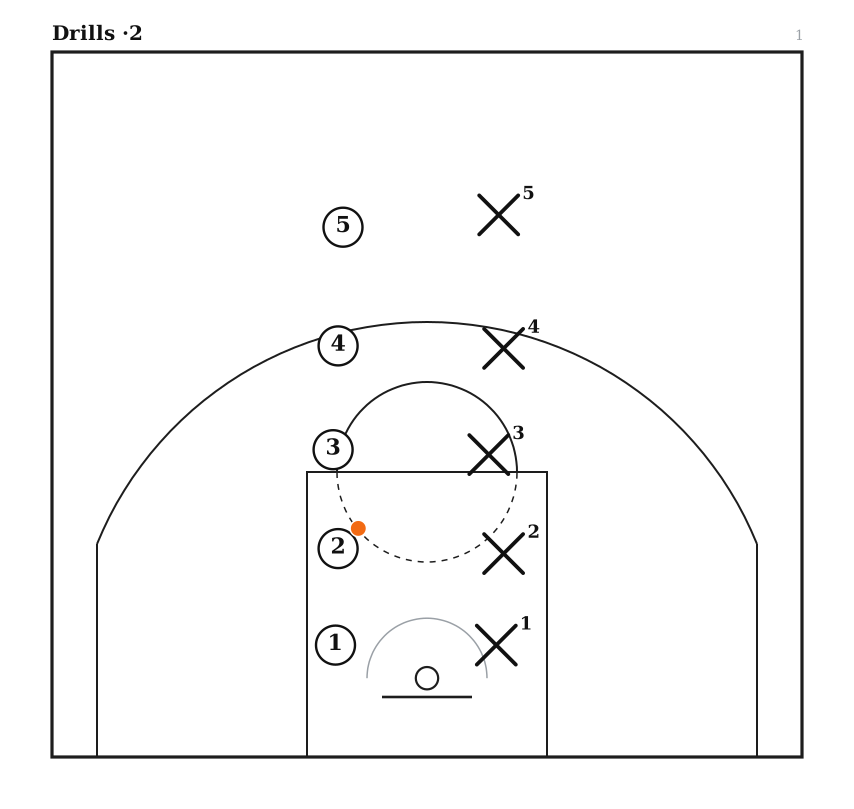
Three offensive players align in a triangle around the key. Three defensive players take their assignments. Coach shoots (or uses a shot fake and pass to a shooter). The defense must box out all three offensive players, secure the rebound, and outlet the ball. If offense gets the rebound, the possession continues live. This drill is the clearest test of whether box-out habits are team-wide or just individual. One player who watches the ball instead of boxing out will give up the rebound every time.
War Drill (Competitive Rebounding)
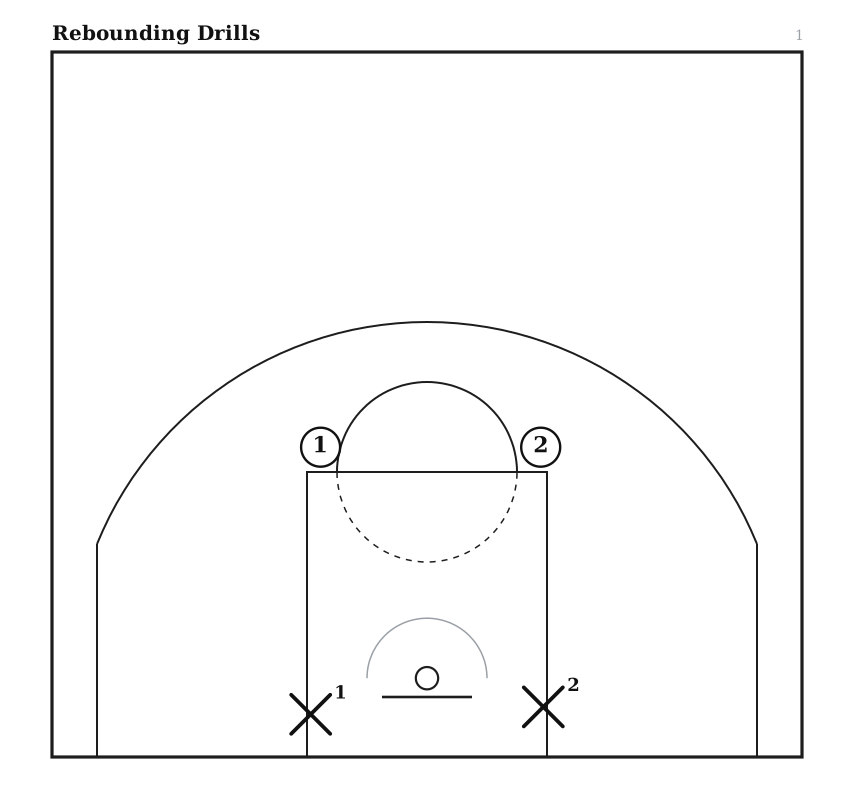
One offensive and one defensive player start in the key. Coach shoots a ball that will miss — use a rim shot or throw it off the backboard. Both players compete for the rebound live. Defense scores a point for securing and outletting. Offense scores a point for getting a put-back or tipping the ball to a teammate. First to five wins. Rotate pairs every two minutes. This drill creates the competitive edge that makes box-outs automatic under pressure.
5-on-5 Shell Rebounding
Run your standard shell drill but add a rebounding layer. Every shot in shell ends with a contested box-out and outlet situation. Award points for defensive rebounds secured and penalize the defense for any offensive rebound. Keep a running score so teams care about the result. The competitive element forces players to maintain box-out assignments even when the ball is moving quickly and they are tired.
Offensive Rebounding Drills
Offensive rebounding is often neglected in practice because coaches spend more time on defensive rebounding — but it is equally important. A team that consistently gets one to two extra offensive rebounds per game can gain five to six extra possessions, which translates directly into points. The key skill is reading the shooter and anticipating the miss direction before the shot goes up.
Read-the-Shooter Drill
Place an offensive player at the three-point line with a defender guarding them. A coach or manager is the "shooter" at another spot. When the coach shoots, the offensive player must read the shot trajectory and attack the glass before their defender can establish a box-out. The offensive player earns a point for any tip or put-back. The drill teaches offensive players to anticipate misses rather than reacting after the fact — a half-step gained early is worth far more than any amount of athleticism gained late.
Ghost Drill
No defense in this drill. Four offensive players position themselves around the key. Coach shoots. All four crash the glass full speed, compete for the ball, and the player who secures it must put it back up immediately — no dribble, no reset. This simulates the controlled chaos of four players pursuing a live ball and forces quick decision-making on the catch. Run for two minutes continuous, rotate players in.
Corner-Entry Tip Drill
This drill focuses on the most common offensive rebound opportunity: the long miss that caroms to the corner. Coach shoots from the wing with a slight push to send the ball to the weak-side corner. An offensive player crashes from the opposite block, tracks the ball, and tips it back to a teammate at the elbow. The tip — not the full catch-and-shoot — is the skill. Teach players to redirect the ball back into the key with one hand, keeping possession alive and giving a teammate a better look.
Outlet Passing and Transition
A secured defensive rebound is only half the job. The outlet pass that starts transition offense is where possessions are won or given back. Turnovers off bad outlets are statistically worse than missed box-outs because they give opponents easy fast-break points instead of just second-chance points.
Outlet to Rim Run
Run this drill at the end of every rebounding block. Five players set up in half-court defensive positions. Coach shoots. Defense boxes out, secures the rebound, and immediately initiates transition — the rebounder chins and pivots, the point guard sprints wide to the outlet position, catches, and the team runs its break. Drill the entire sequence at game speed. The habit you are building is that every defensive rebound immediately becomes offense without hesitation.
Pressure Outlet Drill
Add a defender to the outlet receiver. The rebounder must outlet under pressure, and the receiver must create a clean target — v-cut to the wing, catch facing up, and push ahead to the next level. This simulates press situations and teaches the rebounder to be decisive rather than holding the ball while defenders close in.
- Box out first, find the ball second — never let players skip contact to track the ball early
- Wide base always — feet must be beyond shoulder width on every box-out rep
- Chin-and-pivot after every secure — make it a non-negotiable habit starting in individual drills
- Award points for offensive rebounds in practice — competition drives the habit better than coaching does
- Outlet receiver must v-cut to get open — standing still invites defensive pressure and sloppy passes
- Track rebound margin in every scrimmage — data accountability motivates players more than verbal reminders
Integrating Rebounding Into Practice
The biggest mistake coaches make with rebounding is treating it as a separate unit — one week at the start of the year and then forgotten. Rebounding is a daily habit. The drills described in this guide should be woven into your practice structure every day, even if only for five to eight minutes.
The most effective integration model is a two-segment structure. Start practice with a brief individual skills block — chin-and-pivot, tip drill, box-out wall drill — as part of your warm-up routine. Then end each major half-court segment with a competitive rebounding rep: 3-on-3 box-out drill, or war drill. This keeps the skill fresh without requiring a full standalone unit.
Track rebounding margin in every scrimmage situation. Keep a manager on a clipboard or use a whiteboard visible to the team. When players know they are being measured, they compete harder. When they see the data showing their team giving up five offensive rebounds in a 10-minute scrimmage, the correction is self-evident. Numbers make the problem concrete in a way that verbal coaching cannot.
For in-season practice, the key is that competitive rebounding drills belong at the end of segments when players are fatigued — not at the start when they are fresh. The reason is simple: missed box-outs in games almost always happen when players are tired. If you only drill rebounding when everyone is fresh, you are not preparing them for the conditions where they will actually need the habit.
Assign specific rebounding roles in your system. Know which two players are your primary offensive rebounders on any given shot. Know who is your long-rebound coverage player. Know who triggers the outlet. When every player knows their assignment before the shot goes up, rebounding becomes a system rather than a free-for-all — and systems beat athleticism in the long run.
Get our full practice planning templates and drill libraries delivered weekly.
Join the Online Basketball Playbook Newsletter →See it drawn up
Related diagrams
Keep Building
Related breakdowns
Where to Practice Basketball: Complete Guide to Finding Courts and Training Spaces
Where to Practice Basketball: Complete Guide to Finding Courts and Training Spaces
Sample Practice Plan Basketball: Complete Guide for Effective Team Training
Sample Practice Plan Basketball: Complete Guide for Effective Team Training