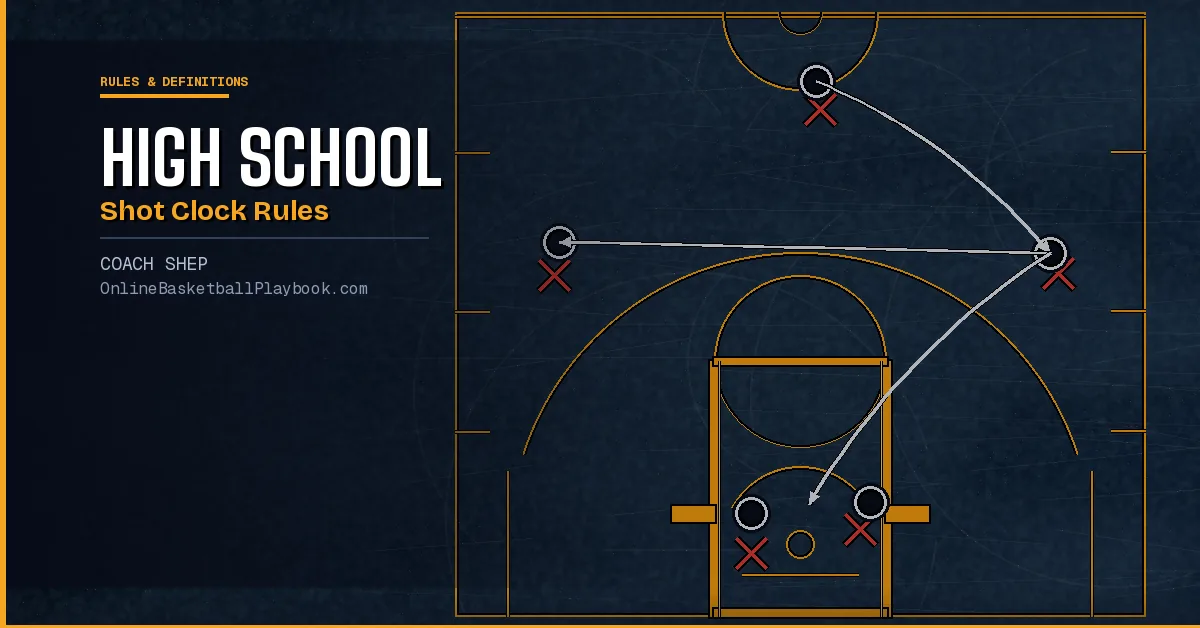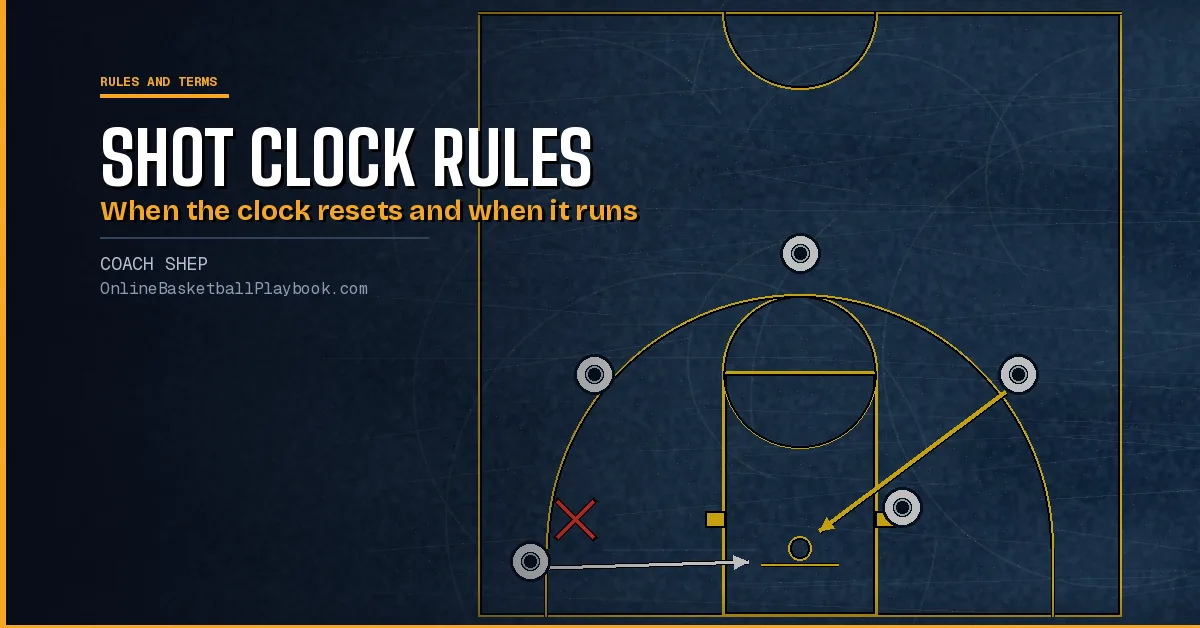
Basketball shot clock rules decide how long a team may hold the ball before it has to get a shot to the ring, and when that count starts over. The length is the easy part: 30 seconds in college, 24 in the NBA and FIBA, and 35 in high school where a state has adopted a shot clock. The resets are where coaches and players get caught, because each level handles an offensive rebound, a defensive foul, a kicked ball and a blocked shot a little differently. This guide goes through each one, level by level, from the current NCAA, NBA and FIBA rulebooks and the NCAA's published comparison with the high school rules.
Basketball Shot Clock Rules: Length by Level
| Level | Shot clock | Reset after the offense rebounds a shot that hit the ring |
|---|---|---|
| NFHS (high school) | 35 seconds, by state adoption | No national rule. Check your state association |
| NCAA men | 30 seconds | 20 seconds |
| NCAA women | 30 seconds | 20 seconds |
| NBA | 24 seconds | 14 seconds |
| FIBA | 24 seconds | 14 seconds |
The NCAA shot clock runs for the whole game, including extra periods, and is turned off only when less time remains on the game clock than on the shot clock. The NBA clock starts at 24 unless Rule 7 says otherwise and shows tenths of a second once it reaches 4.9.
High School and the Shot Clock
The NCAA's comparison of the high school and college books lists the NFHS shot clock as "State adoption - 35 seconds," and its row for shot clock resets reads "No rule." So a high school game has a shot clock only where the state association has adopted one, and the reset details come from that state's rules. If you coach high school, get your state association's shot clock rules in writing before the season and teach from them. The state-by-state picture is on high school shot clock rules.
What Counts as a Shot-Clock Try
At the NCAA, NBA and FIBA levels, a shot beats the shot clock only if two things happen. The ball leaves the shooter's hand before the horn, and then it touches the ring or goes in.

- NCAA men and women. A shot-clock try leaves the hand before the horn and then strikes the ring or flange or enters the basket. It is a violation if the try is not released in time, or if it is released in time and then misses the ring and flange.
- NBA. The ball must leave the hand before the shot clock expires and then make contact with the ring. After a violation, the other team gets the ball on the sideline at the nearest spot, no nearer the baseline than the free-throw line extended.
- FIBA. If the horn sounds with the ball in the air, a made basket counts and a shot that touches the ring is no violation. A shot that misses the ring is a violation, unless the opponents gain immediate and clear control, in which case play goes on.
That is why an air ball released with a second left is still a turnover. Goaltending and basket interference rules still apply to a shot in the air, covered on goaltending.
Resets After the Ball Hits the Ring
The most common reset comes off a missed shot. What matters is whether the ball touched the ring and who gets it back.

- NCAA men. If the offense is first to control the ball in its frontcourt after a try, pass or deflection that touches the ring or flange, or after a missed free throw that stays in play, the shot clock resets to 20. If the defense gets it after the ring, the clock resets to 30.
- NCAA women. If the shooting team is first to control the ball in its frontcourt after a missed field goal or free throw that touches the ring or flange and stays live, the clock resets to 20. If the other team gets it, 30.
- NBA. If the offense is first to gain possession after a missed shot that touches the ring, or a missed free throw that stays in play, the clock resets to 14. A change of possession resets it to 24.
- FIBA. After the ball touches the ring, the clock resets to 14 if the same team gets it back and to 24 if the opponents gain control.
The NCAA men's book counts a pass or deflection that hits the ring the same way as a shot. So does the NBA for this reset: any live ball that touches the ring of the team with the ball counts as a missed shot that hit the ring.
Blocked Shots and Loose Balls
A blocked shot that never touches the ring is not a try that hit the ring, so it does not reset the clock if the offense keeps the ball.

- NCAA men. The shot clock keeps running in loose-ball situations when the offense keeps control and when a try fails to hit the ring or flange. A defender merely touching the ball does not start a new shot-clock period.
- NCAA women. An opponent merely touching the ball does not start a new period either, as long as the same team stays in control.
- NBA. The shot clock is never reset on a field-goal attempt that fails to touch the rim. If a defender touches the ball but does not gain possession, the clock keeps running.
- FIBA. The clock resets only when the ball touches the ring, the opponents gain control, or a rule below applies. A touch by an opponent does not start a new shot clock if the same team keeps control.
One NCAA exception is worth knowing. When the offense regains control in its own backcourt after a try that did not touch the ring or flange, the shot clock is not reset either.
Fouls and the Shot Clock
A foul by the defense resets or protects the offense's clock. Where the throw-in happens decides how much.
| Level | Defensive foul, throw-in in the frontcourt | Defensive foul, throw-in in the backcourt |
|---|---|---|
| NCAA men | 20 seconds or the time left, whichever is greater | 30 seconds |
| NCAA women | 20 seconds or the time left, whichever is greater, for a single personal foul before the bonus | 30 seconds |
| NBA | The time left or 14 seconds, whichever is greater | 24 seconds |
| FIBA | Keeps running from 14 or more. Resets to 14 from 13 or less | 24 seconds |
| NFHS | Check your state association | Check your state association |
A foul or violation by the team with the ball gives the other team possession, and a change of possession starts a new full shot clock at the NBA level (24) and in the NCAA books (30 for a backcourt throw-in). Both NCAA books set 20 when the defense is awarded a throw-in in its frontcourt. In FIBA, the new team's clock is 24 for a backcourt throw-in and 14 for a frontcourt throw-in. A technical foul on the team with the ball does not reset its FIBA clock, which continues from where it stopped. The fouls themselves are on basketball fouls list.
Get the next coaching guide in your inbox
One email when a new guide or diagram set goes up. Free.
Kicked Balls and Other Violations
Kicking the ball on purpose is a violation at the NCAA, NBA and FIBA levels. When the defense kicks it, the offense keeps the ball and the shot clock is protected.

- NCAA men. A kicking or fisting violation by the defense resets the clock to 20 or the time left, whichever is greater, whether the throw-in is in the frontcourt or the backcourt. This applies only before a try hits the ring. After a try hits the ring, a defensive kick with a frontcourt throw-in resets the clock to 20.
- NCAA women. A kicking or fisting violation by the defense during team control resets the clock to 20 or the time left, whichever is greater.
- NBA. A kicked or punched ball by the defense with the throw-in in the frontcourt leaves the clock where it was or sets it to 14, whichever is greater.
- FIBA. A violation by the team without the ball (other than out of bounds) is handled like a defensive foul: the clock continues from 14 or more in the frontcourt, resets to 14 from 13 or less, and resets to 24 for a backcourt throw-in.
The kicking rule itself, and the rest of the violations, are on basketball violations list.
Out of Bounds and Timeouts
When the defense knocks the ball out of bounds, the offense keeps the ball and keeps its clock, with no reset.
- NCAA men and women. No reset when the ball is deflected or caused to go out of bounds by a defender. The NCAA comparison chart sums it up as no reset on out-of-bounds violations.
- NBA. Never reset when a defender is the last to touch the ball before it goes out of bounds. The offense has only the time left.
- FIBA. When the same team keeps the ball for a throw-in after the ball goes out of bounds, the shot clock stops but does not reset.
A timeout does not reset the shot clock on its own. The NCAA books list "a charged or electronic-media timeout has concluded" among the stoppages with no reset. The NBA keeps the game clock and shot clock as they were when a late timeout moves the throw-in to the frontcourt. In FIBA, after a time-out in the last two minutes by the team entitled to the ball from its backcourt, a frontcourt throw-in after an out-of-bounds ball leaves the clock running from 13 or less or sets it to 14 from 14 or more. How late timeouts move the ball is on when to call a timeout in basketball.
The End of a Period
When the game clock shows less time than the shot clock, the shot clock stops mattering, and each level turns it off in its own way.
- NCAA men. The shot clock is turned off when a reset situation occurs and the game clock shows less time than a shot-clock period.
- NCAA women. The display is turned off in the same situation.
- NBA. With 24 seconds or less left in a period, the shot clock does not run after a change of possession. It comes back on, set to 14, if one of the 14-second situations happens.
- FIBA. The shot clock is switched off on a new control of the ball when less than 14 seconds remain on the game clock.
The end of a period is where the shot clock meets clock management: holding for the last shot, the two-for-one, and when to foul. Those decisions are on basketball clock management and basketball late-game situations. The game clock is covered on basketball game clock rules.
Reset Rules Side by Side
| Situation | NCAA men | NCAA women | NBA | FIBA |
|---|---|---|---|---|
| Change of possession | 30 (20 on a frontcourt throw-in after a violation or team-control foul) | 30 (20 on a frontcourt throw-in after a violation or team-control foul) | 24 | 24 (14 on a frontcourt throw-in) |
| Offense rebounds after the ring | 20 | 20 | 14 | 14 |
| Defense rebounds after the ring | 30 | 30 | 24 | 24 |
| Blocked shot, no ring, offense keeps it | No reset | No reset | No reset | No reset |
| Defense knocks it out of bounds | No reset | No reset | No reset | No reset |
| Defensive foul, frontcourt throw-in | 20 or time left | 20 or time left (before the bonus) | 14 or time left | 14 or time left |
| Defensive foul, backcourt throw-in | 30 | 30 | 24 | 24 |
| Defense kicks the ball, frontcourt throw-in | 20 or time left | 20 or time left | 14 or time left | 14 or time left |
NFHS has no national reset rule, so every row at the high school level comes from your state association. The other rules by level are collected in basketball rules and regulations, and the words used here are defined on basketball terms.
Questions Coaches Ask
How long is the shot clock in basketball?
35 seconds in high school where a state has adopted one, 30 seconds in NCAA men's and women's basketball, and 24 seconds in the NBA and FIBA.
Does the shot clock reset when the ball hits the rim?
It resets once someone gains control after the ball touches the ring. If the offense gets it back, it resets to 20 in NCAA games and 14 in the NBA and FIBA. If the defense gets it, it resets to a full clock.
Does an air ball reset the shot clock?
No. A shot that misses the ring does not reset the clock, and if the horn sounds, an air ball released in time is still a violation at the NCAA, NBA and FIBA levels.
Does a foul reset the shot clock?
A defensive foul with a frontcourt throw-in sets the clock to 20 or the time left in NCAA games and to 14 or the time left in the NBA and FIBA. With a backcourt throw-in it goes to a full clock.
Does the shot clock reset on a kicked ball?
The offense keeps the ball, and the clock goes to 20 or the time left in NCAA games and to 14 or the time left in the NBA and FIBA.
Is there a shot clock in high school basketball?
Only in states that adopt one, at 35 seconds. The reset rules come from your state association.
Want the printable playbook packs?
OBP Pro members get the premium playbook packs: the zone attack, out of bounds and practice plan PDFs, plus each new pack as it is finished. The membership page lists what is in each one. Or draw your own version free in PlayDraw.
See what OBP Pro includesMore Rules, Terms and Game Guides
- When to Call a Timeout in Basketball: Strategy and Rules
- Basketball Terms: A Glossary for Coaches and Players
- How to Read a Basketball Play Diagram: Symbols and Lines
- Basketball Free Throw Rules: Lane, Rim and Violations by Level
Back to Basketball Rules and Regulations and every Rules and Terms page.
Keep Building
Related breakdowns
Basketball Timeout Rules: Length, Number and Signals by Level
Basketball timeout rules by level: how long a timeout is, how many each team gets, who may call one and when, the timeout signal and media timeouts.
How Long Is Basketball Halftime? Halftime Length by Level
How long is basketball halftime? 15 minutes in college, the NBA and FIBA, and 10 in the last high school rulebook text. Quarter breaks and halftime rules by level.