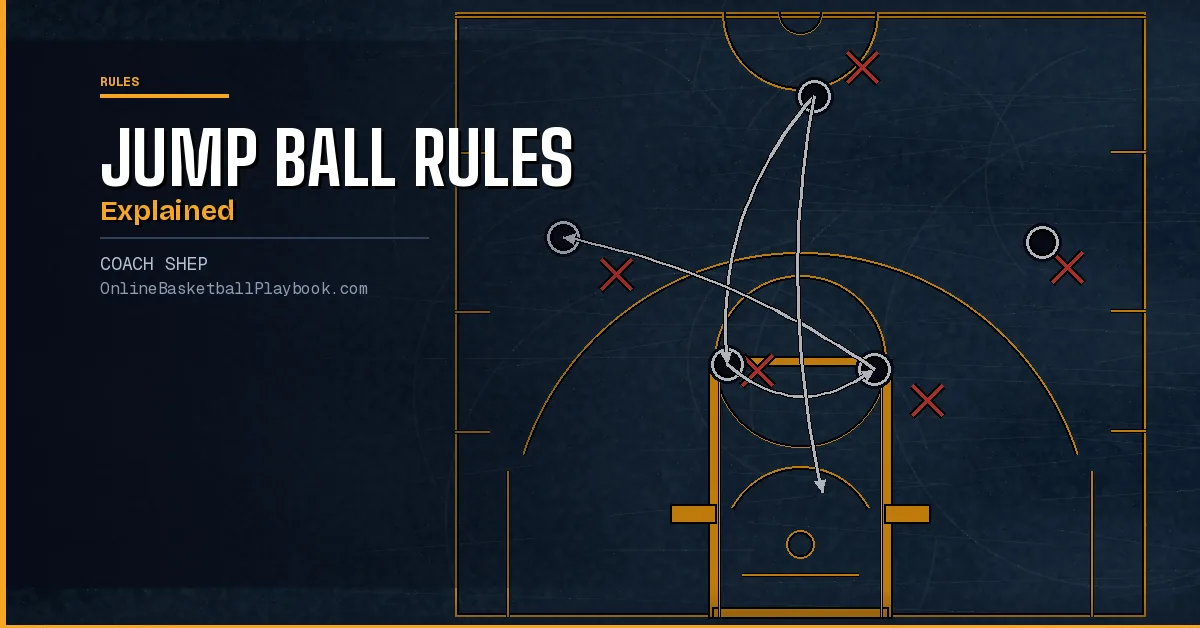
The jump ball starts every basketball game and determines initial possession. Understanding the rules (who jumps, what happens after, and how the possession arrow works) keeps your team prepared and prevents costly mistakes when it matters most.
What Is a Jump Ball?
A jump ball is a method of putting the ball into play by tossing it up between two opposing players in a designated circle on the court. The official throws the ball upward and each jumper attempts to tip it to a teammate before it reaches its highest point. Jump balls appear at the start of the game, at the beginning of overtime periods, and in specific in-game situations where officials cannot determine which team should receive possession.
At the NBA level and in most professional leagues, jump balls occur throughout the game whenever a held ball or simultaneous violation is called. At the high school and college levels, however, those situations are handled differently (through the alternating possession rule), which means the jump ball only happens at the opening tip-off and at the start of each overtime period. Understanding which ruleset governs your level of play is essential.
The jump ball has been part of basketball since Dr. James Naismith's original rules. Though its use has been scaled back at certain levels, the opening tip remains a defining moment in every game. Teams that win the tip frequently gain early possession, which can translate to first-strike scoring opportunities and early momentum. That is why coaches at every level still spend time preparing their jumper and setting up their players around the circle before the game begins.
A well-organized team treats the opening tip like a set play, not just a coin flip. Your tallest player is not always your best jumper; athleticism, timing, and wrist technique all matter. Developing a reliable tip play that sends the ball to a designated teammate gives your team a real edge, especially in close games where every possession counts.
How the Tip-Off Works
The tip-off takes place at center court in the center circle. The official places both jumpers inside the circle, each standing on the half of the circle closest to their own basket. Non-jumpers line up outside the circle alternating by team, and no player may enter the circle until the ball has been tipped. Violating this rule results in a violation and the ball being awarded to the opposing team.
The official tosses the ball upward between the two jumpers. The ball must be tipped (not caught) by either jumper. Each jumper may attempt to tip the ball only twice. If neither player tips the ball successfully on the toss, the official retossses the ball. Once the ball is tipped, it is live, and play proceeds normally. Non-jumpers may enter the circle only after one of the jumpers makes contact with the ball.
Proper jump ball technique involves more than just height. The jumper should bend the knees and time the leap so the tip occurs at the peak of the toss, not on the way up. A controlled wrist flick toward a designated teammate is far more effective than a wild swat. Coaches often assign specific positions to non-jumpers based on their read of which direction the tip will go, creating instant fast-break opportunities or safe possession scenarios depending on the game plan.
Good Basketball IQ Development includes understanding the geometry of the jump ball (where the ball will likely land based on both jumpers' positioning and how non-jumpers can cut or seal off opponents to secure possession). Drilling the tip-off as a set play during Basketball Practice Plan sessions pays dividends over a long season.
The Possession Arrow Explained
At the high school and college level, the alternating possession (AP) rule replaces jump balls for held balls and simultaneous violations during the game. The team that loses the opening tip-off earns the first possession arrow, meaning they receive the ball on the first held-ball situation after the tip. The arrow then alternates with each subsequent held-ball call throughout the game.
The possession arrow is displayed at the scorer's table and points toward the team that will receive the ball next. Officials and scorers are responsible for maintaining and updating the arrow accurately. The team whose arrow is lit gets the ball at the nearest out-of-bounds spot when a held-ball situation is called. If a held ball occurs near a boundary line, the inbound spot is the nearest point along that boundary.
At the NBA level, there is no alternating possession arrow. The NBA uses a jump ball for every held-ball situation during the game, which is why you see more jump balls at the professional level than at the high school or college game. Understanding this distinction is critical for coaches who work at multiple levels or whose players transition from high school to college or professional play.
The possession arrow also resets at the start of overtime. The team that did not receive the alternating possession most recently at the end of regulation typically gets it first in overtime, though officials confirm the arrow direction at the scorer's table before overtime begins. Keeping track of the arrow during a game, particularly late in close contests, is a subtle but important part of situational basketball awareness.
When Jump Ball Situations Occur
Beyond the opening tip-off, there are specific situations throughout a game that trigger a jump ball or held-ball call. The most common is the held ball (when two players from opposing teams simultaneously have firm control of the ball and neither can gain clear possession without undue roughness). Officials watch for situations where players are wrestling for control rather than making a clean basketball play.
Other situations that may result in a jump ball or alternating possession include: the ball going out of bounds when officials cannot determine which player touched it last; simultaneous violations by players from opposing teams; the ball becoming lodged in the basket support; and certain clock errors or administrative situations where possession must be re-established. In the NBA, these all result in a jump ball; in most other levels, they are handled by the possession arrow.
A jump ball is also used to start each overtime period in most rule sets. This creates another opportunity to employ tip-off strategy and set the tone for the extra period. Teams that have rehearsed their tip-off alignment and have a clear plan for where the ball should go have a structural advantage over teams that treat the overtime tip as an afterthought.
Post-play scrambles near the baseline or under the basket often produce held-ball situations. Understanding Post Play in Basketball and how to secure the ball cleanly (rather than allowing a double-possession tangle) directly reduces the number of jump-ball situations your team faces. Teaching players to rip through or protect the ball in traffic is a skill that pays off in possession numbers over a full season.
Violations and Common Rules
Several specific rules govern jump ball conduct, and violations can shift possession or result in a re-toss. Non-jumpers may not enter the center circle until the ball has been legally tipped. If a non-jumper steps into the circle prematurely, it is a violation and the ball is awarded to the opposing team. This rule applies both to the team winning the tip and the team losing it. Both sides must wait for legal contact before entering.
Jumpers may not catch the ball during a jump ball. They may only tip it. If a jumper catches the ball rather than tipping it, it is a violation. Additionally, each jumper may only tip the ball a maximum of two times. If neither player tips the ball after the official's toss, the official simply re-tosses. Players may not leave their designated half of the center circle during the jump; doing so before the tip is a violation.
The ball must go higher than either jumper's hands on the official's toss for the jump ball to be legal. If it does not, the official re-tosses. This prevents a scenario where a very short toss gives one jumper an unfair advantage. Officials are trained to toss the ball to a height slightly above both jumpers' extended reach, giving each an equal opportunity to time their jump and tip the ball.
One violation coaches often overlook: players surrounding the circle must alternate by team. If non-jumpers are not alternating properly, the official may re-arrange them before the toss, or in some cases, the official may award a free throw or possession depending on the specific rule set. Familiarizing your team with proper circle alignment prevents avoidable procedural errors.
Coaching Strategies for Jump Balls
Most coaches underestimate the preparation required for a successful jump ball. The opening tip-off is one of the few moments in a basketball game where you can predict the exact scenario and rehearse it precisely. Treating the tip like a set play (with designated positions, a target direction, and a secondary option) gives your team a meaningful edge at the start of every game and every overtime period.
First, select your best jumper (not automatically your tallest player). The ideal jumper has a high vertical leap, excellent timing, and a controlled wrist tip. A 6'2" player with a 38-inch vertical may consistently out-tip a 6'6" player with a 24-inch vertical. Test your jumpers in practice and identify who gives your team the best chance to win the tip on a regular basis.
Second, design a tip play with a primary target. If your jumper wins the tip most of the time, you want to know exactly where the ball is going. A common approach is to position your best ball-handler to one side and have the jumper tip in that direction. Your other three players fill the remaining positions around the circle to prevent the opponent from intercepting. If the tip goes to the ball-handler, you can run your half-court offense immediately or push in transition depending on what the defense gives you.
Third, prepare for the scenario where you lose the tip. If the opponent wins the tip, your non-jumpers should already be in defensive position. Assigning your quickest perimeter defender to trail the opposing team's best cutter after the tip helps prevent easy layups off the opening possession. Transition Defense principles apply immediately when you lose the opening tip, and your team must get back quickly and not allow an easy conversion.
Fourth, track the possession arrow throughout the game. Know when the arrow is in your favor and communicate it to your players. In late-game situations where a held ball is called, knowing whether the arrow points your way can influence how aggressively you fight for the ball. If the arrow is yours, a clean release is fine, but if it is the opponent's, your players should contest more aggressively to avoid the held-ball call altogether.
At the NBA level, jump balls occur throughout the game for every held-ball situation. At the high school and college levels, the alternating possession arrow governs most in-game held-ball scenarios, with jump balls reserved for tip-offs and overtime starts. Know your ruleset before game day. The difference directly affects how you prepare and how you react in live situations.
- Select your jump ball specialist based on vertical leap and timing, not just height.
- Treat the opening tip as a set play: assign a target direction and position your best receiver accordingly.
- Alternate non-jumpers properly around the circle to comply with the rule and position defenders for the worst case.
- Track the possession arrow throughout the game. It is a live tactical resource in late-game situations.
- At the high school and college levels, remember that the team losing the tip earns the first possession arrow.
- Rehearse the tip-off play at least once per week in practice so alignment and reads become automatic.
Get free play diagrams, drills, and coaching guides delivered weekly.
Draw this play free in the play drawer →
Membership: the full library, playbook packs, and Pro drawing tools →
Keep Building
Related breakdowns
When to Call a Timeout in Basketball: Strategy and Rules
When to call a timeout in basketball, when to play on, how to budget them for the finish, how to run the huddle, and how many timeouts each level allows.
Jump Ball Plays and Alignments: Opening Tip and Defensive Looks
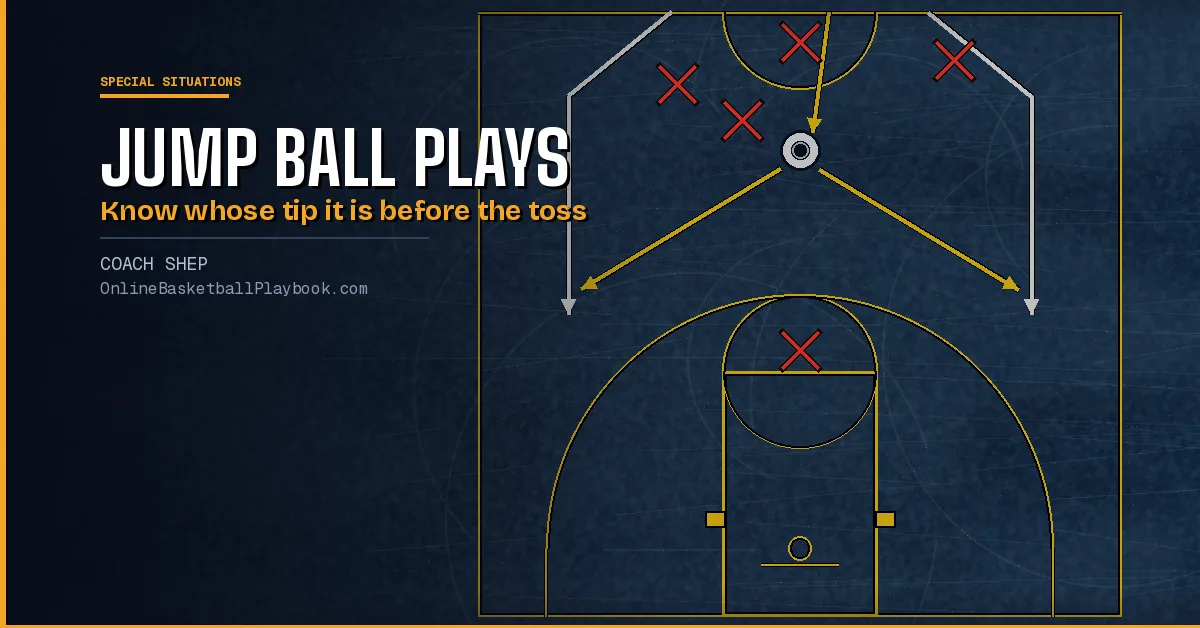
Jump ball plays and tip off positions: box and diamond alignments, opening tip plays with a height edge, defensive and even tips, and the rules by level.