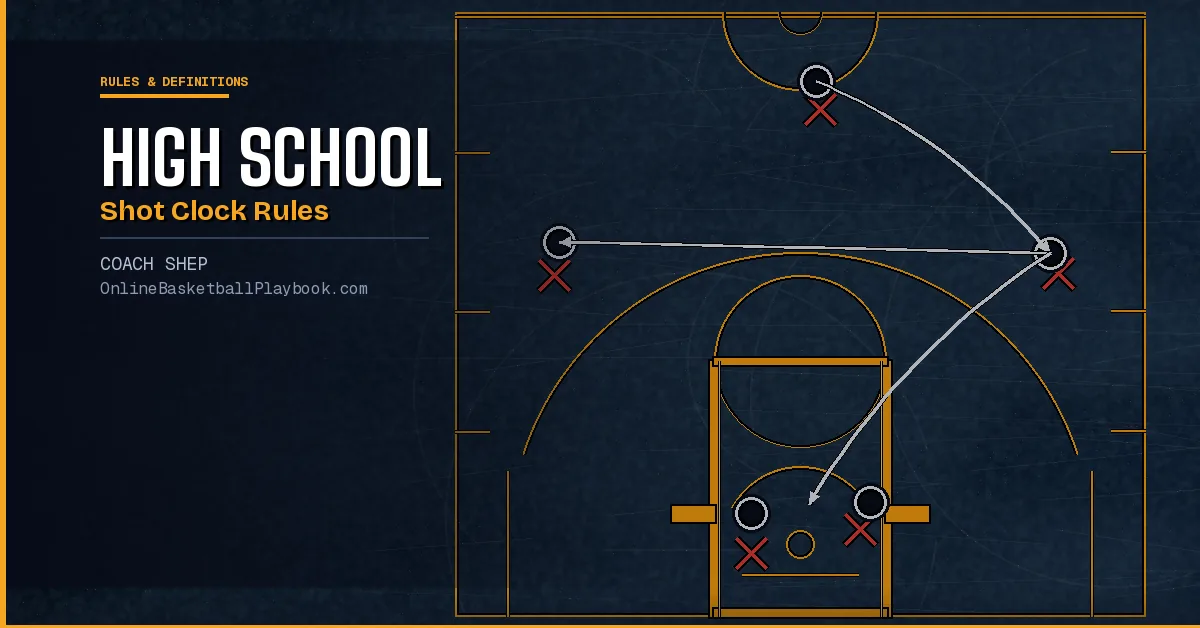
Not every high school game runs a shot clock. Adoption varies by state, the clock length differs, and reset rules catch teams off guard. Here is everything you need to know before tip-off.
Which States Use a Shot Clock
As of the 2024–25 school year, a minority of U.S. states mandate a shot clock for high school basketball, though the number has grown steadily over the past decade. California, New York, Maryland, North Dakota, Rhode Island, Massachusetts, South Dakota, Washington, and a handful of others require a shot clock at the varsity level. Several states leave the decision to individual conferences or districts, meaning two teams in the same state can play under different rules depending on who is hosting.
The NFHS (the National Federation of State High School Associations, which writes the model rules most states adopt) does not mandate a shot clock nationally. Each state's athletic association makes the call. That has created a patchwork that confuses players who transfer across state lines and coaches who travel for tournaments.
States that have adopted the clock generally did so after multi-year pilot programs. California, the largest high school sports state, implemented a 35-second shot clock beginning in the 2023–24 season after several years of CIF-sanctioned pilots. New York has used a 35-second clock for years at both the varsity boys and varsity girls level. Rhode Island and Massachusetts require it for varsity play. North Dakota and South Dakota joined the list more recently, following a regional push to modernize pace of play at the prep level.
States without a mandatory clock (including Texas, Florida, Georgia, Illinois, and Ohio) may see individual invitationals or holiday tournaments opt into shot clock play voluntarily, particularly when the host facility already has the equipment. Coaches entering those events need to check the tournament rules packet, not assume their home-state rules apply.
Clock Length and Standard Timing Rules
Where a shot clock exists at the high school level, 35 seconds is the most common duration. That is the length used in California, New York, and most other adopting states, and it is the length the NFHS has recommended in its guidance documents for states considering adoption. Some states previously experimented with a 30-second clock to more closely mirror the college women's game, but 35 seconds has emerged as the standard for new adoptions.
The clock starts when a team gains possession in their frontcourt. In jump-ball situations, the clock begins when the ball is legally tapped. On a throw-in from out of bounds, the clock starts when the inbounding player releases the ball and it is touched in bounds by a player. On a violation or foul that results in a throw-in, the clock starts on the touch, not on the referee's signal or the release from the thrower's hands.
The clock counts down from 35 (or whatever the state-mandated time is) and must read 0:00 before the shot or the ball must have left the shooter's hand by the time the clock expires. If the ball is in the air when the buzzer sounds and scores or hits the rim, the shot is valid. If the buzzer sounds while the ball is still in the shooter's hands, it is a violation regardless of whether a foul occurred simultaneously.
A key rule many players misunderstand: the shot clock does not stop when the ball hits the rim on a shot attempt unless a reset condition is triggered. If an offensive player tips a ball that bounces off the rim and recovers it, the shot clock continues to run from wherever it was. That ten-second scramble for an offensive rebound can turn into a shot clock violation if the offense is not alert.
When the Clock Resets
Understanding reset triggers is one of the most practical and most misunderstood aspects of shot clock rules. A full reset to 35 seconds (or the state-mandated maximum) occurs in certain specific situations. A partial reset (often to 20 seconds) occurs in others. Knowing the difference can change how a team attacks late-game situations.
A full reset occurs when a live ball goes out of bounds and possession is awarded to the offense, when a foul is committed on the defense and results in a throw-in rather than free throws, when a flagrant or intentional foul gives the offense the ball, or when a jump ball situation results in the offensive team's arrow. In most states, a defensive held ball or a jump ball situation where the defensive team gets the arrow does NOT reset the shot clock. It results in a change of possession, so the shot clock becomes irrelevant to the previous offensive team.
A partial reset (most commonly 20 seconds) is triggered when an offensive player attempts a field goal, the ball hits the rim, and the offense recovers the rebound. This is a critical rule. It means that chasing an offensive rebound after a missed shot does not give the offense a full reset. If the shot clock showed 8 seconds and the shot hits the rim, the offense gets 20 seconds on the reset (or whatever the state-mandated partial amount is), but only if 20 seconds is more than what was already on the clock. If 22 seconds remained when the shot hit the rim, the clock simply continues from 22. No partial reset occurs because the partial amount is less than the remaining time.
Some states do not use a partial reset at all and simply allow the clock to continue after an offensive rebound off a rim shot. Coaches need to verify their state's specific language on this point. The partial reset rule was introduced partly to prevent teams from launching a purposeful off-target shot at the rim with two seconds left to gain a full reset, an old trick from lower levels of play.
Free throw situations do not reset the shot clock in most states unless the result of the free throws is an offensive rebound. If the last free throw goes in, it is a made basket and possession changes. If the last free throw is missed and the offense rebounds it, the shot clock typically resets to the partial amount or continues. Again, state rules vary, so check the rulebook.
Shot Clock Violations and Penalties
A shot clock violation is treated similarly to a backcourt violation. The offense has failed to get a legal shot off in time, and the result is a loss of possession. The defending team is awarded the ball, typically via a throw-in from the nearest out-of-bounds spot to where the violation occurred, though some states default to a specific location such as the nearest sideline or the division line.
The key word is "legal" shot. The ball must hit the rim or enter the basket to satisfy the shot clock. A shot that hits the backboard only (and not the rim) does not count. A shot that is blocked and goes out of bounds without hitting the rim does not reset the clock; if the offense gets the ball back, they play with whatever time remained. A shot that is blocked and the defense recovers it is simply a change of possession. No violation because the defense now has the ball.
Intentional fouling to stop the shot clock is not a violation of shot clock rules specifically, but it does carry its own consequences under the foul rules. If a team is in the bonus, the defensive foul results in free throws and the shot clock resets, so a desperate defensive foul near the end of the shot clock often does more harm than good for the defense in a bonus situation.
Technical fouls on the defense during live ball play can also affect the shot clock. A technical foul assessed to the defense typically results in free throws and then a throw-in with a full shot clock reset, depending on the state rule. Offensive technical fouls can result in a shot clock violation being enforced simultaneously with the technical foul penalty.
One common game-situation mistake: players who are not familiar with shot clock play will sometimes hold the ball near half-court after an inbound with 5 seconds left, not realizing the clock is winding down. This is especially common in states that don't use a shot clock during the regular season but host shot-clock tournaments. Drilling clock awareness in practice, calling out "ten seconds!" as part of normal reps eliminates this in-game error.
Officials and Equipment Rules
Shot clock operation at the high school level requires additional equipment and trained personnel beyond what a standard game needs. Most states that mandate a shot clock require shot clock operators who are separate from the scoreboard operator. The shot clock operator controls a dedicated display (often mounted above each backboard or positioned at the scorer's table) and must respond to official signals during live play.
The shot clock operator takes their cues from the officials, not from their own judgment. When an official signals a reset, the operator resets the clock. When an official signals a shot clock violation, it was the clock that expired, but the official confirms the call. The operator does not make calls; they manage the equipment. Disputes about whether the shot left the shooter's hand before the buzzer are the officials' call, not the operator's.
Equipment malfunctions are covered in the rulebook. If the shot clock malfunctions during play, the officials can suspend play temporarily to reset or repair the clock. If the malfunction cannot be corrected, in most states the game continues without a shot clock. It does not result in cancellation or a forfeit. Schools hosting games where a shot clock is required must have working equipment; failure to provide it can result in a forfeit depending on the state association's rules for pre-game equipment checks.
The visual display of the shot clock must be visible to players, coaches, and officials. Placement rules vary, but most states specify minimum visibility standards. Some smaller gyms struggle to meet these requirements, which is one practical reason shot clock adoption has lagged in states with many small rural programs that lack the facility infrastructure.
Coaching Strategy Under the Shot Clock
The shot clock changes basketball in ways that go far beyond just "you have to shoot faster." It eliminates the four-corners stall. It prevents a team from protecting a lead by simply holding the ball. It forces every offense to generate a quality look within a defined window, which raises the floor for all teams but also demands more from coaches in terms of system design.
The most important strategic adjustment is building a clear shot clock hierarchy: what does your offense look like at 30 seconds, at 15 seconds, and at 5 seconds? Teams that only have one gear (their primary set) are vulnerable when defenses take away the primary action with 20 seconds left. You need a "shot clock bailout" action, something quick and reliable that every player knows to trigger when the clock dips under 10.
End-of-shot-clock actions worth building into practice: the pull-up off a middle drive, the step-back from the wing, the corner kick-out off a drive, and the post entry for a quick shot. These are not panic plays. They are trained responses. The best teams practice "shot clock crunch" scenarios weekly: start a possession with 8 seconds on the clock and make something happen. That repetition removes the anxiety and replaces it with a learned pattern.
Defensively, the shot clock is a tool. A defense that can routinely force a team to use 30 seconds to get a contested shot is winning the possession game even if the shot goes in. Pressure, length, and activity that disrupts the first and second options of an offense can bleed the clock down to a difficult third option. Transition defense becomes even more important because early-offense attempts (shots in the first 8 seconds) often come before the defense is set and represent some of the highest efficiency possessions in the game.
- Know your state's shot clock length before the first game (35 seconds is most common but verify).
- Drill "8 seconds left" possession scenarios weekly so players have a trained bailout action
- Teach the partial reset rule (offensive rebounds off rim shots do not give a full 35).
- Assign a player on every possession to be the "clock caller" and verbally alert the team at 15 and 10
- Understand that a blocked shot returning to the offense does NOT reset the clock. It continues.
- On inbounds plays after timeouts, confirm the shot clock before running any long set
- In bonus situations, do not foul to stop the clock. The reset often hurts more than it helps.
One underrated adjustment: how your team receives a throw-in from half-court when the shot clock is already running. Transition drill work at most programs focuses on pushing tempo, but if you are inbounding at 12 seconds because a held ball or reset situation left you short, you need a quick-hitter from the sideline, not a full-court push.
For teams playing in states without a shot clock that travel to shot-clock tournaments, the prep work is straightforward but non-negotiable: run every practice possession with a 35-second timer visible. The mental habit of seeing the clock and feeling urgency must be built in practice. You cannot install it on the bus ride to the tournament.
Draw this play free in the play drawer →
Membership: the full library, playbook packs, and Pro drawing tools →
Keep Building
Related breakdowns
Basketball Shot Clock Rules: Length and Resets by Level
Basketball shot clock rules at the NFHS, NCAA, NBA and FIBA levels: the length, what counts as a try, and when it resets on rebounds, fouls and kicked balls.
Basketball Game Clock Rules: When It Stops and When It Starts
Basketball game clock rules by level: when the clock stops, when it starts on a throw-in or a missed free throw, made baskets late and the last-two-minute rules.
High School vs College vs NBA Rules: What Changes for a Coach
High school vs college vs NBA rules: shot clock, three-point line, bonus, fouling out, timeouts, backcourt count and defensive three seconds, and what each changes.