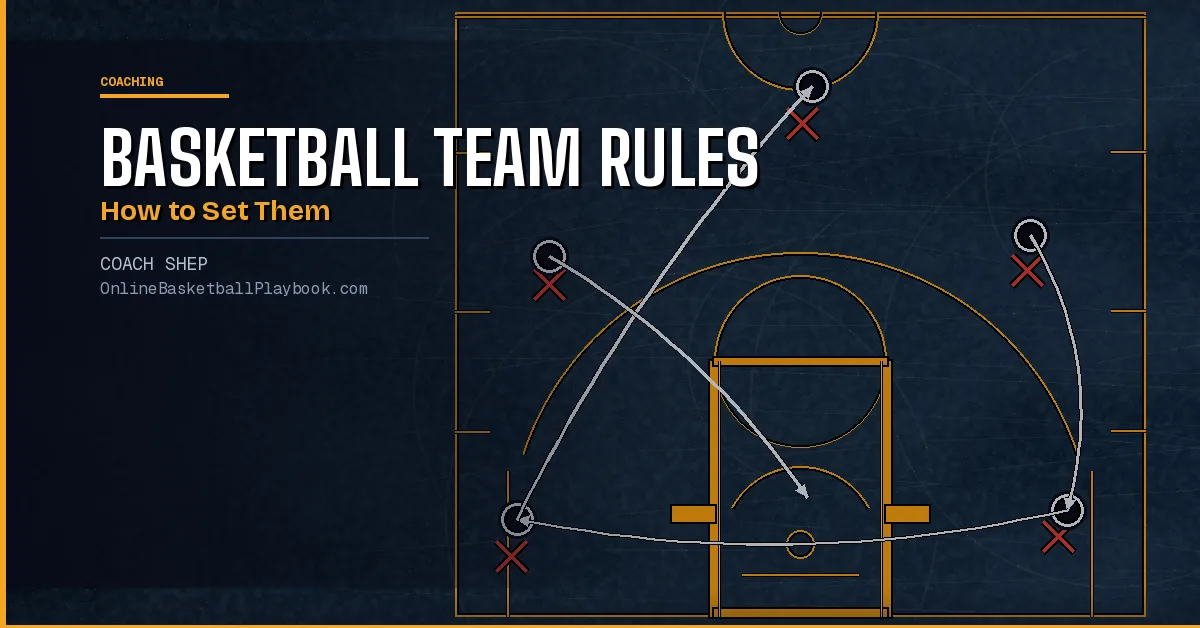
Clear team rules are the foundation of every winning program. Set them early, enforce them consistently, and your players know exactly what is expected on and off the court.
Why Team Rules Matter More Than X's and O's
Most coaches spend the majority of their preparation time on plays, sets, and schemes. Offensive actions, defensive rotations, press breaks (the stuff that fills a whiteboard). But the programs that sustain success year after year tend to share something simpler: a clear, well-enforced set of team rules that every player understands before the first practice tip-off.
Rules create structure. Structure creates consistency. Consistency is what separates a group of talented individuals from a real team. Without a shared standard, players fill the gaps with their own assumptions, and those assumptions rarely align. One player thinks missing a morning lift is a minor infraction. Another thinks showing up five minutes late to film is fine. Left unchecked, those disconnects compound into locker room friction, inconsistent effort, and lost games in the fourth quarter when discipline matters most.
The research and experience from elite coaches backs this up. When teams define their culture through explicit rules (not just vibes and hope), they spend less time managing conflict and more time developing players. Think of team rules not as restrictions but as the operating system the program runs on. A good basketball team culture doesn't emerge by accident; it is built deliberately, rule by rule, standard by standard.
This guide walks you through how to build that system from the ground up: what rules to set, when to set them, how to enforce them, and how to get player buy-in so the rules stick.
Set Your Preseason Code of Ethics
The single biggest mistake coaches make with team rules is waiting too long to establish them. By the time problems arise (a player skipping practice, a conflict in the locker room, an attitude issue during a losing streak), it is too late to introduce new standards without them feeling reactive and punitive. Players read the room. If a rule appears only after a violation, it carries no weight.
The best time to introduce your team rules is before the season begins. A preseason meeting (separate from any physical activity) dedicated entirely to the code of conduct sends an unmistakable message. These standards are not an afterthought. They are the foundation.
A solid preseason code of ethics should cover the basics: punctuality, rest and recovery, respect for coaches and teammates, academic responsibilities (where applicable), and social media conduct. These are the pressure points that cause problems. Cover them before they become issues.
Present the rules in writing. Review them out loud. Give players the opportunity to ask questions. Then have every player sign the document. That signature matters, not as a legal instrument, but as a psychological commitment. It shifts the dynamic from "the coach told us the rules" to "I agreed to these standards." That shift in framing makes accountability conversations significantly easier later in the season.
Some coaches go further and involve veteran players in drafting the code. There is real value in that approach, particularly at the high school and college level. When players help write the rules, they have genuine ownership over them. They become enforcers, not just subjects. But even when coaches write the code unilaterally, the preseason rollout is what makes it real.
Define the Non-Negotiables
Not all rules carry equal weight. Effective programs distinguish between guidelines (expectations that have flexibility and context) and non-negotiables, the hard lines that define the program's character. Understanding the difference is critical to enforcement.
Non-negotiables are the rules that cannot be bent regardless of who breaks them. A star player who misses a mandatory team meeting faces the same consequence as a walk-on who does. There is no asterisk. The moment you create exceptions for your best player, you have destroyed the rule for everyone else. Every player on the roster is watching to see if the standard is real.
Common non-negotiables at the program level include: mandatory attendance at all practices and team activities, punctuality for every commitment, respectful treatment of teammates, coaches, and opponents, academic eligibility requirements, and zero tolerance for dishonesty. These are the categories where a single violation (if handled with an exception) will undermine your entire program culture.
The specific rules will vary based on your level, your players, and your program's history. A youth coach running a recreational league has different non-negotiables than a varsity head coach. But the principle holds across all levels: some rules must be universal and inflexible. When you define them clearly and early, enforcement becomes straightforward. There is no ambiguity. There is no gray area. The player either met the standard or they did not.
This clarity also protects the coach. When a difficult conversation needs to happen (a benching, a suspension, a player removed from the program) the coach is not making a personal judgment in the moment. They are applying a standard the player agreed to before the season. That distinction matters both for player development and for maintaining trust with parents and administrators.
Enforce Rules Consistently and Early
Writing the rules is the easy part. Enforcement is where most programs break down. Consistent enforcement requires two things that are harder than they sound: the courage to address violations immediately and the discipline to apply the same standard every single time.
Address violations early. The first time a player is five minutes late to practice and nothing happens, that player (and every player watching) learns that the punctuality rule is not real. First violations set the precedent. If you let the first one slide, you will spend the rest of the season managing a rule that no one believes you will enforce.
Early enforcement does not have to be harsh. The consequence should be proportional. A first-time tardiness infraction might mean running sprints at the end of practice or sitting out the first five minutes of the next drill. The specific consequence matters less than the fact that it is applied consistently and promptly. Players do not need to fear the rules; they need to know the rules are real.
Consistency across players is where coaches face the most pressure. It is easy to enforce rules on a reserve player. It is harder to bench a starter the night before a big game because they violated a policy. But that is exactly when consistency matters most. The players watching are not just watching the starter. They are evaluating whether the rules apply to them when it costs something. If the answer is yes, your culture is real. If the answer is no, your rules are theater.
One useful framework: before each season, decide in advance what the consequences are for each category of violation. Write them down alongside the rules themselves. When a violation occurs, you are applying a predetermined consequence, not making a reactive judgment in the heat of the moment. That prevents emotional decision-making and ensures fairness. It also removes the temptation to treat different players differently based on their roster status.
Build Player Ownership Into the Rules
Rules handed down from the top are easier to resist than rules a player helped create. When players have a voice in shaping the team's standards, they become invested in upholding them. That investment shows up in peer accountability, the most powerful enforcement mechanism available to any coach.
There are several practical ways to build player ownership. The most direct is to involve veteran players or team captains in drafting the preseason code. Hold a session before the official rules rollout where your leaders can propose, debate, and refine the standards. The coach retains final authority (this is not a vote) but the process signals that player input is valued. Players who contribute to the rules are significantly more likely to police violations among their peers.
Another approach is to frame rules around team identity rather than individual behavior. Instead of "No player may miss practice without prior approval," try "We protect our time together." Instead of "All players must arrive 15 minutes before scheduled activities," try "We are always early." Identity-based framing connects the rule to something the player wants to be part of, not just a policy they are required to follow. This approach aligns with how successful programs build building accountability into daily practice habits.
Player-led accountability meetings (brief check-ins where the team evaluates its own adherence to the code) can also reinforce ownership. These work best when captains facilitate them and coaches stay in a listening role. When players hear the standards from peers rather than coaches, the message lands differently.
Be careful not to over-democratize the process. Rules that are subject to constant renegotiation lose their authority. The goal is buy-in during the preseason, not ongoing debate during the season. Once the rules are set and agreed upon, the conversation shifts to accountability, not revision.
Hold a 30-minute team rules meeting in the first week of preseason, separate from any practice activity. Hand out the written code, review it together, answer questions, and have every player sign it. That signed document is your accountability anchor for the entire season. Reference it by name when addressing violations.
Connect Rules to Team Culture
Rules and culture are not the same thing, but they are deeply connected. Rules are the specific behaviors you require. Culture is the shared identity and belief system those rules reinforce. The strongest programs understand that their rules are expressions of their culture. Every standard they set is a statement about who they are and what they stand for.
When you set a rule about punctuality, you are not just solving a logistics problem. You are saying: we respect each other's time, we take our commitments seriously, and we hold ourselves to a higher standard than the average team. When you enforce a rule about how players speak to one another, you are building an environment where every player (regardless of role or status) feels safe and respected.
Culture built through rules tends to be more durable than culture built through rhetoric. Speeches and slogans fade. Consistently enforced standards accumulate. Over time, players internalize the rules not as external constraints but as expressions of their own identity as members of the program. That internalization is the goal.
Good rules also support player development on the court. A team that practices discipline in how they treat the program's standards will bring that same discipline to basketball player development: The repetition, the attention to detail, the willingness to execute a role even when it is unglamorous. The connection between off-court standards and on-court execution is real and direct.
Consider revisiting your team rules at the midpoint of the season, not to renegotiate them, but to evaluate how well the team is living them. A brief honest conversation at the midseason mark ("Are we being the team we said we'd be?") reinforces the standards and gives players a chance to recommit. Programs that treat their rules as a living standard (not a document that gets shelved after the first week) build the kind of sustained culture that wins in February.
Your rules should also be communicated to parents and guardians at the youth and high school level. When the entire support system around a player reinforces the same standards, compliance increases and the coach spends less time managing violations. A parent who understands why punctuality matters will not excuse their child for being late. They will hold them accountable at home, which multiplies your enforcement capacity significantly.
- Set rules before the season starts: Preseason is the only time standards feel proactive rather than reactive.
- Put everything in writing and have players sign it: A signed document transforms rules from suggestions into commitments.
- Define the non-negotiables explicitly: Every player must know which rules have zero exceptions regardless of roster status.
- Enforce the first violation immediately: The precedent you set in week one determines whether the rules are real all season.
- Apply the same consequence to every player: Stars and reserves face the same standard, no asterisks, no exceptions.
- Involve captains in the rules process: Player ownership of the standards drives peer accountability, which is more powerful than coach enforcement alone.
- Connect rules to team identity: Frame standards around who you are as a program, not just what players are prohibited from doing.
Get free play diagrams, drills, and coaching guides delivered weekly.
Draw this play free in the play drawer →
Membership: the full library, playbook packs, and Pro drawing tools →
Keep Building
Related breakdowns

Basketball Positions: What Each of the 5 Positions Does
The point guard, shooting guard, small forward, power forward and center, what each one does on offense and defense, and when to ignore the numbers.
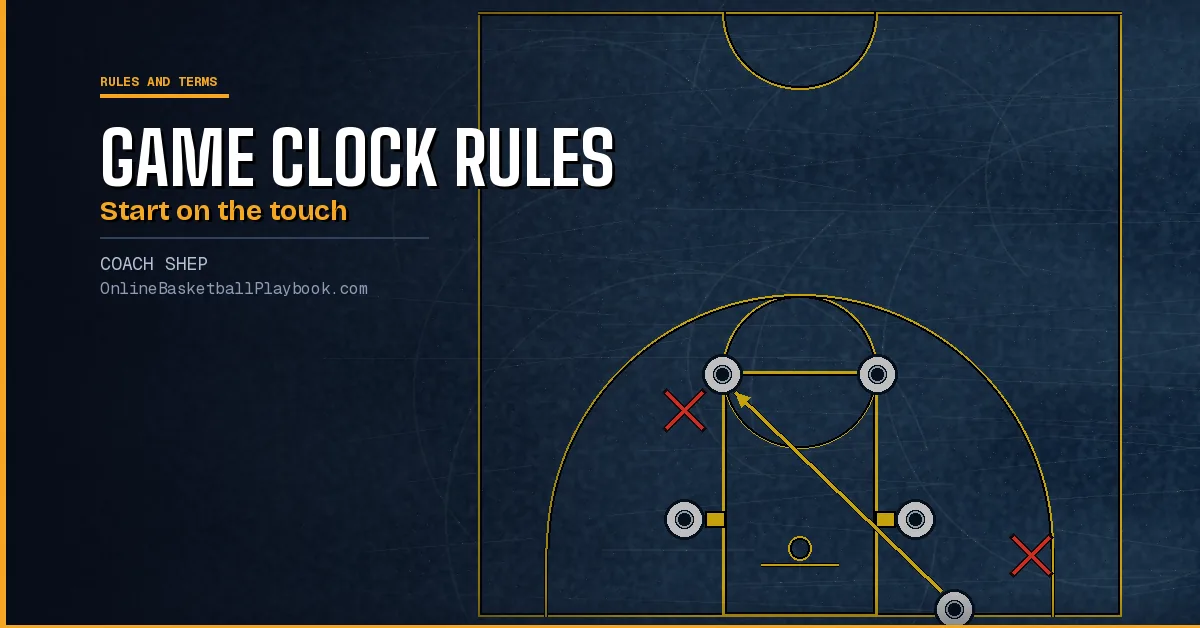
Basketball Game Clock Rules: When It Stops and When It Starts
Basketball game clock rules by level: when the clock stops, when it starts on a throw-in or a missed free throw, made baskets late and the last-two-minute rules.

FIBA vs NFHS Rules for Coaches Who Play Internationally
FIBA vs NFHS rules for coaches: goaltending and the ball on the ring, timeouts, travel and the gather, the clock, the throw-in, plus Olympic rules vs the NBA.