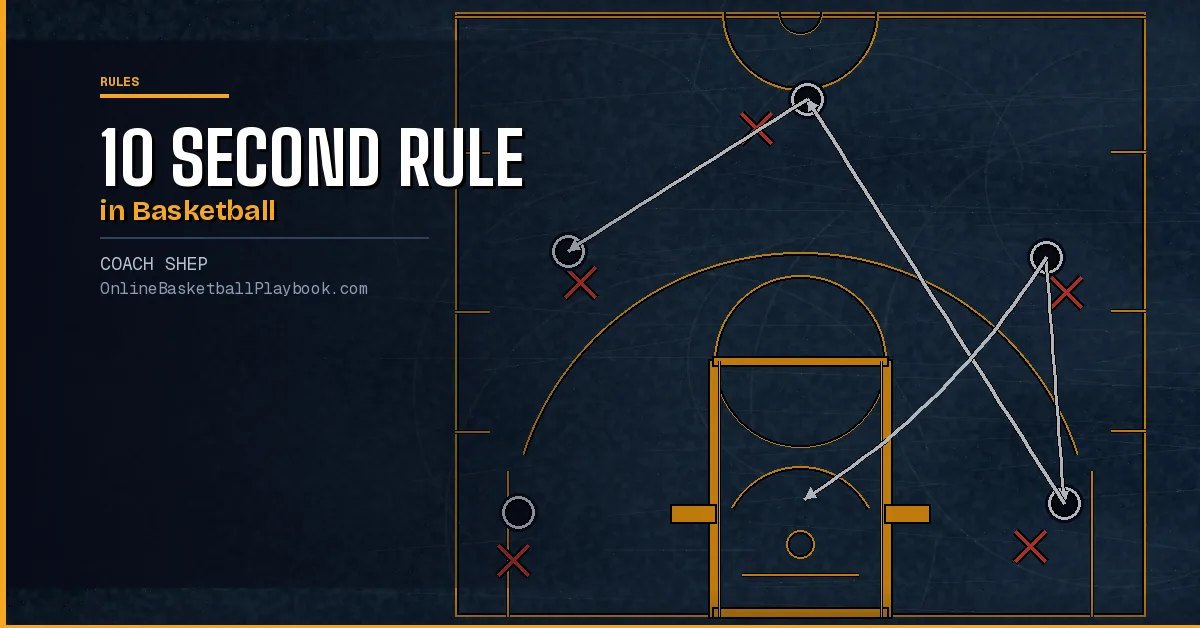
The 10 second rule requires the offense to advance the ball from the backcourt across halfcourt within ten seconds after a made basket or inbound. Fail to cross in time, and possession flips to the defense.
What Is the 10 Second Rule?
The 10 second rule is a timing violation in basketball that prevents the offensive team from stalling in their own backcourt. When a team inbounds the ball or gains possession after a made basket, they are required to advance the ball past the halfcourt line (also called the midcourt line or the division line) within 10 seconds. If they do not, the referee blows the whistle, signals a backcourt violation, and awards possession to the defending team at the nearest boundary line.
The rule exists to keep the game moving. Without a time limit on advancing the ball, a team with a lead late in a game could simply hold the ball in the backcourt indefinitely, draining the clock and eliminating any possibility for the trailing team to mount a comeback. The 10 second rule forces the offense to be decisive and attack the frontcourt, which opens the game up and creates more possessions for both teams.
At every level of organized basketball (youth leagues, high school, college, and the NBA) some version of this timing rule is in place. The exact number of seconds can vary by ruleset (more on that below), but the principle is universal. Get the ball over halfcourt quickly or give it up.
This rule pairs closely with the backcourt violation rule, which states that once a team has legally advanced the ball into the frontcourt, they cannot intentionally return it to the backcourt. Together, these two rules create a strong incentive for offenses to push forward and play aggressively once they have possession.
When the Clock Starts and Stops
Understanding exactly when the 10 second count begins and what can pause or reset it is essential for both players and coaches. The count starts the moment a player in the backcourt touches the ball. In most rulesets, the official begins counting as soon as the inbounder releases the ball and a backcourt player receives it, or when a backcourt player gains control of a rebound or loose ball.
The count is not based on the shot clock or the game clock. A referee tracks it manually, using either a visible count or a mental count, and signals the violation when 10 seconds have elapsed without the ball crossing halfcourt. In many high school and youth leagues, the referee will count aloud and show hand signals visible to coaches and players, which is helpful for situational awareness late in games.
Several things can pause or affect the count:
- A held ball or jump ball situation. If a held ball is called, the count stops and possession is determined by the alternating possession arrow. The 10 second count resets when the new team inbounds.
- A foul by the defense. If a defensive player fouls a backcourt ball-handler before the 10 seconds expire, the count stops and the offense inbounds from the spot of the foul. The count does not carry over.
- A timeout. If the offense calls timeout before the violation is whistled, the 10 second count resets when play resumes. This is a common late-game tactic (more on that in the offensive strategy section below).
- A kicked ball violation by the defense. If a defender intentionally kicks the ball while the offense is still in the backcourt, the 10 second count resets, giving the offense a fresh start from the sideline.
One subtle point: the ball does not have to be dribbled across the line. A player who is standing in the frontcourt and catches a pass from a backcourt teammate satisfies the requirement. The ball has legally crossed halfcourt. What matters is that the ball breaks the plane of the division line, not that a dribbler physically carries it across.
NBA, College, and High School Differences
The 10 second rule is not identical at every level, and coaches who work with multiple age groups or watch different leagues need to know the distinctions.
High School (NFHS Rules): The traditional 10 second rule is alive and well in high school basketball. The offense has exactly 10 seconds to advance from the backcourt to the frontcourt. This is the standard most youth and prep coaches teach, and it is the most common version players encounter through their formative years.
NCAA College Basketball: College basketball also uses a 10 second rule for advancing the ball into the frontcourt. However, the NCAA added an important wrinkle in 2015: the defense can force a reset of the 10 second count by causing the ball to return to the backcourt while the count is active. This gives defensive teams using full-court pressure an extra tool. If they can deflect or force a dribbler back across halfcourt, the 10 second count does not reset. It keeps running from where it was.
NBA: The NBA changed its rule in 2000. Previously the NBA also used 10 seconds, but the league switched to an 8 second rule for advancing the ball. The logic was the same (keep possessions moving) but the NBA wanted a tighter window at the professional level where players are skilled enough to consistently advance in under 10 seconds anyway. The result is a slightly more urgent backcourt environment in NBA games.
For coaches working with young players, the NFHS 10 second standard is what matters most. However, teaching players the discipline to advance quickly (well within 10 seconds) prepares them for the more demanding timelines they will face as they progress through the game.
How Defenses Use the Rule Against You
Savvy defensive coaches treat the 10 second rule as an offensive weapon. By applying backcourt pressure, they can force the offense into mistakes, use up precious seconds, and potentially earn a turnover without the opposing team ever entering the frontcourt. A well-run full court press defense is designed explicitly to exploit the 10 second count.
The most common defensive approach is to trap the inbounder's first receiver. When the ball is inbounded, two defenders converge on the ball-handler near the baseline, pinning them near the sideline or corner. The remaining defenders deny passing lanes up the court. The offense is now burning seconds trying to escape the trap, and the 10 second window starts ticking.
A variation of this is the run-and-jump press, where defenders switch assignments mid-press and try to surprise the dribbler with unexpected traps. This press is particularly effective at the youth and high school level because young ball-handlers have not yet learned to read traps early and make quick decisions under pressure.
Defenses also use the 10 second rule tactically in late-game situations. If the offense has the ball with a lead and is trying to kill clock, a team without timeouts has limited options. The defense can press full-court, knowing that even if the offense escapes the trap, they have used up several seconds and their poise will be tested. Even one or two good trapping possessions can result in a 10 second violation or a five-second inbounds violation, both of which flip possession without the defense ever scoring.
Understanding how defenses exploit the rule is the first step toward designing an offense that can reliably break it.
Offensive Principles for Beating Backcourt Pressure
The best response to any defense built around the 10 second rule is a well-rehearsed press break that puts the ball in the frontcourt in four seconds or less. Teams that are disciplined in their press break do not feel the 10 second rule at all. They advance so quickly that the timing pressure never builds.
Several principles make a press break effective:
The inbounder is a passer, not a bystander. After delivering the inbound pass, the inbounder should step onto the court and become an immediate outlet. Many teams assign the inbounder a secondary role in the press break (cutting to the middle of the court or sprinting to a wide position near halfcourt). This gives the ball-handler an extra option if the primary press break is clogged.
Push the ball to the middle. Sideline traps are the defensive bread and butter. A ball trapped in a corner with the sideline acting as a third defender gives the offense nowhere to go. Moving the ball to the middle of the court opens angles in every direction and breaks the trap's geometry. Teach your guards to attack the middle first when they receive the inbound pass.
Use long passes to advance quickly. Nothing defeats full-court pressure faster than a skip pass to a player who has sneaked behind the press. Every press break should have at least one player designated to look for the early outlet (a long pass that gets the ball to the frontcourt in one touch). This pass must be practiced repeatedly so both the passer and receiver execute it cleanly under game speed.
Stay composed and use timeouts wisely. Coaches should remind players that a timeout in the backcourt, called before the 10 second violation, resets the count entirely. Teams that burn a timeout to avoid a violation are not wasting it. They are avoiding a turnover, which is far more costly. Teaching players to recognize when to call timeout before the count expires is a key piece of basketball IQ development.
Practice the press break every week. Press breaks only work when they are second nature. Teams that only walk through their press break in film sessions fall apart when a live defensive press disrupts their rhythm. Include a live press break rep in every practice plan so players build confidence executing it under pressure.
Teaching the Rule to Youth Players
For youth coaches, the 10 second rule is both a rulebook requirement and a teaching moment. Young players often have no natural urgency about advancing the ball. They dribble in place, look for a teammate slowly, or freeze when confronted by a defender. Helping them feel the clock is one of the most practical skills you can build in early development.
Start by making the rule visual and concrete. Count aloud during practice when a player inbounds the ball. "One, two, three, four, five" gives the player an audible cue that time is passing. Many young players do not feel the count until they actually hear it, and once they do, their urgency increases immediately.
Next, set up drills that simulate press situations. A two-on-one or two-on-two backcourt drill, run live with the 10 second count, forces players to make decisions quickly. Keep the drill simple: the defense is trying to use up time, the offense is trying to cross halfcourt cleanly. Repeat until the offense can do it consistently in under five seconds (well inside the 10 second window).
Teaching youth players to call for the ball is equally important. A trapped ball-handler who is looking for help needs teammates who are actively showing themselves, calling out, and providing a clear target. Passivity from off-ball players is what makes traps work. When every player on the floor understands their role in the press break, getting the ball up the court becomes a team skill rather than an individual burden.
Connect the rule to the broader concept of playing fast and with purpose. Teams that push the pace in the frontcourt, as in a structured fast break, typically have no trouble with the 10 second count because their mindset is already pointed forward. The players who struggle with the 10 second rule are usually the same players who play slow and reactive in the frontcourt. Fixing the mindset fixes the violation.
Common Mistakes and How to Fix Them
Even well-coached teams make predictable errors around the 10 second rule. Knowing what to look for makes it easier to correct in practice before it costs you in a game.
Dribbling toward the sideline after inbounding. A ball-handler who receives the inbound pass near the middle of the court and immediately dribbles toward the sideline has limited their own options. The sideline becomes a second defender, the clock keeps ticking, and now a trap only needs one defender to be effective. Fix: teach players to receive the inbound pass and immediately push forward (north-south, not east-west).
Staring at the trap instead of finding the outlet. When pressure arrives, some players lock their eyes on the defender in front of them and stop looking for escape routes. The outlet is almost always available (either a teammate in the middle or the inbounder who has stepped in) but a ball-handler who is not scanning will not find it. Fix: run trap drills where the outlet is always open and the ball-handler is rewarded only for finding it quickly.
Inbounders who do not enter the play. After throwing the inbound pass, some players step back and become spectators. This removes an extra offensive body from the press break and forces four players to solve a problem that five should be handling. Fix: make it a rule in practice that the inbounder must sprint to a designated spot every single time the ball is inbounded.
Not calling timeout early enough. Teams will sometimes let the 10 second count run to eight or nine seconds before calling timeout in a panic, leaving almost no margin for error. A timeout called at five or six seconds is calm and controlled. A timeout called at nine seconds is rushed and rattles players. Fix: designate a coach or a specific player to count aloud on the bench during press situations and signal for the timeout with time to spare.
Neglecting press break practice. Many coaches spend extensive time on half-court offense and defense but shortchange press break work. If you run it once a week at the end of practice when players are tired, you will not be sharp when a team presses you in a tournament. Fix: build press break into your standard basketball practice plan and treat it with the same priority as your primary offense.
When protecting a lead in the final minutes, teach your players to inbound quickly, push to the middle, and call timeout the instant a trap forms rather than gambling on breaking it. Protecting the ball matters more than avoiding the timeout.
- Count aloud in practice so players develop an internal feel for the 10 second window.
- The inbounder must enter the play immediately. Assign them a sprint cut to a designated spot every time.
- Push all inbound receptions toward the middle of the court. Never let the sideline become a third defender.
- Designate at least one player per possession to look for the long skip pass behind the press. A single deep pass ends the pressure.
- Call timeout at five or six seconds when trapped, not at nine. Calm decisions beat panic every time.
- Drill live press-break situations weekly under the real 10 second count so execution becomes automatic in games.
- Teach players that a timeout resets the count completely. Burning a timeout to avoid a violation is always the right trade.
Get free play diagrams, drills, and coaching guides delivered weekly.
Draw this play free in the play drawer →
Membership: the full library, playbook packs, and Pro drawing tools →
Keep Building
Related breakdowns
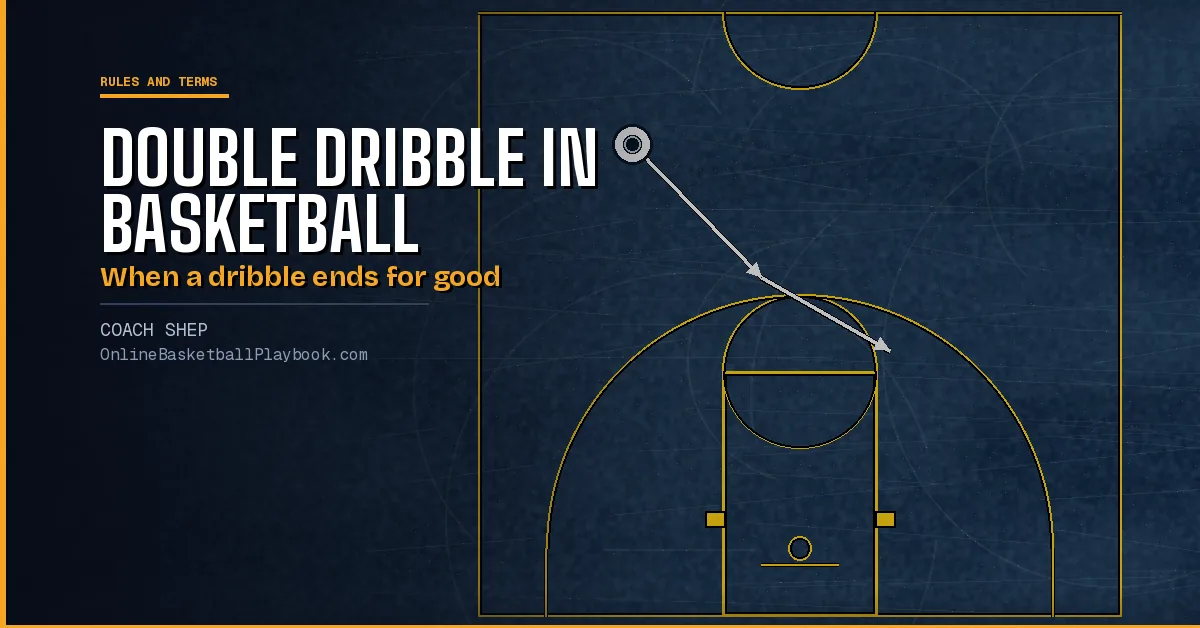
Double Dribble in Basketball: Rule, Examples and Calls
A double dribble is a second dribble after the first has ended. Rules by level (NFHS, NCAA, NBA, FIBA), what restarts a dribble, examples and how to coach it.