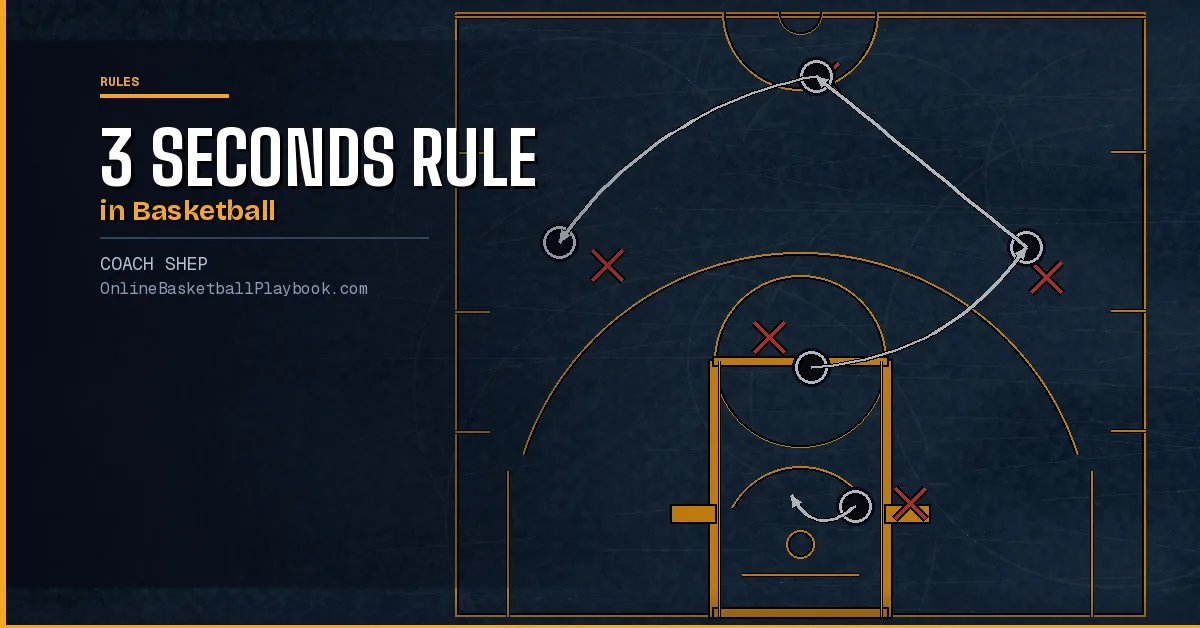
The 3 seconds rule is a lane violation called when an offensive player stands in the paint too long. Understanding it helps your post players stay legal, move with purpose, and attack the basket without giving the ball back to the defense.
What Is the 3 Seconds Rule?
The 3 seconds rule (officially called an offensive lane violation) states that an offensive player cannot remain in the paint (the key, or lane area) for more than three consecutive seconds while their team controls the ball in the frontcourt. If a referee counts to three and the player has not cleared the lane, the ball is turned over to the defense.
The rule exists to prevent dominant post players from simply parking under the basket and waiting for easy layups. Without it, a strong seven-footer could plant themselves in the lane all game and catch lob passes for uncontested attempts. The rule forces all players (regardless of size or position) to keep moving and use the full floor.
The violation is called when all three conditions are met: the offensive team has possession, the ball is in the frontcourt, and the player has been standing in the lane for more than three seconds without actively making a play on the ball. The count resets the moment a player exits the lane, even if only for a fraction of a second, as long as they genuinely clear both feet past the boundary.
At the youth and high school level, this violation gets called fairly regularly because players are still learning where the boundaries are and how to time their post entries. At the college and professional level, experienced players are skilled at the quick step-out move that resets the clock just before the whistle would blow. Teaching your players to recognize the lane lines and develop good habits early will pay off for years.
What Counts as the Lane?
The lane (also called the paint, the key, or the three-second area) is the rectangular zone that runs from the baseline to the free-throw line. Its width varies by level: at the NBA level it is 16 feet wide; at college and high school it is 12 feet wide. The boundary lines themselves are part of the lane, so a player whose foot is on the line is considered to be inside it.
Players need to understand the geometry of the lane instinctively. Many young big men get called for violations because they drift into the lane during ball reversal or simply lose track of their feet while watching the ball. Developing court awareness (the ability to know where you are on the floor without looking down) is a critical piece of basketball IQ development for post players at every level.
The three-second count begins the moment both feet are inside the lane boundary. It stops (and resets) when the player clears the lane with both feet or when their team loses frontcourt possession (a defensive rebound, a steal, or the ball going out of bounds). A shot going up does not automatically stop the count mid-flight, but since the possession status changes on a made or missed shot, the three-second clock becomes moot at that moment.
One nuance worth understanding: the restricted arc near the basket is inside the lane, but the lane extends all the way to the free-throw line. A player camped at the elbow, with both feet on the block, is in the lane. A player standing at the free-throw line with both feet on or inside that boundary is also in the lane. The entire rectangular zone counts. Not just the area close to the rim.
Exceptions and Edge Cases
The three-second rule has several important exceptions that referees are trained to recognize and that coaches need to teach their players.
Actively Making a Play
A player who has been in the lane for close to three seconds but is actively in the process of receiving a pass, catching the ball, or taking a shot is not called for the violation at that moment. The rule is intended to penalize stationary camping, not to prevent a player from receiving a post entry and going to work. Referees use judgment here, but the principle is: if the ball is on its way to you and you're making a genuine play, the count generally does not apply in that instant.
The Step-Out Reset
Any time a player steps out of the lane (both feet clear of the boundary), the count resets to zero. Experienced post players use this constantly. They step to the block, hold for two seconds, step out to the short corner or the lane line, and immediately re-enter to receive a pass. The defense has to honor the movement, which opens up both the catch-and-score opportunity and a potential screen or cut for a teammate.
Loose Ball Situations
When a shot goes up, the ball is momentarily not in any team's possession. The three-second count pauses during the flight of the shot. Once the ball is rebounded, possession is established again and the count begins for whoever is in the lane. This is why rebounding drills Always emphasize clearing space and boxing out rather than camping under the rim. A player who camps under the basket during a shot not only loses rebounding position but risks a violation the moment the ball is secured by their team.
When the Ball Is in the Backcourt
The three-second rule only applies when the offensive team has the ball in the frontcourt. If the ball is pushed back into the backcourt (due to a deflection, a bad pass, or a reset), the count stops. This matters most during press break situations and any offense that reverses the ball back past half court. Your post players should know that while the ball is in the backcourt, they can hold their lane position momentarily without a violation, but this situation rarely lasts long enough to matter in practice.
Defensive 3 Seconds (NBA Only)
At the NBA level, there is also a defensive three-second rule. This rule states that a defensive player cannot remain in the lane for more than three seconds unless they are actively guarding an opponent who is in or near the lane. The penalty is a technical foul, which results in one free throw and possession for the offensive team.
The defensive three-second rule was introduced to open up driving lanes and force defenses to be active rather than stationary. Before the rule, a defensive center could simply camp in the paint and clog the lane, making it nearly impossible for guards to finish at the rim. The rule forces defenders to step out and guard someone, which creates the driving and kick-out opportunities that make the modern NBA offense so effective.
This rule does NOT exist at the high school or college level. At those levels, a defender can legally stand in the paint for as long as they want without an active matchup nearby. Coaches who run a 2-3 zone defense at the high school level take full advantage of this: their two big men can clog the middle, protect the rim, and provide a built-in paint deterrent that would not be legal in an NBA game. Understanding the difference between levels is essential when scouting opponents or preparing for a level change.
For youth and high school coaches, the defensive three-second rule is a non-issue in competition, but it can actually serve as a useful concept for teaching defensive activity. Even without the formal rule, a defender who stands in the paint instead of actively guarding is doing their team a disservice. Using the spirit of the NBA rule as a coaching cue ("you should always be guarding someone if you're in the paint") reinforces good help defense principles without needing the rulebook to mandate it.
Coaching Players to Avoid Violations
Preventing three-second violations is primarily a habit and awareness issue, not a skill issue. Players who get called for this violation regularly are usually not watching the clock or are unaware of where the lane lines are relative to their feet. The fix is two-fold: develop spatial awareness and build the habit of the step-out reset.
Teach the Lane Lines First
Before running any post play, walk players through the lane boundaries. Have them stand on the block, on the elbow, on the lane line, and at the free-throw line. Have them feel where those spots are without looking down. This spatial mapping exercise takes five minutes and prevents a lot of frustration in games. Young big men who understand the dimensions of the lane in their body (not just their head) stay cleaner in live play.
The Two-Count Rule
Teach your post players a simple internal rhythm: count to two in your head after you enter the lane, then step out and re-enter. This is conservative, which is fine. A player who never gets called for three seconds because they always step out at two is a better asset than one who is trying to maximize their lane time and draws violations at critical moments. The two-count habit also keeps players active and moving, which makes them harder to guard.
Connect It to Your Post Actions
Every post action in your offense should have a built-in step-out moment. When you call a ball-side post entry, the post player flashes to the block, counts to two, steps to the short corner if the ball hasn't come in, and re-flashes. When you run a cross-screen action, the screener clears through the lane rather than standing in it after the screen is set. Designing your offense so that lane entry and exit are natural parts of every action eliminates the violation at the schematic level. Players don't have to remember a rule because the movement pattern handles it for them. This is especially useful when building post play systems for your team.
Drills and Practice Applications
The best way to eliminate three-second violations is to make lane awareness automatic through repetition in practice. A few focused drills can handle this quickly without taking up significant time in your basketball practice plan.
The Step-Out Drill
Set up a post player on the block with a coach or manager at the top of the key. On the pass signal, the post player flashes to the block, counts one-two silently, and then steps out to the short corner to receive the pass. The player catches, reads, and makes a play. This drill builds the step-out habit into the muscle memory of the catch itself. The player learns to step out before the ball comes, not after they feel the whistle coming.
Timed Lane Entries
Run post players through a series of consecutive lane entries without the ball. A coach stands outside the lane and calls "in" and "out". Players sprint in and sprint out, working to develop foot speed and lane-line awareness simultaneously. After 60 seconds, add a ball. After 90 seconds, add a live defender. The progression trains awareness first, then layering in competition preserves what was learned.
Three-on-Three Half Court with Consequences
Three-on-three half court scrimmage where any three-second violation by either team results in the other team getting the ball at half court. The elevated consequence makes players police themselves and each other. Teammates start calling out the count during practice: "two, two, step out!" which is exactly the in-game communication you want. This also reinforces the concept that three-second violations are a team breakdown, not just an individual mistake.
Officials count three seconds from the moment both feet enter the lane. They do not announce the count aloud, but many will give a visible hand signal near two seconds as a warning to experienced players. Teach your post players to recognize that signal and react immediately. Stepping out at the warning is always the right call.
- The three-second count starts when both feet enter the lane and resets the moment a player clears with both feet.
- A player actively catching a pass or shooting is typically not called mid-action. The rule targets stationary camping, not live plays.
- The defensive three-second rule exists only at the NBA level; high school and college defenders can legally stand in the paint without a matchup.
- Teach the two-count internal rhythm: count to two, step out, re-enter, conservative but effective and eliminates violations at key moments.
- Design post actions so lane exits are built into the movement pattern, not an afterthought. Cross-screens clear through, post entries have step-out options baked in.
- Three-second violations spike during press situations and fast breaks when players lose track of their frontcourt position. Address this specifically in your press break preparation.
Get free play diagrams, drills, and coaching guides delivered weekly.
Draw this play free in the play drawer →
Membership: the full library, playbook packs, and Pro drawing tools →
Keep Building
Related breakdowns
Double Dribble in Basketball: Rule, Examples and Calls
A double dribble is a second dribble after the first has ended. Rules by level (NFHS, NCAA, NBA, FIBA), what restarts a dribble, examples and how to coach it.