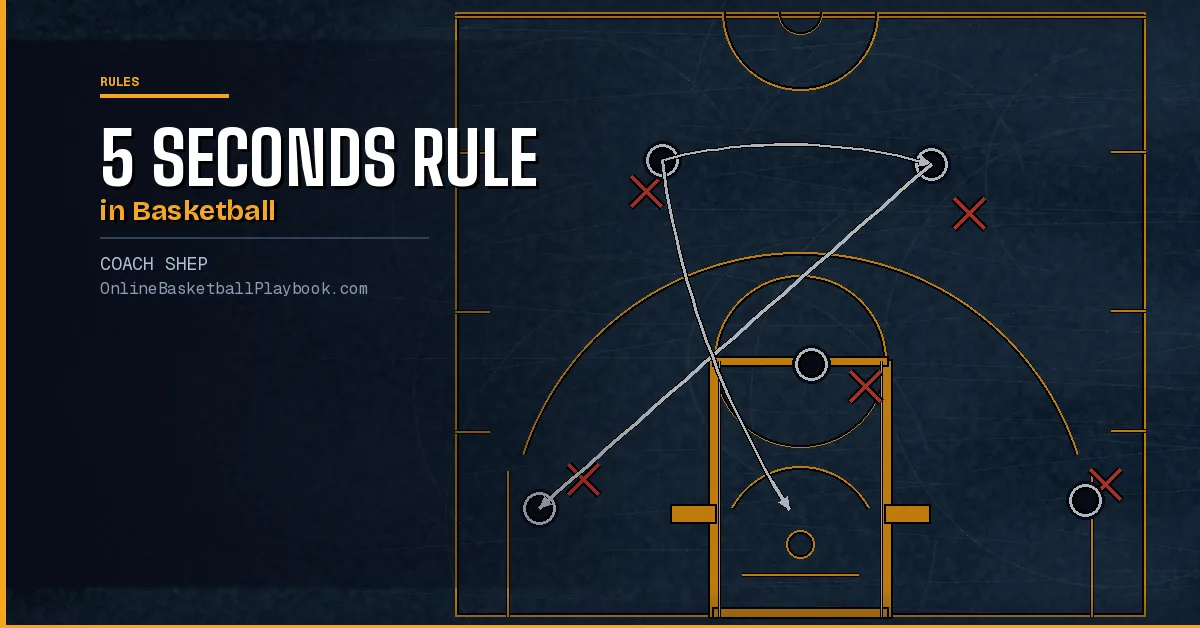
The 5-second rule forces players to act quickly under pressure. It applies to inbound passes, free throws, and closely guarded ball-handlers. Knowing every version, and training against the clock, keeps your team from giving up cheap possessions.
What Is the 5-Second Rule?
Basketball is built on tempo. The shot clock, the backcourt rule, and the 5-second rule all exist for the same reason: to prevent a team with the ball from stalling indefinitely. The 5-second rule is actually a family of related violations, each triggered in a different situation, but all sharing the same core idea. You have five seconds to do something with the ball before the official awards possession to the other team.
At its most basic, the 5-second rule covers three distinct scenarios: (1) inbounding the ball from out of bounds, (2) holding or dribbling the ball while being closely guarded in certain rule sets, and (3) attempting a free throw. Each scenario has its own mechanics, and each is officiated a little differently. Understanding the differences matters whether you are a player trying to avoid the violation, a coach designing your basketball inbounds plays, or a parent helping a young player understand the rulebook.
The 5-second count is among the most misunderstood rules in the sport at the youth and high school levels. Players frequently freeze under pressure or fail to read the official's arm motion that signals the count is running. Coaches who teach their players to recognize the count, and who practice against simulated pressure, eliminate a preventable source of turnovers.
5 Seconds on Inbound Passes
Every time the ball goes out of bounds, the team awarded possession must inbound it within five seconds. The count starts the moment the official hands the ball to the inbounder, or in some leagues, the moment the ball is placed at the inbounder's disposal. The inbounder must release a legal pass before the official's count reaches five.
The five-second inbound clock does not pause for anything that happens on the court except a timeout or a change of possession ruling. If the defense knocks the ball out of the inbounder's hands after the pass is released, there is no violation. The clock stops the instant the ball leaves the passer's fingertips. But if the inbounder juggles the ball, has it batted away before releasing it, or simply hesitates too long reading the defense, the official will blow the whistle and award the ball to the other team at the same spot.
At baseline inbounds situations, particularly under your own basket after a made field goal, the five-second clock compounds with defensive pressure. A defense running a full court press defense will often place a defender directly in front of the inbounder, waving arms and forcing the passer to look past the pressure. If the inbounder panics, takes too many steps searching for an open receiver, or hesitates on a read, the clock runs out. Practicing your inbound sets against live defensive pressure is not optional if you run any kind of press-break attack.
One technical note: in most rule sets, the inbounder may move laterally along the baseline (but not beyond the extended free-throw lane lines in the backcourt) after a made basket. This movement does not stop or reset the count. The five seconds keep running regardless of where the inbounder repositions.
Closely Guarded Rule Explained
The closely guarded rule is where most players, and even some coaches, get confused, because it does not exist in every level of basketball. Under NCAA and NFHS (high school) rules, a player who is holding the ball or dribbling in the frontcourt while being actively guarded within six feet by a defender has five seconds to pass, shoot, or start their dribble (if holding) before a violation is called. The NBA eliminated its closely guarded rule decades ago, which is part of why professional ball-handlers sometimes seem to hold the ball for an eternity without consequence.
For the closely guarded count to begin, three conditions must be met: the ball-handler must be in their team's frontcourt, the defender must be within approximately six feet, and the defender must be actively guarding, not just standing nearby. Once all three conditions are present, the official begins a visible count with an arm motion. If the ball-handler picks up their dribble while being closely guarded, the count continues. If the defender steps away or loses their guarding position, the count resets.
This rule has enormous tactical implications. A team that traps or runs a 2-3 zone defense can create closely guarded situations around the perimeter and wings, putting offensive players in danger of a 5-second call if they catch the ball unprepared. Teaching your offensive players to catch with a purpose (know before the ball arrives whether you are going to drive, shoot, or swing it) eliminates the hesitation that feeds the closely guarded count. Players who catch and freeze, looking for a play to develop, are exactly who the rule is designed to penalize.
At the youth level, even in leagues that do not enforce the closely guarded rule, teaching your players to move the ball within five seconds is a sound fundamental habit. It develops decision-making speed that pays dividends when they reach levels where the rule is enforced.
5-Second Free Throw Clock
The free throw 5-second rule is perhaps the least discussed but is consistently enforced at every level of organized basketball. Once the official hands the ball to the shooter at the line, or bounces it to them in leagues that allow that, the shooter has ten seconds in the NBA and five seconds in NCAA, NFHS, and most youth leagues to release the shot. Failing to shoot within the allotted time results in a lane violation, and the opposing team is awarded the ball.
In practice, a true 5-second free throw violation is rare at the high school and college levels. Most players shoot within two or three seconds of receiving the ball. But the rule carries an underappreciated coaching lesson: pre-shot routine. Players who develop a consistent, time-efficient free throw routine never have to worry about the clock. A routine that runs five or six seconds, excessive bouncing, too many deep breaths, resetting the grip multiple times, puts players at risk as they move up levels. Encouraging a compact, reliable routine that stays comfortably under five seconds is good basketball player development regardless of whether the violation is being called.
The official does not always count out loud on free throws the way they do on inbounds or closely guarded situations. Shooters should internalize the pace of their routine rather than watching or listening for a count. If a player finds themselves mentally checking how much time has passed at the free throw line, their routine is not automatic enough yet.
How the Rule Differs by Level
The 5-second rule is not uniform across all levels of basketball, and coaches who work with players spanning multiple levels need to understand the distinctions. Here is a practical breakdown:
NBA
The NBA has a 5-second inbound rule but no closely guarded rule. Free throw shooters have 10 seconds. This means NBA ball-handlers can hold the ball in the frontcourt for as long as the shot clock allows without being penalized for a 5-second closely guarded violation. Which is why you see professional point guards killing clock on the perimeter with impunity late in games.
NCAA (College)
College basketball enforces the 5-second closely guarded rule in the frontcourt while holding. Dribbling while closely guarded is not a violation at the college level. Only holding. Free throws must be attempted within 5 seconds. Inbound passes must be released within 5 seconds.
NFHS (High School)
High school rules are the most expansive version of the 5-second rule. The closely guarded rule covers both holding AND dribbling in the frontcourt. This is the level where the violation is called most frequently, and where players who lack decision-making skills are most exposed. Players transitioning from high school to college often notice the closely guarded call on dribbling disappears, a welcome change if they were previously a ball-handler who liked to set up off their dribble.
Youth / Recreational
Rules vary widely by organization. Many youth leagues apply a modified inbound rule and skip the closely guarded rule entirely. Check with your specific league before the season. Even in leagues without strict enforcement, use the 5-second framework as a teaching tool. The habit of playing quickly under pressure is worth building early.
Coaching and Training Under Pressure
The 5-second rule reveals two problems that have nothing to do with the rulebook: players who panic under pressure, and players who do not know their options before the ball arrives. Both are coachable. The best effective basketball practice plans bake in time pressure as a feature of drills, not an afterthought.
One of the simplest adjustments is to add an official count to every inbound situation in practice. Designate a manager or assistant coach to stand next to every inbounder and count out loud, one, two, three, four, five, on every rep. Players who have heard the count hundreds of times in practice do not freeze when they hear it in a game. The sound becomes a cue to act rather than a trigger for anxiety.
For closely guarded situations, run 1-on-1 closeout drills where the offensive player catches the ball at a wing or elbow and must make a play, shoot, drive, or pass, before a 5-second count is reached. This trains the decision-making muscle directly. Defenders who know they are also training the count will apply appropriate pressure without fouling. See also the principles behind a solid basketball closeout technique: Understanding how defenders close out helps offensive players read the pressure they face before it arrives.
At the youth level, framing the 5-second rule as a positive challenge works better than warning players about a violation. Tell players: "You have five seconds to make something happen. That's plenty of time if you know what you want to do." Teach them to catch with their eyes already reading the defense, feet ready to move, and a primary option in mind. Players who arrive at the catch with a plan rarely use more than two or three of their five seconds.
Free throw routine work belongs in every practice. Run timed free throw blocks. Players have five seconds from when the ball is handed to them, no exceptions. This makes the time constraint feel natural rather than stressful, and it accelerates the development of a compact, reliable routine that holds up under game pressure.
Add a live verbal count to every inbound and closely guarded drill in practice. When players hear "one, two, three" hundreds of times before a game, the count becomes a cue to execute rather than a signal to panic. The violation disappears because the decision habit is already built.
- Inbound rule: 5 seconds from when the official hands the ball. This counts at all levels. Practice every inbound set under a live count.
- Closely guarded (high school): Applies to BOTH holding and dribbling in the frontcourt; the count begins the moment a defender is within six feet and actively guarding.
- Closely guarded (college): Applies to holding only. Dribbling while closely guarded is NOT a violation at the NCAA level.
- NBA rule: No closely guarded rule at all; free throw clock is 10 seconds rather than 5.
- Free throw clock: 5 seconds (NCAA, NFHS, most youth) from when the official hands the ball to the shooter. Develop a compact pre-shot routine that lands well under the limit.
- Training fix: Catch-and-decide drills with a live count eliminate hesitation; players who arrive at the catch with a read already made are never in danger of a 5-second call.
Get free play diagrams, drills, and coaching guides delivered weekly.
Draw this play free in the play drawer →
Membership: the full library, playbook packs, and Pro drawing tools →
Keep Building
Related breakdowns
Double Dribble in Basketball: Rule, Examples and Calls
A double dribble is a second dribble after the first has ended. Rules by level (NFHS, NCAA, NBA, FIBA), what restarts a dribble, examples and how to coach it.