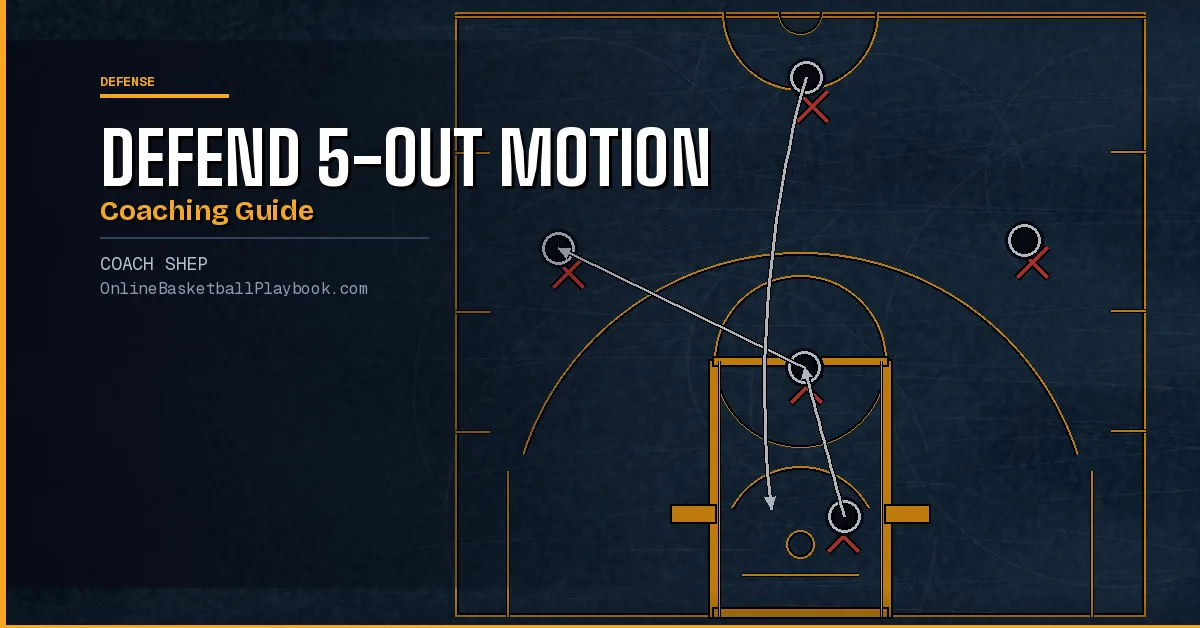
Five-out motion spreads all five players behind the arc, forcing your defense into every gap simultaneously. Stop it with the right coverage, disciplined rotations, and a plan for basket cuts before they happen.
Why 5-Out Is Hard to Guard
Five-out motion does not run plays in the traditional sense. There is no set sequence your scouts can chart and hand players the night before a game. Instead, the offense operates entirely on reads. Each player makes a decision based on how the defense is playing right now, in this moment, on this possession. That is what makes it so difficult to prepare for.
When five offensive players are spread above the arc, your defense loses its natural help structure. In a traditional set, you can tuck help defenders into the lane because the ball-side corner or the weak-side elbow is occupied by a player who does not shoot. Five-out removes that luxury. Every defender is attached to a shooter. Your center, if matched up on a stretch big, is pulled to the three-point line. The paint is empty on purpose. The offense wants the lane open for cutters who exploit any lapse in your on-ball pressure or help rotation.
The read-based nature compounds the problem. Most motion offenses have a primary action and a counter. Five-out has a dozen counters built into the same pass. A pass to the wing can trigger a basket cut, a backdoor, a flare screen, a screen away, or a dribble-handoff, all depending on what the cutter reads from your defender. If your on-ball defender plays too tight, the cutter goes backdoor. If your off-ball defender sags, the cutter goes straight to the basket for a layup. If you try to help early, the corner shooter fires. There is no single answer that neutralizes everything. The defense has to commit to a principle and live with the counter.
Understanding this upfront changes how you prepare. You are not building a scouting report on plays. You are building a system your players can execute without a scouting sheet. The techniques below give you that system.
"Basket-cut a sagging man; backdoor an overplaying one."
Five-Out Motion Offense Core Principles
Coverage Options: Man, Zone, and Hybrid
Before you decide how to guard five-out motion, you need to pick a coverage philosophy and stick with it long enough for your players to trust it. Switching coverages every possession is how you give up easy baskets. Your players are confused, rotations break down, and the offense gets layups they did not earn.
Straight Man-to-Man
Man defense is the most common approach and the most demanding. Each defender is responsible for one player. The upside is that accountability is clear. If your player scores, you know exactly why and who has to fix it. The downside is that five-out puts your worst defender in the most dangerous position on every possession. If your center cannot guard a shooter on the perimeter, the offense will run actions to attack that mismatch relentlessly.
In man coverage, your on-ball defender dictates the pace. Play with one foot in the passing lane, not fully denying, but discouraging easy catches. Force the ball to the side you have rotated your help toward, so when the basket cut comes, your helper is already in position.
Zone Defense Against Five-Out
Many coaches assume zone is a bad choice against spread offenses. That is not automatically true. A 2-3 zone with aggressive top defenders who can close out to the arc can take away the three-point line and funnel penetration into a packed paint. The risk is skip passes. If your zone is slow to rotate, the skip pass from corner to corner produces wide-open threes. Teach your zone to sprint on every skip, not drift.
A 1-3-1 zone is another option worth considering. The top defender pressures the ball handler and disrupts the spacing reads. The wing defenders deny the first pass and force ball reversal. The baseline defender rotates to take away the corner. If your personnel includes a long, active top defender who can cover ground laterally, the 1-3-1 can cause real problems for five-out teams that rely on rhythm passing.
Hybrid: Pack-Line Principles
The pack-line approach splits the difference. Defenders guard man-to-man but position themselves one step off their player and one step toward the lane. This keeps help in the paint without leaving shooters fully open. It is particularly effective against teams that drive first and kick second. The tradeoff is that shooters will be slightly more open. Your pack-line will give up some catch-and-shoot threes in favor of taking away the layup. That is a trade worth making if your opponent has average shooters and elite drivers. If they have elite shooters, you need to adjust.
Defending the Basket Cut
The basket cut is the engine of five-out offense. On every pass, the passer reads the defense and decides whether to cut straight to the basket, curl, or back-cut. Your defense has to have a consistent answer before the cut happens, not after the cutter is at the rim.
The most important rule in defending basket cuts is positioning before the pass. Your off-ball defenders must see both their player and the ball simultaneously. The standard cue is the "pistols" stance: both arms out, one hand pointing to the ball and one hand pointing to your player. If you lose sight of either, you will be late when the cut comes.
When a player cuts baseline, the most common route in five-out, your defender has two options. The first is to front the cut. Step in front of the cutter and make body contact before they receive the pass. This takes away the straight-line layup. The second option is to trail. Stay one step behind and force the cutter to the front of the rim rather than the baseline. Trailing works if you have a shot-blocker protecting the rim. Fronting works if you are a smaller team that needs to prevent the catch entirely.
Teach your players the rule: when your man passes, move. Do not stand and watch the ball. Step to close the cut lane before the cutter takes their first step. Most basket cuts go uncontested not because the defender is out of position. They are simply standing still while the cutter is sprinting.
Handling Screen-Away Actions
After the basket cut action, the screen-away is the most frequent action in five-out. A player passes and immediately sets a screen on the weak side for a teammate who is two or three spots away from the ball. The screener can slip at any point if their defender is anticipating the screen. This puts your defense in a constant decision: fight through, go under, switch, or hedge.
Fighting Through Screens
Fighting through is the default answer when the screened player is a shooter. Your defender has to get through the screen and recover to their man before the catch. This requires full effort on every possession. There is no coasting. The screener's defender must also get low and stay connected so the screener cannot slip cleanly into the lane for an uncontested pass.
Switching
Switching is the simplest communication answer and the one most teams use when they first face five-out. The downside is that five-out offenses, especially well-coached ones, are designed to create switching mismatches. If you switch a big onto a perimeter player repeatedly, you will get burned. Switch selectively: only on actions where the matchup is size-neutral, or when you have athletes who can defend every position.
Going Under Screens
Go under screens only when the screened player is not a shooting threat. If the player catching off the screen cannot shoot from 20 feet, going under gives you a cleaner path to recovery without getting your defender stuck on the screener's body. Against a true five-out team, going under is rarely the right call. All five players are supposed to be threats from outside. Assume everyone can shoot until they prove otherwise.
The Slip Counter
Every good screen-away team will slip the screen when the defender over-anticipates. Your screener's defender cannot chase the screen so aggressively that they abandon the screener in the lane. Stay attached to the screener until the ball-side action resolves. If the screener slips, your defender should be in a position to contest the pass, not watching it happen from across the court.
Help-Side Rotations and Paint Protection
Five-out motion creates driving lanes by design. The spacing forces your on-ball defender into long close-outs, and a hard driver who attacks off a close-out puts your help rotation under immediate pressure. If your rotations are not practiced and automatic, one drive produces a layup or a kick-out three.
The rotation model that works best against five-out is a two-man rotation with a designated nail defender. The "nail" is the off-ball defender positioned at the top of the key, one step below the free-throw line. When the ball penetrates, the nail takes the driver and calls for the help rotation. The strong-side corner defender rotates up to cover the kick-out. The weak-side defenders shift one position toward the ball.
This sounds clean in a diagram. It is messy in practice. Five-out teams know where your help is coming from and will attack the rotation. A good five-out team will drive baseline specifically to trigger your help and then hit the skip pass to the weak-side corner before your rotation can close out. The answer is not to eliminate the rotation. You still need to stop the layup. The answer is to practice the skip-pass close-out until it is a reflex, not a decision.
Two additional rules for paint protection: First, your center cannot sag. In five-out, there is no post player to guard. Your center's job is to be a rover, positioned to help on drives and recover to the corner when the kick-out comes. Second, never help on a shot. Too many defenders leave their shooter to contest a non-threatening drive, then watch the kick-out produce a wide-open three. Stay at home unless the drive is a layup, not a mid-range pull-up.
Practice Drills to Ingrain These Habits
The techniques above only work if your players can execute them without thinking. That requires deliberate repetition in practice, not just a walkthrough on the board. The following drills isolate the key defensive skills five-out exposes.
3-on-3 Perimeter Cut Defense
Run three offensive players on the perimeter in a triangle, two wings and a top. On every pass, the passer cuts to the basket. Defenders must front the cut or trail with contact. No full-court activity, just repetition of the pass-and-cut read. Run for five minutes at the start of every defensive practice until the response is automatic.
Shell Drill with Slip Reads
The classic four-man shell drill, modified. Every time the ball moves, the screener has the option to slip if their defender loses contact. Offense scores a point for a clean slip-and-catch. Defense scores a point for a contested slip. Keep score. Competition makes the drill honest.
Drive-and-Rotate 5-on-5
Walk through the nail rotation in half-court. Designate a nail defender before each possession. The coach calls out a drive direction and each defender rotates according to their role. Freeze when someone rotates wrong and correct it in real time. Build to live five-on-five where the offensive team is rewarded for hitting the right pass against a broken rotation.
Close-Out Competition
The most underrated drill for stopping five-out is the simple close-out. A defender starts in the paint. The coach passes to a corner shooter. The defender closes out with two hands up, no fouling, and contests the shot. Run it from every spot on the arc. Track made versus missed shots over the week. Your defenders will compete to lower the make percentage.
- Front every basket cut: Step into the cutter's path before the pass arrives, not after.
- Stay attached to the screener until ball-side action resolves; don't chase to the screen early.
- Designate a nail defender every possession so rotation calls are automatic, not debated.
- Sprint on skip passes: One drifting close-out turns a rotation into an open three.
- Never help on a mid-range pull-up: Stay home unless the drive is a straight-line layup.
- Assume every perimeter player can shoot until the film proves otherwise; never go under a screen against five-out.
Defending five-out motion is a process, not a scheme. No single coverage shuts it down permanently because the offense self-adjusts to whatever you give it. The teams that defend it well are not the ones with the most complicated system. They are the ones who pick a principle, practice it obsessively, and make corrections in real time. Commit to your rotations, trust your system, and make the offense beat you with a difficult shot rather than a layup.
Get weekly defensive breakdowns, drill libraries, and play diagrams delivered to your inbox.
Draw this play free in the play drawer →
Membership: the full library, playbook packs, and Pro drawing tools →
Keep Building
Related breakdowns
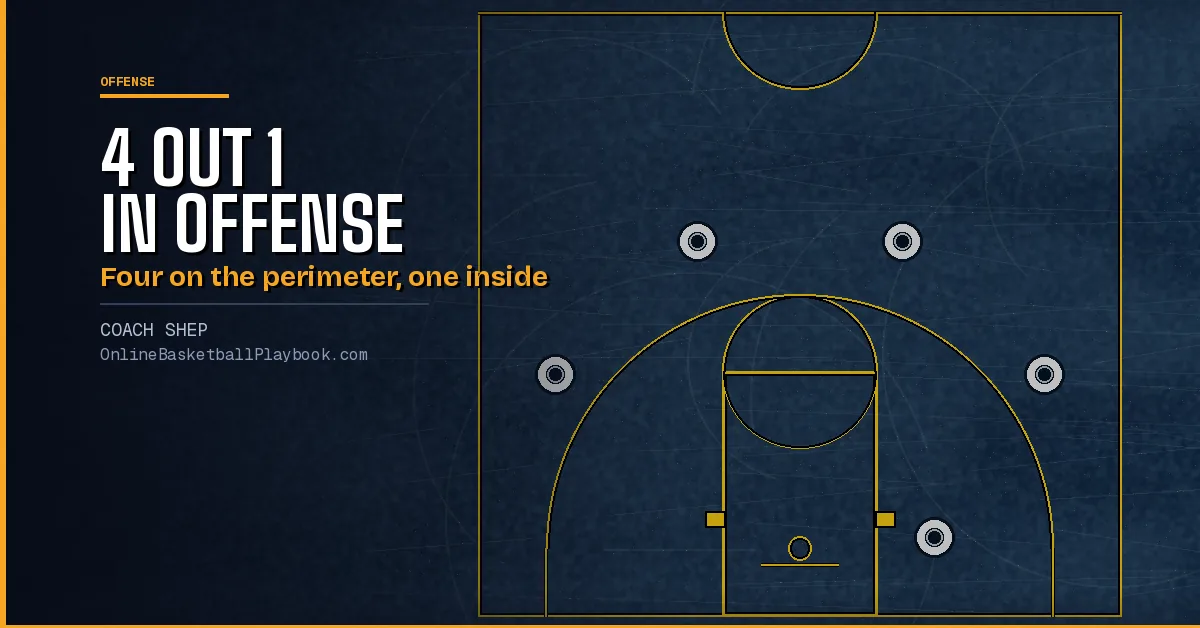
4 Out 1 In Motion Offense: Rules, Spacing and Sets
How to run the 4 out 1 in motion offense: spacing, the six rules, what the post does, pass-cut-fill, screens, quick hitters, zone adjustments and how to install it.
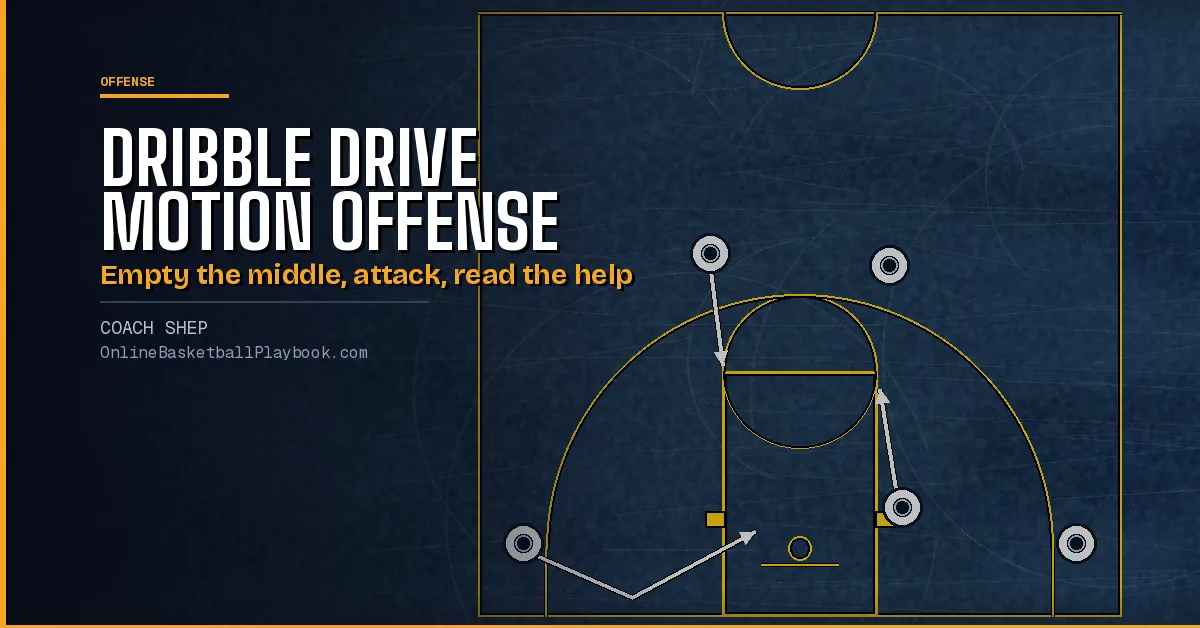
Dribble Drive Motion Offense: Spacing, Reads and Install
The dribble drive motion offense explained: 4-out 1-in spacing, the Drop, Drag and Rack zones, the read off a drive, shot diet, weak spots and the install.