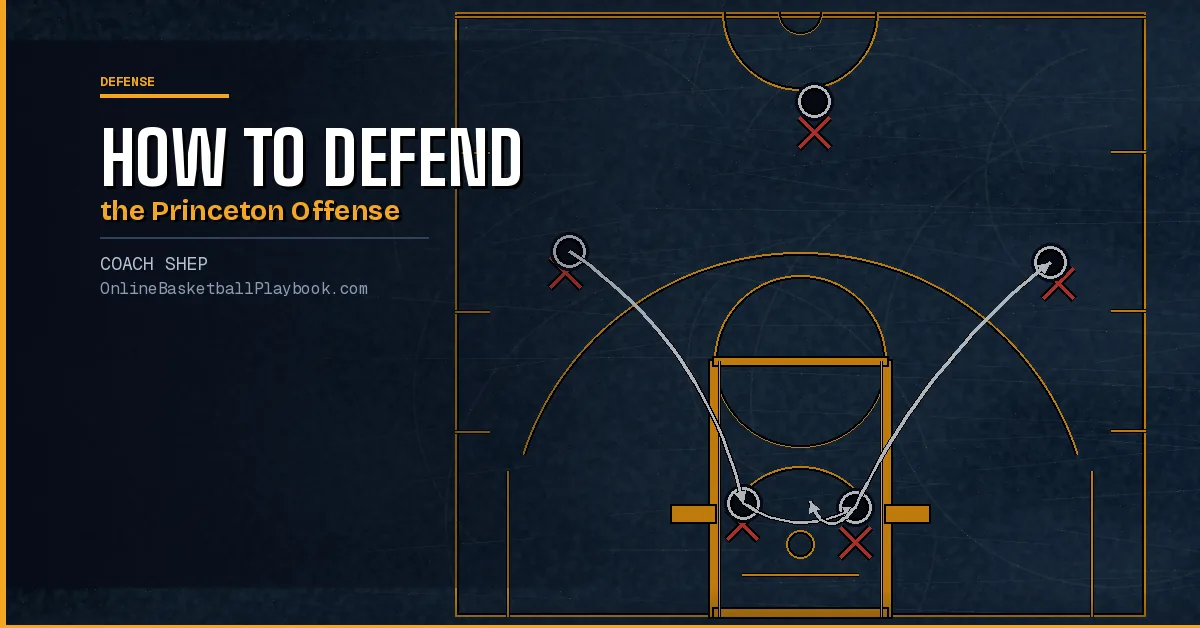
The Princeton offense beats defenses with patience, backdoor cuts, and high-post reads, not athleticism. Stopping it requires disciplined positioning, smart help rotations, and a team-wide commitment to denying the actions that make it tick.
What Makes the Princeton Offense Hard to Guard
Before you can defend any system, you have to understand what it is actually trying to do. The Princeton offense is not a set of isolated plays. It is a read-based continuity built on a few interchangeable actions. Players read what the defense gives them and choose the appropriate counter. Overplay a cutter and you give up a backdoor layup. Sag off and they reset patiently until the open three appears.
What makes this offense especially difficult is the role of all five players. Unlike systems that funnel everything through one or two stars, the Princeton offense demands that every spot on the floor can pass, cut, and shoot. That means your defense cannot hide a weak defender in a corner and forget about him. Every matchup must be attended to, every cutter must be accounted for, and every screen must be communicated early.
The offense flows through a series of recurring actions: the Chin set (a strongside dribble-weave handoff with a weakside exchange), the high-post entry (which triggers an over, under, or away cut by the point guard), and the 5 Out alignment that rebalances the floor between phases. The more your players recognize these patterns in film and in practice, the faster they will identify and disrupt the triggers before they develop.
Understanding motion offense principles in basketball gives your players the vocabulary to see what is coming. Princeton is a motion-continuity offense at its core. Defenders who understand general motion concepts will pick up Princeton tendencies faster and stay connected even when the offense shifts phases mid-possession.
Deny the High-Post Entry First
If there is one principle that should organize your entire defensive scheme against Princeton, it is this: take away the high-post entry. The offense's most dangerous reads (the over cut, the away cut, the backdoor, the ball-screen sequence) are all triggered from the high post. When the five-man catches the ball at the elbow, the point guard reads the defense and cuts in one of three directions. Each direction creates a different scoring opportunity. Your job is to prevent that trigger from ever being pulled.
Defending the high post against a skilled passer requires your perimeter defenders to front or three-quarter front their matchups when the ball is on the strong side. The goal is to force the offense into a reset rather than a clean entry. Your help-side defenders must be positioned to provide immediate help on any lob or skip pass that gets through, so the risk of fronting is manageable.
Your post defender (typically your center or power forward) needs to work hard to deny the catch from the perimeter. He should not allow the five to receive the entry pass in a comfortable, upright catching position at the elbow. Force him to catch deep, catch off-balance, or catch while moving away from his preferred scoring spots. Any of those outcomes disrupts the read-and-react sequence that follows.
This pressure on the high post is one area where solid help defense principles are non-negotiable. Your weakside players must understand where to be so that fronting the high post does not create an open skip pass to the corner. Without that understanding, your denial defenders are exposed and teams will punish you over the top.
Defending Backdoor Cuts
Backdoor cuts are the heartbeat of the Princeton offense. Every time you overplay a perimeter player (reaching, lunging, turning your hips to deny), the offense has a built-in counter ready to go. The player fakes a pass, and the overplaying defender's momentum carries him the wrong direction while the cutter sprints to the rim.
The first correction is technical. Your defenders must stay in an open stance, keeping the ball and their matchup in their field of vision simultaneously. A closed stance (hips fully turned to deny) makes backdoor cuts easy because the defender cannot react to a change of direction he cannot see. Open stance positioning is a fundamental habit that has to be drilled repeatedly until it is automatic.
The second correction is communicative. When a Princeton team is cutting hard backdoor off a perimeter denial, the help defender on the weak side must be vocal. A clear "backdoor" call gives the on-ball defender the information he needs to adjust positioning before the cut happens rather than chasing the cutter from behind. This is where the shell drill becomes your most valuable teaching tool because it isolates exactly this communication habit in a controlled environment before you put it into a live game context.
Third, coach your players on the value of soft denial. Rather than going all the way to a full front (which invites the backdoor most aggressively), defenders can apply moderate denial pressure from a position that still allows them to see the cutter and recover. This is a chess match. The offense is daring you to overplay. Meeting that dare with measured, disciplined pressure is a more sustainable defensive approach than giving up easy layups by overcommitting.
It also helps to identify which players are the most dangerous cutters on your opponent's roster before the game. In the Princeton system, not all five players are equally dangerous on the cut. Some are primarily shooters, some are the primary drivers, and the best cutters tend to be the guards who have been running the offense for multiple seasons. Knowing who poses the biggest backdoor threat lets your defenders calibrate how aggressively they deny on each individual matchup.
Stopping the Chin Handoff and Dribble Weave
The Chin set is the spine of the Princeton offense, and its most visible feature is the strongside dribble-weave handoff between the one and the three. The ballhandler dribbles toward the wing, the wing replaces him, and a handoff occurs that can create a pull-up, a drive, or a continuation action into the post. Simultaneously, the weak side runs a two-four exchange, and the five fills the elbow to become the high-post hub. The whole structure resets and continues until a shot or breakdown occurs.
To disrupt the Chin handoff, your perimeter defenders must go over the top of every handoff screen rather than ducking underneath. Going under the handoff concedes the pull-up jumper at the point of exchange, exactly the shot a skilled Princeton point guard wants. Going over the top is athletically demanding, but it keeps the defender in position to contest the catch and disrupt the rhythm of the handoff before it leads into deeper reads.
Your post defender must also be aware of the UCLA cut that follows from the strongside action. After the handoff, the cutter often cuts hard to the rim using the five as a screener. If your center is not communicating this screen to the perimeter defender early, you will give up open layups off the cut. Call the screen, stay connected, and make the cutter work to get to the rim.
Defending these kinds of screening actions is closely related to the concepts in defending the pick and roll. Many of the same principles apply: communication, early identification of the screen, switching rules, and recovery angles. Teams that have a clear pick-and-roll defensive system in place will adapt faster to Princeton's handoff and screen-the-screener actions.
Help Rotations and Communication
No defensive scheme against Princeton survives without organized help rotations. The offense is designed to move all five defenders. It uses weak-side screens, strong-side handoffs, and high-post reads simultaneously. If one defender gets caught watching the ball, another cutter gets open. If one rotation is late, the offense finds the seam and scores.
The first rule of your help rotation scheme against Princeton should be: never leave a weak-side cutter unguarded in the lane. Princeton teams train their cutters to time their moves with the ball-side action, so while your defender is fighting over a handoff on the strong side, a weak-side player is reading the defense and timing a cut to the basket. Your weak-side help must be positioned in the lane line, not on the perimeter, and must be ready to step up on the cutter before the catch.
Verbal communication is the engine of every help rotation. Players must call out screens, call out cuts, call out the ball location every time it moves. Teams that go quiet on defense against Princeton fall apart quickly because the offense generates so many simultaneous movements. Build a communication standard in practice and hold players to it every possession, not just in game situations.
Rotating correctly also means getting back into position after each rotation. One defensive mistake the Princeton offense is designed to exploit is the secondary break. After the first rotation, if defenders relax and stop moving, the offense can find a third or fourth cutter who slipped into open space while everyone else was watching the primary action. Stay organized, stay vocal, and move as a unit.
Building the Game Plan in Practice
A sound defensive game plan against Princeton is built over multiple practices, not installed in one walk-through. The concepts involved (soft denial, over-the-top on handoffs, denial of the high post, weak-side help positioning) each require repetition before they are reliable in a live game setting.
Start with film. Show your players the specific actions Princeton uses (Chin, high-post entry, 5 Out) so they can identify them in real time. A player who has seen the offense on film five times will read it faster in the game than one who is encountering it for the first time under live pressure. Break down the key triggers: when the high post catches, when the handoff starts, when the weak-side exchange begins. Each trigger has a specific defensive response, and your players need to see that connection before they can execute it.
Then build the defense in pieces. Run the shell drill first to establish communication and positioning habits. Add the handoff defense next, drilling over-the-top technique in a two-on-two setting before you scale it up. Then add the weak-side cut and the help rotation. Only after each piece is working in isolation should you put it together against a live look from your scout team running Princeton actions.
A well-designed basketball practice plan is the best way to guarantee your team actually gets enough repetitions on each concept before game day. Map out which concepts you will cover each day in the week leading up to the game, and hold your scout team accountable for running the offense correctly so your starters are repping against accurate looks.
The physical and mental demands of defending Princeton are also worth accounting for. The offense moves all five defenders continuously for the duration of a possession. That is exhausting over 32 or 40 minutes. Your players need to be in the kind of condition that lets them maintain discipline late in the game when they are tired and the offense is still patient. Build that conditioning into your preparation, not just your scheme.
Before game day, identify which Princeton player initiates the high-post entry most often and which wing is their primary backdoor threat. Shutting down those two specific triggers will disrupt far more of the offense than a generic defensive adjustment ever could.
- Deny the high-post entry: three-quarter front the five at the elbow and force him to catch deep or off-balance because every Princeton read starts there.
- Open stance on all perimeter denials: keep ball and matchup in your field of vision at the same time; closed stance invites the backdoor cut.
- Go over the top on every handoff: ducking under the Chin handoff gives the ballhandler a clean pull-up; stay over the top to keep them uncomfortable.
- Call every screen and cut out loud: verbal communication is how help defenders stay connected when the offense is moving multiple players simultaneously.
- Weak-side defender stays in the lane line: position to stop the weak-side cutter before the catch because late rotations turn into easy layups.
- Run shell drills daily in game-prep week: shell drill builds the positioning and communication habits that the defensive scheme depends on.
Get free play diagrams, drills, and coaching guides delivered weekly.
Draw this play free in the play drawer →
Membership: the full library, playbook packs, and Pro drawing tools →
Keep Building
Related breakdowns
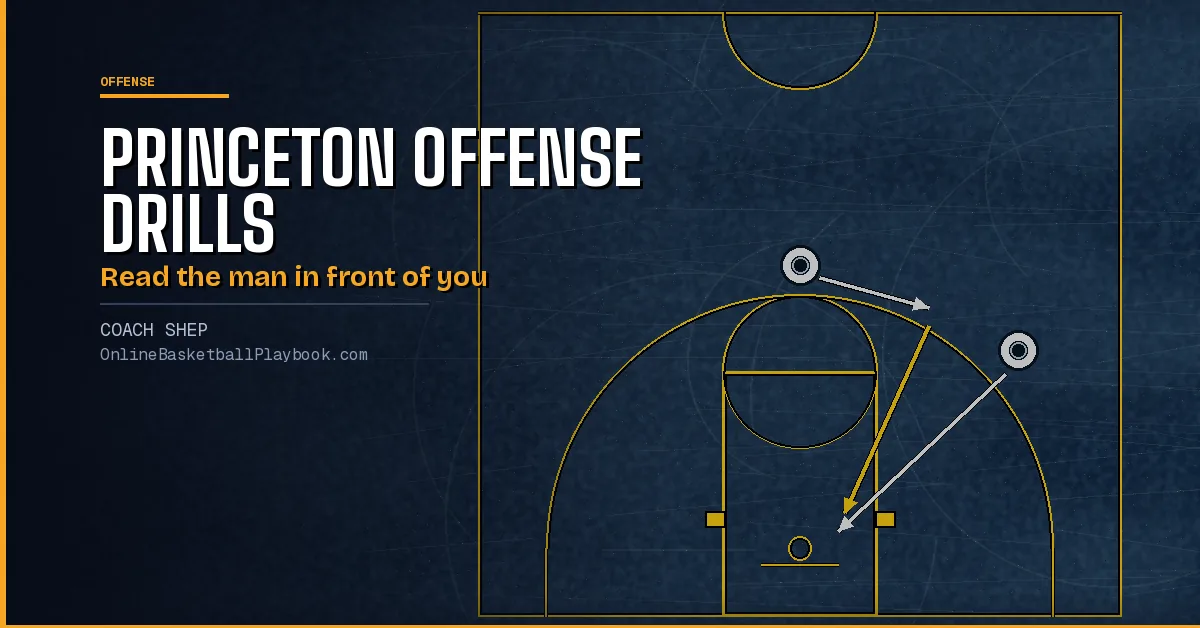
Princeton Offense Drills: Breakdowns, Shooting and Live Reps
Princeton offense drills that teach the reads: spacing, backdoor and hand-off breakdowns, 3-0 Chin and wave drills, Point shooting, a drive drill and an install.
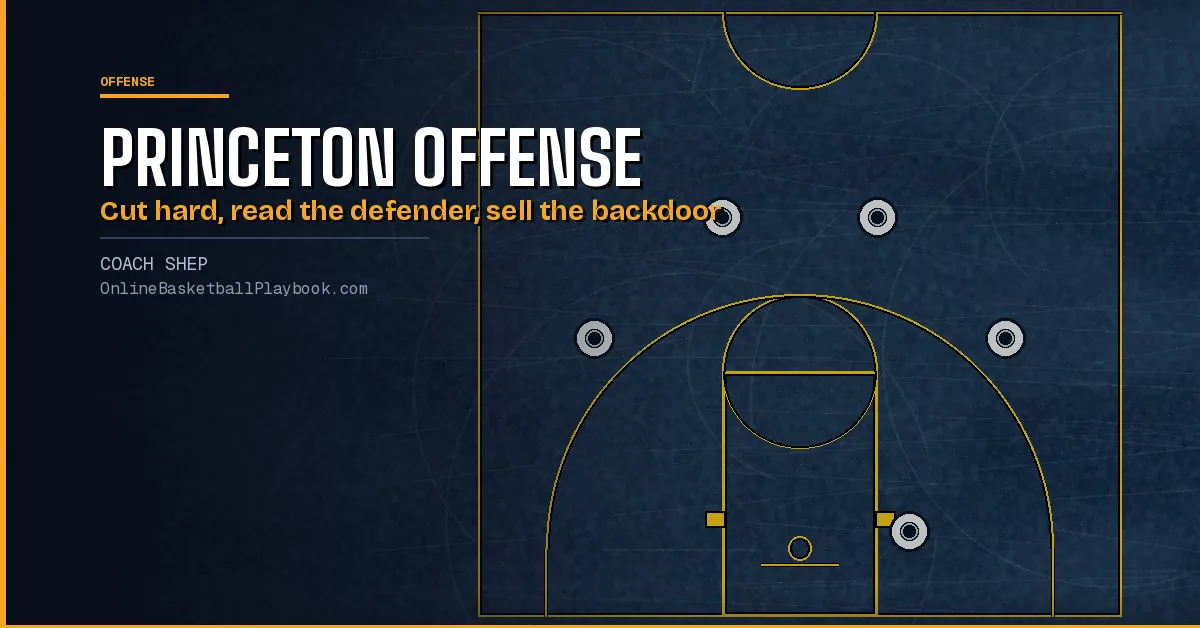
Princeton Offense: Cuts, Reads and Sets
How the Princeton offense works: the Chin set, backdoor cuts, the high-post reads, the players it needs, how to install it and what defenses do to stop it.
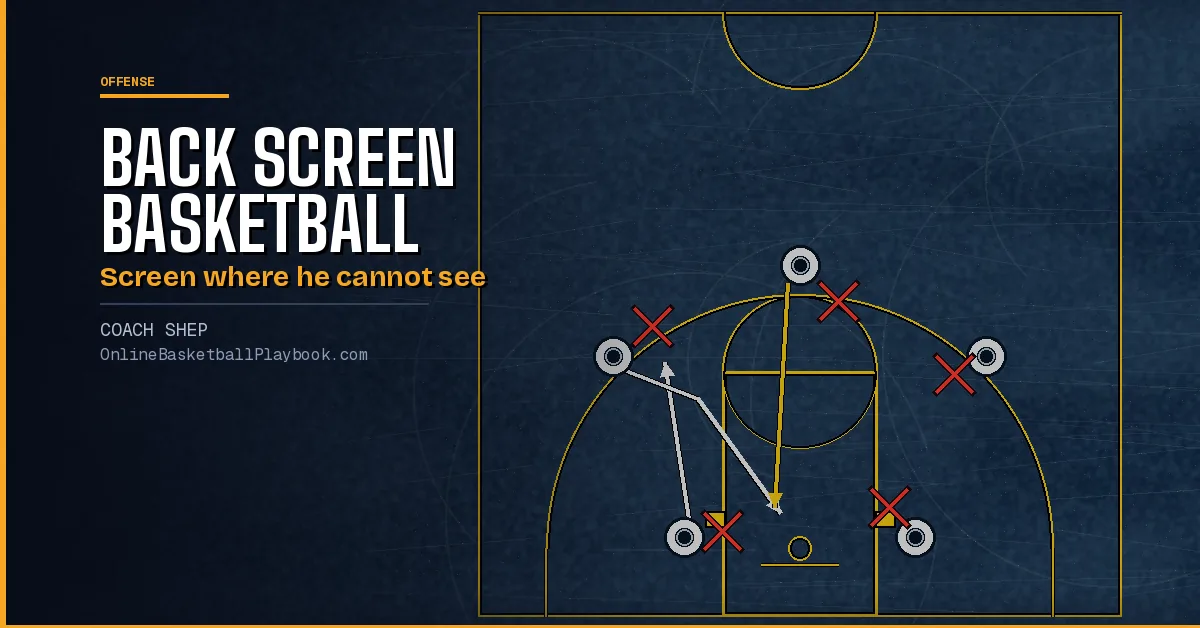
Back Screen Basketball: How to Set, Use and Defend It
Back screen basketball guide: what a back or rip screen is, setting it legally, the cutter's and screener's reads, the UCLA cut, chained actions and defending it.