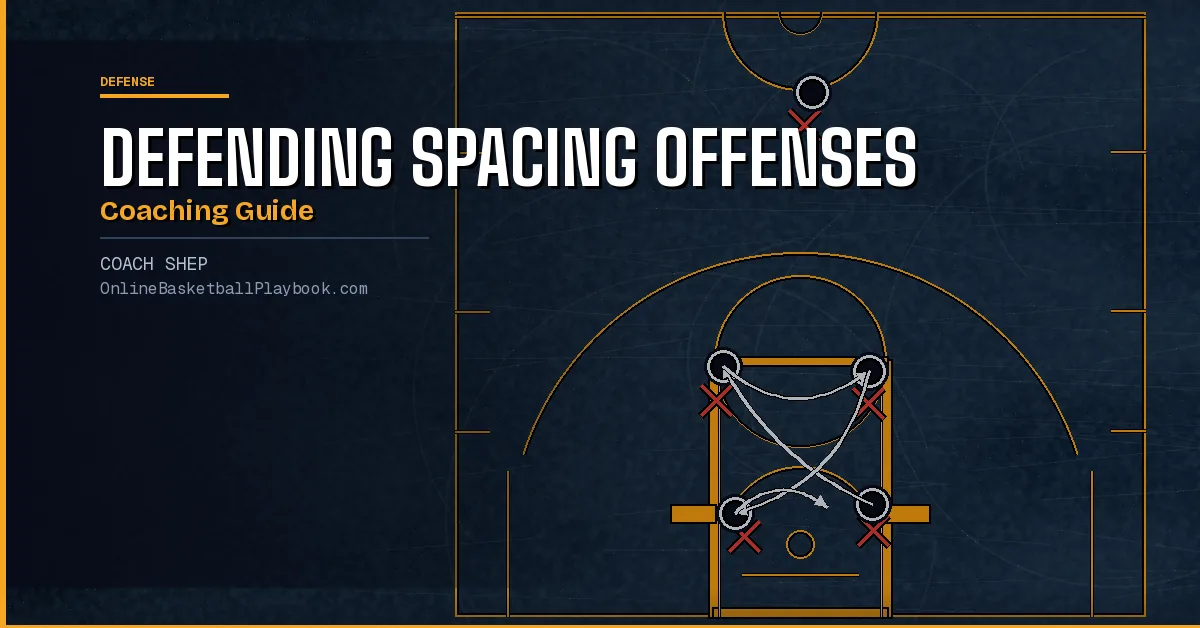
Spacing offenses stretch your defense across the entire floor, forcing rotations on every drive. This guide breaks down the principles, positioning adjustments, and practice habits you need to slow them down.
Why Spacing Offenses Are So Difficult to Guard
A spacing offense, whether it is a 5-Out Motion Offense or any spread-and-drive system, puts five shooters on the floor at once. Every time a ball handler attacks the rim, four defenders have to make a choice: help and leave a shooter, or stay home and concede the drive. That dilemma is exactly what spacing-offense coaches spend their offseasons engineering.
The math is brutal. If your help defenders are even a half-step slow on their rotation back, a capable shooter will knock down an open three. Do it repeatedly, and the deficit compounds quickly. Spread offenses in the modern game, fed by analytics showing the massive value of corner threes and layups, have made this problem more acute at every level.
The root cause of most breakdowns against spacing offenses is not physical. It is positional. Defenders who are not in the right spot before the drive happens will always be a step late on the recovery. Good spacing-offense teams do not beat you with athleticism alone; they beat you with geometry. Your defensive system has to counter that geometry before a single dribble is taken.
Understanding Motion Offense in Basketball from the offensive side actually sharpens your defensive read. When you know the actions an offense is trying to create, pin-downs, DHOs, skip passes to corners, you can anticipate and position accordingly rather than reacting after the fact. The best defensive teams study their opponents' tendencies and build their coverage rules around those habits.
Finally, spacing offenses operate at pace. They want to push before your defense is set, catch you in transition coverages, and exploit mismatches created by quick ball movement. Defending spread systems well requires both a sound half-court scheme and a disciplined transition-defense mindset that gets everyone back and matched up before the offense can run its primary action.
Closeout Discipline: The First Line of Defense
The closeout is where most teams give up easy threes against spacing offenses. A defender who flies out of control, weight leaning forward, momentum carrying past the shooter, gives an experienced shooter a free lane to drive right by them. Proper Basketball Closeout Technique is non-negotiable against any spread system.
The technique starts with the approach. Sprint the first two-thirds of the distance to the shooter, then chop your steps and arrive under control with your chest facing the ball. Your hands should be up, active, not waving, and your feet should be beneath your hips so you can slide laterally without crossing over. Arriving out of control is worse than a slow closeout because it gives the offense both the drive and the shot.
Closeout angle matters just as much as speed. Against right-handed shooters, shade slightly to their shooting hand to take away the one-dribble pull-up. Force them baseline or toward your help side, whichever your defensive scheme designates. That consistency, every defender on the floor sending their man the same direction, allows the rest of the defense to anticipate rotations and be in position before they are needed.
A common mistake at every level is closing out too high on the catch. When a shooter receives a skip pass in the corner, the defender who is still recovering from the opposite wing often arrives standing straight up. A good shooter reads that immediately and goes up into the defender for a foul or simply fires. Teach your players to stop two full steps short of the shooter and contest with the near hand rather than leaving their feet or reaching.
Repetition in practice is the only answer. Build closeout habits through daily, game-speed reps. A five-minute drill at the start of every practice, catch, close, contain, will show up when the game is on the line in the fourth quarter and the offense is running its best spacing action.
Help-Side Positioning and Rotation Rules
Against a spacing offense, where your off-ball defenders are positioned is more important than almost anything your on-ball defender does. If your help side is already in a gap, the ball handler has nowhere to go. If your help side is flat-footed or shading the wrong direction, one decisive drive blows up an entire defensive possession.
The foundational rule is line of ball. Every off-ball defender should be on or below the level of the ball, with their body opened up so they can see both their man and the ball simultaneously. Defenders caught above the ball level, in denial when the ball is below them on the same side, are easy to skip-pass past, and the resulting rotation is almost always too slow against a shooter who catches in rhythm.
Gap depth is the next variable. A defender guarding a shooter two passes away from the ball should be in the gap between their man and the ball, positioned to help on a drive while still being able to recover to their shooter on a skip. Exactly how deep depends on your scheme, some coaches play a tight gap, others play full help and trust their rotations, but every defender needs to know the rule before the possession begins.
Rotation rules must be clear and non-negotiable. When the ball handler turns the corner on your on-ball defender, your nearest help defender takes the drive. The next defender in the rotation covers the vacated spot. The weak-side defender, often guarding a corner shooter, is the last line. That sequence has to happen without verbal communication in the open floor; it must be drilled until it is reflexive. The Shell Drill is the foundational practice tool for building exactly this kind of rotation discipline.
Help-and-recover, sometimes called "show and go", is a key skill for defenders guarding shooters on the weak side. They step up to take the drive, then sprint back to their shooter before the skip pass arrives. Timing is everything. Step too early and you open up the lob or dump-off. Step too late and the ball is already in the paint with no help available. This skill requires hundreds of reps before players trust it in game situations.
On-Ball Pressure Without Gambling
Spacing offenses want you to gamble. They set actions designed to draw your on-ball defender into a reach, a jump, or an overcommitted step, and the moment that happens, the driver is past you and the entire rotation collapses. Disciplined Man-to-Man Defense against spread systems is about pressure without risk.
The on-ball defender's job is to make the ball handler uncomfortable without leaving their feet or extending their hands into the lane. Active feet, chest in front of the ball, and an understanding of where help is located, those are the tools. A good on-ball defender in a spacing offense is not trying to steal the ball; they are trying to slow the decision clock so the offense cannot execute at its preferred tempo.
Forcing direction is a team decision. Most coaches in today's game prefer to force the ball handler toward their help side, typically the middle, so that drives are into a crowd rather than into open space. Others prefer to force baseline where there is a boundary. What you cannot do is let every defender make individual choices about direction. The help side is only in position to help if they know where the drive is coming.
Hedge depth on ball screens determines how much you slow pick-and-roll actions. Against a spacing offense, a hard hedge is risky. It pulls two defenders out of position and can be exploited by a skilled passer finding the corner shooter or the roller. Many coaches prefer a tight hedge or a switch on pick-and-roll actions in spacing systems, keeping defenders tied to shooters and limiting the offense's decision-making advantage. See Defending the Pick and Roll for a full breakdown of coverage options.
Whatever coverage you choose, consistency is what makes it work. A defense that uses five different coverages on five consecutive possessions gives the offense exactly the confusion they are looking for. Pick a primary coverage, drill it until it becomes automatic, and add a wrinkle only after your players can execute the base scheme without thinking.
Communication and Defensive Switching Rules
Spacing offenses use off-ball movement, cuts, screens, and relocations, to create communication breakdowns. A single missed screen call leaves a shooter wide open in the corner. Clear communication rules are not a soft, optional addition to your defensive system. They are the system.
Every screen must be called. "Screen left," "screen right," "down screen," "back screen". The defender being screened should hear the call from their teammate before the screen is set, not after. That requires your off-ball defenders to track the entire floor, not just their own assignment. It is a high cognitive load, which is why you have to train it explicitly rather than assuming players will figure it out during games.
Switch rules eliminate hesitation, but they come with tradeoffs. A team that switches all ball screens against a spacing offense keeps every defender attached to a shooter, which limits the drive-and-kick threat. The cost is potential mismatches, a guard switched onto a bigger player, or a big switched onto a quick guard in space. Know your personnel and set your switch rules based on which mismatches you can live with versus the ones that will break your defense.
Communication does not stop at screen calls. Defenders must also talk through rotations, "ball," "help," "I've got corner", so that every player on the floor understands the current coverage assignment in real time. Teams that are silent on defense against a spacing offense will give up open shots because two defenders converge on the ball while a shooter stands unguarded.
Building this communication culture starts in practice, not in games. If you let players be silent in the shell drill, they will be silent in games. Require verbal communication on every rep. Make it a standard, not a request. Over time, it becomes the team's defensive identity, and identity is what holds up under pressure in the fourth quarter when a spacing offense is running its best sets.
Drills That Build Spacing-Defense Habits
The habits required to defend spacing offenses, controlled closeouts, help-side positioning, rotation discipline, and communication, do not develop by accident. They require deliberate, repeated practice at game speed. A well-structured Basketball Practice Plan should include spacing-defense work every session.
The Shell Drill is the cornerstone. Four defenders, four offensive players in a 4-on-0 or 4-on-4 live format, working ball movement and rotations. Run it with rules: no driving allowed (positioning only), then allow drives and require rotation. The shell drill exposes every gap in your help-side scheme and builds the muscle memory for rotation coverage before players face live pressure.
Closeout-and-contain drills should be a daily habit. A coach or player with a ball at the three-point line, a defender starting in the paint. On the catch, the defender sprints out, chops, arrives under control, and contains the drive without fouling. Progress to live one-on-one so defenders learn to execute the closeout under competitive pressure, not just in isolation reps.
3-on-3 rotation drills are underused at most levels. Three offensive players spaced around the arc, three defenders, live. Every drive requires a rotation, every rotation requires a recovery. This format creates more rotations per minute than 5-on-5 and lets coaches correct mistakes in real time without the complexity of a full-court possession. Add a skip-pass rule (offense must use a skip pass at least once per possession) to create even more closeout and rotation reps.
Talk drills, where defenders must verbally call every action before it happens, are one of the highest-return practice investments against spacing systems. Run any of the above drills with a rule: silent defense earns a whistle and a reset. Force players to communicate every screen, every rotation, every coverage switch. It feels awkward at first and becomes automatic by mid-season.
Finally, condition your defenders to close out and rotate late in games when legs are tired. A spacing offense that struggles to score in the first half will exploit your physical and mental fatigue in the fourth quarter. End practices with defense, particularly closeout and rotation work, after players are already tired. That is when the habits either hold or break down, and practice should reflect that reality.
Defending spacing offenses is a system, not a collection of individual efforts. Every breakdown, a missed rotation, a lazy closeout, a silent defender on a screen, is a system failure. Build the system in practice, hold it accountable every day, and communicate that standard clearly to your players.
- Close out under control: sprint two-thirds, chop steps, arrive with hands up and weight balanced
- Every off-ball defender must be on or below ball level and able to see both their man and the ball
- Set consistent force-direction rules for your entire team, help side can only help if they know where the drive is going
- Call every screen verbally before it is set, not after. Build this habit in every practice rep
- Define your switch rules based on your personnel and the mismatches you can and cannot accept
- Run shell drills and 3-on-3 rotation work daily; finishing practice with defense builds late-game defensive conditioning
- Require verbal communication on every defensive rep. Silence in practice becomes silence in games
Get free play diagrams, drills, and coaching guides delivered weekly.
Draw this play free in the play drawer →
Membership: the full library, playbook packs, and Pro drawing tools →
Keep Building
Related breakdowns
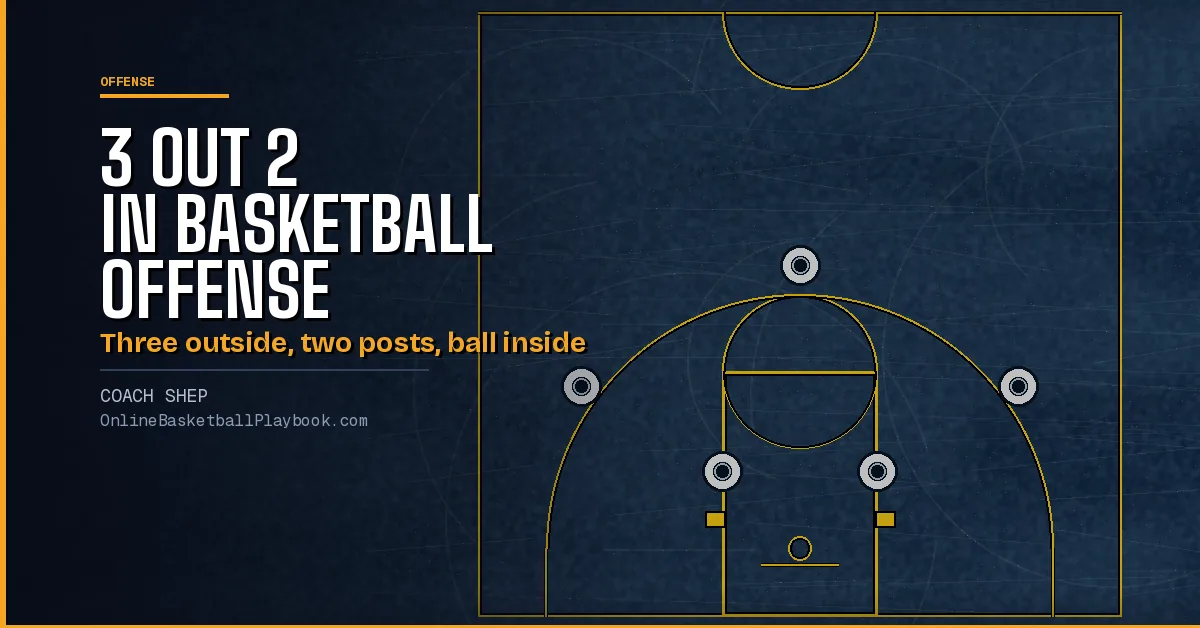
3 Out 2 In Basketball Offense: Spacing, Actions and Reads
The 3 out 2 in basketball offense explained: alignment, actions off every pass, the high-low counter, drive rules for the posts, add-on plays and who fits it.
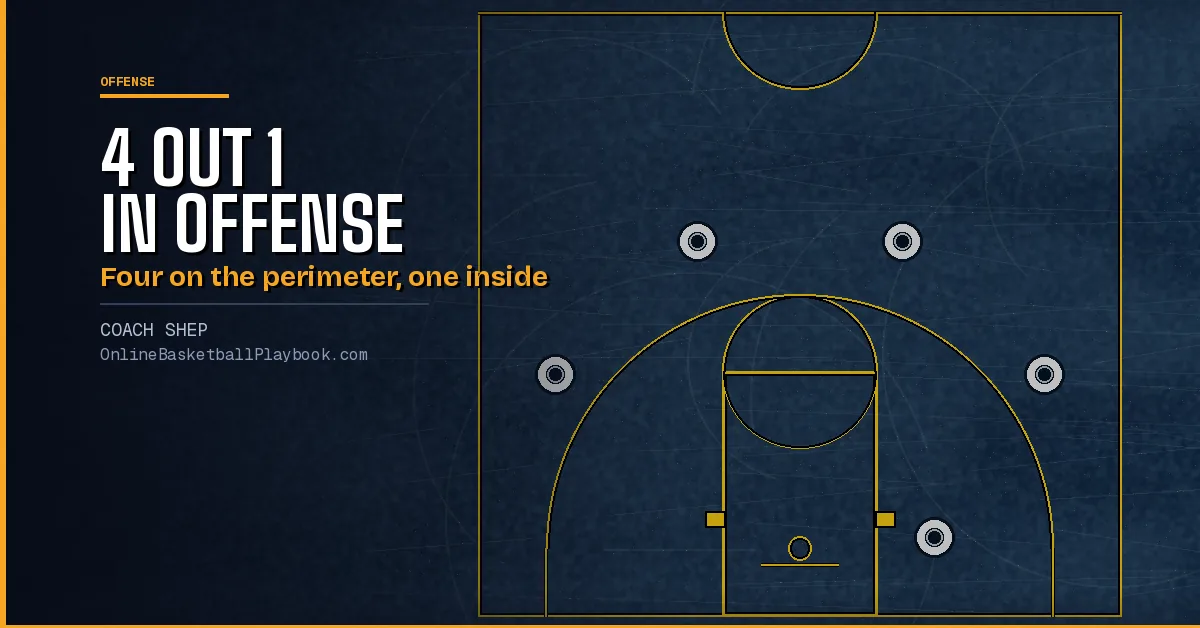
4 Out 1 In Motion Offense: Rules, Spacing and Sets
How to run the 4 out 1 in motion offense: spacing, the six rules, what the post does, pass-cut-fill, screens, quick hitters, zone adjustments and how to install it.
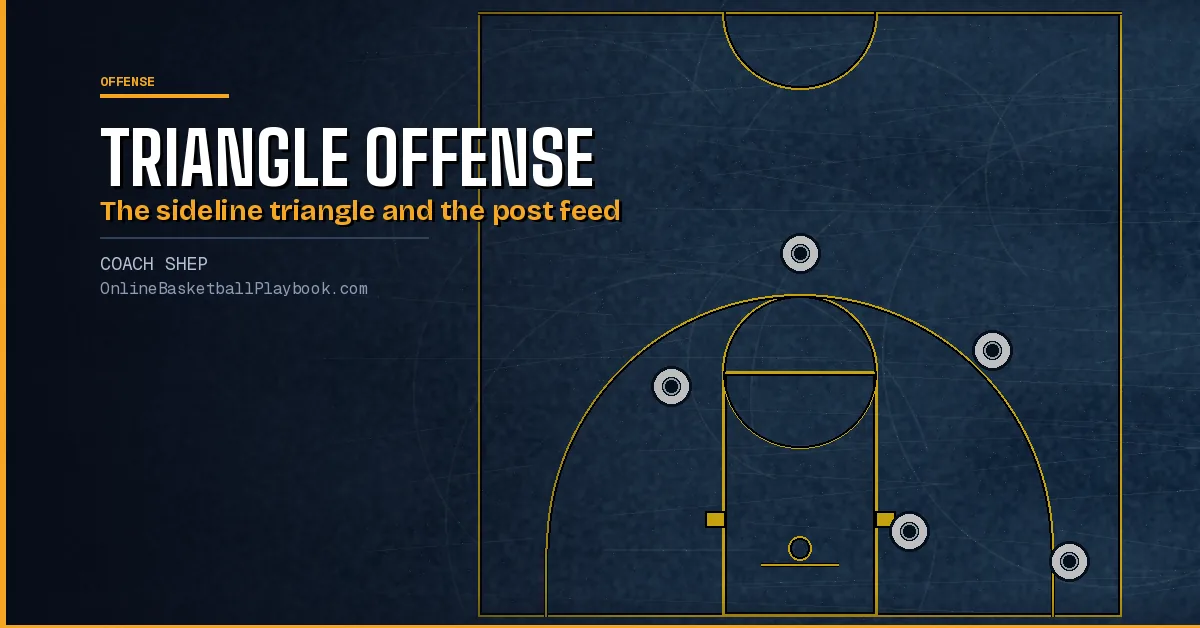
Triangle Offense Basketball: Reads, Spacing and Entries
How to run the triangle offense in basketball: the sideline triangle, spacing, entries, the four wing reads, post splits, counters and how to teach it in pieces.