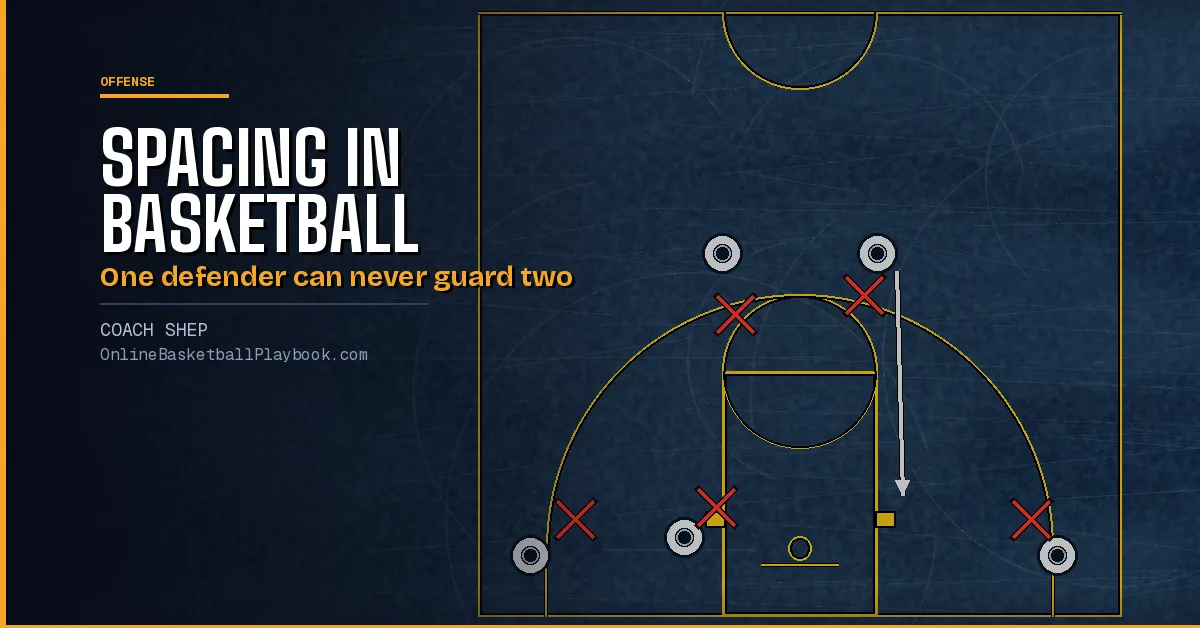
Spacing in basketball is where the four players without the ball stand so that no single defender can guard two of them, while every pass is still short enough to complete. The seam that spacing opens between two defenders is called a gap, and the offense attacks it with a drive, a cut or a pass while the other four re-space. Coaches across every system, from Tex Winter's triangle to the dribble drive, list spacing as the first principle.
This page covers the distances coaches teach, the three sizes of gap, spacing in each alignment, how drives, cuts and post entries change the spots, the errors that crowd a floor, and the drills that teach it. Every system page in the basketball offense hub and the wider offense section builds on it.
What Spacing in Basketball Means
Kelvin Sampson's line is short: spacing is the offense, and with good spacing you do not need plays because you run the offense out of the spacing. Rick Majerus opened a clinic with "spacing, spacing, and more spacing." Chuck Daly's line is that offense is spacing and spacing is offense, and Jay Wright repeats the same words.
The working test is that one defender must never be able to guard two attackers. Bob Huggins puts a number on it: far enough apart that one man cannot guard two, close enough that a direct pass still works. There are four answers when a defender can guard two players or guard his man and still affect the ball: a cut, a perimeter slide, a pin away or a flare.
Underneath the rule sits a dribble-drive belief that comes first among its assumptions: one on one in open space favors the offense. Spreading the floor pulls help out of the paint, and that opens the gaps every action attacks. Dribble-drive adds that the point of the gaps is to create closeouts several times in one possession.
How Far Apart: The Distances Coaches Teach
There is no single number. Each approach lines up differently, and only Winter's triangle ties its number to a level of play.
| Approach | Distance | Note |
|---|---|---|
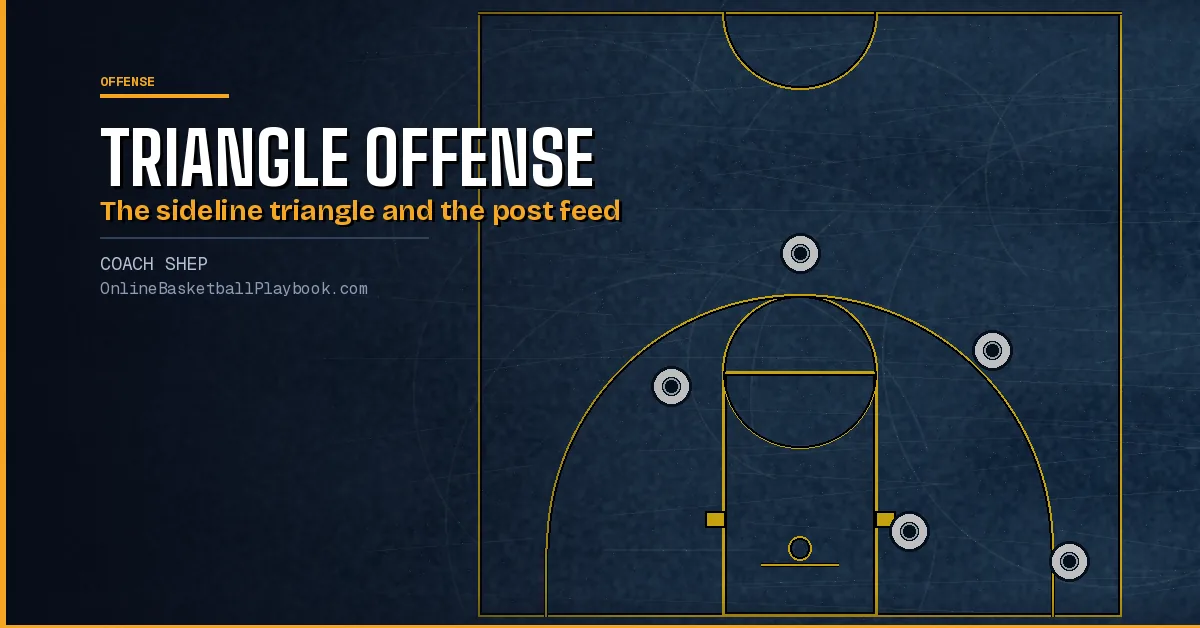
| Triangle, high school | About 12 to 15 feet | Tex Winter's number for high school players |
| Triangle, college | About 15 to 18 feet | Winter's college number, also used in motion and dribble-drive systems |
| Triangle, NBA | About 15 to 20 feet | Winter's pro number |
| Open-post motion | 15 to 17 feet | Bob Huggins: one man cannot guard two, a direct pass still works |
| Constant band | 12 to 18 feet at all times | Closer only when setting a screen |
| Four metres apart | At least 4 metres between outside players | Ettore Messina: closer means fewer drive lanes and easier help |
| Court lines | The three-point line and the free-throw line extended | A wheel offense that sets its spots by the court lines, not by feet |
| Deep 5 out | Spots on the NBA three-point line | Widest 5-out spacing |
| Delay spread | Perimeter at 25 feet or more | A high-and-wide stall, posts at the elbows or short corner |
| Weave entry | 6 to 8 feet, on purpose | A dribble-drive weave entry keeps passer and receiver this close so the kick-back reads as a pass, not a weave screen |
Winter's triangle is the only approach that gives a different number for each level. Most of the other numbers never say which level they were written for, so pick the band you teach and mark it on the floor.
Single, Double and Triple Gaps
Gaps come in sizes, and the dribble-drive coaches gave them names:
- Single gap. The seam between a wing and a slot. One defender can help on the drive and still recover.
- Double gap. The seam the corners create. With the wing empty and the shooter deep in the corner, help has to commit fully.
- Triple gap. The seam that appears after a drive, a kick and a relocation.

Vance Walberg's dribble-drive article names all three from a four-out set with one player on the weak-side block. He is credited with a ladder for the sizes: only the very best players beat a single gap, good players beat a double gap, and anybody should beat a triple gap. The alignment itself creates a double gap on the strong side, and a pass and cut by the 1 turns it into a triple gap.
The word collides with other uses. Ball-screen material counts "single, double and triple side" by how many shooters stand opposite the screen, and a film analyst uses "double gap" for a third idea. Say which one you mean before you teach it.
Spacing by Alignment: 5 Out, 4 Out 1 In, 3 Out 2 In
The three common alignments form a ladder that widens as perimeter skill improves.
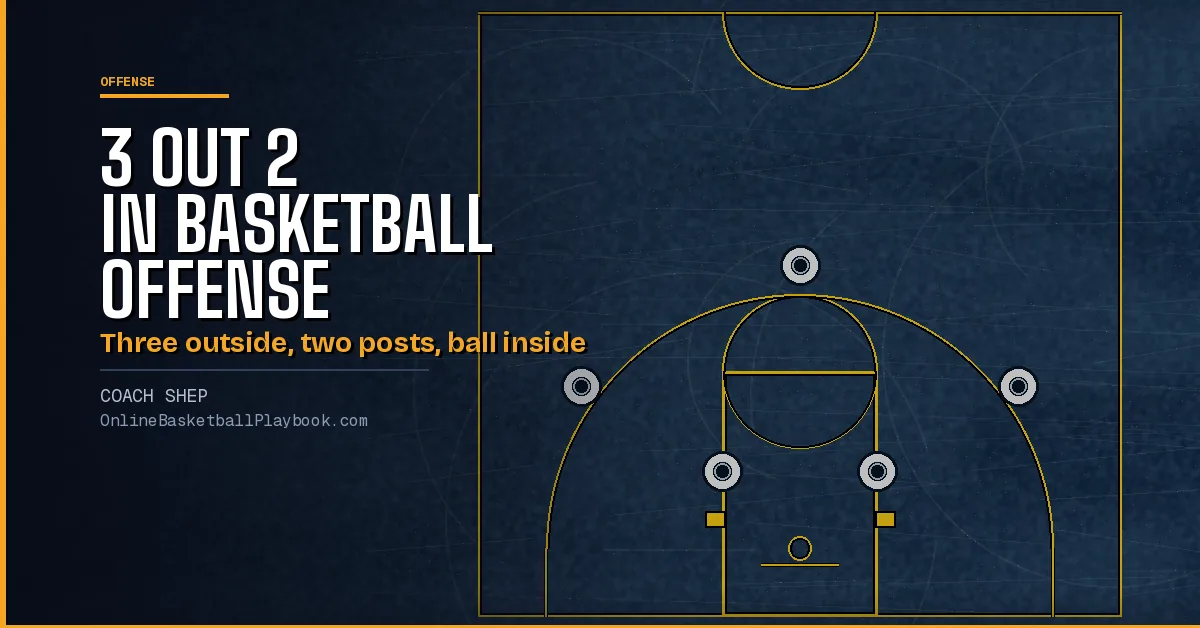
3 out 2 in. Three perimeter players and two posts.
- Start youth teams here. It has clear post entries and simple roles.
- Or skip it for 5 out. 5 out is recommended instead for most youth teams.
- Keep a post presence. 3 out 2 in does that for a team without five shooters, but it only works with two high-IQ posts.
See the 3 out 2 in motion offense.

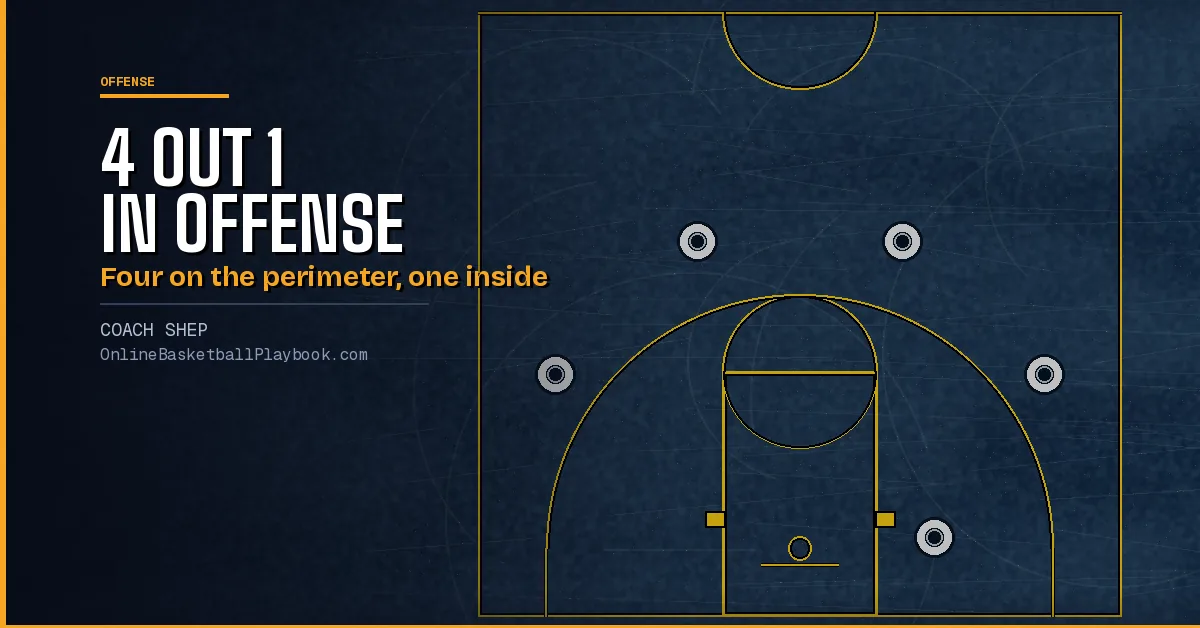
4 out 1 in. A fourth perimeter player opens more driving room. A post who does not understand spacing clogs the lanes. In dribble-drive offenses his job is to stay opposite the ball and react. Jay Wright's four-out starts with 1 in the right slot, 4 in the weak-side slot, players in both corners and 5 on the ball-side block, everyone 15 to 18 feet apart. Full guide: 4 out 1 in offense.

5 out. All five on the perimeter and nobody in the lane. It fits a team with shooters at all five spots and two players who create off the dribble. The price is offensive rebounding. There are three crash plans:
- Point guard back. The point guard goes back and four crash.
- Two guards back. Two guards go back and three crash.
- Everyone below the line. Everyone below the free-throw line crashes.
Full guide: 5 out motion offense.

Tony Bennett's Virginia blocker-mover sets are areas, not plays (Lane-Wide, Lane-to-Lane, Top-Bottom, Wide-Wide and Free-Blocking), and personnel picks the area: two bigs, one big, no bigs, or a defense packing the paint each get their own. Systems built on one alignment are covered in dribble drive motion offense, the Princeton offense and motion offense. Match the alignment to the shooters and post players you have.
How Drives Change the Spots
Every drive moves four other people. These named rules say what those four do.
- John Calipari's four fills. On a perimeter drive, fill the near corner, the far corner, the spot behind the ball at the top of the key, and the post opposite the drive.
- The post on a drive. If the ball is driven at that post, he goes under the rim to the far side for a drop-off. If it is driven away, he seals the helper coming from the far corner.
- Filled corners. They put the corner defender in a lose-lose spot: help and give up the three, or stay and give up the rim.
- Messina's clock rule. On baseline penetration the help-side player moves away from the drive to open a passing lane. On middle penetration players move toward the baseline, behind the defense. After the kick, the driver keeps cutting to the corner for a second catch.
- Sherri Coale's three reads. Chase and space by moving 15 feet away, trail into the crack behind the driver, or drift to the corner while the others fill up.
- Wing fade. In dribble drive the wing fades to the corner on a same-side drive and fills high on the weak side on an opposite-side drive.

Pick one rule and rep it until all four players move on the first dribble.
More driving reads are on dribble drive motion offense.
Get the next coaching guide in your inbox
One email when a new guide or diagram set goes up. Free.
How Cuts and Post Entries Change the Spots
Fill the spot someone just left. In 5 out, fill all five spaces unless a player is cutting or screening. Jay Wright's four-out says leave a spot, fill a spot. Four-out has four players sharing six spots and relocating on penetration.
Never cut into a space someone already holds. No two cuts to the same area, and do not follow your own pass. Blocker-mover caps a side at three players, and the floor needs at least two on each side.
Stay out of the lane unless you are scoring. A cut inside the arc goes to the rim and then gets out. A V-cut should never set up toward the lane, because it drags a defender into the paint.
Move after a post entry. In Aito Garcia Reneses' motion, the passer cannot stand still after feeding the post, because standing lets his defender help on the post and recover easily. He has three ways to move.
- Toward the point. Move toward the point.
- To the corner. Move to the corner.
- To the basket. Cut to the basket.
Calipari fills four spots on a post feed: a diver to the rim, the corner, high and wide on the ball side, and a weak-side spot where the post can see him.

The post stays opposite. In dribble drive the post stays opposite the ball and reacts to the drive, and the rule is never drive when the big is in the low post. Ball-screen spacing is its own topic, covered on pick and roll basketball.
Every pass and every drive is a reason to move.
Common Spacing Errors
- Spacing as a fixed spot. Spacing changes through the whole possession. A player who plants at one distance and never adjusts turns good opening spacing into a crowded floor a few passes later.
- Two cutters to one area. Messina's youth mistake is the "border": players flood the baseline and corner on penetration, and three defenders form one wall.
- Standing after the kick. A concept-based offense makes "floor is lava" a rule: the moment the ball is kicked, sprint to space.
- Spacers who cannot shoot. Zeljko Obradovic requires every perimeter player to be able to shoot the three when he spreads the floor against a switch. A defender guarding a non-shooter sags into the lane for free.
- Drifting into the driver's lane. Over-dribbling and settling for quick threes are the system's weaknesses, and so are young players drifting into the driver's lane.
- Copying NBA isolation spacing. The NBA's defensive three-second rule keeps help out of the paint, so NBA isolation spacing does not transfer below the NBA.
- A post who does not understand spacing. He clogs the lanes in a four-out set.
The defensive side of these errors, how teams sag and help against spread offenses, is on how to defend spacing offenses. Fix the error in practice before it shows up in games.
Where Coaches Split
Move the ball
Messina says five players standing still and passing quickly beat five players moving while one holds the ball. Obradovic runs a no-dribble 5 on 5 because nobody moves without the ball otherwise. Too much cutting numbs a player, so cut and replace with quick full reversals.
Move the bodies
Dave Odom splits it by opponent: a passive zone needs player movement, an attacking zone needs ball movement and fakes.
Three out or four out for the driver. Walberg has said that three out can be easier for penetration than four out, because wider spacing can leave too much distance for the driver to read the corner. That cuts against the four-out dribble drive his own article teaches. Jay Wright's four-out uses three guards and two forwards, not four guards and a post.
When the cutter starts.
- On the release. Messina: the first step of the give-and-go happens as the pass is released.
- On the flight of the ball. Move on the flight of the ball.
- On the head turn. Obradovic: the man without the ball waits until the handler turns his head toward the help.
Decide when the cutter starts before the first practice.
Spacing Drills
Teach it with marks on the floor first.
- Mark X's. Mark X's on the floor to show the gaps before any drill.
- Cone the spots. Use cones on the five 5-out spots.
- No-dribble 5 on 5. Obradovic runs it for 5 to 10 minutes every practice, with many turnovers at first and learning after.
- Start beginners in a square. Use a marked square, then no-dribble, no-scoring 2 on 2 and 3 on 3.
- Finish with shell and cut-and-fill. The shell drill and cut-and-fill work round it out.
Spacing is a habit, so rep it every day.
Full drill write-ups: basketball spacing drills and the shell drill.
Questions Coaches Ask
What is spacing in basketball?
Where the four players without the ball stand so no single defender can guard two of them, while every pass stays short enough to complete. Good spacing opens gaps between defenders for drives, cuts and passes.
How far apart should players be in basketball?
Coaches differ. Tex Winter gave about 12 to 15 feet for high school, 15 to 18 for college and 15 to 20 for the NBA. Bob Huggins uses 15 to 17 feet, and Ettore Messina wants at least 4 metres between outside players.
What is a double gap in basketball?
In dribble-drive language, the seam the corners create. With the shooter deep in the corner and the wing empty, the defender who helps on the drive has to commit fully.
Why is spacing important in basketball?
Spreading the floor pulls help defenders out of the paint and opens the gaps that drives, cuts and passes attack. One on one in open space favors the offense.
Which alignment gives the best spacing?
Coaches choose by personnel. 5 out gives the most room but needs shooters at every spot and costs offensive rebounding. 3 out 2 in keeps a post presence for teams without five shooters, and 4 out 1 in keeps one player inside for rebounding.
Want the printable playbook packs?
OBP Pro members get the premium playbook packs: the zone attack, out of bounds and practice plan PDFs, plus each new pack as it is finished. The membership page lists what is in each one. Or draw your own version free in PlayDraw.
See what OBP Pro includesMore Core Coaching Guides
- Pick and Roll Defense: Every Ball Screen Coverage Compared
- Dribble Handoff: Types, Reads, Counters and How to Defend It
- Lock Left Defense: Force Direction, Rules and Help Rotations
- Pressure Defense Basketball: The SOS Man-to-Man System
Back to Basketball Offense and every Offense page.
Keep Building
Related breakdowns
3 Out 2 In Basketball Offense: Spacing, Actions and Reads
The 3 out 2 in basketball offense explained: alignment, actions off every pass, the high-low counter, drive rules for the posts, add-on plays and who fits it.
4 Out 1 In Motion Offense: Rules, Spacing and Sets
How to run the 4 out 1 in motion offense: spacing, the six rules, what the post does, pass-cut-fill, screens, quick hitters, zone adjustments and how to install it.
Triangle Offense Basketball: Reads, Spacing and Entries
How to run the triangle offense in basketball: the sideline triangle, spacing, entries, the four wing reads, post splits, counters and how to teach it in pieces.