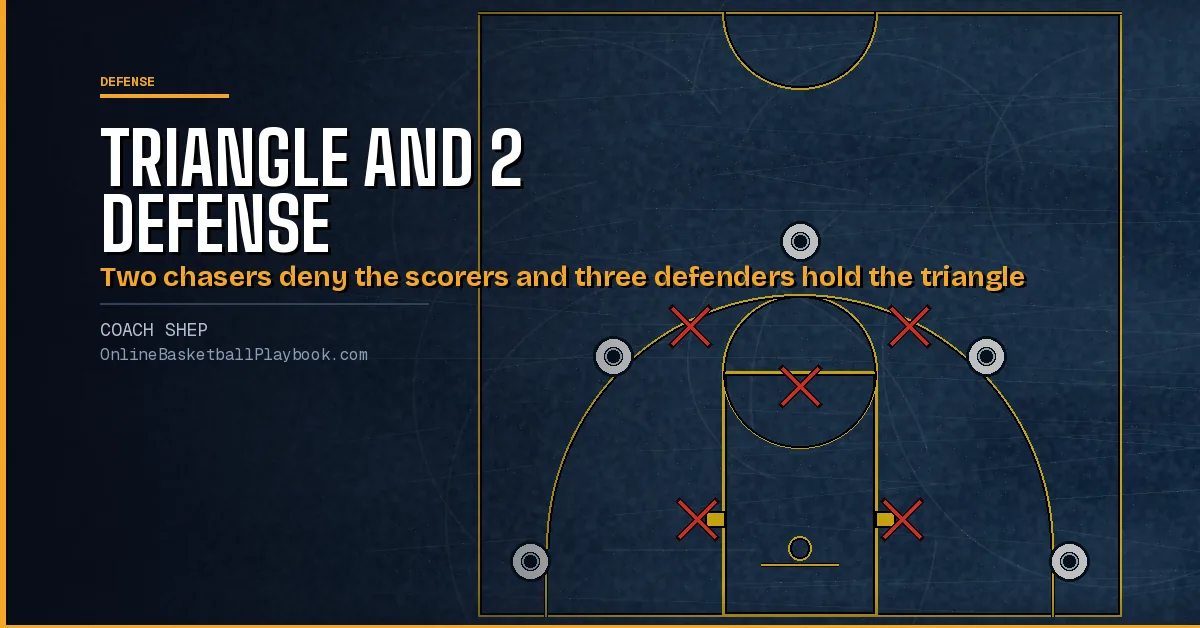
The triangle and 2 defense is a hybrid of man-to-man and zone. Two defenders chase the opponent's two best scorers and deny them the ball everywhere, and the other three defenders play a zone in the shape of a triangle behind them. It is a game-plan defense for a team that scores through two players, and coaches treat it as a special-situation tool, not a base defense. This guide covers the roles, the rotations by ball location, the inverted triangle and 2 against a two-guard front, and the ways offenses attack it. Where the versions differ, they are shown side by side, each named for what it stresses.
Triangle and 2 Defense at a Glance
| Question | Answer | Version |
|---|---|---|
| Structure | Two chasers in full denial, three defenders in a triangle with two low and one on top | Full-denial version |
| Structure | Three defenders hold a triangle for backside support while two chasers deny the two best scorers | Post-double version |
| Best against | Two excellent scorers with three average teammates | Special-situation version |
| Avoid when | Other players on the floor can shoot, or one of the two scorers works in the post | Full-denial version |
| Use as | A special-situation tool, never a season-long base | Special-situation version |
| Against a two-guard front | Invert the triangle so two defenders are high and one is low | Special-situation version and the post-double version |
Triangle and 2 Alignment and Roles
The full-denial version describes the defense as the box-and-1 logic with one fewer zone defender, so most of its space goes to where the three triangle players stand as the ball moves. Its rules are short. Limit the two stars' touches with full denial, limit second-chance points, and collapse to the triangle when a star catches the ball. Its reason for using it is surprise. The defense is rarely used and rarely practiced against, so it can frustrate and tire the two stars and push the other three players into plays they are not used to making. For the one-chaser version see the box and 1 defense.

| Role | Job | Version |
|---|---|---|
| Chasers | Full denial with no help duties. They deny touches and stay out of foul trouble, because denial on a frustrated star invites fouls | Full-denial version |
| Chasers | The denial also breaks up the opponent's set continuity, so the chasers have to be genuine competitors | Post-double version |
| Bottom of the triangle | Two bigger players. They front the low post when the ball is above the free-throw line, guard the ball below it, help on the weak side and rebound | Full-denial version |
| Top of the triangle | A quick, good on-ball defender. He denies the high post and takes the ball handler any time the ball is above the free-throw line | Full-denial version |
| Who goes where | Put the best athlete on top of the triangle and the best post defender on the center's favorite side. It describes the defense as usually two perimeter players and a post player | Athlete-on-top version |
The athlete-on-top version also lists reasons to use alternative defenses at all. They take out a star, control tempo, make teams prepare for you, take away a special set and "steal" a timeout.
Rotations by Ball Location
The full-denial version gives the triangle a rule for each ball spot. It asks the top defender to guard the drive and discourage the entry without heavy ball pressure, because a role player shooting from outside is a win for the defense.
- A star has the ball. The three triangle defenders set back into their original positions. The ball handler sees help and open teammates around the perimeter, and the hope is that he passes.
- Ball at the top of the key. The top defender sits between the ball and the high post without heavy pressure. The bottom defenders front if there is a low post.
- Wing above the free-throw line. The top defender goes to the ball-side elbow with the same job. The ball-side bottom defender fronts the post and the weak bottom defender takes the middle of the lane for drives and skips.
- Wing below the free-throw line. The ball-side bottom defender steps out to the ball, again without pressure. The weak bottom defender slides behind the ball-side post, behind and not in front, so he can still close out on a skip. The top defender drops just below the ball-side elbow.
- Corner. The same shape. The ball-side bottom defender is on the ball, the weak bottom defender plays behind the ball-side post and the top defender drops toward the ball side to help against penetration and the entry.
- High post. The top defender plays the ball with real pressure to force it back out. The bottom defenders hold their triangle spots, deny the low post and stay ready to close out below the free-throw line.
- Low post with a seal. The sealed bottom defender plays straight up and contests, and the top defender sinks to help.


Skip Passes
The full-denial version gives each skip an owner. On a skip from the wing to the opposite corner, the weak bottom defender, who was in the middle of the lane, closes out and forces the ball toward the middle, where the top defender helps. On a skip from the corner to the opposite wing, the top defender takes it above the free-throw line and a bottom defender takes it below. On a skip from the top of the key to a corner, the ball-side bottom defender closes out and forces the ball toward the middle.
Get the next coaching guide in your inbox
One email when a new guide or diagram set goes up. Free.
The Strong Post Question
The two main versions answer a strong post scorer differently.
| Situation | Idea | Version |
|---|---|---|
| One of the two stars scores in the post | Avoid the triangle and 2. The lane gets congested and two defenders can end up in the same spot | Full-denial version |
| A strong post player | The triangle plus a chaser automatically creates a double team on a low post player, and the outside chaser still gets backside support against penetration | Post-double version |
| Drives against the triangle | On a baseline drive, two defenders double the ballhandler while a chaser keeps denying. On a drive to the middle, two other defenders double | Post-double version |
Inverted Triangle and 2
The special-situation version shows an inverted triangle and 2 for a team that splits the middle defender with a two-guard front. The triangle flips so two zone defenders stand at the elbows and one plays low. The post-double version says the same adjustment against a two-guard front, and adds that the shifts then mirror a 2-3 zone, so the same defense covers a different alignment without a new shell. It also says that against a strong post player the inverted version doubles the post automatically whenever a chaser is assigned to deny that player the ball.

For the shifts of the zone shape the inversion borrows, see the 2-3 zone defense.
When to Use It and When Not To
The full-denial version lists what the defense does well. It is easy to install, it gives the team another option if the base defense is not getting stops, it frustrates the two stars, it tires them and it makes the other three players shoot. Its weak spots are the middle of the zone, because three defenders cover it, and the three-point line when other players can shoot. It adds that a team built around two scorers is unlikely to have other great shooters too.
The special-situation version files the triangle and 2 with the box-and-1 and the diamond-and-1 as tools against a strong opponent, never a season-long base, and warns that a switching look only works if your players are less confused than the other team. The post-double version suggests it for a change of pace or a hold-the-ball look at the end of a game, and as one of three packages for a baseline out-of-bounds play, with a shared opening in which the team sags to protect the middle for three seconds. For its relatives, see how to score against junk defenses, and for the families it sits in see types of defense in basketball, the defense section and the best zone defense comparison.
How Offenses Attack It
There are several answers to the offense of a triangle and 2. Use this section when you are the team facing it.

- Both scorers on one side. The special-situation version puts the two chased players in one area. When both chasers must cover both stars on the same side, the triangle loses its shape.
- Move the ball faster than the defense can rotate. The special-situation version says junk defenses are often installed without enough practice and can crack under pressure, and that a calm team finds the gaps within a few possessions.
- A baseline continuity. The special-situation version's offense has one guard pass and cut through to the corner while the ball swings around to him, and he shoots if the low zone defender does not close out. If the defender closes out, one big cross-screens the low defender and the other cuts ball side for a layup against a mismatch. If nothing opens, the ball reverses and the same read repeats on the other side. A pass fake to the runner and a direct pass to the post is the counter once the low defender closes too fast.
- Single and double screens. The post-double version sets a single screen on one side and a double screen on the other, and the shooter can fake one and reverse back to the other. It teaches the action in a 4-on-4 shell first and says to mix entries so chasers cannot key on one look.
- Motion. The special-situation version says a motion offense can often be run largely unchanged against the triangle and 2. A read-first motion attack handles box-and-1 and triangle-and-2 looks by reading the defense, not by running a set sequence.
Also see how to beat a box-and-1 defense, how to attack a zone defense and motion offense.
Questions Coaches Ask
What is a triangle and 2 defense?
A defense in which two chasers play full denial on the opponent's two best scorers and three other defenders play a zone in a triangle shape. It combines man-to-man and zone.
What is an inverted triangle and 2?
The same defense with the triangle flipped so two zone defenders are at the elbows and one is low. It is used against a two-guard front, and its shifts mirror a 2-3 zone.
When should you not use a triangle and 2?
The full-denial version says to skip it when other players on the floor can shoot, because three zone defenders cannot cover the arc, and when one of the two scorers works in the post.
How do you beat a triangle and 2 defense?
Put both scorers on the same side, move the ball faster than the defense rotates, run a baseline continuity or a single and double screening action, or read the defense in motion.
What is the difference between a box and 1 and a triangle and 2?
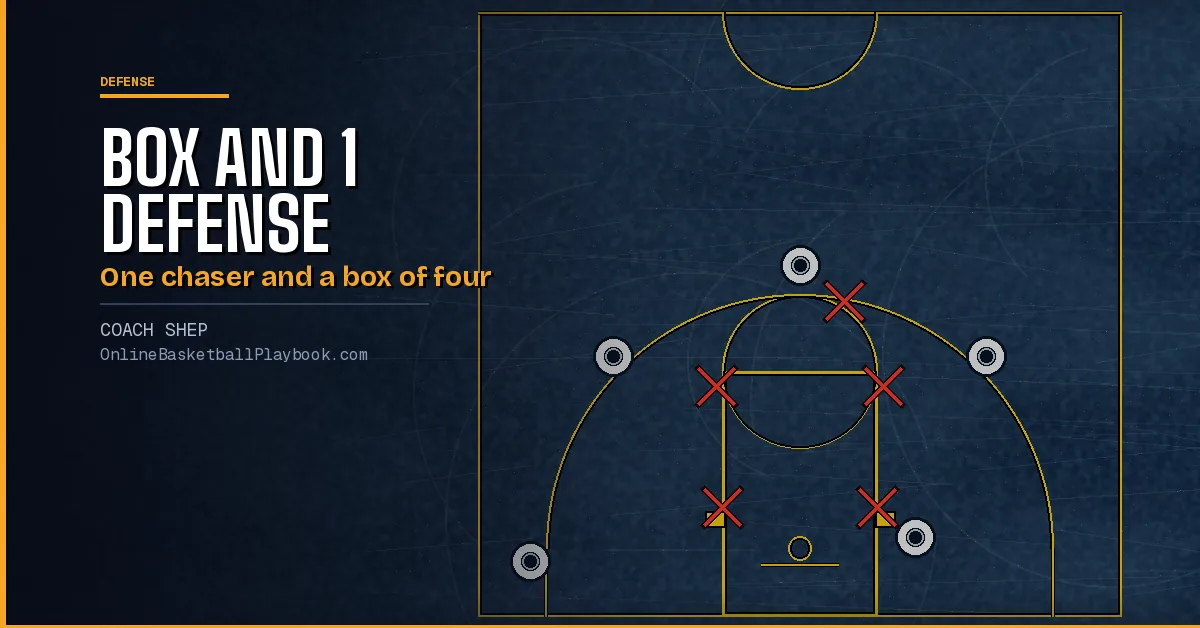
A box and 1 uses one chaser and a four-player zone. A triangle and 2 uses two chasers and a three-player zone, so each zone defender covers more floor.
Want the printable playbook packs?
OBP Pro members get the premium playbook packs: the zone attack, out of bounds and practice plan PDFs, plus each new pack as it is finished. The membership page lists what is in each one. Or draw your own version free in PlayDraw.
See what OBP Pro includesMore Guides From This Batch
- Basketball Offense: Systems, Actions and Sets Explained
- 1-2-2 Press: Roles, Traps, Rotations and Breakdowns
- Traveling in Basketball: Rule, Steps and Pivot Foot by Level
- 2-1-2 Zone Defense: Rotations, Weak Spots and Personnel
Back to Types of Defense and every Defense page.
Keep Building
Related breakdowns
Box and 1 Defense: How It Works and How to Beat It
What the box and 1 defense is, how the chaser and the box play, when coaches call it, where it leaks, and how an offense beats it with a decoy star.
Junk Defense Basketball: Box and 1, Triangle and 2, When to Use
Junk defense basketball explained: the box and 1, diamond and 1, triangle and 2 and inverted triangle, when to call one, what it costs and how offenses beat it.