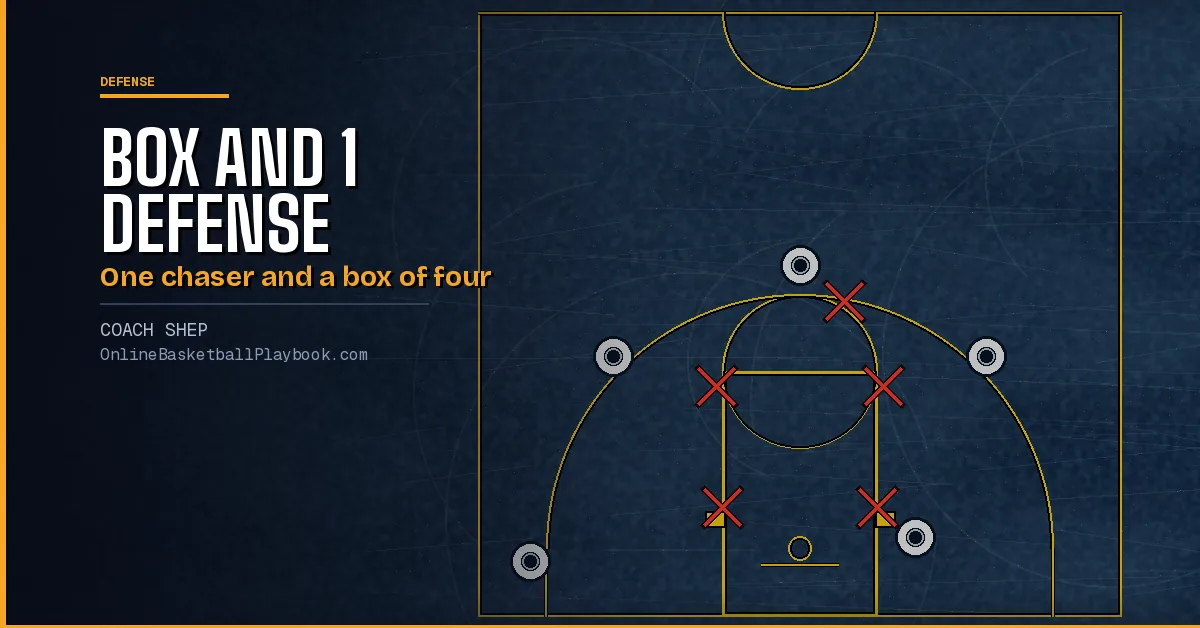
The box and 1 defense is a hybrid of man-to-man and zone. One defender, the chaser, guards the opponent's best scorer everywhere on the floor. The other four play a box zone, two high and two low. It is a game-plan weapon for a team built around one scorer. This guide covers how the box and 1 defense works, who plays each spot, when to call it, where it breaks, and how an offense beats it.
The Box and 1 at a Glance
| Piece | Job | Who fits |
|---|---|---|
| Chaser (1) | Full denial of the star, no zone duties, no help | The most disciplined and composed defender |
| High box (2) | Protect the high post and their side of the perimeter, close out on wing catches | Quick, athletic players |
| Low box (2) | Own the low post and corner, front the post | Players who can front and close out |
Box and 1 Defense Diagram

The Chaser
The chaser follows the star through every screen, sprint and inbound. If the star never touches the ball, the possession is a success. The star will use elbows, push off and talk. Composure matters more than speed.
Rotate two or three players through the role in a game, because one chaser wears out fast. The chaser should never be routed to the ball side, where he can be screened away from his man. He fights screens from the front. Once he falls behind a screen, the defense has lost its main mechanic for that possession.
The Box Zone
The high box defenders sprint out on any wing catch. The low box defenders front the post before a teammate of the star can seal, and close out and stop the baseline drive when the ball goes to the corner. The box also rebounds well. It forms a natural triangle on perimeter shots and the chaser boxes out the star.

If the star catches it anyway, all four box defenders collapse toward the ball. The star has to pass, and the perimeter shot that follows belongs to a role player. That is the trade the defense wants.
The Skip Pass Weakness

Two high defenders cannot cover the arc. A skip from one side to the other means a long sprint that often arrives late. This is why the box and 1 fails against a team that can shoot. The defense trades interior protection for perimeter risk, and the trade only pays if the role players cannot shoot.
Get the next coaching guide in your inbox
One email when a new guide or diagram set goes up. Free.
When to Use the Box and 1
- The opponent has one or two clear scorers and three or more unreliable ones.
- You need to break a rhythm. A call after a timeout, after a made basket or at the start of the third quarter forces the opponent to re-read.
- You are athletically outmatched and cannot guard the star without fouling.
- You are protecting a lead late.
- Use it in bursts of three to five possessions and then return to your base defense.
- Decide your Plan B before the game. If the chaser gets two fouls, you need to know whether you switch to pure zone or pure man.
- The defense fails against balanced scoring, against shooters who never stop moving, and against hard screening for the chaser's man.
- A hybrid can fool a young opponent, who may call it a zone and run zone sets. Practice it, because unpracticed hybrids fall apart under pressure.
Last Shots and Out of Bounds
A box and 1 also fits two special moments. When the opponent's best scorer will take the last shot, the staff can put a combination call on the last-shot sheet next to switching all screens and checking the foul count. It is also one of the choices against a baseline out-of-bounds play, because the defense holds a five-on-four edge at that moment. Every version starts by sagging off to protect the middle for about three seconds. Then the defense denies or pressures the pass and settles into the box or diamond once the ball goes live. The defense must be set before the official hands over the ball, or an alert cutter goes straight to the basket behind a defender who is out of position.
Diamond and 1

The diamond and 1 replaces the box with a diamond: one top, two wings and one inside. It covers the perimeter with three players and the inside with one. Coaches use it against a dominant post scorer with outside shooters around him. Some use it against a one-guard front. If the corner becomes a problem, go back to the box. Individual post technique still comes first, because a team scheme cannot fix a defender who is beaten to the block. The triangle and 2 is the next member of the family, and it is covered on What Is a Triangle and 2.
How to Beat the Box and 1
The full offensive plan is on How to Beat a Box and 1 Defense and a set-play approach is on How to Beat a Box and 1 with a Set Play. The main ideas follow.

- Send the star away. Park the chased player in the far corner and run a four-man offense. The four box defenders now guard four attackers and the extra chaser has no help to give.
- Use the star as a decoy. Screen the chaser into traffic and free the star for a late cut from the other side. A star who cuts late is harder to find than a star who isolates.
- Star runs the zone. Sprinting into the gaps forces the box to make rotation decisions and drags the chaser through the shape.
- Spread the four. Put the other four in the corners and wings so the box defenders cover the maximum range before the star touches it. A defender who sprints to a corner is out of place for the next rotation.
- Move the ball. Make the box rotate six or seven times before the first shot. The zone tires and the chaser tires faster.
- Screen for others while he trails. A back screen set by the chased player is free. The chaser cannot hedge and the box does not help.
- Skip the ball. The long close-out is the box's weakest step.
- Against the triangle and 2, put both chased players on the same side so the triangle loses its shape.
- Shoot. Role players must make the shots that the defense gives them.
Calm ball movement solves most junk defenses in a few possessions. Name what you are facing within two possessions, because the wrong counter helps the defense. Coaches split on set plays and reads. Some run a scripted answer with the star as the decoy. Others teach players to read the seams. See How to Beat Junk Defenses.
Practice Plan for the Defense
- Install it early. A 20-minute block is enough so the call is ready the night before a game.
- Teach the offensive counter in the same session so players see why the box rotates as it does.
- Pick the chaser for composure and motor.
- Run three to five possessions of live work and film them.
- Set the defense before the ball is inbounded if you use it on an out-of-bounds play. Sag off and protect the middle for three seconds, then convert when the ball goes live.
- Keep the junk menu small so your own players stay less confused than the opponent.
Questions Coaches Ask About the Box and 1
What is a box and 1 defense in basketball?
A defense where one player, the chaser, guards the best scorer man-to-man and the other four play a box zone.
When should you use a box and 1?
When the opponent has one dominant scorer and unreliable teammates. Use it in short bursts, to break a rhythm, or to protect a lead.
How do you beat a box and 1?
Send the star to the far corner and run four-man offense, use him as a decoy, move the ball, skip it, and make the open shots.
What is the difference between a box and 1 and a diamond and 1?
The box and 1 uses two high and two low defenders. The diamond and 1 uses one top, two wings and one inside.
What is a triangle and 2?
Two chasers on two scorers and a three-player triangle zone. See What Is a Triangle and 2.
Every defense sits under the Defense hub and Types of Defense in Basketball. Related pages are Amoeba Defense, How to Coach a Matchup Zone Defense and Best Zone Defense for Your Team.
Want the printable playbook packs?
OBP Pro members get the premium playbook packs: the zone attack, out of bounds and practice plan PDFs, plus each new pack as it is finished. The membership page lists what is in each one. Or draw your own version free in PlayDraw.
See what OBP Pro includesMore Zone and Junk Defenses
- 2-3 Zone Defense: Rotations, Weak Spots and Drills
- 3-2 Zone Defense: Rotations, Weak Spots and Drills
- 1-3-1 Zone Defense: Traps, Rotations and Drills
Back to Types of Defense and every Defense page.
Keep Building
Related breakdowns
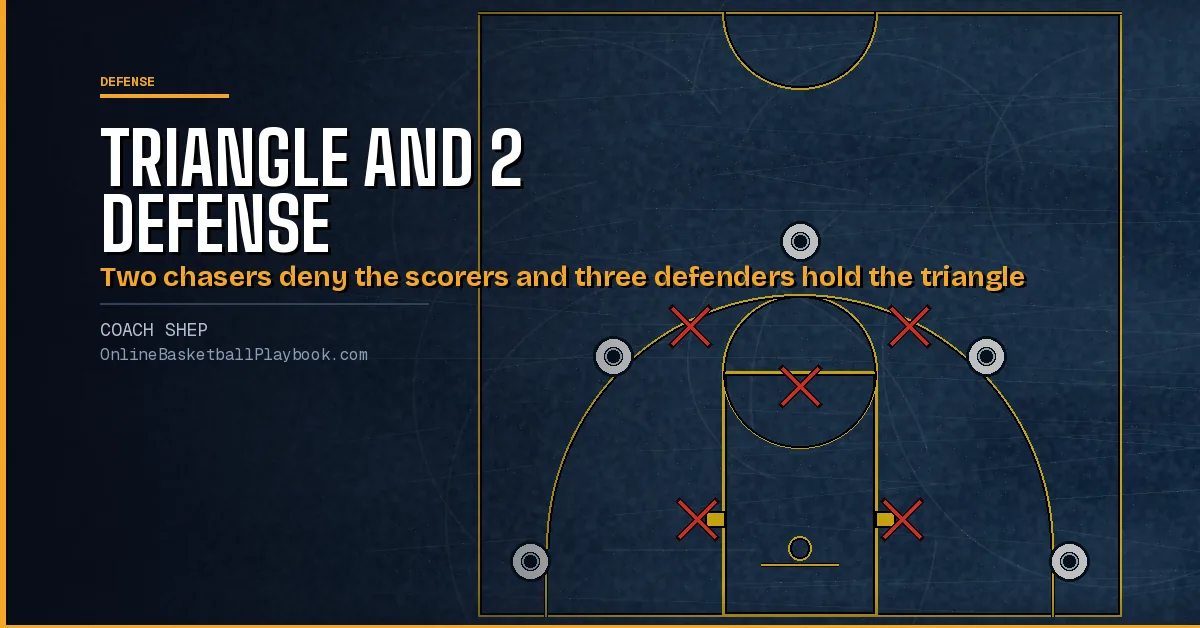
Triangle and 2 Defense: How It Works and How to Beat It
Triangle and 2 defense explained with the chaser and triangle roles, rotations by ball location, the inverted version, when to use it and how offenses attack it.
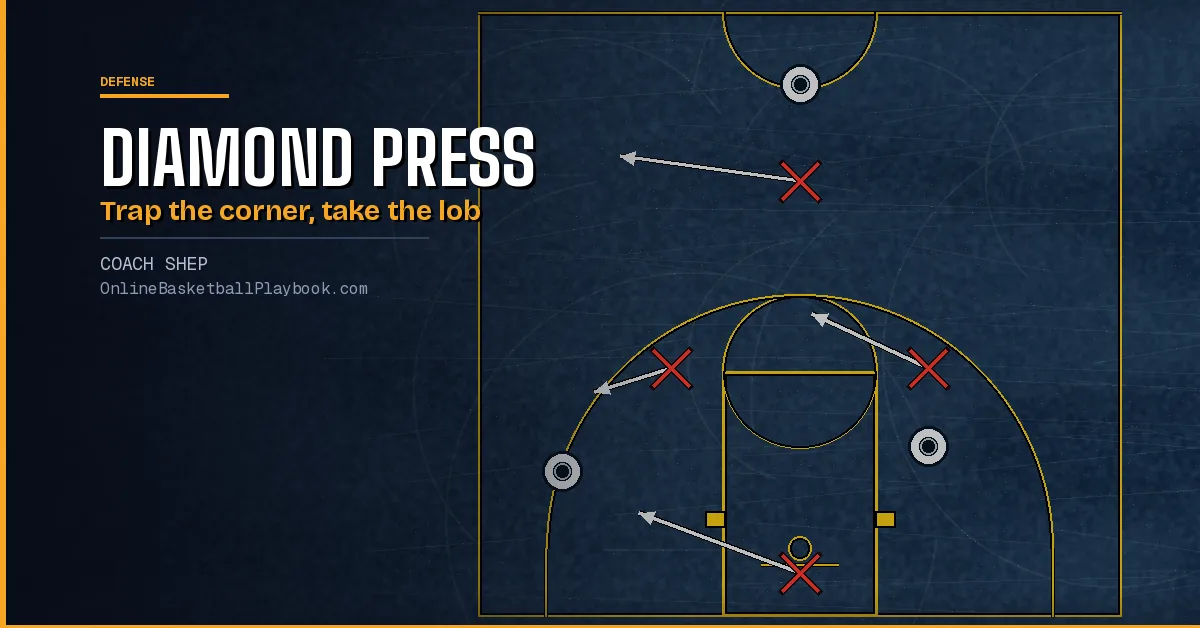
1-2-1-1 Diamond Press Basketball: Roles, Traps and Install
How to run the diamond press in basketball: who plays each role, how to trap the corner, what to do on the reversal and the lob, and how to install it step by step.