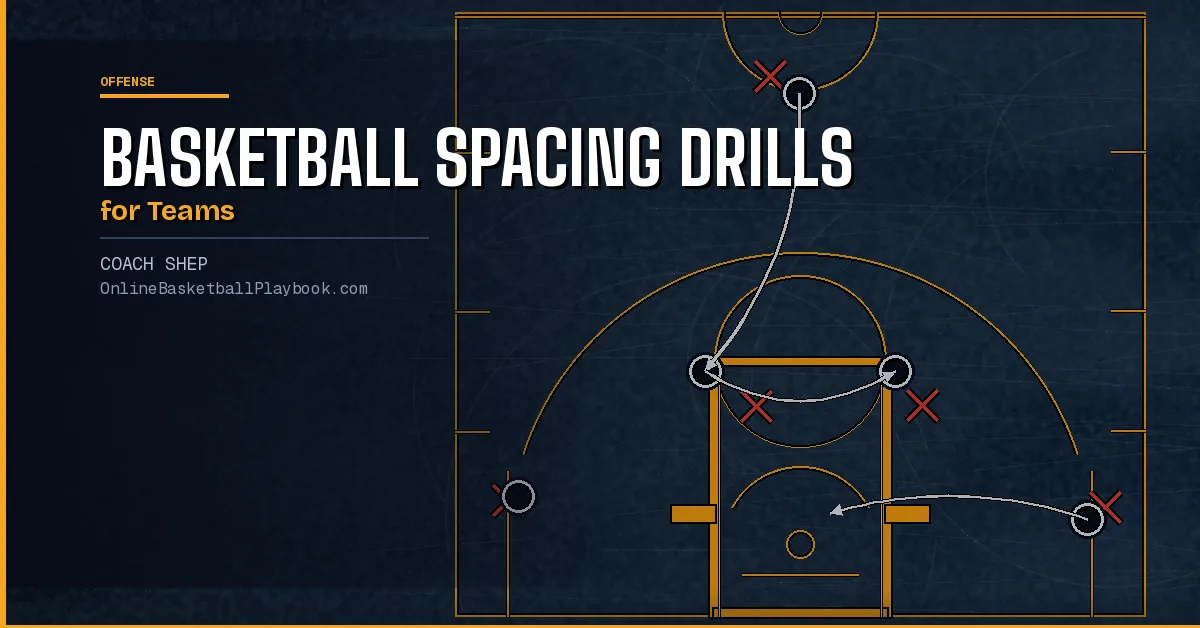
Good spacing is the foundation of every effective offense. These basketball spacing drills teach players to maintain 15–18 foot gaps, read the defense, and move with purpose, eliminating the clutter that collapses attacks before they start.
Why Spacing Matters More Than Any Play
Most offensive breakdowns have the same root cause: players crowd each other. When four players collapse into the same 12-foot paint area while a teammate drives, there is nowhere to kick the ball. The help defender recovers easily. The drive stops. Possession wasted.
Spacing is the antidote. When players hold proper floor position (typically 15 to 18 feet apart across the arc), every drive creates a genuine decision for the defense. Help one way and leave a corner shooter. Help the other way and expose the weak-side cutter. No defense can guard properly spaced players without giving up something.
This is why spacing drills belong at the top of every basketball practice plan, not as an afterthought after sets and plays are installed. Spacing is infrastructure. Everything else (pick-and-roll coverage, fast break opportunities, post entry angles) works better when your team spaces the floor correctly by habit.
The problem is that players do not naturally hold spacing under defensive pressure. Left to their own instincts, they drift toward the ball. They cheat toward the paint to be "closer to the action." They stand still when they should relocate. Spacing drills are the mechanism for replacing those instincts with something better.
If you run a 5-out motion offense or any read-based system, spacing is not a component of the offense. It is the offense. Get spacing right and plays emerge naturally. Ignore it and no amount of diagrammed sets will save your attack.
Spacing Fundamentals Every Player Must Know
Before drilling spacing, players need a clear mental model of what they are trying to achieve. Coaching abstract concepts like "spread the floor" produces limited results. Coaching specific rules produces consistent behavior.
The 15–18 Foot Rule
Each player should maintain roughly 15 to 18 feet of distance from the nearest teammate. This spacing creates two-pass ball movement, forces defenders to cover the entire arc, and leaves driving lanes open. When a teammate drives baseline, the nearest weak-side player does not stand and watch. They relocate to fill the open gap.
The Ball-You-Basket Triangle
Every off-ball player should be positioned so that a straight line from the ball through them points toward the basket. This positioning maximizes catch-and-shoot efficiency, shortens passing lanes, and keeps defenders from camping in help position. Players who understand this triangle intuitively find better spots on every possession.
Movement Has Purpose
Spacing drills distinguish between two types of movement: purposeful and reactive. A player cutting to the corner after their teammate catches the ball in the post is purposeful. They are opening a passing lane and occupying a help defender. A player drifting toward the paint because their defender sagged is reactive. They are compressing spacing and shrinking the court. Purposeful movement expands the offense. Reactive movement kills it.
Space Away from the Drive
One of the most teachable spacing habits is this: when a teammate drives, move away from the drive. If the drive goes left, the nearest player on the left side relocates right. This keeps help defenders in a bind. They cannot help on the drive without abandoning an open shooter. Teaching players to read drive direction and adjust accordingly is the single most impactful spacing lesson at the youth and high school level.
Core Basketball Spacing Drills
Drill 1: 4-Corner Spacing Walk-Through
Setup: Place four players at the four corners of the three-point arc (two wings, two corners) with one player at the top of the key. No defense. The coach holds the ball at the top of the key.
Execution: The coach drives left. The left-wing player must immediately relocate to the opposite corner or far wing. The right-side players adjust to fill the now-open gaps. Coach resets and drives right. Players relocate accordingly.
Coaching cues: "See the drive. Move away. Find the gap." Run this at walk-through speed first, then at full speed, then with a live drive and kick-out to test catch-and-shoot readiness.
Why it works: It isolates the most common spacing error (standing while a teammate drives) and creates a clear, repeatable response. Players who do this drill correctly for two weeks stop standing in the paint during live scrimmages.
Drill 2: 3-on-0 Pass-and-Relocate
Setup: Three players, no defense, starting at the top of the key and two wings. Ball at the top of the key.
Execution: The player at the top of the key passes to the right wing and immediately cuts through to the left block. The left-wing player fills the top of the key. The right-wing player catches and passes to the new player at the top of the key. Continuous for 90 seconds.
Coaching cues: Watch spacing after each pass. If players are within 12 feet of each other, blow the whistle and reset. The drill continues only when spacing is maintained throughout.
Why it works: It trains pass-and-move as a default habit rather than a play instruction. Players learn to anticipate the open area and move toward it before being told. This is the foundation for any motion-based system.
Drill 3: Ghost Defense Spacing
Setup: Five offensive players in a 5-out alignment. No defense. Coach calls out "help left" or "help right" randomly.
Execution: On "help left," two defenders would theoretically rotate left to help. All five offensive players immediately find where they would be open given that defensive rotation and relocate to those spots. Coach checks positions and gives feedback before resetting.
Why it works: It builds defensive-read habits without the chaos of live defense. Players start recognizing which gaps open based on where help defense comes from. A critical skill for any team that wants to score against zone or collapsing man.
5-on-0 Spacing Progressions
5-on-0 work is undervalued at every level. Many coaches treat it as a warm-up or skip it entirely. High-level programs use it as a primary teaching tool because it isolates spacing and movement decisions without the noise of defensive pressure.
If you want to build spacing habits that survive live defense, the motion offense in basketball principles must first be cemented without defenders in the way. Here is a four-stage progression:
Stage 1: Stationary Spacing Check
Five players set up in your base offensive formation. Coach blows whistle. Players freeze and the coach walks the court measuring gaps. Any player within 12 feet of a teammate must physically move to a better spot before play resumes. Do this until every player understands the spatial map of the offense by feel.
Stage 2: Pass-and-Cut Only
Add movement (pass and cut only, no dribble). Every pass is followed by a basket cut or a fill cut. Players must fill open gaps on the perimeter rather than stacking. Run for two minutes without stopping. Coach calls out "freeze" at random moments and checks spacing.
Stage 3: Pass, Cut, and Screen
Layer in ball screens and off-ball screens. Players must still maintain spacing after each screen action. Common error: the screener rolls into traffic and eliminates a driving lane. Correct pattern: screener rolls to the open area, keeping floor spacing intact.
Stage 4: Full 5-on-0 Tempo
Run at game speed with all actions (passes, cuts, screens, drives). Coach stops play only when spacing collapses. The goal is fluid, read-based movement where all five players are always in a threatening position. This is the offensive baseline you want to reach before introducing live defense in your effective basketball practice structure.
Live Spacing Drills with Defense
Once players can hold spacing in 5-on-0 work, you introduce defense. The key is to add defense gradually, first in controlled rotations, then in scramble situations.
3-on-2 Spacing Drill
Setup: Three offensive players against two defenders. One defender takes the ball-handler. One defender plays the strong-side wing.
Execution: The ball-handler drives. The unguarded wing must relocate to the most dangerous open spot. The third offensive player fills behind. Offense gets three possessions, then rotate. Defenders score points for forcing bad passes caused by poor spacing.
Coaching cues: "Where does the defense have to go to stop the drive? Go to the opposite spot." This is the key read. Players who make this read consistently become the most valuable spacing players on the team.
4-on-3 Spacing and Kick-Out
Four offensive players against three defenders. One offensive player is always open if spacing is correct. The drill teaches players to trust spacing and find the open man rather than forcing contested shots. Reset after every made basket or turnover.
This drill builds the mental habit of looking for the open teammate created by proper spacing. Not hunting the ball, but trusting that if you hold your spot and the drive happens, the ball will find you.
Shell Drill Spacing Integration
The shell drill is primarily a defensive tool, but it doubles as a spacing evaluation. Run it with offensive players required to maintain proper spacing throughout all defensive rotations. Any time an offensive player drifts out of position, the defense calls "collapse" and scores a point. It teaches both defense and offense simultaneously and makes spacing a competitive element of practice.
Spacing habits built in 5-on-0 and controlled drills will hold under live defensive pressure only if you hold players accountable during scrimmages with the same standards you used in drills. Call spacing violations in scrimmage just like you would call a traveling violation. Every time, consistently, until it sticks.
How to Build Spacing Into Every Practice
Spacing drills work best when they are woven into daily practice structure rather than treated as a separate unit. Here are the most effective integration points:
Opening warm-up: Replace lazy lay-up lines with a 3-on-0 pass-and-relocate drill. Gets players moving with purpose from the first minute and starts building spacing habits before fatigue sets in.
Before live 5-on-5: Always run a short 5-on-0 spacing check before transitioning to full scrimmage. It calibrates spacing expectations and prevents bad habits from bleeding into full-team work.
End-of-practice competitive drill: Use a 4-on-3 or 3-on-2 spacing drill as the final competitive segment. Players are tired, defense is aggressive. Perfect conditions for testing whether spacing habits hold under pressure.
Building basketball IQ at the team level means teaching players to see the whole floor, not just their man and the ball. Spacing drills are the most direct path to that vision. When players understand why spacing matters, not just where to stand, they self-correct during games without waiting for a timeout.
Track your team's spacing discipline over four-week blocks. Count live-ball spacing violations in scrimmage (players within 10 feet of a teammate while the ball is in play). A team that starts at 12 violations per scrimmage and gets to 3 over four weeks has made a measurable improvement in offensive effectiveness, and you will see it in their shooting percentages and drive-and-kick efficiency before the season starts.
- 15–18 feet: the spacing gap to maintain between every offensive player on the arc
- Space away from the drive: nearest player relocates away from the drive direction every time
- Pass-and-move is non-negotiable: standing after a pass is a spacing violation, call it every time
- 5-on-0 before 5-on-5: run spacing progressions without defense before every live scrimmage block
- Count violations: track how many spacing errors happen per scrimmage and measure weekly improvement
- Ghost defense reads: teach players to identify which spot opens based on where help defense rotates
- Freeze checks: blow the whistle mid-drill and evaluate spacing without movement to build positional awareness
Get free play diagrams, drills, and coaching guides delivered weekly.
Draw this play free in the play drawer →
Membership: the full library, playbook packs, and Pro drawing tools →
Keep Building
Related breakdowns
Fun Basketball Games for Practice: Scored Games for Any Team
Fun basketball games for practice at any level: shooting games, defense-only scoring, rebounding contests and passing games, with scoring rules and records.
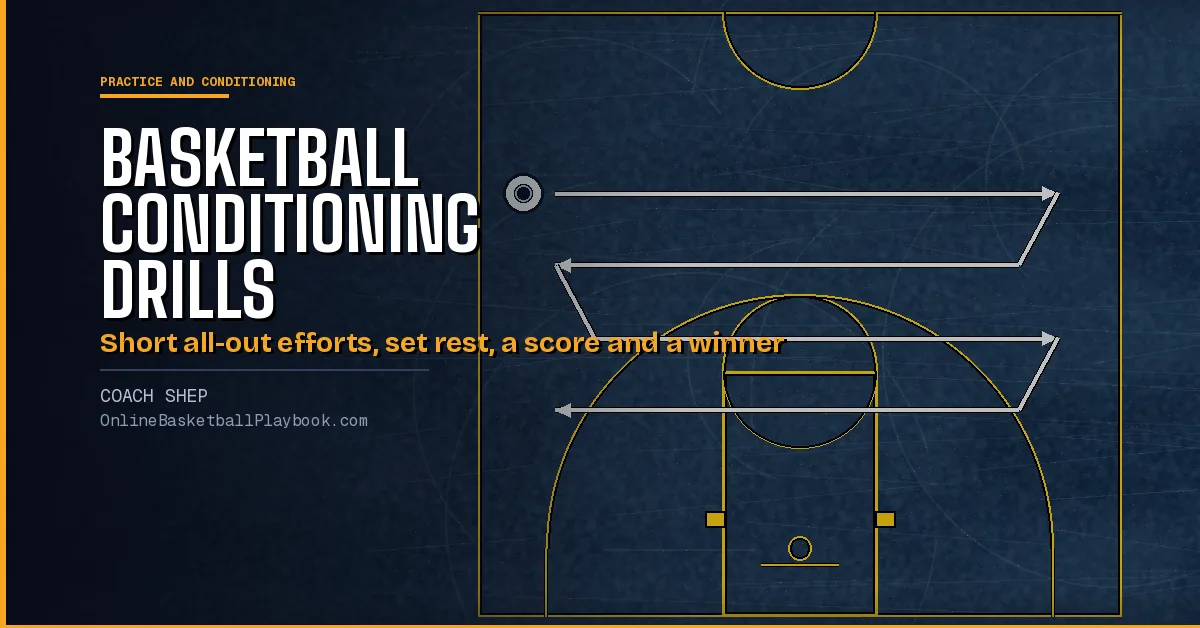
Basketball Conditioning Drills for Teams: Runs, Games and Tests
Basketball conditioning drills in three styles, timed runs, conditioning inside skill drills and scored games, with the tests and yearly plans coaches use.
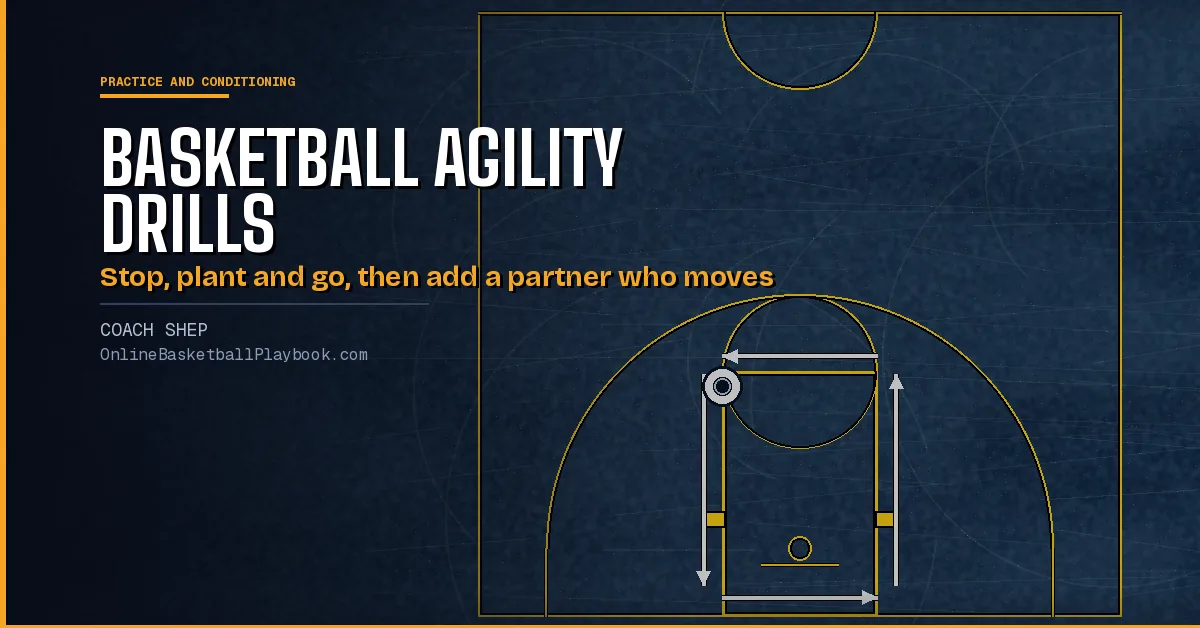
Basketball Agility Drills: Cone, Reaction and Ladder Drills
Basketball agility drills from timed cone tests to reaction, mirror and ladder drills and defensive circuits, with schedules and where coaches differ.