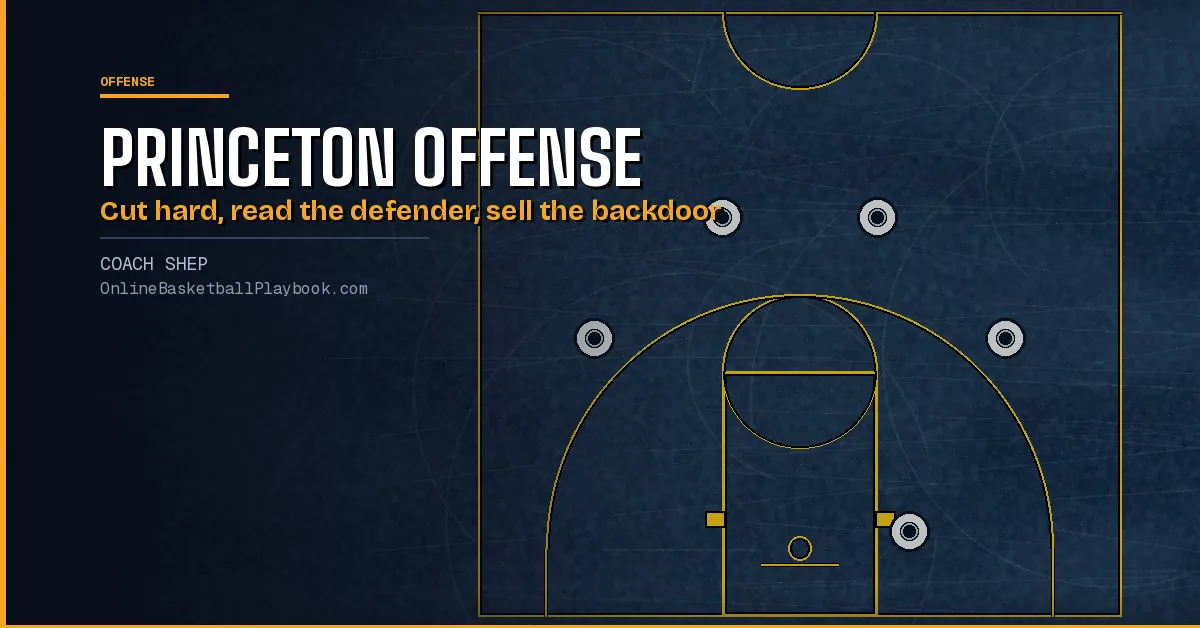
The Princeton offense is a patient, read-based continuity. Five players who can all pass, cut and shoot move off what the defender gives them, and the offense punishes an overplay with a backdoor and a sag with patience and threes. Pete Carril built it at Princeton, and it spread to college programs such as Georgetown and Air Force and to NBA teams such as Sacramento. This guide shows the Chin set, the high-post reads, how to sell a backdoor, who the offense fits, how to install it and how defenses try to stop it.
The Princeton Offense at a Glance
| Piece | What it is | Why it matters |
|---|---|---|
| Chin set | A dribble-weave entry, then a backscreen chained to a flare screen | The spine. The offense returns to it when a look dies |
| Point series | The ball enters the 5 at the high post and the point cuts over, under or away | The post is the decision hub |
| 5 Out | The 5 steps out to the top of the key and the floor opens up | Connects one phase to the next |
| Backdoor | A cut behind a defender who overplays | The punishment for denial |
| Reset | Dribble up to the guard spot | Reforms the Chin alignment without a call |
What Is the Princeton Offense?
It is a motion-continuity system with named sets that flow into one another, among them Chin, 5 Out, Low, Point, Twirl and X. Nobody calls an isolation. The ball goes from the perimeter to the high post and back out, and the player without the ball does most of the work.
Four ideas hold it together. Every player can pass, cut and shoot, so no spot is a place to hide. The cutter reads the defender in front of him and the defender shows him what to do, the rule laid out on the read principle. Spacing creates the openings, with the guards and forwards held at the same spots every time. And the offense never stops. When a look dies, the ball handler dribbles to the guard spot and the set forms again.
Carril's core rule was short: when closely guarded, go back door. A second rule explains why the offense has no designated creator. Everybody with the ball is a point guard, so any of the five can start a read. Carril named four pillars: cutting, screening, passing and shooting. One cue goes with every cut: look for the ball. A cutter who looks away is a decoy, and the defense stops respecting him.
The Princeton Offense Chin Set
Chin is the set to learn first. Everything else connects to it and returns to it.

The post (5) starts on the ball-side block. The forwards (3 and 4) stand a step above free-throw-line extended. The guards (1 and 2) stand on the guard line, three to four feet above the arc. The side with the ball is the strong side and the other side is the weak side, and every call reads off that split. Spacing is the play, so teach the spots before the movement.

The entry. The 1 and the 3 run a dribble weave on the strong side. The 3 takes the handoff and brings the ball back to the guard spot. On the weak side the 2 and the 4 exchange spots. The 5 steps up and fills the strong-side elbow. The ball swings from the 3 to the 4 to the 2.

The engine. The 5 backscreens for the 3, who cuts to the rim, and then flare screens for the 4. The 2 reads in order. The layup to the 3 comes first and the 4 coming off the flare comes second. If nothing opens, the ball reverses and a weak-side UCLA cut keeps it going until a shot or a new set.
The timing rule. The 3 does not cut off the 5 until the ball leaves the 4. Drill it three on zero before any defender joins.
The cutter's read. In the down-screen version of Chin, the 5 down screens and pops instead. There the cutter reads his defender: on his heels means curl, under the screen means pop, denial means backdoor.
Two branches come off the same entry. In Chin High, the ball reverses and the 5 sets a UCLA screen for the 3 before going to the high post, with a backdoor pass from the 5 to the 3, or the 4 setting a flare screen for the 1 on the weak side. In Strongside, the ball goes to the strong-side wing instead of reversing. The 1 UCLA cuts off the 5 for a return-pass layup, and the 5 steps out above the elbow after screening. That 5 is part of two games at once, a down screen on the strong side and a flare on the weak side, which is why it is hard to guard. Every Chin version and its branches are compared on Princeton Chin series.
The High Post and the Point Series

Carril put the post at the high post for a reason. It spreads the defense, big defenders are less comfortable guarding at the high post, and the ball reverses more easily from there. When the ball enters the 5, the point cuts over the ball, under it or away from it. Each cut keys a different counter. The over cut brings a ball screen where the 5 rolls. The away cut brings a ball screen where the 5 does not roll. Both carry post and flare options. Define the under cut for your team before you teach it. Each cut and its options are drawn on Princeton Point series.
When the pass to the 2 is denied, Carril gives the wing a ranked list after the catch. Hit the center cutting. If he is not open, hit the corner. Then look to score. As a last choice, throw the ball back to the passer. When the pass into the post is denied, swing the ball back up top, then drive and pitch. The half of the offense run with the center on the block is on Princeton low post series.
Get the next coaching guide in your inbox
One email when a new guide or diagram set goes up. Free.
Backdoor Cuts: How to Make the Defense Overplay

There is no backdoor without misdirection. The cut has to be sold. Take one or two hard steps toward the ball as if to catch it, read the defender's head and then cut. When the passer and the cutter are a double gap apart, with two empty spots between them, no help is waiting at the rim. The cues and plays that call the cut are on backdoor triggers.

Three more rules keep the cuts honest. When a teammate dribbles at you, hold your spot for a beat and then go backdoor. The pause freezes the defender and earns the cut. Cut with your eyes on the ball. After the cut, return to the perimeter. And a backdoor is an option, not a mandate. If the defender does not overplay, wait and reverse the ball.
Cuts and Screens to Name
Players who can name every cut and screen can run any phase without a call. Teach the words as part of the install.
- Eight cuts. Dive, strongside, weakside, shuffle (off a back screen to the opposite block), UCLA (off a back screen to the same-side block), backdoor, duck-in and rub.
- Seven screens. Down screen, backscreen, rub screen, flare or fade, screen toward, screen away and double.
Who the Princeton Offense Fits
The 5 is the filter. He needs to pass well and hit a 15-foot jumper, because most of the offense starts with him at the high post. Without that 5, the high-post version says to pick another offense. Beyond the 5, the usual roles are the best shooter at the 3, a driver and post scorer at the 4, and the best ball handler, smart and tough, at the 1, and a balanced driver at the 2.
The offense also depends on how the defense plays. It punishes overplay. A conservative, sagging man defense closes the backdoors and takes away the reads. A realistic install takes years, not one season, because reads, cut timing and patient shot selection build slowly. Running Princeton concepts inside another base offense is the usual fallback. How it compares with a drive-first offense is on dribble drive vs Princeton.
| Version | How it runs | Pick it when |
|---|---|---|
| All five learn every spot | Every player passes, posts, cuts and screens | You have the practice time and the depth to carry the teaching load |
| Two roles, perimeter and post | Players specialize, with the 5 as the hub | Players specialize, the high school version |
| Continuity entries | A loop with three entries: dribble at a wing, wing pass, post entry | You want three entries and five-man rules instead of named sets |
Coaches disagree on where Princeton belongs. Carril's lineage teaches it as a full system with an interchangeable five. The one-phase view uses it as one phase inside a read-based framework and dislikes it as a base because a power forward cannot play in it and it hides people. Pick a version in writing before the first practice.
What Defenses Do and Your Answers
- Overplaying the passing lanes. This is what the offense wants. Backdoor at every chance.
- Sagging. The backdoor closes. Be patient, reverse the ball and shoot the three. Against a sag, call the ball-screen actions, such as the GO action, a pass fake that calls the 5 into a ball screen. The Chin sag counter has the 4 and the 5 double down for a three at the top of the key.
- Jumping the shuffle cut. Call Chin Reverse. On a pass fake the cutter steps over the screen and cuts to the block.
- Switching. The ball screen where the screener does not roll is one of the better answers.
- Making the defense work first. Start with a dummy offense for 10 to 12 seconds. The 5 cuts hard to the hash mark and the guards cut through off rub screens. If the defense gets lazy, cut backdoor.
To see the same offense from the defender's chair, read How to Defend the Princeton Offense.
How to Install the Princeton Offense
Master one option before adding a choice. Start each new piece with no defense, then add a defender the same week.
- Two on zero backdoor layup. The dribbler attacks from two different floor spots and the cutter goes backdoor.
- Two on zero hand-off. Three finishes: shoot, drive, or reverse pivot and back-cut pass.
- Three on zero flares. Then four on zero flares into penetration and pitch.
- Chin without defense. Weave, exchange, elbow fill, backscreen, flare and reset, in that order, with the timing rule.
- Add defenders. A passive shell first, then live.
- Add the Point series. One cut at a time before the three are combined.
A useful daily rep is ten minutes of selling the backdoor. The cutter takes two hard steps toward the ball, a coach or a teammate calls overplay or sag, and the cutter goes backdoor only on an overplay. More drills are on Drills to Teach the Princeton Offense.
Common Mistakes
- Cutting without looking for the ball, which turns the cutter into a decoy.
- Cutting off the 5 before the ball leaves the 4.
- Throwing a backdoor with no sold overplay.
- Teaching all the sets in the first month.
- Calling the offense like a play. The cutter makes the read.
Questions Coaches Ask About the Princeton Offense
What is the Princeton offense?
A patient continuity offense where five players who all pass, cut and shoot score through backdoor cuts, screens for the screener and passes from the high post.
What is the Chin set in the Princeton offense?
The base set. A dribble weave on the strong side starts it, then the 5 backscreens for a cutter to the rim and flare screens for a shooter.
Is the Princeton offense a motion offense?
It is a motion continuity with named sets. Players read the defender as in motion, but the sets give the cuts and screens a shape. Compare the two on Princeton offense vs motion offense, or read motion offense and 5 out.
Is there a Princeton offense PDF?
A PDF gives you diagrams. The reads come from practice. Use this page for the reads and print the diagrams for your binder.
Can a high school or youth team run it?
Yes, in pieces. Full installs take years, so teach the backdoor reads and the Chin cuts inside the offense you already run.
What does the Princeton offense need from the 5?
Good passing and a 15-foot jumper. Without both, the high-post reads lose their trigger.
Other systems that share these ideas are the flex offense, the triangle offense and the 4-out 1-in offense, and continuity offense compares them. The backdoor needs good spacing, covered on What Is Spacing in Basketball, and a post who passes, covered on Post Play in Basketball. See every system under Offense.
Want the printable playbook packs?
OBP Pro members get the premium playbook packs: the zone attack, out of bounds and practice plan PDFs, plus each new pack as it is finished. The membership page lists what is in each one. Or draw your own version free in PlayDraw.
See what OBP Pro includesMore Offense and Press Guides
- Triangle Offense Basketball: Reads, Spacing and Entries
- 1-2-1-1 Diamond Press Basketball: Roles, Traps and Install
- 4 Out 1 In Motion Offense: Rules, Spacing and Sets
Back to Continuity Offense and every Offense page.
Keep Building
Related breakdowns
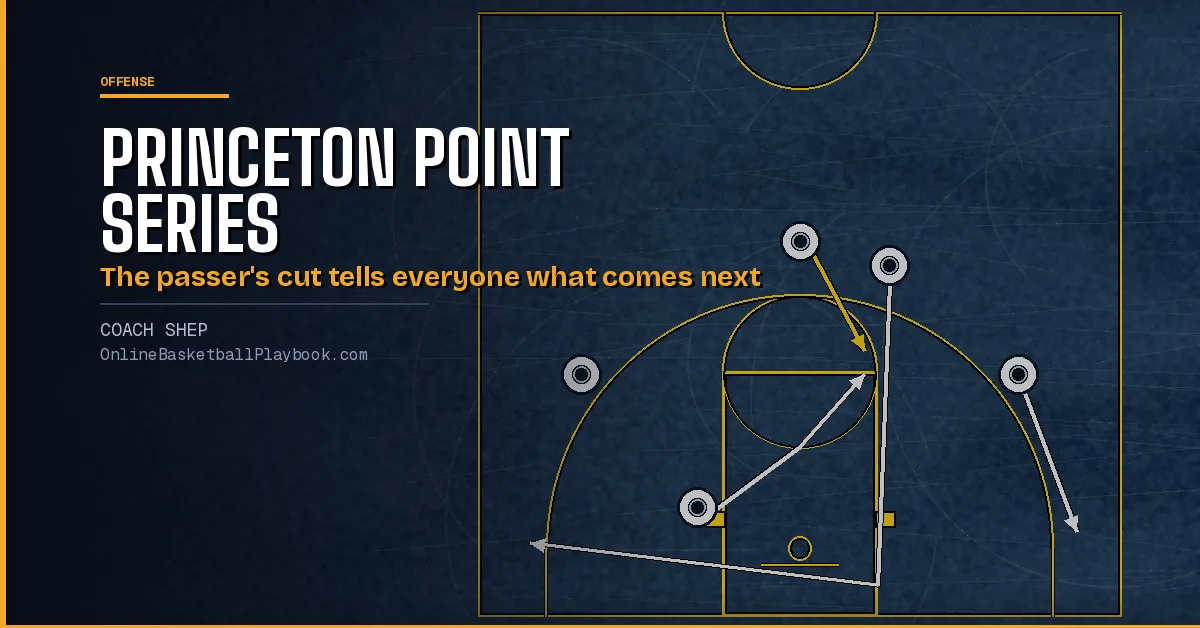
Princeton Point Series: Over, Away and Under Reads
The Princeton Point series: the wave-through entry, the Over, Away and Under cuts, the side ball screen, post and flare options and the spin counter.
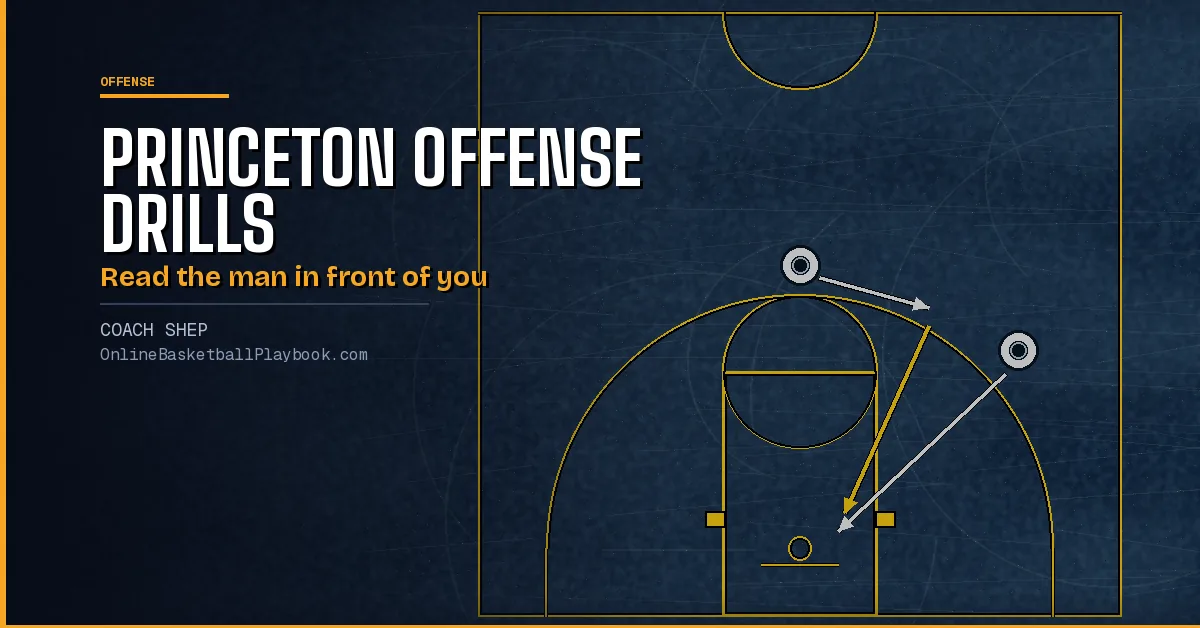
Princeton Offense Drills: Breakdowns, Shooting and Live Reps
Princeton offense drills that teach the reads: spacing, backdoor and hand-off breakdowns, 3-0 Chin and wave drills, Point shooting, a drive drill and an install.
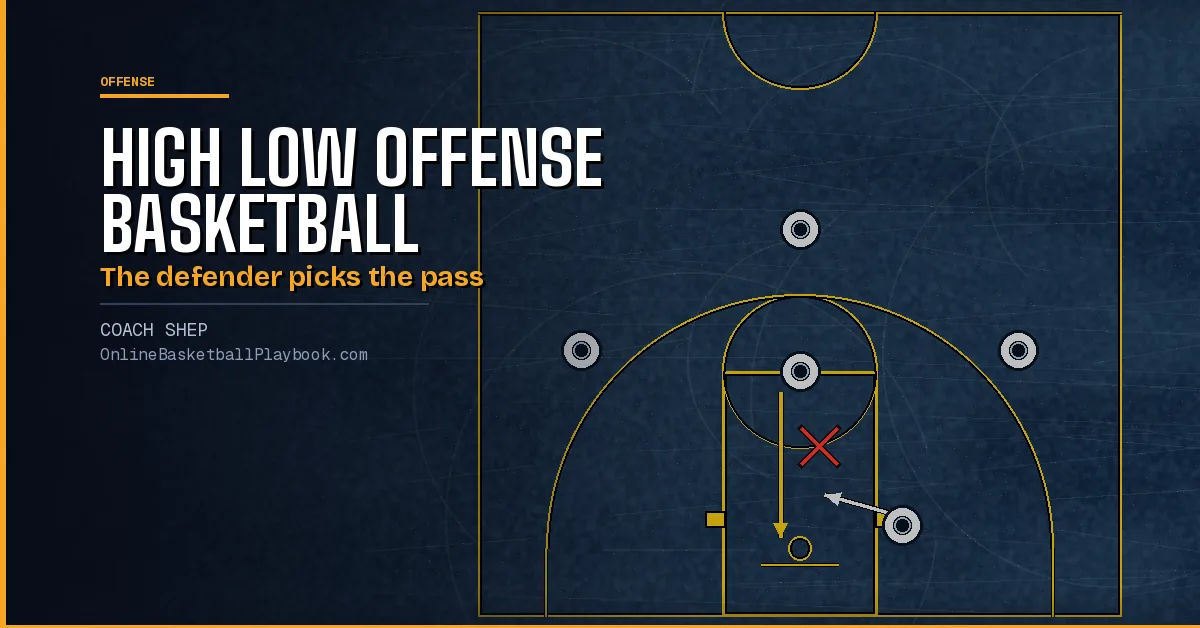
High Low Offense Basketball: Reads, Counters and Zone Rules
High low offense basketball explained: the two-post shell, the lob and bounce reads, answers to a front, down-screen reads, 1-4 low sets and the hi-lo against zones.