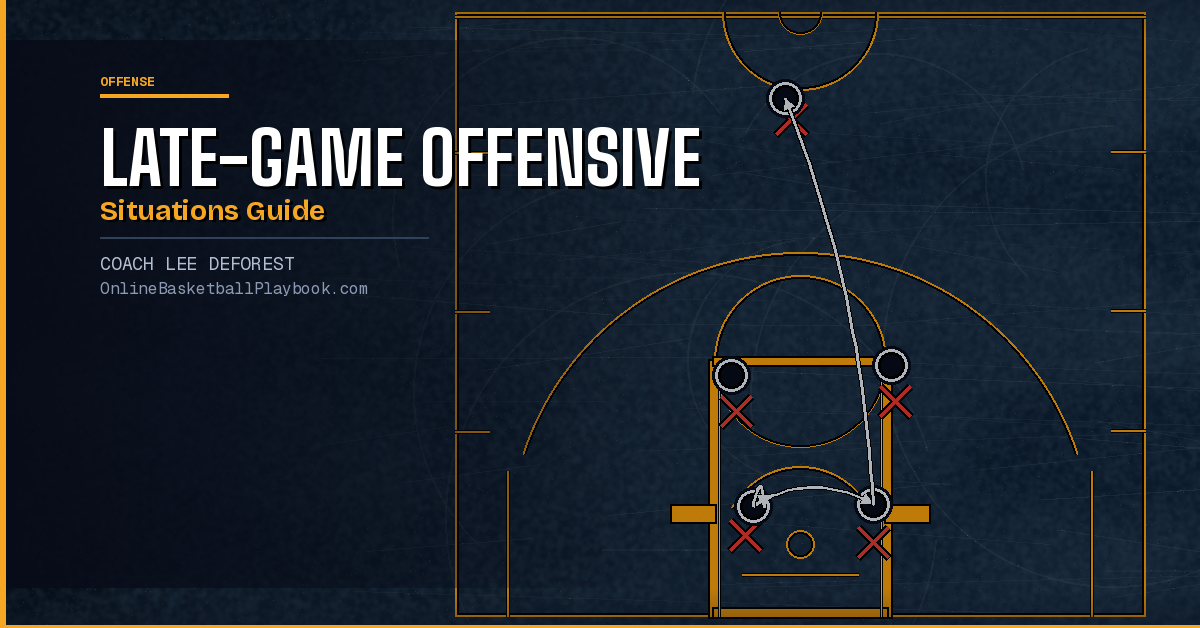

Late-game offense separates well-coached teams from everyone else. When the clock is under two minutes and the game is tight, preparation, timing, and personnel decisions matter far more than raw talent. Here is how to get your team ready.
Why Late-Game Offense Breaks Down
Most teams do not lose close games because they lack talent. They lose because the offense has no clear plan when the clock matters. Players hesitate, dribble away precious seconds, or freelance their way into a bad shot. The bench erupts with conflicting instructions. Nobody owns the moment.
The root cause is almost always preparation. If your team has never practiced a specific end-of-game sequence at full speed with a live defense, a hostile crowd simulation, and a real clock, they will revert to instinct when the moment arrives. Instinct under pressure is almost never optimal offense.
Late-game offensive breakdowns typically fall into a few categories. First, there is clock mismanagement — teams do not know when to foul, when to push tempo, or when to hold for a final shot. Second, there is personnel confusion — the wrong player has the ball in the wrong spot. Third, there is action breakdown — players do not execute the designed play because they have only walked through it, never run it live. Developing strong basketball IQ across your roster is one of the most reliable ways to address all three problems simultaneously.
The fix is not complicated, but it requires deliberate investment in practice time. Late-game situations need their own dedicated block on your basketball practice plan, not a thirty-second mention at the end of a scrimmage. Treat these scenarios like any other skill: teach the concept, drill the execution, and test it under competitive conditions before you need it in a real game.
Build One Trusted Special Play
Every program needs a core special play — a single action the players know cold, that has been run hundreds of times in practice, and that can be called at the buzzer without hesitation. The temptation is to build a large library of end-game sets. Resist it. Depth of execution on one play beats shallow familiarity with ten.
The play should be simple enough that any five players on your roster can run it without thinking about the structure. That usually means a two-man action at its core — a ball screen leading into a pin-down, a hand-off into a flare, a stagger cut series that collapses the defense and creates a secondary read. Complexity is the enemy of execution when fatigue and adrenaline are both elevated.
"Have ONE trusted core special you run with every team."
— Basketball Vault
Once you have your core action, develop two or three counters off the same initial look. The defense will eventually adjust and take away the primary option. When that happens, your players should be able to read the defense and trigger the counter without a new play call. This is how elite programs manufacture late-game points — not by having more plays, but by having more options built into fewer plays.
Run the special in practice until it is boring. Then run it some more. The confidence your players feel when the coach calls it in a close game comes entirely from repetition. They should be able to close their eyes and visualize every cut, every screen angle, and every passing window before the huddle breaks.
Using Decoys and Misdirection
Defenses in late-game situations key on your best offensive player. They will deny him the ball, switch everything to prevent him from getting a clean catch, and double-team the moment he touches it. Knowing this in advance is an advantage, not a problem — if you build your special around it.
The most effective late-game offense uses the star as a decoy. Send him to one side of the floor on a hard cut or off a ball screen. The defense collapses to stop him. Meanwhile, the actual play is developing on the opposite side — a screen-the-screener action, a back-cut from a wing who the defense has been ignoring all game, or a flare for a shooter who the defense has over-helped on.
Misdirection is especially powerful in inbounds situations because the defense has to guard the ball AND the four players inside the arc. A well-timed fake cut by your best shooter, followed by a screen-the-screener action for your second option, can produce a wide-open look in under three seconds. The key is that every player must sell their role, including the decoy. If your star tiptoes through his fake cut, the defense reads it immediately and the play dies.
Good misdirection also applies to the inbounder's footwork. The inbounder should step toward the free-throw-line extended rather than drifting toward the corner. Staying at that position keeps passing lanes open and prevents the defense from recovering once the action unfolds. A corner inbounder is predictable; a disciplined inbounder at line-extended is a threat on every possession.
Inbounds and Out-of-Bounds Execution
Sideline and baseline inbounds plays are among the most undercoached situations in basketball at every level. Most teams walk through a basic alignment, hope someone gets open, and fire a simple pass. Opponents who actually prepare for these situations can manufacture a quality shot almost every time.
Baseline inbounds plays (BLOBs) have the advantage of starting close to the basket. A stagger cut that drags both defenders toward the corner, followed by a deep dive to the rim from your most athletic player, is one of the highest-percentage actions in the game. Very few youth or high school defenses have a practiced answer for it because very few teams actually run it.
Sideline inbounds plays (SLOBs) require more discipline because the angles are tighter. The best SLOB actions get a ball-screener involved quickly to create a two-man game with the inbounder stepping in. Alternatively, a quick stagger cut to drag the defense one direction, followed by a skip pass to the open corner for a three, can produce a quality look in under four seconds.
Pair your inbounds work with dedicated inbounds play development so your team has a full library of options organized by situation — down one with four seconds, down three with eight seconds, tied with thirty seconds. Each scenario calls for different spacing and different shot selection, and your players need to know which play fits which scenario before the game, not during a timeout.
Down one possession with under thirty seconds, your team needs a play that generates either a layup or a mid-range shot in rhythm — not a contested three that leaves no time to rebound a miss. Match the shot type to the deficit before the game starts, so players are not making those decisions in real time.
Practicing Under Pressure
The single most important thing you can do to improve late-game execution is to simulate it in practice — repeatedly, realistically, and with real stakes. Walkthroughs are not enough. Your players need to run your special play against a live defense, with a clock running, while another coach simulates crowd noise and the rest of the team watches and applies social pressure.
Build a late-game drill block into practice at least twice per week during the season. Vary the scenarios: down one with twelve seconds, tied with six seconds, down two with twenty seconds after a timeout. Make the defense competitive. Award points or conditioning consequences based on execution so both offense and defense have something to play for.
One of the best training tools for late-game situations is the two-minute drill, borrowed from football. Start with ninety seconds on the clock, your team down two possessions, and a live five-on-five. The offense must score twice; the defense must stop them. Run it until the offense succeeds, then flip it. This drill builds clock awareness, communication habits, and composure under pressure simultaneously.
Incorporate your core special play into every late-game scenario drill. The goal is that when you call it in a real game, at least five players on your bench could describe exactly what each of the five players on the floor is supposed to do. That kind of collective knowledge only comes from volume repetition in practice. Pairing this work with regular basketball footwork drills ensures players can execute the precise angles these plays demand without thinking about their feet.
- Designate one play as your "special" at the start of each season and run it every practice until the team can execute it perfectly under pressure
- Assign every player a role in your late-game sets — including decoy responsibilities — so no one is guessing when the play is called
- Run two-minute drills with real stakes twice per week; walkthroughs do not build composure, live reps do
- Organize your inbounds plays by scenario before the season — down one, down two, tied, and with varying seconds on the clock
- Practice the inbounder's footwork separately: staying at free-throw-line extended, not drifting to the corner, keeps every passing lane viable
- After every late-game drill, talk through what the defense was taking away and which counter your team should trigger next time
Matching Personnel to the Situation
The best-designed play in the world fails if the wrong players are on the floor. Late-game personnel decisions are just as important as the X's and O's, and most coaching staffs underinvest in thinking through them before games.
Start with your inbounder. In baseline and sideline situations, you need someone who can read the defense, throw a precise pass under duress, and stay composed with a defender in their face. That is not always your best offensive player. Identify your best inbounder early in the season and practice with them in that role so they are confident when the moment comes.
Next, consider who you need on the floor for each specific type of late-game action. A play that finishes with a lob to the rim requires an athlete who can catch a ball above the square under contact. A play that finishes with a mid-range pull-up requires a player whose footwork off ball screens is polished enough to get into their shooting motion in rhythm. A play that relies on a decoy requires a star willing to sacrifice their shot opportunity for the team's best chance to score.
Match the personnel to the play, not the play to whoever happens to be on the floor. This means keeping track of substitution patterns and fatigue levels throughout the second half so that your best late-game lineup is available when you need it. If your two best late-game executors have both fouled out, your play library needs a contingency version that works with whoever remains.
Personnel decisions also extend to the defensive end of late-game situations. Understanding transition defense principles in end-of-game scenarios — particularly after made baskets when the opponent might foul or push — keeps your team organized on both sides of the ball and prevents the kind of defensive breakdowns that turn manageable late deficits into blowout losses.
Finally, think about matchup exploitation. Late-game special plays are most effective when they are designed to attack a specific defensive weakness you have identified during the game. If their best defender has two fouls and is playing passively, run your star at him. If their help-side rotation is slow, run the stagger-cut action that exploits the lag. The more your special plays can be adjusted in real time to punish what the defense is giving you, the harder they become to stop.
Get free play diagrams, drills, and coaching guides delivered weekly.
Keep Building
Related breakdowns
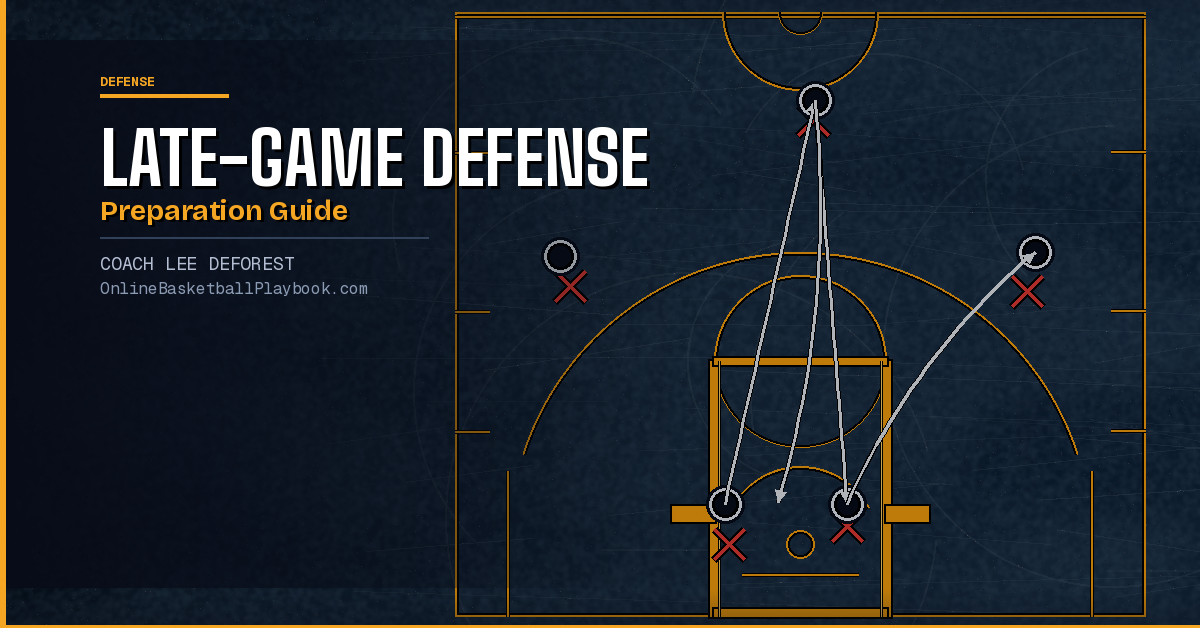
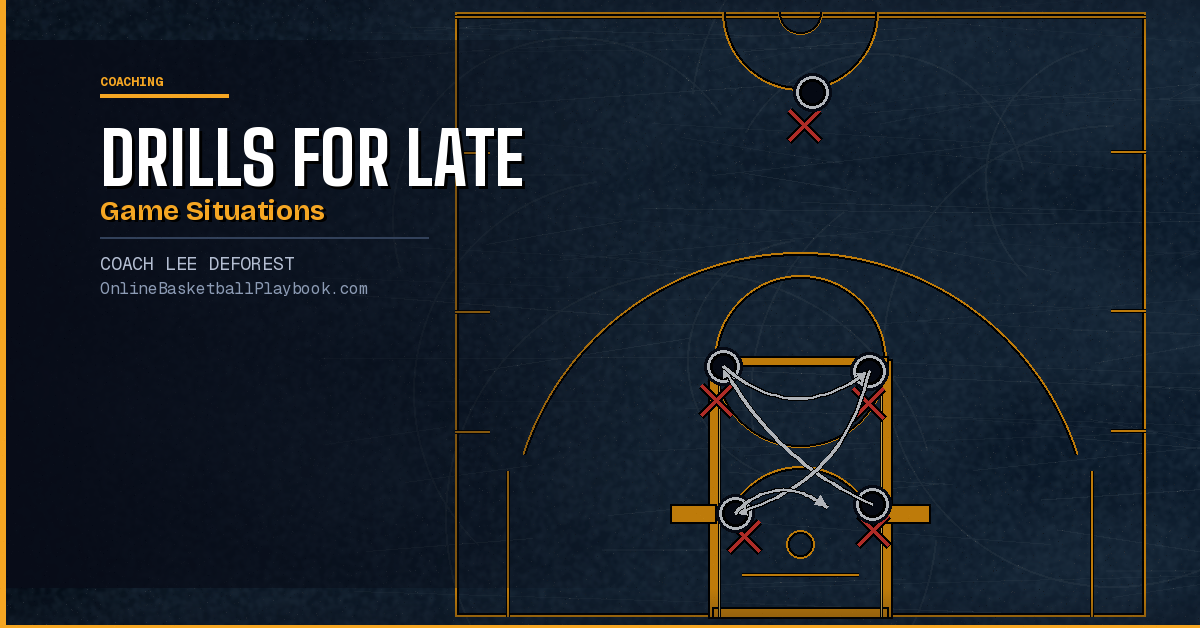
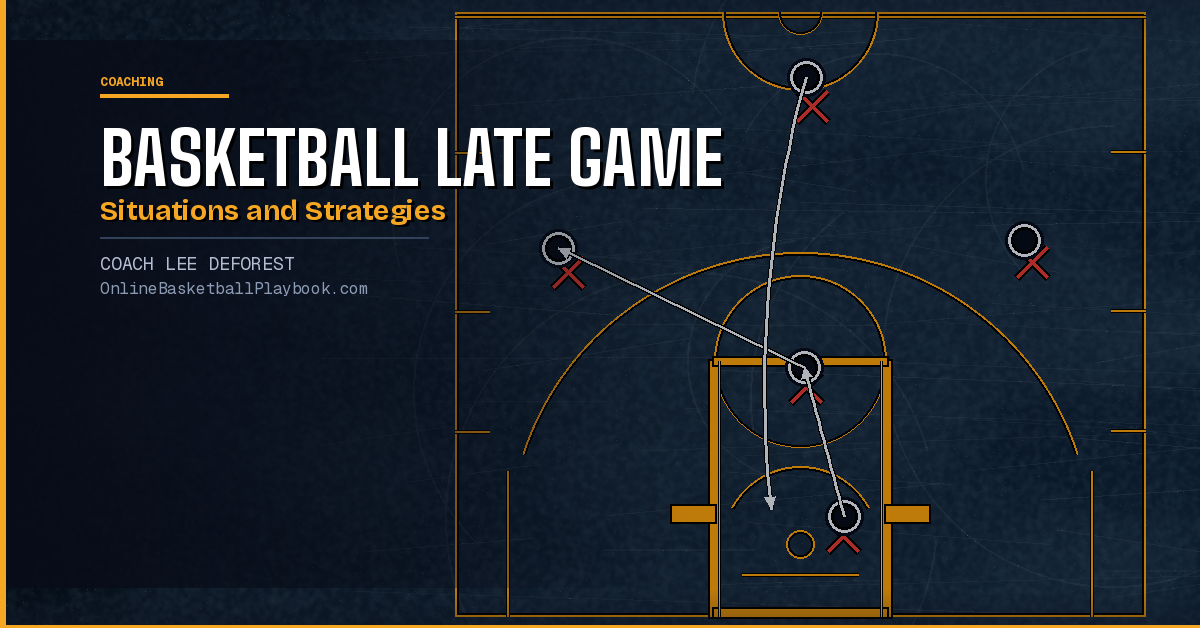
Basketball Late Game Situations and Strategies
Basketball Late Game Situations and Strategies