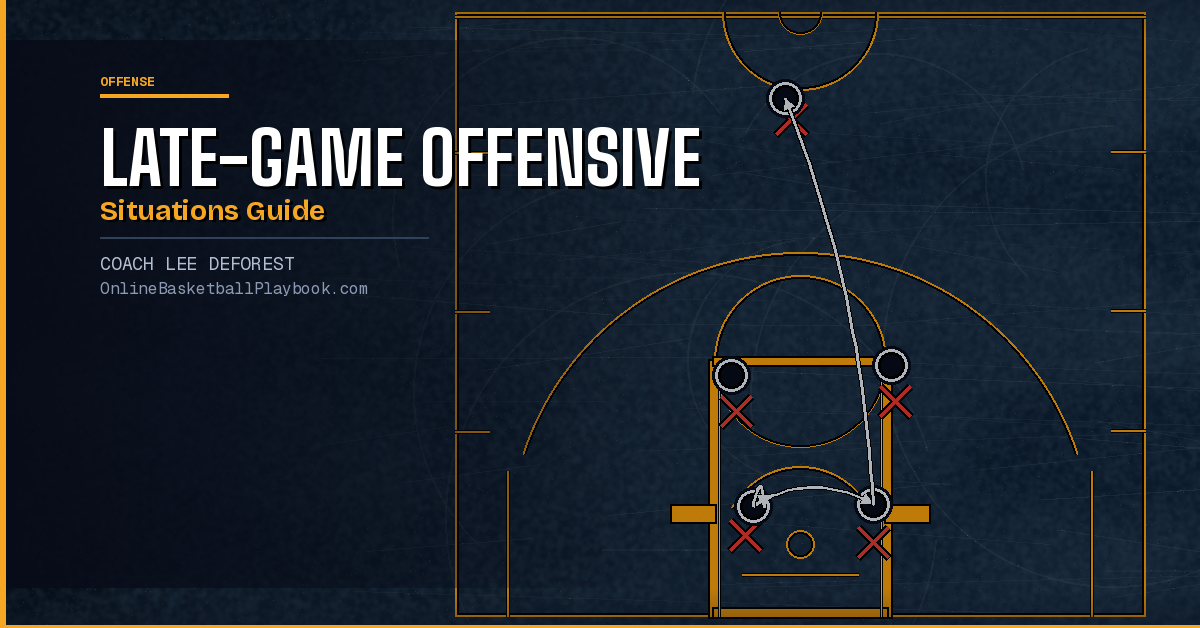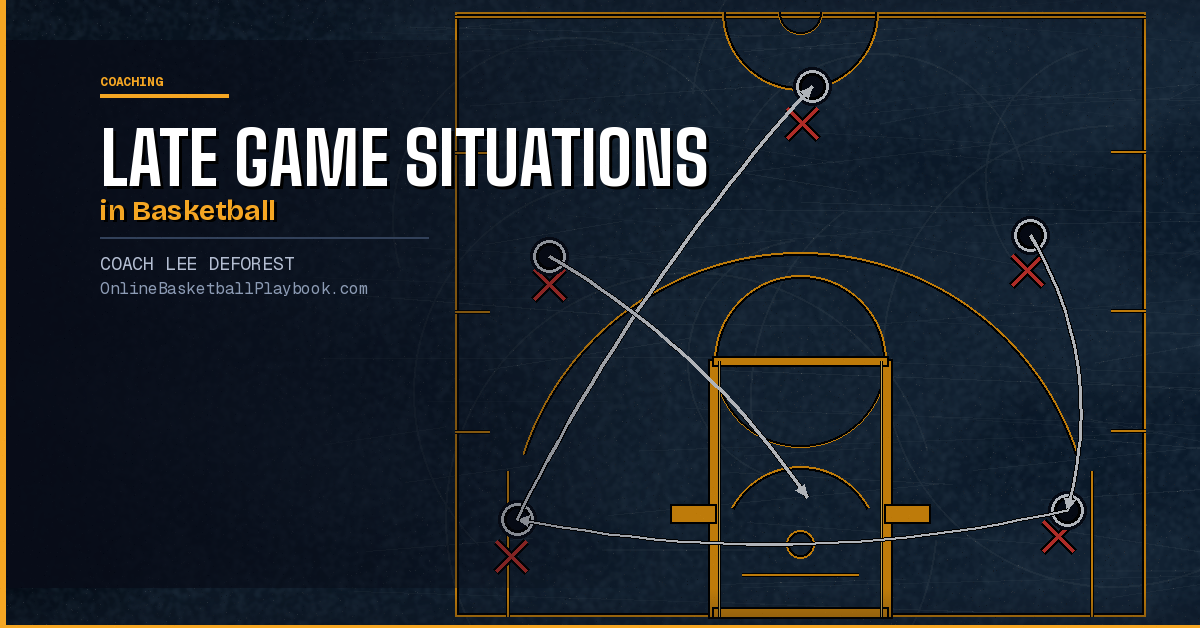

Late game situations separate prepared teams from panicked ones. When the clock is under two minutes and the score is close, execution — not talent — decides winners. Here is what every coach needs to know.
Why Late Game Execution Matters
Every coach has watched a well-prepared team fall apart in the final two minutes. The ball gets held too long, the wrong player takes the shot, and a winnable game slips away. Late game situations in basketball are their own discipline — separate from your regular offense, separate from your half-court sets, and separate from the conditioning that got your team to that point.
The fundamental challenge is that pressure collapses decision-making. Players who look sharp in practice will hesitate when the crowd is loud and the game is on the line. That is why the preparation you do away from the scoreboard matters so much. Teams that win close games do not improvise — they execute something they have done hundreds of times before. Their players know exactly where to be, when to move, and what the options are before the timeout ends.
Think about the margins involved. In a tight game, a single possession can mean a three-point swing. A poor inbounds decision, a turnover in transition, or a missed assignment on a box-out can decide a season. Developing basketball IQ in your players is one of the best investments you can make, because late game situations demand players who process information quickly and execute without hesitation. The X's and O's only work if the players understand why the play is designed the way it is.
There is also a psychological element to late game preparation. Teams that have a plan walk onto the court with confidence. Teams without a plan feel the weight of the moment and often play not to lose rather than playing to win. That difference in mindset shows up in body language, in shot selection, and in defensive rotations. Preparation breeds composure.
After-Timeout Sets (ATO)
An after-timeout set (ATO) is any scripted offensive action you run immediately following a called timeout. These are among the most valuable tools in a coach's arsenal, but only if they are built around what your personnel can actually execute under duress. A complex five-action set with multiple reads is fine in October. In March, with the game tied and four seconds on the shot clock, you need one action that everyone on your roster can run in their sleep.
The most durable ATO principles hold across every level of the game. First, run a core special with every team you coach. Your players need to believe in the play — confidence comes from repetition, not complexity. Pick a simple action — a middle ball screen into a pin-down, a screen-the-screener wrinkle, a flare and handoff — and run it year after year. Build options off the same base action so the defense cannot pin it down but your players never feel lost.
Second, decoy your star player. Defenses spend all week in film sessions tracking your best scorer. Smart ATO design uses that attention against them. Send your top option to one side of the floor with a screen action that looks like the primary, while the real shot is developing on the weakside. Screen-the-screener actions, flares, and backdoor cuts all exploit a defense that is ball-watching or over-committed to stopping one player.
Third, clear the floor for the primary action. Two players in the corners create maximum space for a two-man action at the top or elbow. Help defenders cannot reach in time, and your ball handler has a clean read. Crowding the paint with five players is one of the most common ATO mistakes at every level.
"Timing beats talent on a special."
— Basketball Vault
The inbounder's positioning is also frequently overlooked. On a sideline out-of-bounds, stepping to free-throw-line-extended rather than drifting to the corner gives the inbounder a better angle and keeps defenders from clogging the passing lane. A late pass or an extra dribble lets the defense recover — run your ATO set without unnecessary delays and without an extra dribble once the ball is caught.
Inbounds Plays Under Pressure
Sideline out-of-bounds (SLOB) and baseline out-of-bounds (BLOB) plays represent some of the most undercoached areas in the game. Most youth and high school teams know a couple of basic sets, but do not practice them under game conditions. That gap costs points. A well-designed inbounds sequence against a scrambling defense can generate easy looks every time — but it requires players who have internalized the timing and know their role.
On baseline inbounds plays, stagger cuts are one of the most effective actions you can use. A stagger pulls defenders toward the corners in pursuit of your cutters, then a deep dive or lob action catches the help defense out of position. Defenses that are not disciplined in their BLOB coverage will give up layups and open threes when they rotate to the wrong cutter. Basketball inbounds plays deserve dedicated practice time, not just a quick walk-through at the end of a session.
Jump ball situations are another area where prepared teams take free points. The tipper should reverse-pivot wide after tipping, sending the ball to a big who can immediately hit ahead for a layup or alley-oop. Most teams tip the ball and hope — elite teams have a designed action off the tip that converts possession into scoring chances. The same principle applies to free-throw-rebound situations: screening the box-out defender, slipping behind, and covering the long board creates offensive rebound chances that undisciplined teams concede for free.
When designing inbounds plays, always think about what happens if the first option is not open. Your inbounder needs a safety valve — a secondary cutter or a reset option — so the five-second count never becomes a factor. Practice the runout scenarios as often as you practice the primary action.
Defending Late Game Possessions
Offense gets the spotlight in late game situations, but defense wins close games just as often. The team that forces one extra missed shot, one extra turnover, or gets one critical stop in the final minute usually wins. Defending late game possessions requires discipline, communication, and an understanding of what the offense is trying to do.
Foul discipline is paramount. Reaching fouls in the final two minutes extend possessions and put opponents on the free-throw line in bonus situations. Coach your players to stay in front and keep their hands active but controlled. A clean block or a deflection is far better than a foul that sends a decent free-throw shooter to the line.
Defending ball screens in late game situations is one of the highest-leverage skills your team can develop. When the offense is trying to get a specific player free for a three or a midrange shot, understanding how to hedge, switch, or drop-cover based on who is involved makes the difference. Study the concepts in defending the pick and roll and apply them specifically to the ATO sets your opponents run most often.
Communication is the variable that breaks down most often in tight games. Players who are normally vocal go silent when the game is close and they are afraid to make a mistake. Emphasize talking during practice late game simulations so it becomes automatic. Defenders need to call out screens, call out switches, and verbalize who has the ball handler. Silent defense is blown coverage waiting to happen.
Know when to foul intentionally — and when not to. Fouling a poor free-throw shooter in the final seconds when you are down three is a legitimate strategy. Fouling on a three-point attempt is never intentional and must be drilled out of your players. Understanding the exact scenario — score differential, time remaining, foul situation — determines the correct defensive action. Teams that have rehearsed these scenarios make better decisions than teams that are figuring it out on the fly.
Clock and Foul Management
Late game situations are governed by two resources: time and fouls. Teams that manage both intelligently put themselves in position to win even when the talent gap is not in their favor. The best coaching in the fourth quarter is often invisible — it shows up in the timeouts saved, the intentional fouls avoided, and the possessions not wasted.
Clock management starts with understanding possession value. When you are ahead with two minutes to play, each possession your offense uses is a possession the other team does not get. Teach your players the difference between a good shot inside the final ten seconds of the shot clock versus a quick shot that gives the defense an extra possession. Motion offense in basketball lends itself to clock management because the continuous movement and cutting naturally keeps the ball moving without forcing bad shots.
When you are trailing, time management cuts the other way. Your team needs to score quickly enough to give the defense a chance to respond and still have time to foul if necessary. Know how many possessions remain. Know the foul situation. Know whether you need a three or whether two possessions of two points each will do. Players who understand game theory in these moments make smarter decisions without a timeout.
Foul management in the final two minutes often determines who gets extra trips to the line. If your opponents are in the bonus and your team keeps fouling on perimeter drives, the game ends at the free-throw line — usually in their favor. Build a defensive scheme that absorbs contact in the paint rather than rewarding it.
How to Practice Late Game Situations
Most coaches understand late game situations in theory. Fewer build dedicated practice time around them. The gap between knowing a play and executing it under pressure is closed only through repetition in conditions that simulate the actual stress of competition. If your players are encountering late game scenarios for the first time during a real game, the preparation is incomplete.
Build late game segments into your regular basketball practice plan. A five-to-ten minute block at the end of practice — when players are physically tired and mentally fatigued — is the most realistic simulation you can create without a crowd. Set up specific scenarios: down two with 30 seconds, up one with 45 seconds and the ball, inbounds under your basket with three seconds left. Make it competitive with consequences for the losing team so players feel the pressure.
Run your ATO sets from the whiteboard all the way through live defense. Walk it in, then speed it up, then run it against a defense that knows what is coming. When your players can execute against a prepared defense, they will execute against an unprepared one at game speed. The final layer is running it after conditioning — fatigue is part of the late game experience, and tired players make mental errors. Finishing with these reps builds both physical and cognitive toughness.
Film review is also a critical piece of late game preparation. Watch how your team executes ATO sets in real games. Watch how opponents defend them. Identify the moments where assignments broke down or timing was off. A five-minute film session before practice with clear focus points gives players a mental picture to correct against — which accelerates improvement far faster than verbal instruction alone.
Include your bench players in late game preparation. They need to understand the sets, the rules, and the substitution triggers just as well as your starters. A substitute who enters the game with fifteen seconds left and has never rehearsed the situation is a liability. Teams where every player understands the late game plan have a depth of execution that shows in tight games.
Most teams practice late game plays once a week at most. The teams that win close games consistently are the ones that treat end-of-game execution as a daily discipline — embedding short competitive scenarios into practice rather than saving them for pre-game walk-throughs.
- Pick ONE core ATO set and run it with every team — repetition builds confidence and trust when the game is close
- Decoy your best scorer: send them one way, get the real shot the other way off a screen-the-screener or flare action
- Clear the floor to two corners for any two-man late game action — space eliminates help defense
- Practice inbounds plays live against defense, not just in walk-throughs — timing only develops under pressure
- Know the exact foul situation, possession count, and score differential before calling your timeout
- Build late game reps at the end of practice when players are already fatigued — that is when the reps count most
Get free play diagrams, drills, and coaching guides delivered weekly.
Keep Building
Related breakdowns
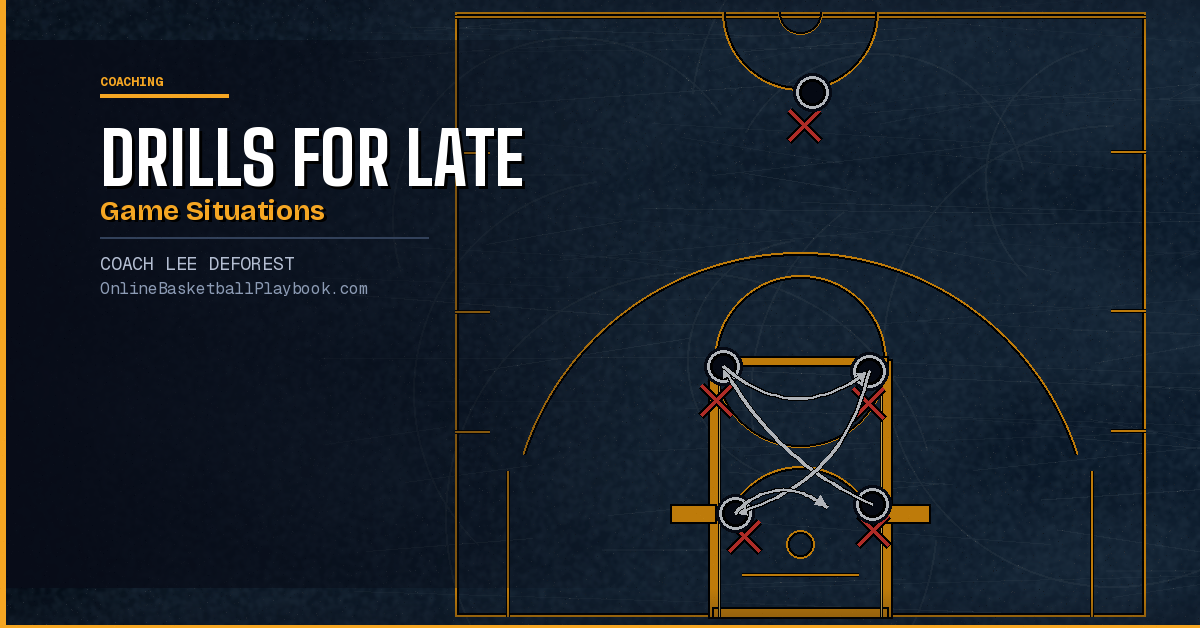
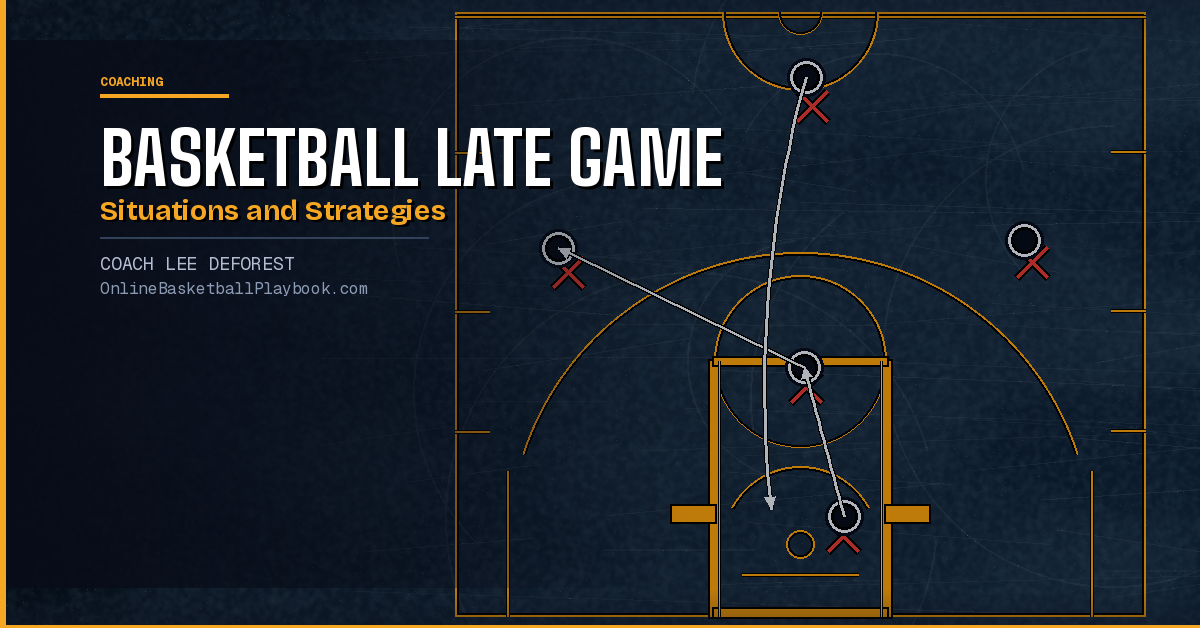
Basketball Late Game Situations and Strategies
Basketball Late Game Situations and Strategies