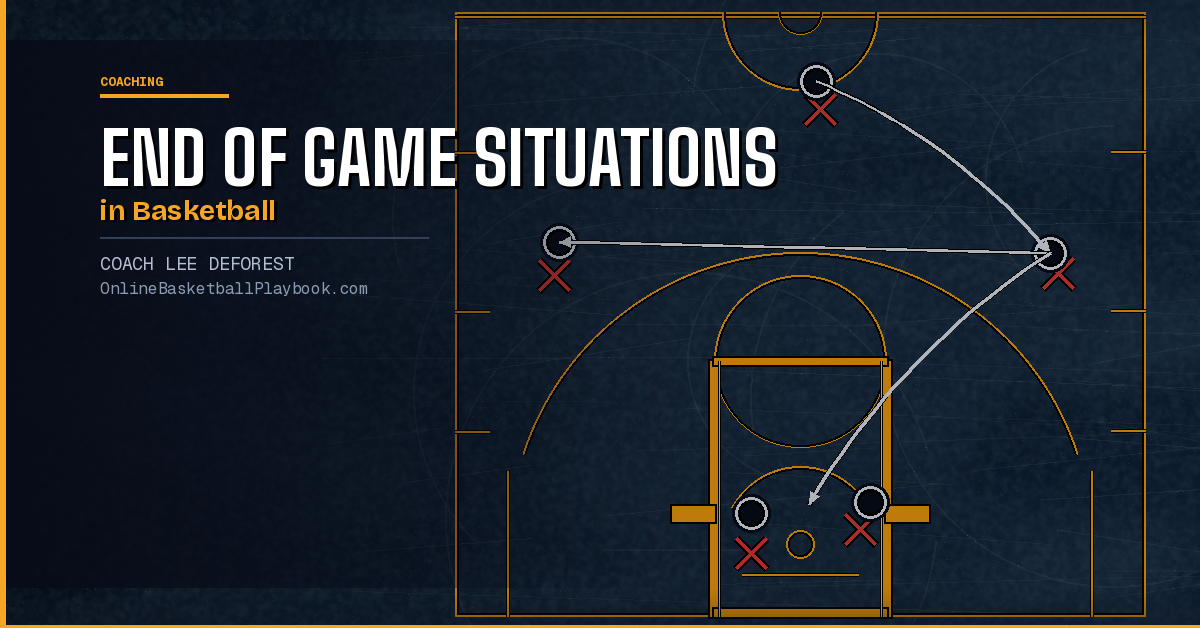

End-of-game situations decide championships. Most teams lose those moments not because of talent gaps, but because they never practiced the specific decisions required — clock management, foul strategy, last-second sets, and composure under pressure.
Clock Management Fundamentals
Every close game eventually becomes a clock game. The team that understands when to push tempo, when to bleed time, and when to stop the clock gains a structural advantage that has nothing to do with talent. Clock management is a skill, and like any skill, it must be taught and drilled before it is needed.
The most common mistake at all levels — youth through high school — is burning a timeout too early or holding one too late. Timeouts are currency. Spending one to stop a run in the third quarter might feel necessary in the moment, but that same timeout at the two-minute mark is worth exponentially more. As a rule, preserve your final timeout for a last-possession situation unless your team is in genuine crisis.
On offense, when you have a lead with under two minutes, the priority shifts from scoring to possession quality. Attack when the defense gives you something easy. Take the open layup. Hit the foul-line jumper if it's there. But do not force a shot that risks a quick turnover and gives the opponent a free trip back. Every second of clock that you use on offense is a second they cannot use.
Defensively, clock management cuts both ways. If you are trailing, you must stop the clock — and that means getting fouled, stepping out of bounds intentionally (losing possession but stopping the clock on a dead ball), or deflecting a pass out of bounds. Many young players do not understand that the goal on defense when trailing late is not just a stop, but a stop fast enough to leave time to answer. Understanding transition defense is critical here — allowing a layup wastes precious seconds even if you score on the other end.
Coaches should designate a clock-watcher on the bench whose only job in the final two minutes is to monitor the game clock and shot clock and signal the floor. Players under pressure often lose track of the numbers. Having one set of reliable eyes on the clock takes cognitive load off your players at exactly the moment when cognitive load is highest.
Leading by Three — The Toughest Margin to Protect
Being up three with the ball and five seconds left feels safe. It is not. Coaches at every level have experienced the gut-punch of a late three-pointer tying the game, and many of them never fully diagnosed why it happened. The answer is almost always one of three errors: a bad foul (sending the opponent to the line for two plus possession), a turnover that gifts a quick three-point attempt, or poor defensive positioning on the final shot.
The decision to foul or not foul when leading by three is one of the most debated topics in the sport. The analytics are nuanced and situation-dependent, but the general rule is this: if the opponent has the ball with enough time to catch, shoot a three, and win in regulation, you should consider fouling before they can attempt that shot. A made two-pointer, a missed free throw, and a recovered offensive board in that sequence is far less likely than a clean three-pointer from a shooter who has been doing it all night.
Who fouls is as important as whether to foul. You must designate in advance which players are authorized to commit an intentional foul in that situation. Leaving it to improvisation produces undisciplined fouls — on the three-point shooter, behind the arc, which gifts three free throws and possession. That is a loss you hand them directly. Deliberate, practiced fouling away from the arc by a reliable defender is a repeatable skill. Accidental fouling on the shooter is a catastrophic gamble.
Defensively, when you choose not to foul and play the final shot out, your principles must be locked in. No help rotations that leave corners open. A disciplined approach to help defense principles actually works against you in a one-possession game if it creates open shooters — your man defense must be tight at the perimeter. Every defender must know his man, must not leave him for any reason, and must make the ball-handler beat you off the dribble rather than off a screen.
Designing and Executing the Last Possession
The teams that consistently execute last-second plays are not the ones with the most elaborate sets. They are the ones who have one or two trusted plays they run every time, that everyone on the roster understands, and that they have repped in practice until the motion is automatic. Complexity is the enemy of execution when the pressure is maximum.
The structure of a good last-possession set follows a few consistent principles. Start with a clear primary option — usually your best scorer in a position where they can operate in their sweet spot. Layer in a secondary option that the defense will not be looking for, because they are focused on stopping the primary. The decoy is as important as the scorer. When the defense locks onto your star, the screen-the-screener action for the second option becomes wide open if the timing is right.
Floor spacing is non-negotiable. Two players in corners, one in the slot, and a screener for the ball-handler gives you maximum space for a two-man action while removing help defenders from the critical zone. This is not the moment for a crowded paint with four players watching one person iso. Space creates seams, seams create looks, and clean looks win games.
The pass-catch-shoot timing is where most last-second plays die at the youth level. A late pass after an extra dribble gives the defender time to recover. The ball must arrive at the same moment the shooter is ready to shoot — no settling, no re-dribbling. This requires the passer to read the cut early and throw before the cutter is fully open, trusting the timing of the action. That level of chemistry only comes from repetition in practice. Studying basketball inbounds plays gives you a strong library of concepts to adapt to your personnel.
"End-of-game is its own discipline — rep the math."
— Basketball Vault
Fouling Strategy — When, Who, and How
Fouling strategy encompasses two different situations that require opposite decisions: fouling to stop the clock when you are trailing, and avoiding fouls when you are leading. Coaches who conflate these two scenarios make costly errors in both directions.
When trailing, deliberate fouling is the most reliable way to extend the game. The key variables are: how many points you trail, how many team fouls the opponent has accumulated, and who their weakest free-throw shooter is. The classic "hack-a-player" strategy is most effective when the opponent's worst free-throw shooter is on the floor and their percentage is below 55%. Two free-throw attempts at 50% yield one point on average — less than a field goal attempt — and stop the clock, giving you possession back. The math strongly favors it in many situations.
Who takes the foul matters enormously. Assign this responsibility in practice. Designate a fouler and a backup fouler for late-game situations so that in the heat of the moment no one is guessing. The foul should be clean, deliberate, and away from any shot attempt — a foul on the body in a non-shooting situation is what you want, not a reach-in near the arc that can result in three free throws.
The counter-side — protecting a lead while committing no fouls — requires your defense to be disciplined about hands. Vertical position, no lunging, no reaching. In the final two minutes, every foul gives the trailing team a free point, stops the clock, and grants possession. The number of late-game leads surrendered through unnecessary fouling across all levels of basketball is staggering. Drill your defenders to stay off the ball-handler's arms, contest shots with feet and body rather than hands, and let contact go if it is marginal.
The timeout interaction with fouling strategy is another layer coaches must plan. If you intend to foul, use the timeout first to set the personnel, communicate the target, and position your team for the rebound after made free throws. A chaotic foul with no plan for what follows wastes the possession you just manufactured.
Late-Game Inbounds Situations
Inbounds plays under pressure are the moments where preparation creates the biggest separation. Most youth teams have no BLOB (baseline out-of-bounds) or SLOB (sideline out-of-bounds) action at all — they just throw it to the point guard. That is a gift to a prepared defense. A well-designed inbounds action with a clear primary and secondary read gives you a quality shot even against a locked-in opponent.
The inbounder is often overlooked as a player in the action, but they should always be a threat to receive the ball back. After passing in, the inbounder can step to a release position on the three-point line — becoming an outlet that the defense must account for. Most defenses focus entirely on the players on the court and forget the inbounder as a scoring option. A quick return pass to a skilled inbounder who catches and shoots before the defense can close out is one of the highest-percentage last-second actions available.
Jump ball situations are micro-opportunities that most teams concede entirely. If you have a tipper with reach, have a plan: tip backward to a big, hit ahead immediately for a layup or lob. The defense is rarely positioned to stop a rehearsed tip-and-go because they have not prepared it either. Free-throw-line rebounding situations late in the game deserve similar attention — screening the box-out man and slipping behind the box is a repeatable action that can generate offensive boards and second-chance points at the exact moment they matter most.
A solid press break is also part of your late-game toolkit. A team that trails by four with a minute left will often see a full-court press designed to force a turnover and kill time. Having a disciplined, practiced press break that attacks the press rather than retreating from it can turn that pressure into easy baskets on the other end.
Practicing End-of-Game Situations
The single biggest gap between teams that win close games and teams that lose them is not talent — it is preparation. Most teams spend the vast majority of practice time on half-court sets, transition drills, and individual skill work. End-of-game scenarios, if practiced at all, are tacked onto the last five minutes of a practice session when players are tired and coaches are already moving toward the locker room. That is not preparation. That is theater.
True preparation means creating game-like pressure conditions at full intensity with specific scenarios scripted in advance. Start with a score. Assign a time. Designate who has possessions. Run the scenario until the execution is crisp, then vary the score and time to stress different decisions. Your players need to have physically experienced the moment — the short clock, the deficit, the assignment — before they see it in a real game. Mental reps through film and meetings help, but physical reps in practice are irreplaceable.
Building this into your basketball practice plan as a regular segment — not an afterthought — changes the culture around close games. When players have executed last-second plays successfully in practice, they carry confidence into those moments rather than anxiety. When they have fouled intentionally on command with the right target ten times in a session, they do not hesitate at the two-minute mark. Repetition converts strategy into instinct.
Film review of your own late-game execution — not just the other team's — is the accountability layer that makes the practice reps stick. When players see themselves making a wrong decision on the clock, committing an unnecessary foul, or forcing a shot off-schedule, it registers in a way that a verbal correction in the moment cannot match. A brief film session the morning after a close loss, focused only on the final two minutes, is one of the most efficient coaching tools available for closing this gap.
Identify your five best late-game players right now — not necessarily your five best overall players. Your best free-throw shooter, your coolest ball-handler under pressure, your most disciplined defender, your best cutter without the ball, and your most reliable inbounder. Know that lineup before you need it, and practice it together regularly so the unit has chemistry in those specific situations.
- Designate intentional foulers before the season — know exactly who fouls, on whom, and where on the court
- Never foul a three-point shooter; pressure the ball with feet and body, not hands
- Preserve your final timeout for a last-possession play, not a momentum timeout in the third quarter
- Have one trusted last-second set your team runs every year — simplicity beats creativity under pressure
- Space the floor on the final possession — two corner players, clear the paint for your two-man action
- Script at least three end-of-game scenarios into every practice week — not just on game week
- Review your own late-game film after every close game, win or loss — execution only improves through accountability
Get free play diagrams, drills, and coaching guides delivered weekly.
See it drawn up
Related diagrams
Keep Building
Related breakdowns
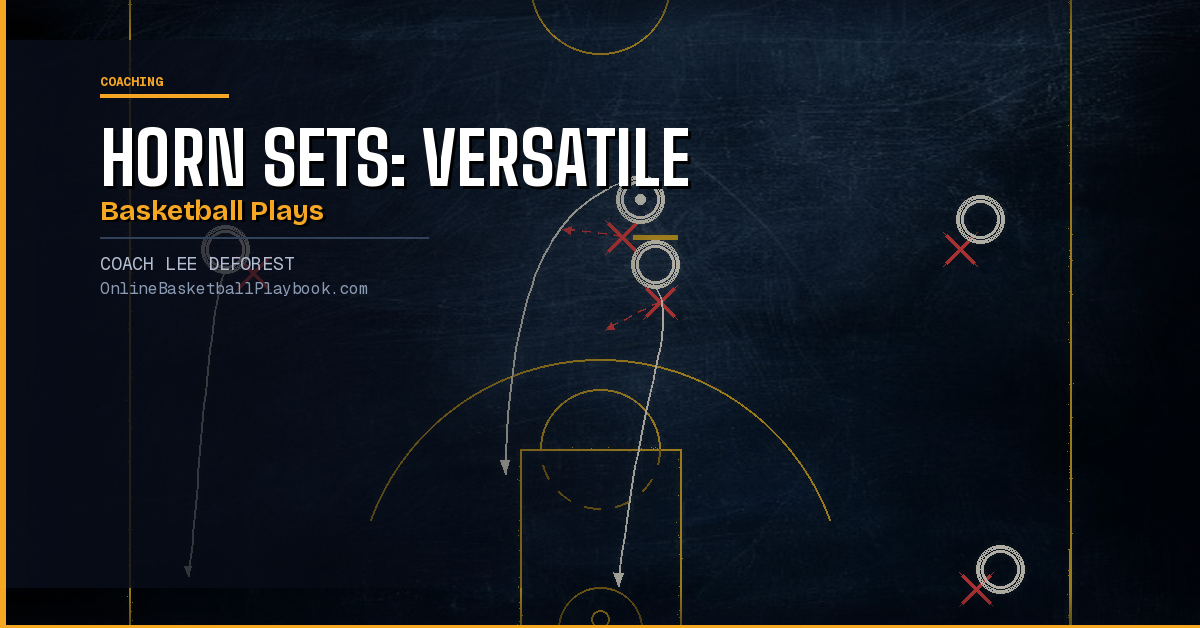
Horn Sets: Versatile Basketball Plays for Various Situations
Horn Sets: Versatile Basketball Plays for Various Situations
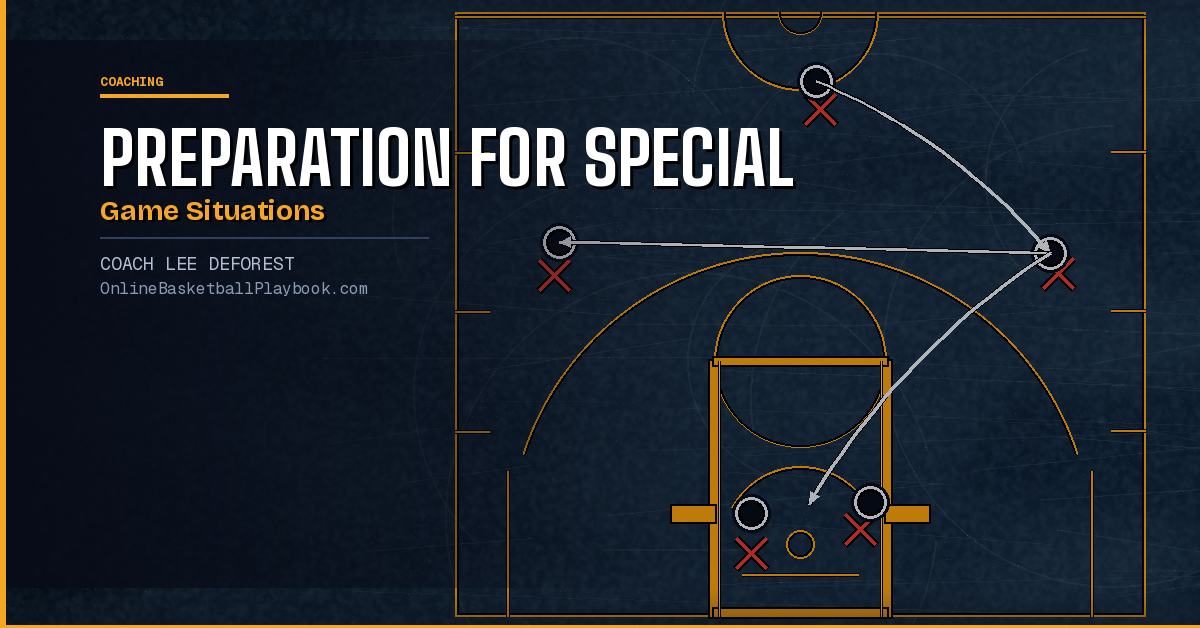
Preparation for Special Game Situations in Basketball
Preparation for Special Game Situations in Basketball