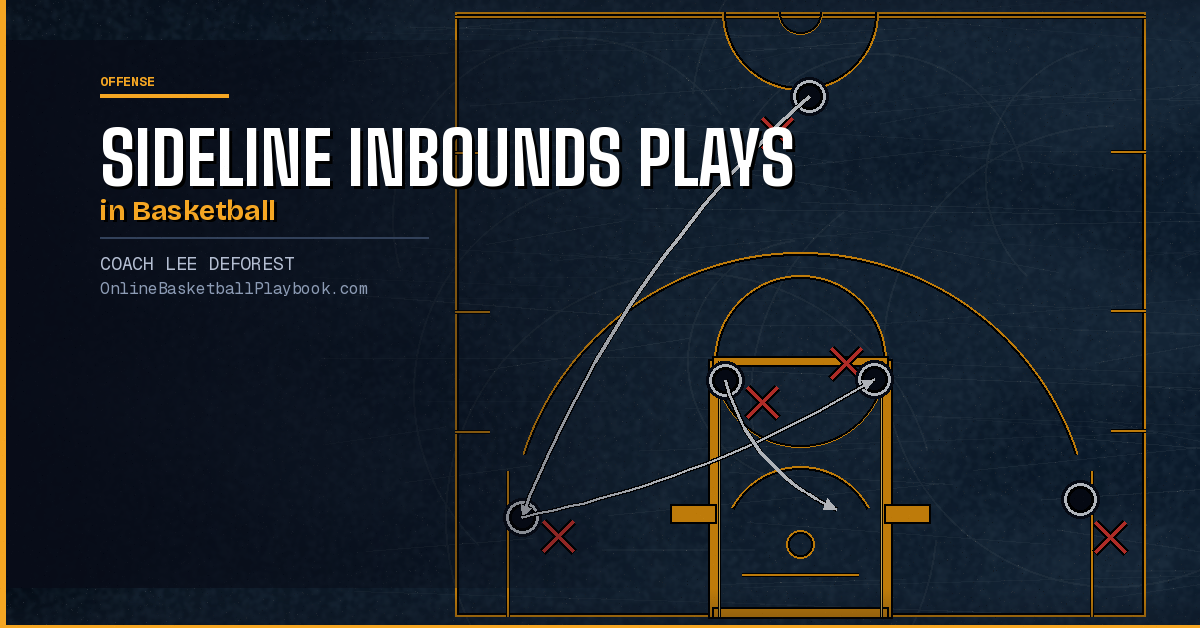

Sideline inbounds plays — called SLOBs — are among the most undercoached situations in basketball. Run them well and you generate clean looks; run them poorly and you waste timeouts and possession. This guide covers the design principles that actually work.
SLOB vs. BLOB: Why the Sideline Changes Everything
Most coaches treat all inbounds situations as variations of the same problem. They are not. A baseline out-of-bounds play (BLOB) and a sideline out-of-bounds play (SLOB) present fundamentally different geometric puzzles, and the design logic should reflect that.
On a BLOB, your offense is right beneath the basket. Every action is within a few feet of the rim, the court is compressed, and the defense can pack the paint. You are looking for a lob, a quick cut, a post touch, or a flash to a corner shooter. The inbounder is pinned under the baseline and rarely re-enters the live play in a meaningful way. BLOBs are almost always one-terminal-action plays.
SLOBs operate under entirely different conditions. The ball is live from the sideline — sometimes as close as the elbow extended, sometimes as far out as mid-court. Your players have space to spread and move. The defense cannot crowd one zone the same way they can on a BLOB. And critically, once the inbound pass is made, the inbounder re-enters the court naturally and becomes a fifth player in the half-court set. That single difference — the inbounder becoming a live option — dramatically expands what you can design.
The SLOB is also the natural vehicle for motion offense in basketball because the play does not have to end with the first pass. You can flow directly from the inbound action into your base offense without calling timeout or resetting. That continuity is one of the most underused advantages in the game at all levels.
Distance from the basket shifts the scoring objective as well. You are not looking primarily for layups off a SLOB. You are looking to get a good player a clean catch in a position to score — whether that means a mid-range pull-up, a catch-and-shoot three, a drive to the lane, or a quick entry into the post. The SLOB is as much about quality of possession as it is about immediate scoring.
Two-Phase Design: The Foundation of Every Good SLOB
The most common mistake coaches make with sideline inbounds plays is trying to score on the first pass. A single direct pass to a cutter or shooter is easy to scout, easy to take away, and leaves you with no recovery option when the defense does its homework. The play has nowhere to go when the primary option is denied.
Elite SLOB design — used consistently at the Olympic level and in professional basketball — relies on two sequential phases. Phase 1 gets the ball inbounds safely. Phase 2 is the scoring action. The two phases are separate, purposeful, and connected.
In Phase 1, the goal is a clean, uncontested inbound pass. This usually means creating a mismatch or an open receiver through movement — a quick flash cut, a screen away from the ball, or a screen-the-screener action that pulls the defense out of position. The primary receiver in Phase 1 does not need to be your best scorer. The objective is simply to get the ball live in a good spot on the floor.
Once the ball is inbounds, Phase 2 begins. Now the scoring action runs. This might be a hand-off, a second screen, a drive, or a quick reversal to an open shooter. The defense has already been forced to react to Phase 1 movement, so they are a step slow when Phase 2 initiates. That half-second of advantage is what you are designing for.
This two-phase structure also builds in a natural safety valve. If Phase 1 is denied, the inbounder has time to reset and look for an alternative entry. If Phase 2 is covered, the ball is already live in the half-court and you flow into your offense rather than panicking with a jump ball. The structure removes the chaos that kills single-action SLOB plays.
Understanding this framework is also important for building basketball IQ in your players. When athletes understand why the play is designed in two phases — not just where to go — they make better decisions when the defense takes something away.
Screen-the-Screener: The Most Reliable SLOB Concept
If there is one SLOB concept worth mastering before anything else, it is screen-the-screener (STS). This action is reliable because it creates two simultaneous threats and forces the defense to make an impossible choice.
Here is the basic structure. Player A sets a screen for Player B. As Player B uses the screen, Player C sets a screen on Player A's defender. Player A — the original screener — is now curling, popping, or flaring off the second screen. The defense has committed to stopping Player B and is now caught flat-footed when Player A becomes the primary option.
The beauty of STS in a SLOB context is that it pairs perfectly with the two-phase design. The first screen (Player B's action) is Phase 1 — it creates movement, pulls a defender, and threatens enough that the defense has to account for it. The second screen (for Player A) is Phase 2 — the real scoring action.
You can set STS up with different personnel configurations. If your best shooter is Player A — the screener who gets freed — the defense has to decide between stopping the initial cutter or staying attached to the screener. If your best driver is Player B, you have a different problem for the defense. The action is versatile because you can load either phase depending on your personnel.
STS also flows naturally into your half-court offense. After the screen-the-screener action, the ball is live, your players are in motion, and you can continue into a pick-and-roll, a dribble hand-off, or a 5-out motion offense spacing. The SLOB becomes the entry point to your half-court attack rather than a standalone play that dies in three seconds.
At higher levels of play, you can add a read layer. If the first screen frees Player B for an open catch, take it. If the defense fights through, the screener (Player A) is already in motion for the STS action. The two reads are sequential but fast, and players who rep this in practice develop the read instinctively.
"The SLOB is the most natural after-timeout vehicle in basketball because the offense controls the spot, controls the start time, and re-enters the inbounder cleanly."
— Basketball Vault
Ready-to-Run SLOB Play Sets
Theory is useful. Plays you can install tomorrow are better. Below are three SLOB sets that work at the high school level and above and can be adapted down for younger players.
Play 1: "Box Clear"
Start in a box alignment with two players on each elbow. On the signal, the two low players cut toward the ball-side corner and weak-side wing simultaneously. This movement clears the paint and creates initial confusion. The inbounder's primary target is the ball-side elbow player who has flashed to the ball. The weak-side elbow player pins the help defender and then pops to the weak-side three-point line. If the first option is denied, the inbounder hits the elbow player who immediately swings to the popper for a catch-and-shoot opportunity. Simple, two-option, hard to completely shut down.
Play 2: "Double Stack STS"
Align two players stacked on each side of the lane, roughly at the lane-line extended. The top player on the ball side screens for the bottom player, who curls toward the basket. Simultaneously, the weak-side top player screens for the ball-side top player (the first screener), who pops to the three-point line. This is the full screen-the-screener action described above. The inbounder reads the ball-side curl first, then the STS pop. After the inbound, the inbounder steps in and the play can continue into a PnR or hand-off.
Play 3: "Horns Entry"
Set your two big players at each elbow in a horns alignment. Two perimeter players set up on opposite wings. On the signal, both perimeter players cut through the lane toward the corners, clearing space. The ball-side elbow big flashes to the ball for the inbound pass. The second big holds and prepares to set a ball screen. Once the ball-side big catches, the weak-side big steps out to set a screen, and you are immediately in a horns pick-and-roll set. The SLOB has flowed directly into your half-court offense with no wasted motion. For teams already running press break basketball or transition-heavy systems, this seamless connection between special situations and half-court offense is especially valuable.
Using SLOBs as After-Timeout Vehicles
One of the most practical applications of sideline inbounds design is the after-timeout (ATO) situation. When you call timeout with the ball on the sideline — either to set up a late-clock play or after an opponent's score — the SLOB is your delivery mechanism.
The advantage is significant: you control when the clock starts. Unlike a live-ball half-court set, you can hold the inbound until your players are exactly where you want them. The defense cannot trap, pressure, or switch before the ball is live. You determine the starting position of all five players, the angle of every screen, and the timing of every cut. That level of control is not available in any other situation in basketball.
Good ATO SLOB design starts with your personnel. Who needs the ball and where do they score from? Work backward from that answer. If your best player catches a ball screen best at the left elbow, design the ATO SLOB to get them there. If your shooter needs to catch off a curl, build the action around that specific footwork. The SLOB is the most coachable situation in the game precisely because you start from a dead stop.
Against zones, ATO SLOBs can target specific gaps. A 2-3 zone defense is particularly vulnerable to quick ball movement after the inbound to the high-post area — the middle of the zone is vacated when players shift to defend the initial entry. Design your ATO SLOBs to attack the coverage your opponents are most likely to use when protecting a lead, and teach your players to recognize which zone gaps are open before the inbound.
The psychological element matters too. A well-executed ATO SLOB after the opponent scores sends a message: your team is prepared, calm, and operating from a plan. That composure communicates to the opponent and to your own players. Preparation at practice level is the prerequisite, which is why SLOBs deserve dedicated time in your basketball practice plan.
Coaching and Practice Tips
Sideline inbounds plays fail most often not because of bad design but because of inadequate preparation. The actions are not complicated. The problem is that players are asked to execute them in the highest-pressure moments of a game — late clock, close score, loud gym — with only a handful of reps in their legs. The solution is deliberate, targeted practice.
Start by installing one SLOB play per week during the early season. Do not give players three different sideline plays in the first week and expect clean execution in November. One play, repped repeatedly from the correct starting position, in game-like conditions. Add a second play when the first is automatic. Build the playbook incrementally and your players will execute under pressure.
Walk-through practice has limited value for special situations. You need live defense running the actions. Put a scout team on the floor with instructions to play tight, switch everything, and try to deny the inbound. When your starters can execute the SLOB against that kind of pressure in practice, they will execute it in games.
The inbounder is a position that requires specific coaching. Who are you putting on the sideline? The inbounder on a SLOB should be composed, able to read the play, and — because they re-enter the court — a player who can make a decision with the ball in their hands once they step live. A player who panics under pressure or cannot read a defense is not your ideal inbounder regardless of what position they play.
Teach your players to read the defense before signaling the play. What coverage is the opponent showing? Are they switching or going under screens? Is there a trap on the inbound? The player on the sideline should look before slapping the ball. That two-second read can determine whether you take Option 1 or move immediately to Option 2 in the two-phase structure.
Video is a useful teaching tool for SLOBs. Show your players what successful execution looks like from the sideline camera angle — the same angle they will see in game film. Identify the defender who has to make an impossible choice in the STS action and point it out explicitly. When players understand why a play works geometrically, they execute it with more confidence and adapt better when the defense adjusts.
Building good habits around SLOB execution also reinforces broader principles around decision-making and reading the floor — foundational skills in basketball player development that carry over to every other possession.
The inbounder on a sideline play is not a throwaway assignment. Choose a composed, decision-making player who understands the full play structure — because once they step inbounds, they become a live fifth option in your half-court offense and must be ready to act immediately.
- Design every SLOB with two phases: Phase 1 gets the ball live, Phase 2 is the scoring action.
- The inbounder re-enters on a SLOB — always design a role for them in the second phase or your half-court flow.
- Screen-the-screener is your most versatile SLOB concept; it creates two simultaneous threats from one set.
- Rep SLOB plays against live defense in practice — walk-throughs alone will not build the composure you need in late-game situations.
- Teach your inbounder to read the coverage before slapping the ball — zone, man, switching, or trap all require different entry reads.
- ATO SLOBs should be designed backward from your best player's scoring position: identify where they score, then engineer the play to get them there.
Get free play diagrams, drills, and coaching guides delivered weekly.
Keep Building
Related breakdowns
Basketball Inbounds Plays: Best Sideline and Baseline Sets
Basketball Inbounds Plays: Best Sideline and Baseline Sets
Taking Advantage of the Sideline in Basketball
Taking Advantage of the Sideline in Basketball
Sideline Out of Bounds Plays: Complete Playbook
Sideline Out of Bounds Plays: Complete Playbook