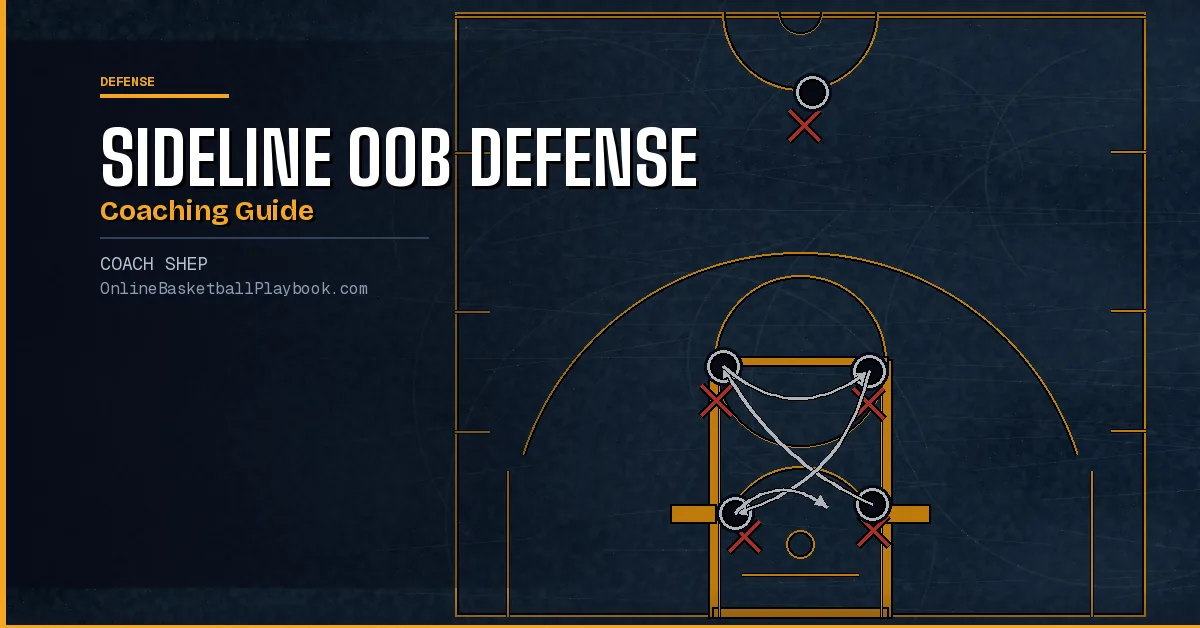
Sideline out of bounds plays catch defenses off guard because they combine a screen action with a live inbounder who re-enters freely. This guide breaks down the assignments, rotations, and rules your team needs to stop them cold.
Why SLOB Plays Hurt Defenses
Sideline out of bounds situations (often called SLOBs) are among the most undercoached defensive moments in basketball. Coaches spend hours on half-court defense, press breaks, and transition, but SLOB defense often gets reduced to a quick reminder before a game: "stay attached, no easy catches." That is not enough.
The reason SLOBs are difficult to defend starts with geometry. Unlike a baseline out of bounds play, the offense takes the ball in from the sideline, anywhere from the extended baseline to near half-court. That placement opens the entire half-court to spread attackers. The offense can send cutters toward the basket, pop shooters to the corners, and set screens at multiple levels of the floor simultaneously.
More critically, the inbounder re-enters the play the moment the ball is in bounds. On a baseline out of bounds play, the inbounder typically stays on the endline and is out of the action for a beat. On a SLOB, that fifth attacker immediately becomes a live threat: a screener, a cutter, or a release valve. Defenders who focus entirely on their assignment often lose track of where the inbounder went after the pass, which creates open catch-and-shoot opportunities or drives on the second action.
Well-designed SLOB plays operate in two phases. The first phase uses a screen or flash to get the ball inbounded safely. The second phase is the actual scoring action: a drive, a catch-and-shoot, or a flow into the half-court offense. Defenses that treat a SLOB as one pass and one action are always a step behind because they are defending only phase one. The offense has already moved into phase two.
Understanding this two-phase structure is the foundation of SLOB defense. Your players need to know that stopping the initial catch does not end the play. Defense must stay connected through both phases or the offense gets the score they designed for.
Assignment Rules and Match-Up Priorities
Before you can defend any specific SLOB action, your team needs a clear assignment structure. Confusion about who guards whom is the single most common reason SLOB defense breaks down. When your players are still figuring out assignments as the inbounder is slapping the ball, screens are already being set and cutters are already moving.
The first rule is simple: guard the inbounder first. Many teams leave the inbounder open on the assumption that the offensive player's position on the sideline prevents a direct scoring threat. That assumption is wrong. The inbounder in a SLOB play re-enters the court immediately after the pass, and smart offensive teams design the scoring action around that re-entry. Assign your least dangerous offensive match-up (typically a wing stopper) to the inbounder so that a more versatile defender can stay attached to a primary scorer.
The second rule concerns the screener. SLOB plays almost always involve at least one screen, and your players must identify the screener before the ball is handed to the inbounder. The defender on the screener cannot be surprised by the screen, so they need to anticipate it, communicate it, and decide how to play it before it happens.
The third rule is that your best defender guards the best shooter or cutter, regardless of position. SLOB plays are often designed around a specific player getting a clean catch. Offensive coaches identify the mismatch they want to attack and build the play around creating it. Your defensive assignment structure must reflect that reality and match your best individual defender to their most dangerous offensive counterpart.
For teams running man-to-man defense, this means assignments must be called loudly before the ball is handed to the inbounder. Players should know their man, their switch rules, and whether they are trapping the first action or staying home on shooters. For teams that mix in zone looks, a 2-3 zone can create confusion for the offense, but zone teams still need to identify the inbounder and the most dangerous cutter before the play starts.
Defending the Screen Actions
Screens are the engine of SLOB offense. Whether the play uses a single back-screen, a double stack, a flare screen, or a screen-the-screener action, the offense is trying to get a cutter open on the initial pass or a shooter open on the re-set. Your defense must have clear rules for each screen type and communicate those rules before the inbound.
Back Screens and Curl Cuts
Back screens set near the lane are designed to free a cutter going toward the basket. The defender on the cutter must fight over the top of the screen. Going under gives the cutter a clean catch near the rim. This requires the screener's defender to show high and bump the cutter's path, even if it means giving up a step on the screener's roll or pop.
Curl cuts off back screens are especially dangerous when the offensive player cutting is a guard who can finish in traffic. The defender must keep their body between the cutter and the basket, staying on the cutter's high shoulder through the screen. If the defender gets caught on the low side of the screen, they are beaten and the cutter is catching near the rim with a head of steam.
Flare Screens
Flare screens send a shooter away from the ball toward the perimeter. These are most common when the offense has a catch-and-shoot player in the corner or at the wing. The defender on the shooter must fight through the flare screen and not get caught under it. If you go under a flare screen against a shooter, you are conceding an open three.
The screener's defender plays a critical role here. They must hedge or show on the flare to slow the screen enough for the shooter's defender to fight through. That hedge must be controlled. A full switch on a flare can give the screener a quick roll to the basket that is hard to recover from.
Double Stack and Screen-the-Screener
Double stack sets and screen-the-screener actions are more complex because they sequence two screens and create multiple reads. The offense is trying to spring either the first cutter or the second, depending on how the defense responds to the initial action.
Against a screen-the-screener, your defense needs a clear rule: either both defenders fight through their respective screens, or you are switching everything. A half-switch (where one defender switches and the other fights through) leaves gaps that a well-coached offense will identify and exploit immediately.
Communication is the key to handling complex screen actions. If your players are silent on SLOB defense, they will get beaten. Defenders must call out screens, announce switches, and talk through the action in real time. Referencing your help defense principles in practice helps players understand how to layer communication across all five defenders simultaneously.
Defensive Rotations After the Inbound
Most SLOB defensive breakdowns do not happen on the inbound pass itself. They happen three to five seconds later, when the defense is still recovering from the initial action and the offense has already moved into its second phase. Rotations after the inbound are where games are won or lost on SLOB defense.
The first rotation principle is that the inbounder's defender cannot ball-watch. The moment the inbound pass is made, the defender guarding the inbounder must locate their player and stay attached. The inbounder is now live and is one of five offensive players who can receive a pass, set a screen, or attack a close-out. Losing the inbounder after the initial pass is how teams give up open threes or driving lanes on the second action.
The second rotation principle concerns help-side defenders. When a screen is set near the ball and creates a potential drive or catch on the strong side, help-side defenders must be alert and ready to rotate. This is not different from standard half-court help defense, but the compressed time of a SLOB sequence means the rotation must be faster and the communication must start earlier.
The third principle is closeout discipline. When the ball moves from the primary catch to a skip pass or a swing to the perimeter, defenders closing out must use correct technique. Sprint to close the gap, then break down into a defensive stance with hands up before the shooter catches. Lazy closeouts on SLOB second actions are one of the most common sources of open corner threes in basketball at every level.
Teams that have drilled transition defense have a head start here because both disciplines require full-court awareness and fast communication after a live-ball turnover. The mental habits transfer: stay connected to your man, communicate help, sprint to close gaps.
Drills to Build SLOB Defense
SLOB defense is a skill, and skills require repetition. The good news is that you can train it efficiently in practice without dedicating an entire block to dead-ball situations. Short, focused segments at the start of practice or embedded in your individual defense work will build the habits your team needs.
Walk-Through Assignment Drill
Before any live SLOB drill, walk through assignments at half speed. Place your offense in a common SLOB set (a double stack, a wide pin-down, or a screen-the-screener) and have your defense call out assignments verbally before the ball is touched. Each defender says their man's name and their switch rule out loud. Do this three times per set before going live. The habit of verbalizing assignments before the ball moves is more valuable than any physical drill.
5-on-5 SLOB Scenarios
Run five-on-five SLOB situations from multiple spots on the sideline. Give the offense the inbound location, call the play, and let them run it against your defense live. After each rep, stop and discuss what the defense did, not just whether they stopped the play, but whether every defender was in the right position through both phases. Did the inbounder's defender stay attached? Did help-side defenders rotate on time? Did closeouts break down properly?
Variety is important here. Run sets from the mid-court area, from the wing extended, and from just above the block. Each location changes the geometry slightly and forces your defenders to adjust their positioning and rotation angles.
Inbounder Tracking Drill
This drill isolates the most commonly neglected assignment: the inbounder. Set up a live SLOB play, but put your best offensive player as the inbounder. After the inbound pass is made, the former inbounder immediately tries to score: off a handoff, a slip screen, or a quick catch in a seam. The defender assigned to the inbounder must track them through the re-entry and prevent the easy score.
Coaches who embed this drill into their basketball practice plan regularly find that their teams handle SLOB defense with far more poise in late-game situations, simply because defenders have practiced the specific habit of tracking a live inbounder.
Communication-Only Drill
In this drill, the offense runs their SLOB set in slow motion while the defense calls every screen, every cut, and every rotation out loud in real time. No live competition. Just the defense verbalizing the action as it unfolds. This drill sounds simple but reveals quickly which players are reading the play in real time versus reacting after the fact.
The best SLOB defensive teams are not necessarily the most athletic, but they are the most organized. Five players who know their assignments before the ball is touched will consistently outperform a more talented group that is still sorting out coverages as the play develops.
Common Mistakes and How to Fix Them
Even well-coached teams make predictable errors on SLOB defense. Identifying these mistakes and training corrections before they show up in games separates disciplined defensive teams from reactive ones.
Mistake 1: Over-Helping on the Initial Screen
Defenders who help too aggressively on the first screen action leave their own man open on the perimeter. The offense designs SLOBs with a primary and secondary option. If you send help on the first action, the second option catches clean. The fix is discipline: help must be angled to influence both the primary and secondary read, not abandon a shooter to stop a cutter.
Mistake 2: Losing the Inbounder
This is the most common mistake at every level. Defenders get absorbed in the action near the ball and forget that the inbounder stepped in bounds. The fix is a clear post-inbound rule: the inbounder's defender calls "ball in" and immediately locates their player. This verbal cue also alerts teammates that the inbounder is live.
Mistake 3: Switching Without Rules
Switching SLOB screens without a clear team rule creates size mismatches, abandoned shooters, and confused rotations. Switching everything sounds simple but often puts a big guarding a guard on the perimeter or a wing tracking a post in the lane. The fix is a specific switch rule that accounts for position and size, not a blanket switch on everything.
Mistake 4: No Transition Mindset After a Stop
After your defense gets a stop on a SLOB (either by forcing a poor inbound or securing a deflection), teams sometimes relax without converting to offense quickly. The best teams treat the SLOB stop as the beginning of an offensive opportunity. Get the outlet pass, push pace, and attack before the opponent resets. This connects directly to good fast break habits that your team should already be building.
Mistake 5: Ignoring Film Preparation
SLOB plays are often repeated. Offensive coaches have three or four sets they run in late-game situations, and they run the same plays throughout the season. A defense that has watched film on an opponent's SLOB package knows exactly what screens are coming, where the primary catch is designed to happen, and which player the offense is trying to free. Ignoring that preparation means your defense is always guessing on plays the opponent has already scripted.
- Call assignments out loud before the ball is handed to the inbounder. Every player says their man's name.
- Assign the inbounder first; use your least dangerous match-up so your best defender can guard the primary scorer.
- Fight over the top of back screens. Going under gives the cutter a clean catch near the basket.
- The inbounder's defender must call "ball in" and locate their player the moment the inbound pass is made.
- Defend both phases of the play: the initial inbound action and the second action that follows as the inbounder re-enters.
- Watch film on your opponent's SLOB sets. Teams repeat the same plays and preparation eliminates guesswork.
- Use correct closeout technique on skip passes after the inbound. Sprint to close the gap, then break down before the catch.
Get free play diagrams, drills, and coaching guides delivered weekly.
Draw this play free in the play drawer →
Membership: the full library, playbook packs, and Pro drawing tools →
Keep Building
Related breakdowns
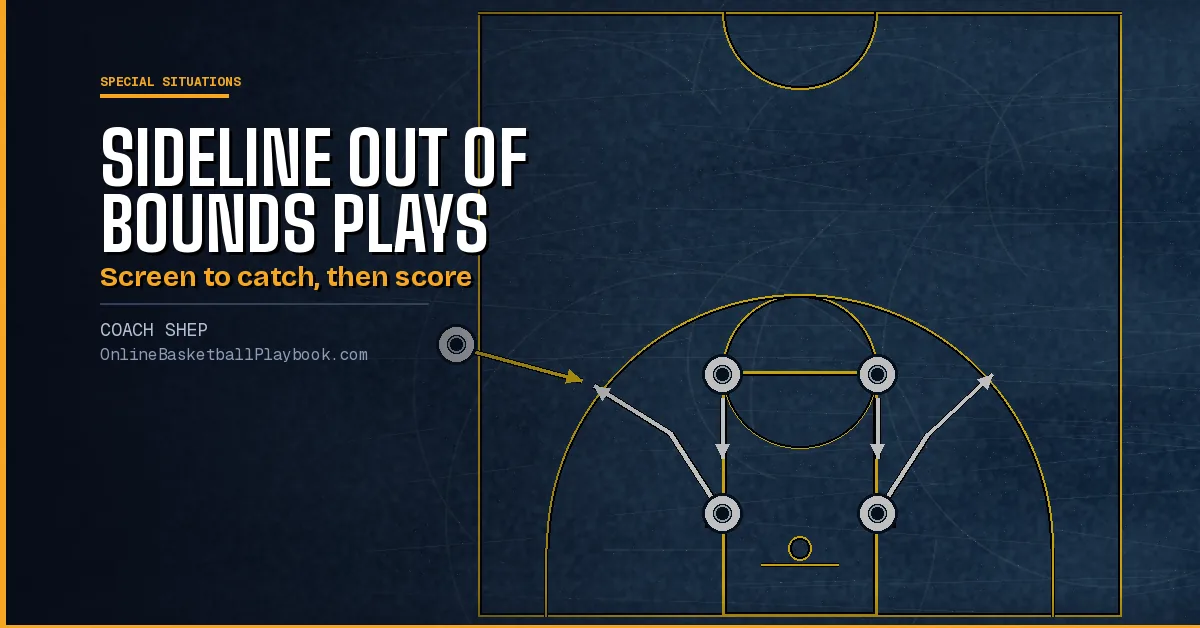
Sideline Out of Bounds Plays: SLOB Sets, Reads and Practice
Sideline out of bounds plays for coaches: SLOB sets from a box, stack and line, the inbounder's reads, plays against zone and denial, the clock and practice.
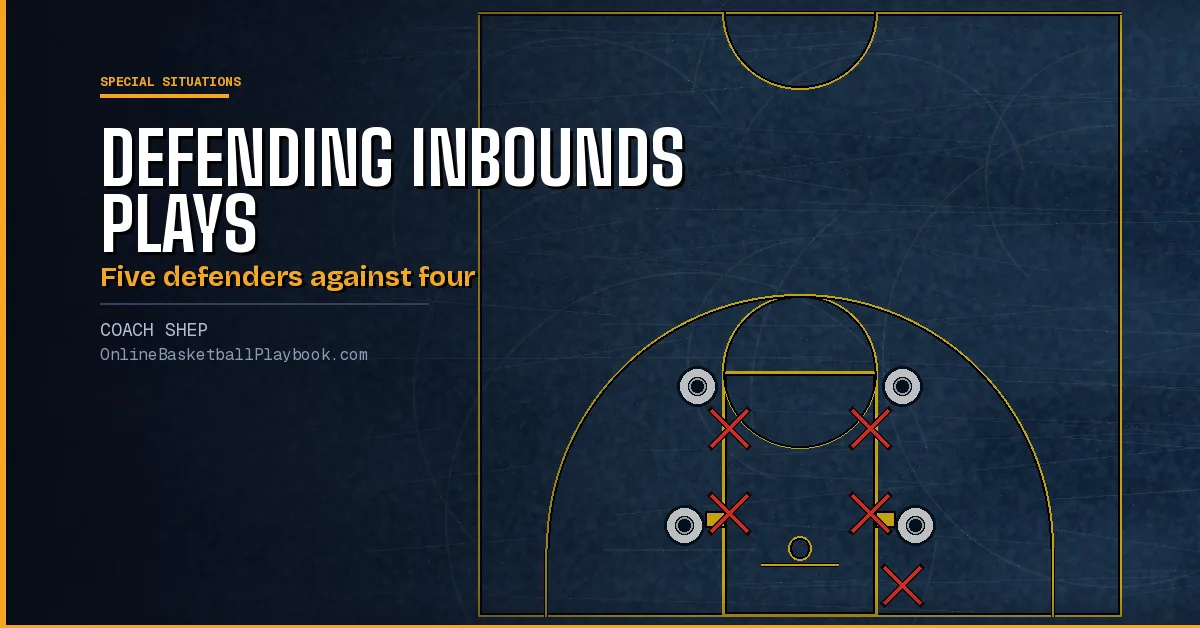
How to Defend Inbounds Plays: Baseline and Sideline Options
How to defend inbounds plays: the 5 on 4 edge, what to do with the inbounder, Jam, Jump Switch, Trap and zone options, sideline answers and late-game calls.
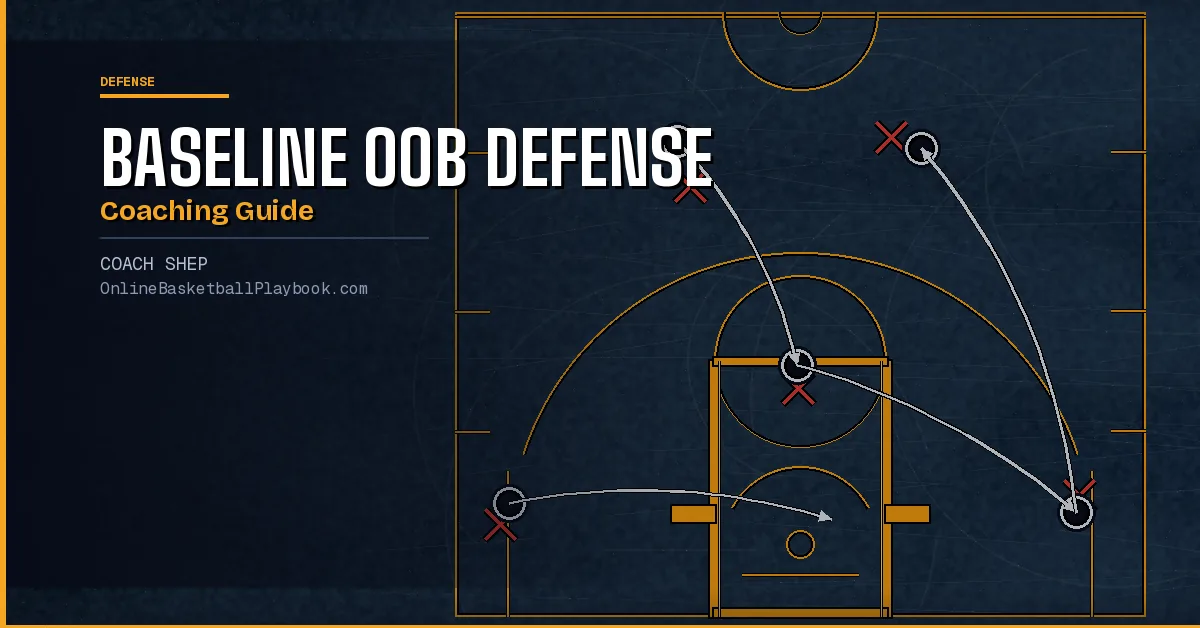
How to Defend Baseline Out of Bounds Plays
How to Defend Baseline Out of Bounds Plays