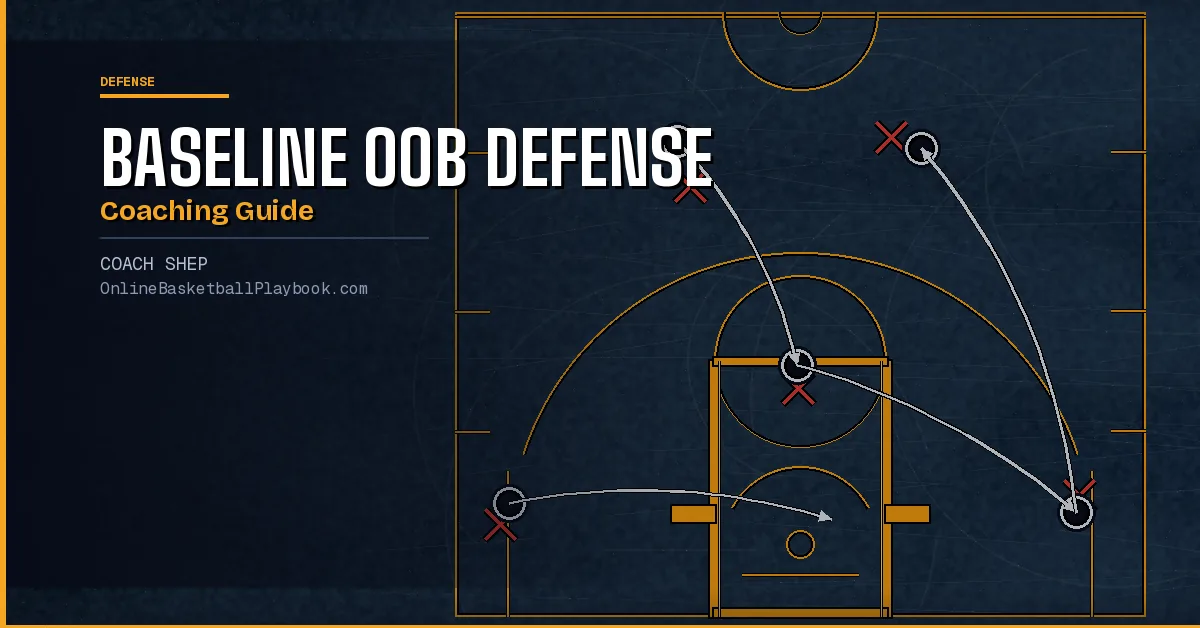
Baseline out of bounds plays are among the most dangerous dead-ball situations in basketball. The offense starts in scoring position, controls the clock, and runs rehearsed actions. This guide gives you the defensive schemes and assignments to take that advantage away.
Why BLOBs Are So Dangerous
Baseline out of bounds plays (commonly called BLOBs) put your defense at a structural disadvantage before the ball is ever touched. The offense starts under the basket with the clock stopped. They can hold the inbound until the alignment is perfect, they have rehearsed actions your players may have never seen, and the five-second count is the only pressure the defense can apply.
Well-designed BLOB plays exploit one consistent truth: defenders are reactive. The offense knows exactly what is coming. The defense is reading and responding. That gap between knowing and reacting is where layups and corner threes are born. Over the course of a game, surrendering two or three easy baskets off baseline inbounds situations can swing a close contest. Across a season, teams that defend these situations poorly give up a significant number of points that could have been prevented with preparation and structure.
The most dangerous BLOB formations (box sets, stack sets, and spread alignments) each attack the defense differently. A box set occupies four danger zones at once. A stack or line set creates quick-peel cutters on one side of the floor. A spread set isolates your worst defender in space. Understanding how each alignment threatens you is the first step toward building a coherent defensive system.
Defending BLOBs is also a test of basketball IQ. Players who understand why each assignment exists (not just what to do) can make adjustments when the offense shows something new. That contextual understanding is what separates teams that just survive BLOBs from teams that actually take away the primary action.
Core Defensive Principles
Before you install specific coverages, you need to establish the foundational principles that govern every BLOB defensive possession. Without these, your players will memorize one look and get beaten by anything the offense hasn't shown before.
Eliminate the First Read
Every BLOB has a primary action: a lob, a back screen, a curl off a stagger. The primary read is where the offense is trying to score. Your job is to take it away cleanly enough that the offense has to go to a second or third option. A well-positioned defender doesn't have to be athletic enough to make a play on a lob. They just have to be positioned correctly so the pass never gets thrown.
Communicate Before the Ball Is Live
The five seconds before the inbound is the highest-value communication window in basketball. Use it. Your players should be calling out who they have, pointing to cutters, and confirming switches before the inbounder slaps the ball. Dead-ball situations are no-excuse moments for defensive communication because the clock isn't running and nobody is moving yet. Teams that develop habits around pre-inbound communication defend BLOBs at a fundamentally higher level than teams that wait to react.
Match Effort to Danger
Not every player in a BLOB set is an equal threat. The offense has a primary option, a secondary option, and a bailout. Your best defenders should be on the most dangerous players (typically the shooter coming off the stagger or the big posting to the strong side block). Don't let your rotation habits from man-to-man defense in the open court override what the specific alignment demands.
Matchup Assignments and Positioning
How you assign defenders in a BLOB situation determines whether your system can hold up against multiple looks, or whether it breaks down the moment the offense runs something new. Assignment clarity is non-negotiable.
Guard the Inbounder with a Purpose
Many coaches leave the inbounder open and put all five defenders on the four players in-bounds. That is a reasonable base, but it creates a vulnerability: the inbounder who steps in late in the count for an uncontested catch near the basket. Some teams dedicate a defender to the inbounder to apply five-second count pressure and prevent the step-in. Either approach is sound. What matters is that your players understand the rule and execute it consistently.
If you choose to leave the inbounder open, one defender must take ownership of the step-in. That player cannot drift away from the inbounder's zone. If the primary receiver is denied and the five count is approaching, the step-in catcher has to be accounted for.
Front or Three-Quarter Deny
Against box sets, the defense has to decide whether to front the block players or play behind them. Fronting eliminates the lob look but requires your weakside defenders to be in help position for any skip passes. Three-quarter denials (body angled between the ball and the receiver, near hand in the passing lane) balance denial with recovery. The three-quarter position is generally more sustainable because it keeps defenders athletic and able to recover if a screen changes the look.
Switch Rules on Screens
BLOBs are loaded with screens. Back screens. Cross screens. Staggers. If your players freeze or get separated on a screen, the offense gets exactly what it designed. You need to install a clear switch rule before the game. Do you switch everything, switch only certain pairings, or fight through? Most teams at the high school level benefit from a simple "switch all" rule on baseline OB screens because it keeps defenders attached to bodies. The cost is potential mismatches, but the alternative (getting separated and giving up a layup) is worse.
Practicing switch reads under shell drill conditions is an efficient way to build these habits without running the full five-on-five defensive BLOB coverage every session.
Defending Common BLOB Sets
The majority of what you'll see from opponents falls into three or four formation families. Learning to recognize the shell (not just the specific play) is what lets your defense adapt in real time.
The Box Set
Two players on each block, forming a rectangle around the paint. The box is the most common BLOB alignment at every level of basketball because it gives the offense four simultaneous reads. A lob off a back screen. A shooter off a stagger. A post on a cross screen. The inbounder stepping in. Against a box, you need to decide your priority. Most teams make the lob their first elimination. They want no free layups. That means the defender guarding the player most likely to receive the lob should front aggressively or shade the high side.
The secondary danger in a box set is the shooter peeling to the corner or the wing off a stagger. If you eliminate the lob but your shooter defender gets stuck on the back screen, the offense gets a three off a clean look. The stagger defender has to fight over the top of both screens without getting separated. If separation happens, call for help immediately. Do not gamble on a contest.
The Stack Set
All four offensive players align on one side of the lane, stacked tight. The stack is a quick-hitter alignment: the first player peels as a decoy, the second player is the money cutter, and the defense has to process both movements without losing the primary. Against a stack, stay connected. The most common mistake is over-chasing the first peel and losing the second. Guards defending a stack set need to understand that the first movement is not the shot, but it is the setup.
The Spread or 1-Up Set
The offense spreads shooters across the three-point line, keeping the paint relatively open, and runs one isolation action (typically a back screen for a big or a curl for their best shooter). Against spread sets, your help defense principles become critical because the spacing limits your ability to recover off the ball. Players need to be in help defense positions that let them protect the basket without abandoning a shooter on the perimeter.
Denying the Inbounder Step-In
The inbounder step-in is the most consistently underdefended play in all of basketball. When the five count is approaching and the primary, secondary, and tertiary options are all denied, a skilled inbounder simply steps in-bounds and catches from a teammate who has drifted to an open spot. If no one is responsible for stopping this, you will give up baskets that feel impossible to account for. The play didn't run. The inbounder just stepped in and scored.
Defending this requires one player to maintain visual awareness of the inbounder at all times. That player's primary job may be to deny the step-in rather than front another receiver. When the four in-bounds players are all occupied by defenders, the inbounder threat becomes the most dangerous person on the floor.
At the youth and high school level, this awareness gap is especially wide. Spend time in practice (even just a few minutes at the end of a basketball practice plan: running live BLOB reps where your scout team is instructed to use the step-in. Your players will learn through experience faster than through explanation alone.
The five-second inbound count is your most reliable defensive weapon in a BLOB. Aggressive ball-denial on the first option, paired with a defender who actively contests the inbounder's vision, forces the offense onto the clock. Every second of hesitation is a second the offense cannot use to reset and find the best shot.
Practice and Preparation
Defending BLOBs well is entirely a function of preparation. You cannot install a coherent system by talking about it. You have to rep it. The good news is that dead-ball situations are time-efficient to practice because there is no live possession required to set the scene. You can freeze the action, coach, reset, and run again.
Scout and Install Weekly
Each week, pull two or three BLOB sets from your upcoming opponent's film. Install the defensive coverage against those specific sets in a walk-through before your next practice. Coaches who do this consistently find that players remember BLOB coverages far better when they are attached to a real opponent rather than an abstract diagram. The context makes the assignment stick.
Live Rep Volume
Walk-throughs install the concept. Live reps build the habit. Run at least five to eight live BLOB defensive reps per practice week, even when the session is not focused on dead-ball defense. Brief, consistent repetition is more effective than one long installation block every few weeks. This is the same principle that makes the most effective basketball practices: Return to important skills briefly and often rather than in long, infrequent blocks.
Test Your Defense Against Variety
The measure of a BLOB defensive system is how it handles something it has never seen. Once your base coverage is installed, run your scout team with a play they haven't shown before: a new stagger location, a different peel sequence, an inbounder step-in at the four count. Watch how your defenders respond. If they freeze or argue about assignments, the system needs more work. If they apply their principles and communicate through the new look, the system is sound.
- Call out assignments verbally before every inbound. No silent coverages, ever.
- Make the lob your first elimination on any box set; front or shade high-side the lob receiver.
- Implement a clear switch rule on all baseline OB screens. Switch all is the simplest and most reliable default.
- Designate one defender to track the inbounder's step-in zone on every possession. This cannot be a shared responsibility.
- Scout opponent BLOB sets weekly and walk through your coverage against those specific sets before game day.
- Run live BLOB defensive reps multiple times per week to build habit. Brief and consistent beats long and infrequent.
- Test your system against unscouted looks in practice so players learn to apply principles, not just memorize one coverage.
Get free play diagrams, drills, and coaching guides delivered weekly.
Draw this play free in the play drawer →
Membership: the full library, playbook packs, and Pro drawing tools →
Keep Building
Related breakdowns
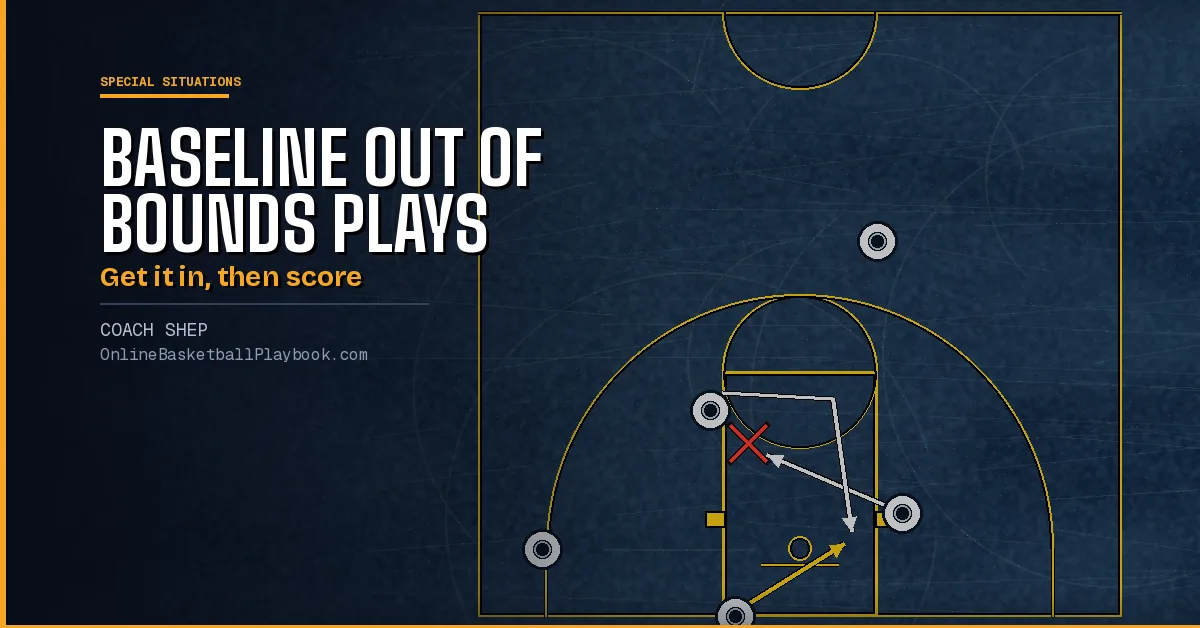
Baseline Out of Bounds Plays: Sets vs Man, Zone and for Youth
Baseline out of bounds plays drawn step by step: a box back screen and roll, Pick the Picker, the double stack, a 2-3 zone play, youth one-pass plays, the rules and the reads.
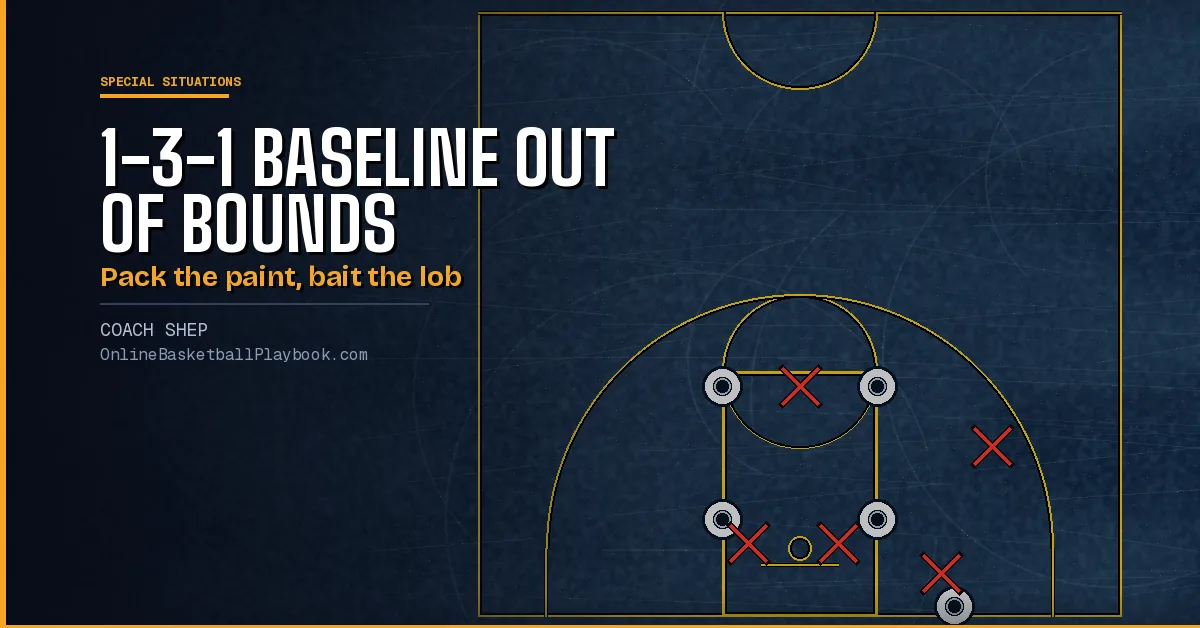
1-3-1 Baseline Out of Bounds Defense: Shape, Jobs, Traps
The 1-3-1 baseline out of bounds defense packs the paint and baits a deep lob. See the five jobs, the corner trap, the pass above the line and when to use it.
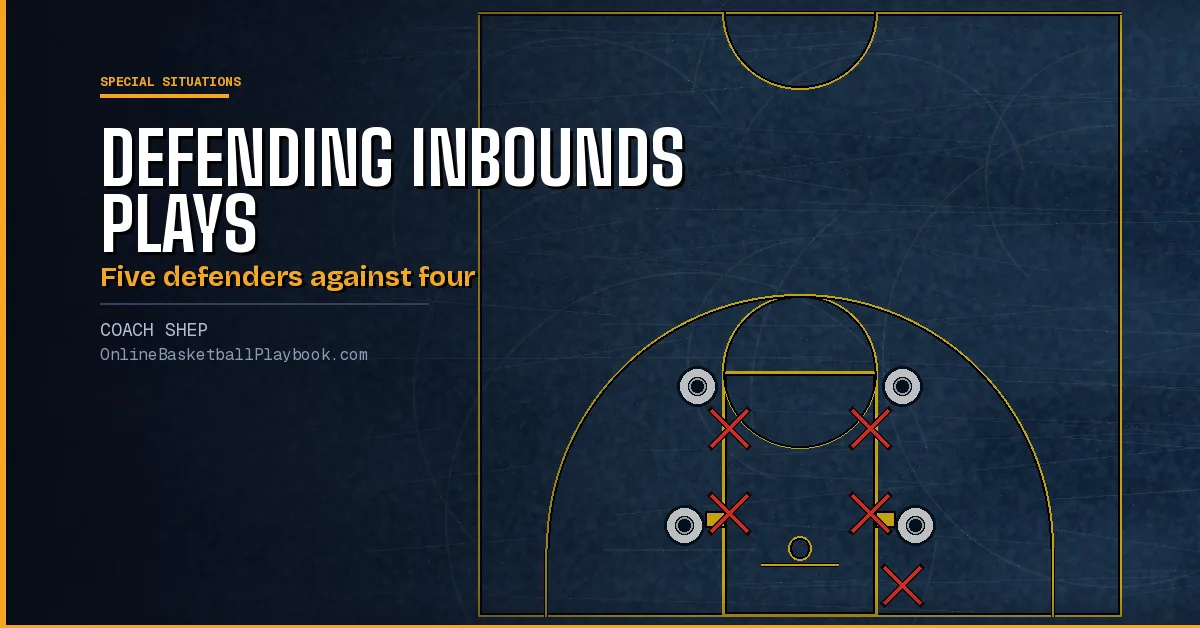
How to Defend Inbounds Plays: Baseline and Sideline Options
How to defend inbounds plays: the 5 on 4 edge, what to do with the inbounder, Jam, Jump Switch, Trap and zone options, sideline answers and late-game calls.